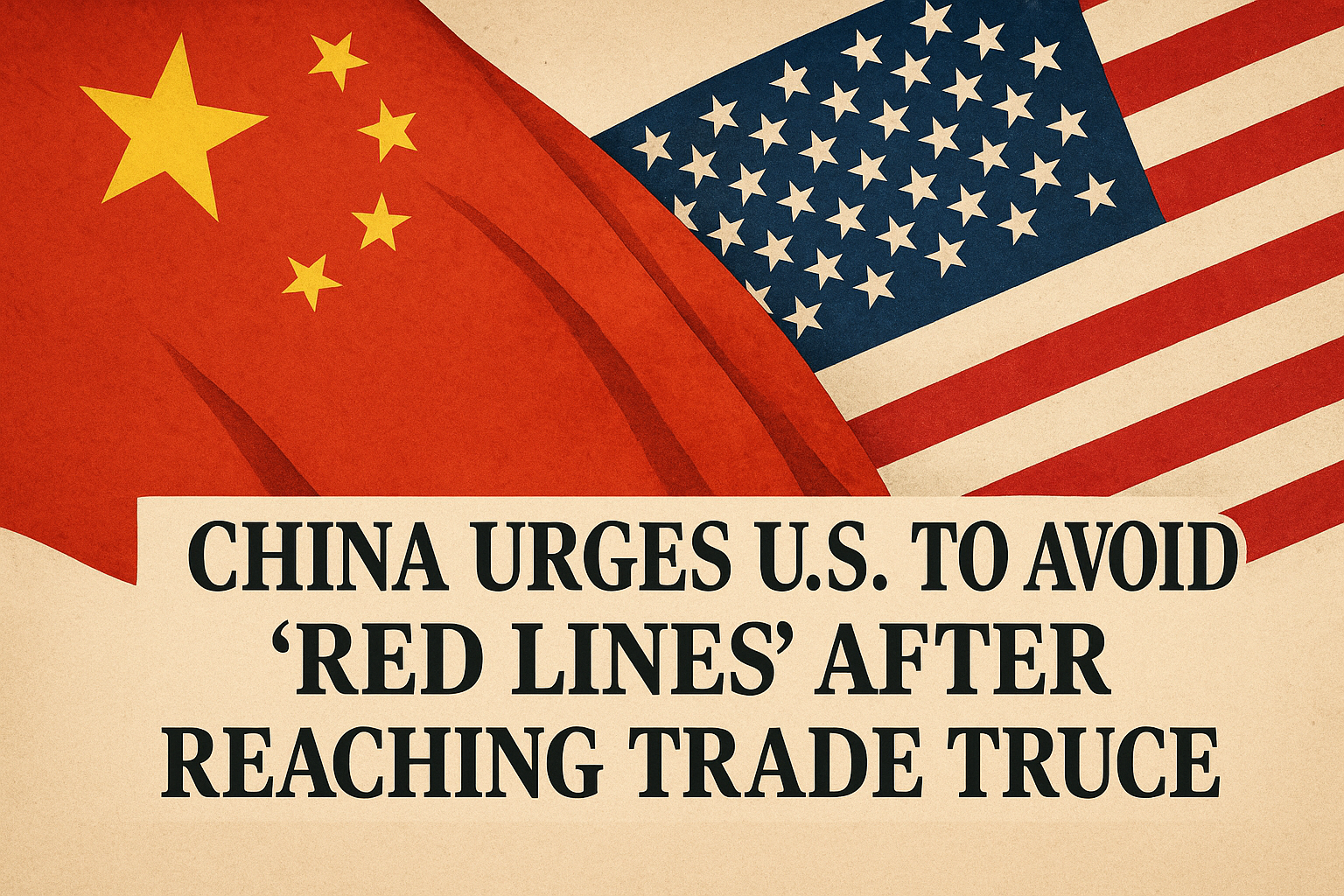
The world’s two largest economies may have hit pause on their trade war — but the truce remains uneasy. In the aftermath of a tentative trade understanding reached on October 30, 2025, Beijing has urged Washington to “avoid crossing red lines,” underscoring how sensitive the détente remains. The warning, delivered just days after Presidents Donald Trump and Xi Jinping met in South Korea, reveals that while both sides are seeking stability, deep-rooted mistrust and competing strategic goals continue to shape the global economic landscape.
A New ‘Calm’ in U.S.-China Trade Tensions
When Trump and Xi shook hands at Gimhae International Airport in Busan, South Korea, on the sidelines of the Asia-Pacific Economic Cooperation summit, markets cautiously exhaled. The two leaders agreed to a one-year truce that included China pausing sweeping export controls on rare earth minerals, while the U.S. would suspend measures expanding its blacklist of Chinese firms from accessing sensitive American technologies. The U.S. also agreed to cut tariffs on goods related to fentanyl production from 20% to 10%, reducing overall tariffs on Chinese goods to 47% from 57%.
This represents a significant de-escalation from the chaos that had characterized U.S.-China relations since April 2025, when Trump dramatically escalated tariffs and export restrictions. The agreement also includes Chinese purchases of U.S. soybeans and expanded agricultural trade, though the specifics remain vague. Trump characterized the meeting as “amazing,” rating it “a 12” on a scale of one to ten — typical Trumpian hyperbole that masks a more complex reality.
Yet this is no comprehensive peace treaty. The agreement left most tariffs and export controls hindering trade between the two sides in place, with average U.S. duties on Chinese goods remaining around 47 percent and China’s average tariff on U.S. products at about 32 percent. More than 1,000 Chinese firms remain on U.S. export control lists, while Beijing maintains its own “unreliable entity list” targeting American companies. As one trade policy expert put it, this is best characterized as a “partial freeze” or “minor rollback” in the ongoing trade war.
China’s Message: Red Lines and Boundaries
Days after the summit’s apparent goodwill, Beijing drew clear boundaries. In a virtual address to the U.S.-China Business Council, Chinese Ambassador to the U.S. Xie Feng identified four specific “red lines” that Washington must not cross: Taiwan, democracy and human rights, China’s political system, and development rights. His message was unambiguous: “The most important thing is to respect each other’s core interests and major concerns.”
This four-point framework reveals Beijing’s strategic priorities and anxieties. Taiwan remains the most neuralgic issue — China views the self-governed island as territory that must eventually be brought under its control, by force if necessary. The fragility of the relationship was underscored by separate defense talks on Friday, where U.S. Defense Secretary Pete Hegseth voiced “serious concerns” to his Chinese counterpart about Beijing’s naval activities around Taiwan and the South China Sea.
The reference to China’s “political system” and “development rights” speaks to deeper concerns about U.S. efforts to constrain China’s economic and technological advancement. Ambassador Xie warned that conflicts over “tariffs, industry or technology will lead to nothing but a dead end”, signaling that Beijing views technological competition as existential rather than merely commercial.
What makes this warning particularly significant is its timing. Rather than allowing the goodwill from the Busan summit to build momentum, Beijing immediately established guardrails. This reflects a fundamental Chinese assessment: cooperation is possible, but only within clearly defined limits that protect core interests.
Washington’s Response and Policy Calculus
The Trump administration’s response has been characteristically mixed. While Trump expressed optimism about the trade relationship, his team has been more circumspect about crossing Beijing’s red lines — particularly on the most sensitive technology issues.
The Wall Street Journal reported that senior U.S. officials successfully convinced Trump not to discuss next-generation artificial intelligence chips with Xi, arguing that making Nvidia’s advanced Blackwell chips available to China posed a national security risk. This decision, made despite Trump’s earlier hints that he might be open to chip sales, reveals the limits of détente.
The technology question illustrates the administration’s dilemma: how to balance trade normalization with strategic containment. American companies like Nvidia are eager to access China’s massive AI market, which represents roughly 13 percent of the chipmaker’s revenue. Yet national security hawks in Washington view advanced AI chips as perhaps America’s most critical strategic asset.
The U.S. approach reflects competing internal pressures. Trump faces midterm elections in 2026, and continuing trade war escalation could harm the U.S. economy and Republican electoral prospects. Yet he also confronts bipartisan congressional pressure to maintain technological guardrails against China. The result is a policy that seeks tactical pauses while maintaining strategic competition — precisely mirroring Beijing’s approach.
Market Reaction: Relief or False Calm?
Financial markets greeted the Busan summit with measured optimism, though reactions were notably muted. Chinese stocks held steady near a 10-year peak, while analysts characterized market sentiment as a “relief rally rather than a structural reset”.
The caution is warranted. Market analysts noted that “this looks like a tactical pause rather than a strategic breakthrough, with underlying tensions in technology, supply chains and rare earths still unresolved”. Investors understand that the fundamental drivers of U.S.-China competition — technological rivalry, supply chain security, and geopolitical ambitions — remain unchanged.
For specific sectors, the implications vary considerably. Agricultural exporters saw potential gains from China’s soybean purchase commitments. Technology firms face continued uncertainty, with semiconductor and AI companies caught between market opportunities and export restrictions. Rare earth-dependent industries gained temporary breathing room but remain vulnerable to future Chinese leverage.
The broader market message is clear: this is managed rivalry, not reconciliation. Companies are not reversing their supply chain diversification strategies or abandoning efforts to reduce China exposure. The truce simply provides a window for adjustment rather than a signal to return to business as usual.
Global Ripple Effects
The U.S.-China détente reverberates far beyond bilateral relations. For American allies in Europe and Asia, the Busan summit raised familiar questions about Washington’s reliability and strategic coherence. Will Trump negotiate away allied interests in pursuit of bilateral deals? How should they position themselves in a world where U.S.-China relations swing unpredictably?
Countries like Vietnam, Mexico, and India — which have benefited from supply chain diversification away from China — now face uncertainty. If U.S.-China tensions genuinely ease, will companies reverse course? More likely, businesses will pursue hedging strategies, maintaining diversified supply chains while cautiously re-engaging with Chinese partners.
For developing economies dependent on Chinese demand, the truce provides relief. Bilateral trade between the U.S. and China reached approximately $606 billion in 2024, making even partial disruption of this commerce systemically significant. A prolonged trade war would have devastated commodity exporters and emerging markets integrated into Chinese-led supply chains.
Yet the truce also highlights China’s growing economic power. As one analysis noted, “Unlike nearly 10 years ago, when Trump’s first trade offensive caught Beijing by surprise, this time a better prepared and economically more powerful China has been able to fight its once far mightier opponent to a standstill”. China’s ability to leverage rare earth dominance and its massive market demonstrates that economic coercion is a two-way street.
Outlook: A Managed Rivalry, Not Reconciliation
The Busan truce and Beijing’s subsequent “red lines” warning fit a clear pattern: competitive coexistence. Both Washington and Beijing recognize that complete decoupling would be economically catastrophic, yet neither is willing to compromise on core strategic interests. The result is a relationship characterized by tactical accommodations within a framework of ongoing strategic competition.
Several indicators will determine whether this fragile truce holds in 2025 and beyond:
Semiconductor export controls remain the most sensitive flashpoint. Trump’s team has so far resisted loosening restrictions on advanced AI chips, but pressure from U.S. companies will continue. Any significant change here would cross one of China’s implicit red lines regarding development rights.
Taiwan tensions could instantly shatter the truce. With U.S. defense officials expressing “serious concerns” about Chinese naval activities, any military incident in the Taiwan Strait would overwhelm trade considerations.
Currency policy and financial sanctions represent additional pressure points. If either side perceives the other as using monetary policy as a weapon, retaliation could follow quickly.
Investment restrictions in both directions will test the durability of cooperation. As both countries scrutinize foreign investment in sensitive sectors, businesses face growing compliance burdens.
Perhaps most fundamentally, the 2026 U.S. midterm elections and China’s own economic challenges will shape each side’s willingness to maintain the truce. If Trump fears economic weakness will hurt Republican chances, he may seek to extend accommodation. Conversely, if China’s economy falters, Beijing might pursue more aggressive trade policies to boost domestic growth.
The Bottom Line
China’s “red lines” warning represents diplomatic realism rather than hostility. Beijing is simply making explicit what was already implicit: cooperation has limits, and those limits are defined by core national interests. The U.S. faces similar constraints, caught between economic opportunities and strategic imperatives.
For markets and businesses, the message is clear: plan for continued volatility. The Busan truce provides a window for adjustment, not a foundation for long-term strategy. Companies should use this period to strengthen supply chain resilience, diversify market exposure, and prepare for potential re-escalation.
The world’s two largest economies have chosen managed rivalry over mutual destruction — for now. But with deep mistrust, competing visions of global order, and irreconcilable positions on Taiwan, this is best understood as a strategic timeout rather than lasting peace. Both sides are simply catching their breath before the next round of what promises to be a decades-long competition.
As Ambassador Xie put it, “the pressing priority is to follow up on the consensus reached between” the two presidents “to reassure both our countries and the world economy with concrete actions and outcomes.” Whether those concrete actions materialize — or whether the red lines are crossed — will determine if 2025 marks a turning point or merely another chapter in the ongoing U.S.-China economic cold war.