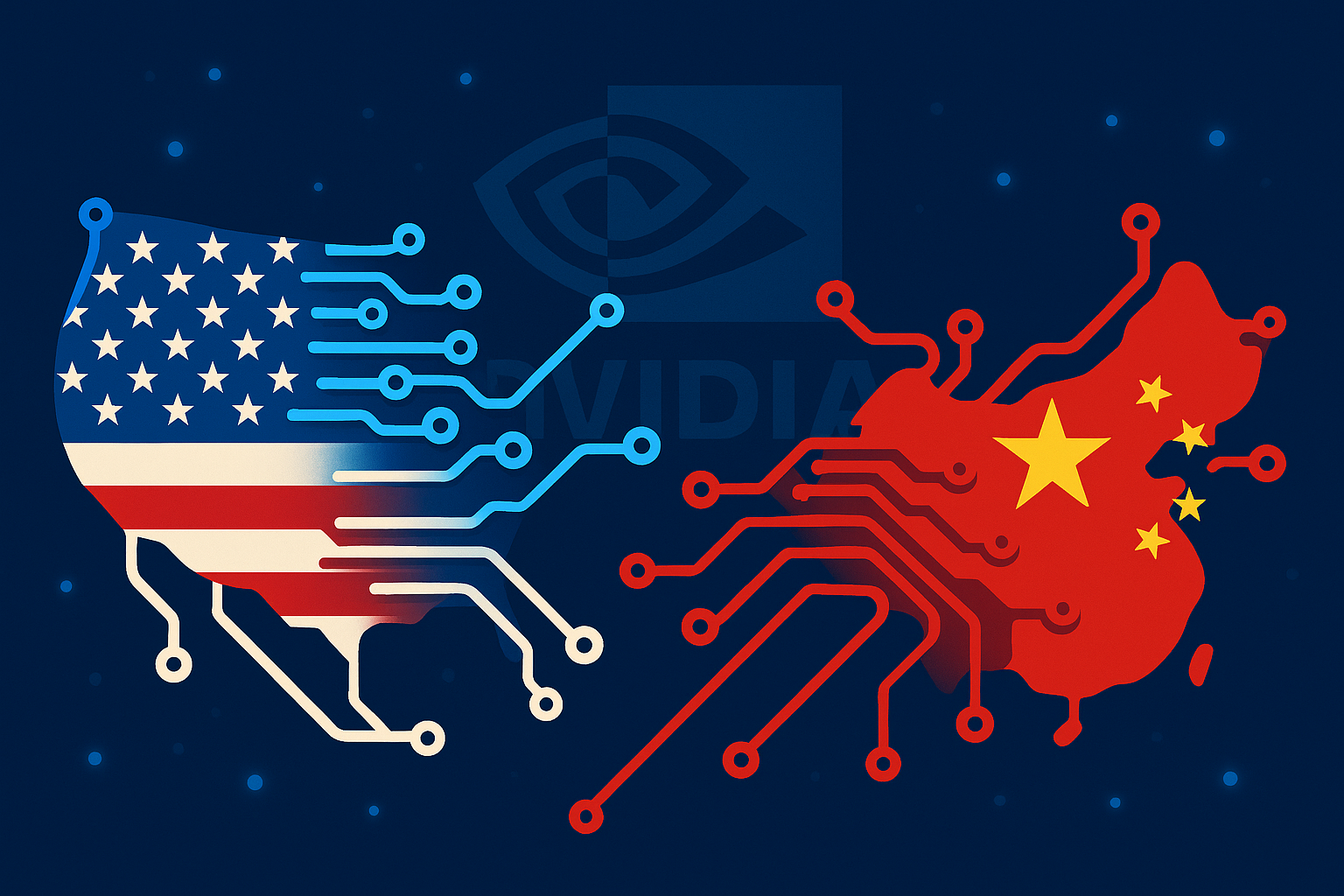
When Nvidia’s charismatic CEO Jensen Huang declared that “China will win” the artificial intelligence race at a Financial Times summit in London this week, his words sent ripples across Silicon Valley and beyond. At a time when Washington is tightening chip export controls and Beijing is accelerating AI investments, Huang’s comments reopened the question of whether technological leadership is shifting eastward—and exposed the complex calculus facing the world’s most valuable chipmaker.
The statement, made on November 5, 2025, comes amid an extraordinary paradox: Nvidia’s market access in China has effectively fallen to zero due to Beijing’s national security review, yet Huang remains adamant that cooperation between the world’s two AI superpowers is essential for America’s long-term competitiveness.
The Geopolitical Backdrop: When Export Controls Meet Innovation
The Trump administration’s position remains clear: Nvidia’s most advanced Blackwell chips should be reserved exclusively for American customers. This stance represents the culmination of export restrictions that began in October 2022, when the U.S. banned the export of top-tier GPUs including Nvidia’s A100 and H100 chips to China. The controls have since expanded to cover modified versions and now encompass the “AI Diffusion Rule” introduced in January 2025, establishing global performance thresholds that block sales of flagship GPUs to China.
However, Beijing has shut Nvidia out of the market as it conducts a national security review of its chips, with Huang stating that the firm’s market share has been reduced to zero. For a company that recorded more than $17 billion in China sales in 2024—representing roughly 13% of its revenue—this represents a strategic nightmare.
Yet Huang’s frustration extends beyond lost profits. At the London summit, he warned that states in the U.S. were considering “50 new regulations” for AI, while Beijing was subsidizing energy costs to encourage local companies to run Chinese alternatives to Nvidia’s chips. His message: America risks losing not just a market, but the innovation race itself.
China’s energy advantage is formidable. In 2024 alone, China added 429 GW of net new power generation capacity—more than 15 times the net capacity added in the United States during the same period. This infrastructure advantage could prove decisive as AI models demand ever-more electricity to train and deploy.
The Market Reality: A Tale of Two Strategies
The numbers tell a complex story. U.S. private AI investment hit $109.1 billion in 2024, nearly 12 times higher than China’s $9.3 billion and far exceeding the combined total of China and the European Union in generative AI investment. American tech giants are doubling down: the U.S. Big 4 (Amazon, Alphabet, Microsoft, and Meta) spent $224 billion on capital expenditures in 2024, expected to rise to $302 billion in 2025.
But China is playing a different game. Chinese AI capital spending is projected to reach between $84 billion and $98 billion in 2025—a 48% increase from 2024—with government investment accounting for up to $56 billion of the total. This state-led approach contrasts sharply with the venture capital-driven model in Silicon Valley, prioritizing infrastructure and energy resources over cutting-edge hardware acquisition.
U.S. firms maintain advantages in R&D intensity and monetization potential. The top three U.S. cloud platforms (Microsoft, Amazon, and Alphabet) are expected to spend a combined $180 billion on R&D in 2025, compared to $35 billion by the top three Chinese cloud platforms (Alibaba, Tencent, and Baidu).
The semiconductor bottleneck remains real. China controls about 15 percent of total AI compute, while the United States controls about 75 percent of that total, demonstrating the significant deficit in computing infrastructure that China’s AI industry faces.
Patents vs. Impact: The Quality-Quantity Divide
China’s patent dominance tells one story, but closer examination reveals another. Between 2014 and 2023, China-based inventors filed 38,210 generative AI patents—six times more than the United States’ 6,276. Chinese tech giants lead the top patent applicants: Tencent (2,074 inventions), Ping An Insurance (1,564), and Baidu (1,234).
Yet impact matters more than volume. American AI patents are cited nearly seven times more often than Chinese patents, with an average of 13.18 citations compared to China’s 1.90. Moreover, many Chinese firms file patents exclusively within China, while larger U.S. firms and companies like Samsung file across 10 or more jurisdictions.
The Stanford AI Index Report found that U.S. institutions produced 40 AI models of note in 2024, compared with 15 from China—though Chinese models have rapidly caught up in quality, reaching near parity on key benchmarks.
The DeepSeek Disruption: A New Paradigm
The emergence of DeepSeek in early 2025 fundamentally altered the conversation. The Chinese startup released DeepSeek-R1, an open-source AI model that rivals OpenAI’s most advanced offerings—and does so for roughly $6 million in training costs, a “joke of a budget” compared to the hundreds of millions OpenAI is spending.
DeepSeek launched with just 2,000 specialized Nvidia chips compared with the 16,000 or more required to train leading U.S. models, demonstrating that Chinese companies have learned to “work with what they have.” This efficiency breakthrough sent shockwaves through markets: Nvidia lost more than $600 billion in market valuation in a single day following DeepSeek’s announcement.
DeepSeek’s innovations are primarily algorithmic and architectural improvements rather than hardware advantages. The company represents the first time a Chinese AI lab has demonstrated breakthroughs at the absolute frontier of foundational AI research. Some of these innovations had already been independently discovered by U.S. firms but not disclosed publicly; others were genuinely new.
Yet context matters. China AI researchers point out that data centers in China are still running on tens of thousands of pre-restriction chips, and the real impact of export restrictions on China’s ability to develop frontier models will show up in a couple of years, when it comes time for upgrading.
Expert Perspectives: Redefining “Winning”
The notion of “winning” the AI race itself deserves scrutiny. According to experts at the Carnegie Endowment for International Peace, DeepSeek and other advanced Chinese models have made it clear that Washington cannot guarantee that it will someday “win” the AI race, let alone do so decisively.
Huang himself emphasized the importance of the Chinese market beyond mere profits: “About 50% of the world’s AI researchers are in China. The vast majority of the leading open source models are created in China.” His argument: a policy that causes America to lose half of the world’s AI developers is not beneficial in the long term.
Alexandra Mousavizadeh, CEO of Evident and creator of the Global AI Index, argues that export controls may have forced China to innovate with fewer resources: “What China just needs to do is develop chips that are good enough. They don’t have to be state of the art to get to something that’s highly competitive.”
Economist Stephen Roach notes that while semiconductors represent an obvious strategic chokepoint working to America’s advantage now, China has been pouring money into R&D. China accounted for 28% of global R&D investment in 2023, only slightly behind the U.S. at 29%, with Chinese R&D spending increasing at nearly 14% annually over the past decade.
Nvidia’s Balancing Act: Commerce and Conviction
Huang’s comments reflect Nvidia’s precarious position. Hours after the Financial Times published his “China will win” prediction, Nvidia issued a clarifying statement on X: “As I have long said, China is nanoseconds behind America in AI. It’s vital that America wins by racing ahead and winning developers worldwide.”
This rhetorical pivot underscores the tightrope Huang walks between advocating for his company’s commercial interests and maintaining political capital in Washington. In July 2025, the U.S. government reached a deal with Nvidia and AMD allowing the companies to resume some sales of AI chips to China, requiring the firms to share 15 percent of their China sales revenue with the Department of Commerce. Yet broader access remains elusive.
Meanwhile, China’s domestic chipmakers are rapidly filling the void. Huawei’s Ascend 910B and 910C chips reportedly train half of China’s top large language models, while companies like Biren Technology and Cambricon Technologies are achieving performance levels that approach Nvidia’s offerings.
Can Cooperation Survive Competition?
The future of the AI race may hinge less on who accumulates the most patents or processing power, and more on which approach proves sustainable. Two scenarios emerge:
Scenario One: Accelerated Decoupling. Export controls tighten further, forcing complete bifurcation of technology stacks. China develops fully indigenous alternatives, potentially at lower performance levels but sufficient for most applications. The world divides into competing AI ecosystems, with developing nations forced to choose sides. Innovation slows globally as researchers can no longer freely collaborate or build on each other’s work.
Scenario Two: Pragmatic Coexistence. Washington and Beijing establish “rules of the road” for AI development, distinguishing between commercial and military applications. Limited technology transfer continues for beneficial uses, while the most advanced capabilities remain controlled. Competition drives innovation on both sides, with periodic breakthroughs in each jurisdiction pushing the frontier forward.
Huang’s statement—provocative yet rooted in business reality—suggests he believes in a version of the second scenario. “We want America to win this AI race. No doubt about that,” he said at Nvidia’s developer conference in Washington last month. “But we also need to be in China to win their developers. A policy that causes America to lose half of the world’s AI developers is not beneficial in the long term, it hurts us more.”
The Verdict: Victory Without End
Can China really win the AI race? The question itself may be obsolete. Rather than a sprint with a clear finish line, the AI competition resembles an infinite game where the rules constantly evolve and “winning” means sustaining innovation across decades.
The United States maintains a leading position in AI infrastructure and development, driven by substantial private investments, top-tier model production, and access to advanced compute resources. However, China is rapidly closing gaps in model performance, talent output, and strategic investments, bolstered by government-led initiatives and cost-efficient approaches.
The reality confronting policymakers in both capitals is that absolute technological dominance may be unattainable. DeepSeek demonstrated that algorithmic innovation can partially compensate for hardware disadvantages. China’s energy infrastructure and state coordination provide structural advantages that market-driven economies struggle to match. Yet America’s deep pool of private capital, research universities, and immigration-fueled talent pipeline remain formidable assets.
For investors, the takeaway is clear: diversification across the AI value chain matters more than betting on a single winner. Companies providing picks and shoves—from semiconductor equipment manufacturers to cloud infrastructure providers—may benefit regardless of which nation claims leadership. Meanwhile, firms deeply embedded in China’s domestic market face growing regulatory risks, as Nvidia’s experience illustrates.
Huang’s warning about “50 new regulations” deserves attention. If the United States hamstrings its own AI industry through fragmented state-level rules while China maintains centralized direction, the race could indeed shift eastward—not through Chinese superiority, but American self-sabotage.
The AI race will not be won or lost in 2025, or likely even 2030. It will be determined by which society can sustain innovation intensity, attract global talent, and maintain the infrastructure to support ever-more demanding computational workloads. On that timeline, both superpowers have strengths and vulnerabilities.
Huang’s provocative declaration may ultimately serve a strategic purpose: jolting American policymakers into recognizing that export controls alone cannot substitute for proactive investment in R&D, energy infrastructure, and talent development. Whether that message resonates in Washington remains to be seen. But one thing is certain—the AI race is far from over, and the finish line keeps moving.