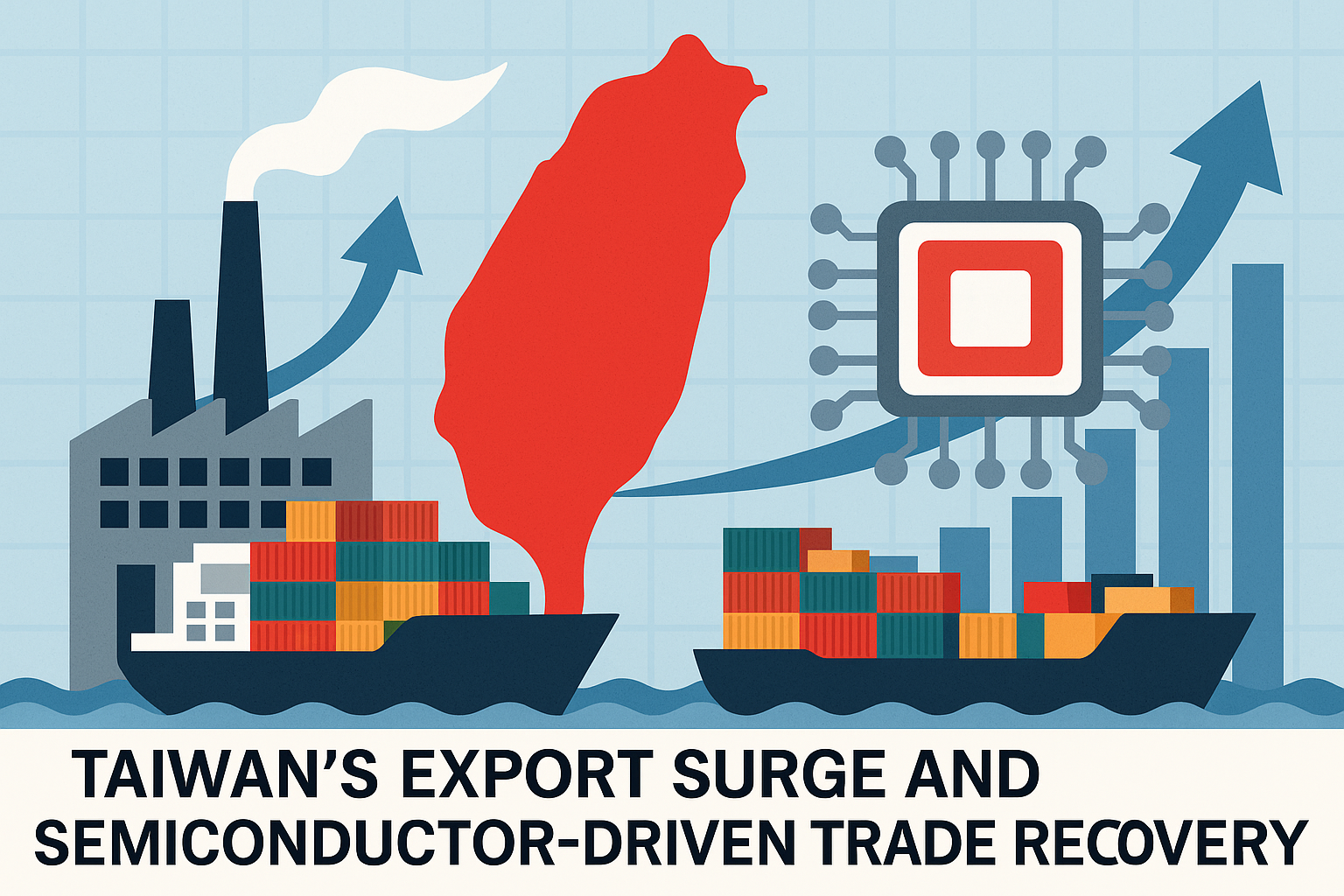
Taiwan’s exports surged in October at their fastest pace in 15 years, signaling a decisive rebound in Asia’s tech-driven manufacturing. Fueled by booming demand for AI servers and semiconductor components, the island’s trade revival suggests that the global electronics downturn may finally be bottoming out.
Context: From Slowdown to Surge
Taiwan’s export sector, a bellwether for global technology demand, has weathered a turbulent two-year period. Following the pandemic-era surge, the island’s trade performance contracted sharply through 2022 and much of 2023 as global inflation eroded consumer purchasing power, enterprise IT budgets tightened, and companies worked through bloated electronics inventories. The confluence of monetary tightening across major economies and weak demand for consumer electronics—particularly smartphones, laptops, and tablets—created a perfect storm for Taiwan’s export-dependent economy.
But October 2025 marked a dramatic reversal. Taiwan’s exports jumped 11% year-over-year, the fastest growth rate since 2008 and significantly exceeding analyst expectations of around 7% growth. The surge was broad-based but heavily concentrated in technology sectors, with semiconductors leading the charge. This represents not merely a statistical uptick, but potentially a structural shift in the global technology cycle.
The October performance brought Taiwan’s cumulative export growth for the year into positive territory, reversing months of year-over-year declines. Critically, the momentum appears sustainable: forward-looking indicators including semiconductor equipment orders, capacity utilization rates at major foundries, and order backlogs all point to continued strength through the end of 2025 and into early 2026.
Semiconductor Recovery and AI Demand
The driver behind Taiwan’s export renaissance is unambiguous: artificial intelligence. Semiconductor exports, which constitute roughly 35% of Taiwan’s total exports, surged 18% year-over-year in October, with AI-related chips accounting for the lion’s share of growth. The explosion in generative AI applications—from ChatGPT to enterprise AI platforms—has triggered unprecedented demand for advanced processing chips, high-bandwidth memory, and specialized AI accelerators.
NVIDIA’s relentless demand for cutting-edge chips to power its data center GPUs has been transformative for Taiwan Semiconductor Manufacturing Company (TSMC), the world’s largest contract chipmaker. TSMC’s advanced 3-nanometer and 5-nanometer process nodes are running at over 90% capacity utilization in Q4 2025, with the company rapidly expanding production to meet orders that extend well into 2026. This isn’t just about NVIDIA—cloud computing giants including Microsoft, Amazon, Google, and Meta are all racing to build out AI infrastructure, driving massive procurement of Taiwan-made server chips, networking components, and storage solutions.
The October export breakdown reveals the breadth of this technology resurgence. Integrated circuits jumped 20% year-over-year, electronic components rose 14%, and optical equipment—used in data centers and telecommunications infrastructure—climbed 16%. Even mature semiconductor categories that had been languishing saw renewed demand as automotive and industrial applications recovered.
“AI server demand has given Taiwan’s export sector a second wind,” said economist Iris Pang of ING, capturing the sentiment across financial markets. The AI infrastructure buildout represents a multi-year cycle that could sustain Taiwan’s export momentum far longer than previous technology booms, which tended to be more cyclical and consumer-dependent.
Asia’s Supply Chain Reconfiguration
Taiwan’s export surge doesn’t exist in isolation—it reflects broader transformations reshaping Asian manufacturing networks. The island’s gains mirror strengthening trade performance across the region, from South Korea’s memory chip exports to Vietnam’s expanding electronics assembly operations. This regional revival suggests the worst of the post-pandemic inventory correction is over and that global supply chains are entering a new phase of growth.
Geopolitically, U.S.–China technology restrictions have accelerated supply chain diversification, benefiting Taiwan and other Asian economies that can serve as alternative manufacturing hubs. Taiwan’s October exports to the United States surged 21%, reflecting American companies’ efforts to secure semiconductor supplies from trusted partners. Exports to Japan rose 17%, ASEAN nations increased 15%, and even exports to mainland China—despite ongoing tensions—grew 8% as Chinese manufacturers continued sourcing critical components.
South Korea, another semiconductor powerhouse, has seen its memory chip exports stabilize after two years of decline, buoyed by the same AI data center demand driving Taiwan’s growth. Vietnam’s role as a major electronics assembly hub has expanded as companies diversify away from China, with Vietnamese exports of smartphones, laptops, and peripherals reaching record levels. This rebalancing of Asian supply chains, driven by both economic and geopolitical factors, is creating new trade patterns that could persist for years.
Macroeconomic and Market Implications
The export rebound has profound implications for Taiwan’s economic trajectory. Economists have begun revising GDP growth forecasts upward, with several major banks now projecting Taiwan’s 2025 GDP growth could exceed 4%, up from earlier estimates of 2-3%. The government’s Ministry of Finance has raised its export growth forecast for Q4 2025 to 5-7%, a significant upgrade from previous projections.
Currency markets have taken notice. The New Taiwan dollar has appreciated modestly against major currencies as capital flows strengthen, though Taiwan’s central bank has carefully managed the exchange rate to preserve export competitiveness. Equity markets have responded enthusiastically—Taiwan’s stock market has surged to multi-year highs, with the technology-heavy TAIEX index up over 30% year-to-date, driven primarily by TSMC and other semiconductor stocks.
Beyond Taiwan, the export revival signals potential green shoots for global manufacturing more broadly. After nearly two years of industrial recession across developed economies, the technology sector’s rebound could presage wider manufacturing recovery. If AI infrastructure investment continues its torrid pace, it could offset persistent weakness in consumer electronics and provide a bridge to the next phase of the economic cycle.
Risks and Sustainability
Despite the euphoria, significant risks cloud the sustainability of Taiwan’s export boom. The surge is heavily concentrated in AI-related demand, which remains vulnerable to several factors. If the generative AI hype cycle cools or if cloud computing companies pull back on infrastructure spending—as they did during previous periods of over-investment—Taiwan’s exports could reverse quickly.
“The chip cycle is recovering faster than expected, but sustainability remains uncertain beyond early 2025,” noted a Taipei-based trade official, reflecting concerns among policymakers. The current boom shares characteristics with previous semiconductor super-cycles that ultimately proved unsustainable, leading to painful inventory corrections.
Taiwan also faces structural challenges. Energy costs remain elevated, creating margin pressure for manufacturers. Geopolitical tensions with mainland China pose ongoing risks to supply chain stability and regional trade flows. The island’s heavy dependence on a few key customers—particularly large American technology companies—creates concentration risk. If U.S. demand softens due to recession or if companies slow their AI buildouts, Taiwan would feel the impact acutely.
There’s also the question of competition. South Korea, China, Japan, and increasingly the United States itself are all investing heavily in domestic semiconductor capacity. While these efforts will take years to bear fruit, they represent longer-term threats to Taiwan’s dominant market position. The U.S. CHIPS Act and similar industrial policies in Europe and Japan aim explicitly to reduce dependence on Taiwan for critical semiconductors.
Conclusion
Taiwan’s October export surge—the fastest in 15 years—represents more than a statistical milestone. It signals a potential inflection point in the global technology cycle and validates the transformative impact of artificial intelligence on industrial demand. The island’s semiconductor sector, powered by TSMC’s technological leadership and surging AI infrastructure demand, has emerged from the post-pandemic downturn with renewed strength.
For global investors and policymakers, Taiwan’s rebound serves as a bellwether. It suggests that the inventory correction that plagued technology sectors through 2023 and early 2024 has run its course, and that a new investment cycle—driven by AI and data center expansion—is gaining momentum. The recovery’s sustainability will depend on whether AI demand proves durable and whether the current infrastructure buildout can avoid the boom-bust patterns that have characterized previous technology cycles.
What seems clear is that Taiwan has positioned itself at the center of the most important technological shift of the decade. As companies worldwide race to build AI capabilities, they must pass through Taiwan’s semiconductor foundries. This gives the island extraordinary leverage but also exposes it to the full force of any downturn in technology spending. For now, the momentum is decidedly positive, and Taiwan’s export data suggests that the early phases of an AI-driven industrial cycle are indeed underway, potentially reshaping Asia’s economic landscape for years to come.