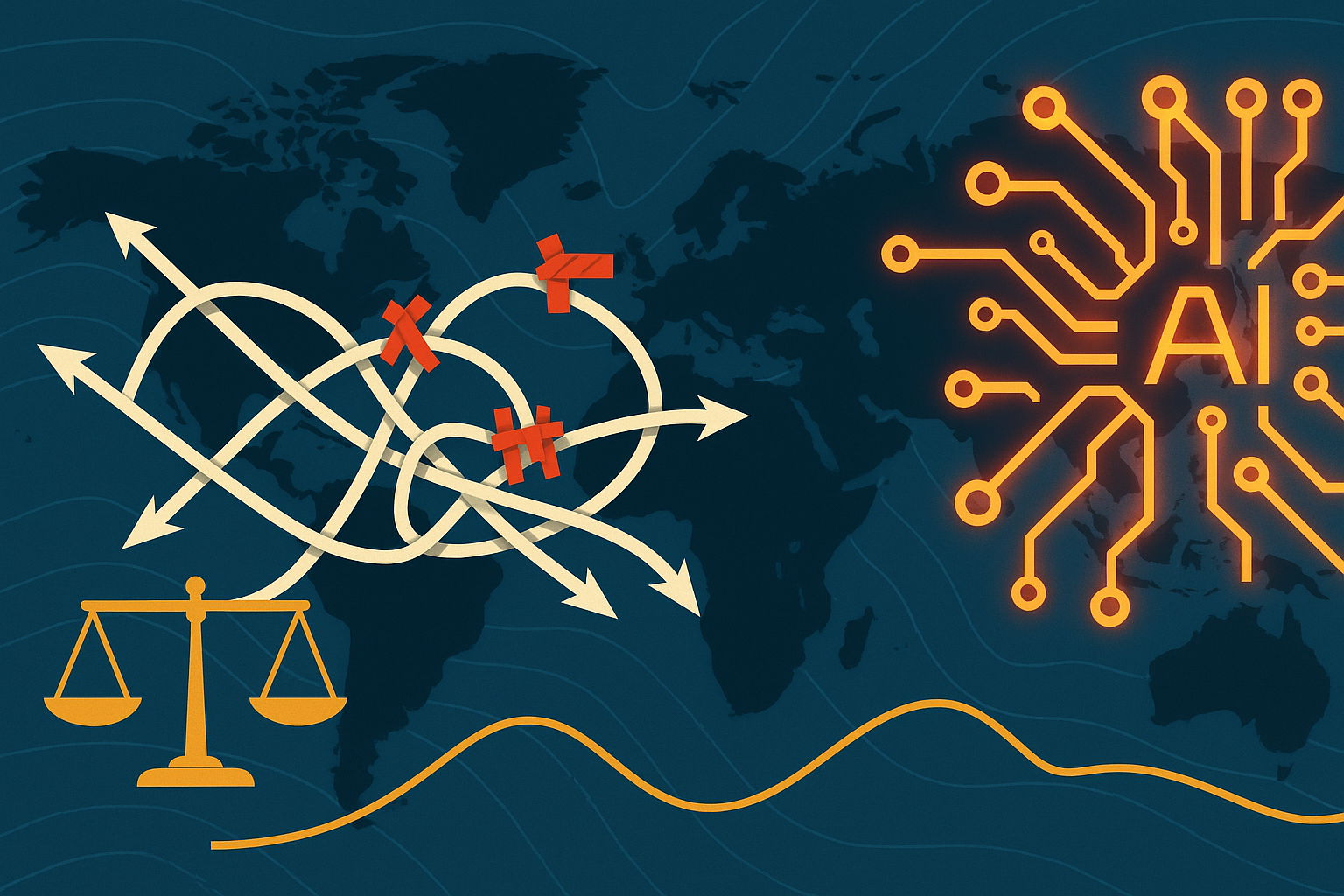
The OECD has issued a stark reminder that the global economy, while more resilient than expected, is entering a period where escalating tariffs and a debt-fueled AI investment surge could expose new vulnerabilities. As the world balances cooling inflation with persistent geopolitical frictions, the coming years may determine whether global growth can withstand overlapping structural shocks.
A World at an Inflection Point
The global economy finds itself at a peculiar crossroads in late 2025. On one hand, growth has proven surprisingly durable in the face of trade tensions and policy uncertainty. On the other, two powerful forces—rising protectionism and an unprecedented artificial intelligence investment boom—are simultaneously reshaping the economic landscape in ways that could either reinforce or undermine long-term prosperity.
The Organisation for Economic Cooperation and Development forecasts global growth will slow modestly from 3.2% in 2025 to 2.9% in 2026, before rebounding to 3.1% in 2027. While these figures suggest stability on the surface, the OECD warns that this resilience masks deeper fragilities. The interplay between trade fragmentation and capital-intensive technological investment creates a dual-risk environment that policymakers have rarely confronted.
OECD’s Updated Global Growth Outlook
The OECD’s December 2025 Economic Outlook reveals a global economy defying pessimistic predictions, but only narrowly. The U.S. economy is forecast to grow 2% in 2025, revised up from 1.8% in September, before slowing to 1.7% in 2026. What makes this growth particularly noteworthy is its composition: without booming AI investments the US economy contracted by 0.1% in the first half of 2025, according to OECD estimates.
In Asia, China’s growth is expected to hold steady at 5% in 2025 before slowing to 4.4% in 2026 as fiscal support fades and new U.S. tariffs on goods imported from China bite. Meanwhile, the euro zone’s 2025 growth forecast was revised up to 1.3% from 1.2%, supported by resilient labour markets and increased public spending in Germany, though growth is expected to moderate to 1.2% in 2026 as budget tightening in France and Italy constrains expansion.
Japan’s economy is projected to grow 1.3% in 2025, buoyed by strong corporate earnings and investment, before slowing to 0.9% in 2026. The outlook reflects an economy caught between domestic consumption challenges and corporate optimism about technological transformation.
Tariff Escalation: A Renewed Drag on Global Trade
The return of protectionist trade policies under the Trump administration has reintroduced uncertainty into global supply chains. OECD head Mathias Cormann said the trade shocks triggered by US President Donald Trump’s tariff hikes had so far proved relatively mild, but added their costs were likely to rise.
The full impact of tariffs operates on a delayed fuse. Global trade growth is expected to moderate from 4.2% in 2025 to 2.3% in 2026 as the full effects of tariffs weigh on investment and consumption. This deceleration reflects not just the direct cost of import taxes, but also the chilling effect on business investment decisions as companies reassess cross-border supply chain strategies.
The OECD’s concern centers on fragmentation—the gradual splintering of the global trading system into rival blocs. Unlike the relatively predictable tariff regimes of the past, today’s trade tensions are characterized by sudden policy shifts, retaliatory measures, and strategic decoupling efforts, particularly between the United States and China. This volatility makes long-term business planning difficult and discourages the kinds of productivity-enhancing investments that drive sustainable growth.
The AI Boom: Catalyst or Bubble?
If tariffs represent a headwind for global growth, artificial intelligence investment has emerged as a powerful—if controversial—tailwind. The scale of corporate spending on AI infrastructure is genuinely unprecedented. In the first half of 2025, AI-related capital expenditures contributed 1.1% to GDP growth, outpacing the U.S. consumer as an engine of expansion.
The hyperscale technology companies—Amazon, Meta, Microsoft, Alphabet, and Oracle—are projected to allocate $342 billion to capital expenditures in 2025, a 62% increase from the previous year. This surge is driven primarily by the construction of data centers and the acquisition of advanced computing hardware needed to train and deploy large language models and other AI systems.
Data center construction hit a record $40 billion annual rate in June, up 30% from last year—a bright spot in an otherwise challenged construction environment. Hardware investment has been equally dramatic, with investment in computers and related equipment up 41% year-over-year, reflecting surging demand for servers and GPU systems.
Yet the OECD’s optimism about AI-driven growth is tempered by significant concerns. The Paris-based organisation warned that global growth was vulnerable to any new outbreak of trade tensions while investor optimism about AI could trigger a stock market correction if expectations are not met. The risk is that corporate spending is running ahead of demonstrated returns, creating the conditions for a sharp correction if AI applications fail to generate anticipated revenues.
Moreover, the AI investment cycle exhibits characteristics that could amplify rather than dampen economic volatility. The concentration of spending among a handful of firms, the rapid depreciation of computing hardware, and the winner-take-all dynamics of the technology sector all suggest that AI capex could swing dramatically based on shifting market sentiment.
When Two Forces Collide: Tariffs × AI
The simultaneous pressures of trade fragmentation and AI-driven investment create complex policy trade-offs. AI investment, fiscal support and expected Federal Reserve rate cuts are helping offset the drag from tariffs on imported goods, reduced immigration and federal job cuts. This offsetting dynamic has provided crucial short-term resilience, but it also obscures underlying structural problems.
Consider the inflation challenge. While overall inflation has cooled significantly from 2022-2023 peaks, tariffs exert upward pressure on consumer prices, particularly for imported goods. At the same time, the massive energy demands of AI data centers are straining electricity grids and potentially driving up power costs. This creates an uncomfortable scenario for central banks: growth remains sluggish enough to justify accommodative policy, yet specific price pressures complicate the path toward lower interest rates.
Trade policy and technology investment also interact in less obvious ways. Much of the capital equipment needed for AI infrastructure—advanced semiconductors, networking hardware, power systems—comes from global supply chains that tariffs disrupt. Protectionist measures could therefore inadvertently slow the very technological investment that has been propping up economic growth.
Furthermore, the strategic competition between the United States and China increasingly encompasses both trade policy and technological leadership. Export controls on advanced chips, restrictions on AI software, and competing industrial policies all reflect an effort to deny rivals access to cutting-edge capabilities. This dynamic risks creating parallel, incompatible technology ecosystems that reduce overall innovation efficiency.
Winners and Losers in a Fragmenting Global Economy
The dual pressures of protectionism and AI investment are reshaping economic geography in profound ways. Countries that can position themselves as hubs for AI infrastructure while maintaining access to multiple trading blocs stand to benefit significantly.
The United States, despite its trade tensions, remains the clear leader in AI investment and is attracting massive capital inflows to fund data center construction. However, the Trump administration had put US fiscal policy on an unsustainable trajectory with large budget deficits and rising debt that would require a significant adjustment in the coming years.
Emerging markets face a more complex calculus. Those heavily dependent on exports to either the U.S. or China are vulnerable to further trade restrictions and supply chain reconfiguration. Capital flows could prove volatile as investors reassess the risk-reward profile of different regions in light of geopolitical fragmentation.
Meanwhile, countries that supply critical inputs for AI infrastructure—from power generation equipment to advanced semiconductors—may find themselves in increasingly advantageous positions, though this also makes them potential targets for strategic competition and pressure.
What Policymakers Need to Watch
The dual-risk environment calls for nuanced policy responses. Most major central banks are expected to maintain or lower borrowing costs over the coming year as inflation pressures ease, with the Federal Reserve projected to cut rates slightly by the end of 2026, barring inflation surprises from tariffs.
Yet monetary policy alone cannot address the structural challenges posed by trade fragmentation and potentially volatile technology investment. Governments face difficult choices about industrial policy: Should they subsidize domestic AI capabilities? How should they balance competition policy with the desire for national champions? What framework should govern cross-border data flows and AI systems?
Fiscal sustainability also looms as a growing concern. The combination of rising debt levels, pressure to support domestic industries, and the need for infrastructure investment to accommodate AI’s energy demands creates competing claims on limited public resources.
Can Global Growth Bend Without Breaking?
The OECD’s assessment reveals an economy that has proven more adaptable than many feared, but also one facing genuinely novel stresses. OECD Secretary-General Mathias Cormann wrote in a commentary that the global economy has been resilient this year, despite concerns about a sharper slowdown in the wake of higher trade barriers and significant policy uncertainty. Yet he cautioned that higher tariffs are expected to gradually feed through to higher prices, reducing growth in household consumption and business investment.
The 2025-26 period represents a stress test for the post-pandemic economic order. Can global supply chains remain functional amid rising protectionism? Will AI investment deliver productivity gains sufficient to justify unprecedented capital expenditures? Can policymakers navigate between the Scylla of inflation and the Charybdis of stagnation?
The answers to these questions will shape not just the next two years, but potentially the next decade of economic development. A successful navigation would see AI-driven productivity gains offset trade inefficiencies, allowing continued growth despite fragmentation. A failure scenario might involve a sharp AI investment correction coinciding with escalating trade tensions, potentially tipping major economies into recession.
What’s clear is that the old playbooks may no longer apply. The simultaneous pressures from protectionism and rapid technological change demand policy frameworks that can accommodate greater volatility and structural transformation. The global economy may be bending under these dual pressures—the question is whether it can do so without breaking.