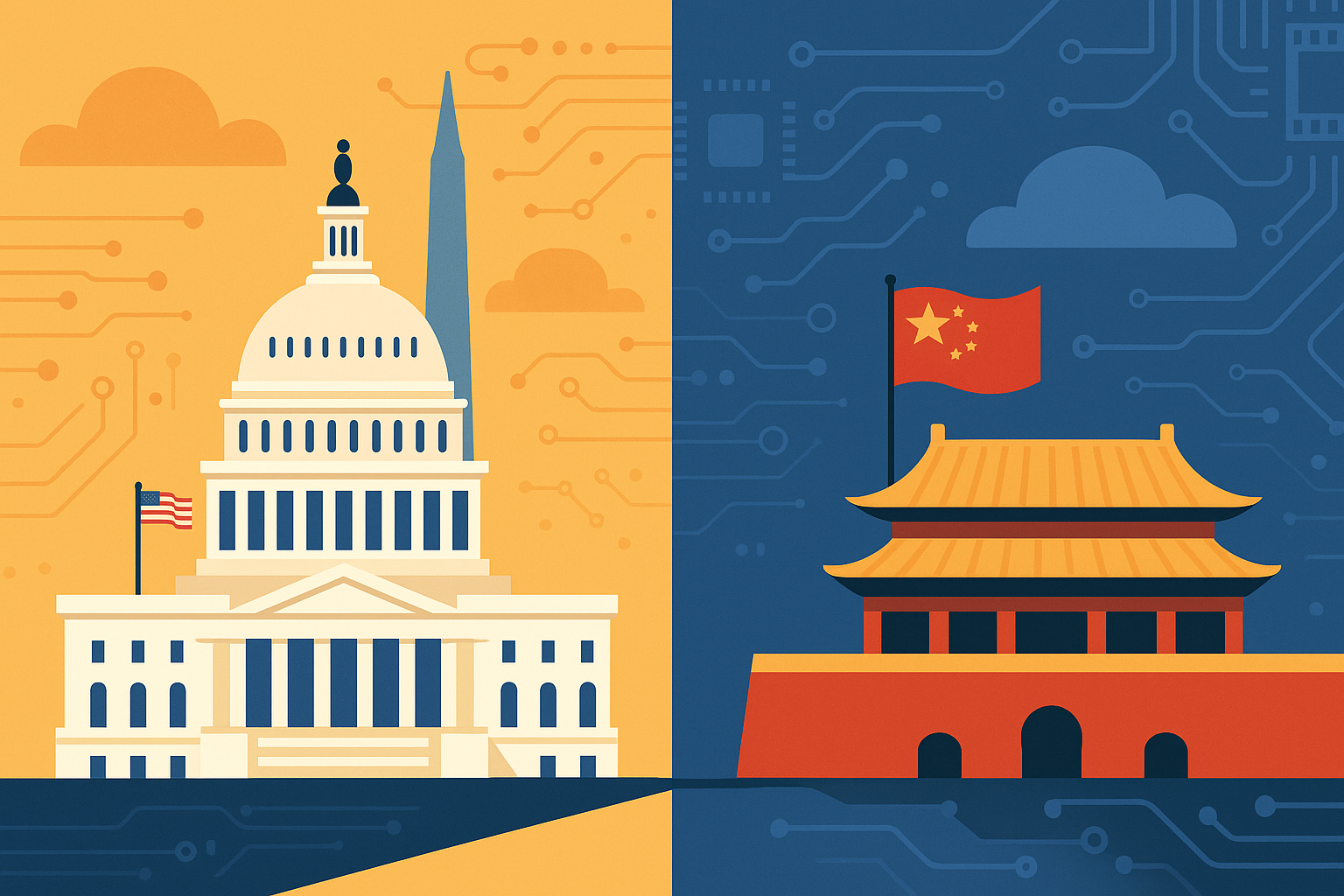
The United States has quietly paused plans to sanction China’s Ministry of State Security—an unexpected shift that signals Washington’s desire to preserve a fragile trade truce with Beijing. The decision comes as both countries navigate escalating tensions over technology supply chains, industrial policy, and geopolitical competition. The move may ease market anxieties in the short term, but raises larger questions about how the world’s two largest economies balance national security with economic stability.
The Defining Axis of Global Economic Risk
The U.S.-China relationship remains the single most important determinant of global economic stability in 2025. With bilateral trade flows exceeding $195 billion in just the first five months of this year, and both nations deeply integrated into critical supply chains spanning semiconductors to rare earth minerals, any disruption in their relationship reverberates across continents. Recent reporting reveals that the Trump administration suspended plans to impose sanctions on China’s Ministry of State Security and associated contractors linked to the Salt Typhoon cyber espionage campaign, specifically to avoid disrupting the trade truce reached in October 2025.
This decision reflects a calculated trade-off: accepting continued national security risks in exchange for economic predictability. For policymakers, investors, and business leaders worldwide, understanding the reasoning behind this pause—and its implications—is critical for navigating the months ahead.
What Sanctions Were Being Considered?
The Ministry of State Security (MSS) serves as China’s primary foreign intelligence and counterintelligence agency, comparable to a combination of the CIA and FBI in the United States. The MSS is widely understood to operate Salt Typhoon, an advanced persistent threat actor that has conducted high-profile cyber espionage campaigns, infiltrating over 200 targets in more than 80 countries.
The Salt Typhoon campaign compromised nine U.S. telecommunications companies—including Verizon, AT&T, and T-Mobile—targeting core network infrastructure and giving Chinese intelligence access to communications metadata and, in some cases, the actual content of phone calls and text messages. The operation, which began as far back as 2022, represents one of the most severe breaches of American telecommunications infrastructure in history.
Washington had planned to sanction not only the MSS itself but also contractors allegedly used by the ministry to conduct the Salt Typhoon hacker campaign. In January 2025, the Treasury Department did sanction Sichuan Juxinhe Network Technology Co., LTD., a cybersecurity company with direct involvement in Salt Typhoon, demonstrating that some punitive measures proceeded even as broader MSS sanctions were shelved.
The symbolism of sanctioning the MSS would have been profound. It would have represented a direct rebuke to China’s intelligence apparatus and signaled that the United States views cyber espionage operations—particularly those targeting critical infrastructure—as crossing a redline worthy of severe economic consequences. The practical impact would have included asset freezes, travel restrictions, and limitations on business dealings with sanctioned entities and individuals.
Why the U.S. Paused the Sanctions
The decision to hold back on MSS sanctions comes down to three interconnected priorities: economic stability, political pragmatism, and diplomatic recalibration.
Preserving the October Trade Truce
In October 2025, during the APEC summit in Busan, South Korea, President Trump and Chinese President Xi Jinping reached a framework agreement that reduced U.S. tariffs on Chinese goods from 57% to 47%, while China agreed to suspend export controls on certain rare earth minerals for one year. China also committed to purchasing large quantities of U.S. agricultural products and intensifying efforts to curb fentanyl precursor chemicals.
This truce, while limited in scope, provided immediate relief to businesses and consumers who had endured months of escalating tariff warfare. Through May 2025, the U.S. trade deficit with China averaged approximately $20.4 billion monthly, with U.S. imports from China averaging $29.71 billion compared to exports of just $9.31 billion. Given these massive trade flows and their impact on supply chains, inflation, and consumer prices, maintaining even an imperfect détente held significant value for the Trump administration.
Domestic Political Calculations
The decision reflects complex political dynamics in Washington. While bipartisan consensus exists regarding the need for a tougher stance on China, there’s less agreement on execution. Technology companies, including semiconductor manufacturers and firms like Nvidia, have lobbied intensely for relaxed export controls, arguing that overly restrictive policies will simply push China to develop indigenous alternatives while depriving American companies of critical revenue streams.
During the Busan meeting, Trump discussed the export of Nvidia chips with Xi, though conversations did not cover the most advanced Blackwell graphics processing units. The pressure from the tech sector to maintain some level of commercial engagement with China—balanced against national security imperatives—creates difficult choices for policymakers.
Manufacturing sectors dependent on Chinese inputs or markets also favor stability. According to sources, the U.S. administration’s policy seeks to ensure “stability” until Washington can reduce China’s dominance in rare earth minerals—a process that will take years, not months, requiring massive investments in alternative supply chains.
Diplomatic Recalibration After Recent Talks
The pause on sanctions reflects a broader recalibration of U.S.-China relations following months of escalation. White House deputy chief of staff Stephen Miller was instructed to ensure that agencies do not take actions that could disrupt the thawing of tensions, signaling high-level coordination to prevent bureaucratic actions from undermining diplomatic progress.
This represents a shift from the approach of previous administrations, which often allowed individual agencies to pursue enforcement actions with limited consideration for broader diplomatic objectives. The current strategy suggests greater centralization of China policy, with the White House maintaining tighter control over actions that could trigger Chinese retaliation.
China’s Position and Strategic Calculus
For Beijing, potential sanctions targeting the MSS represent a red line that goes beyond typical trade disputes. The MSS sits at the heart of China’s national security apparatus, and any attempt to sanction it would be perceived as a direct attack on Chinese sovereignty and security capabilities.
China views intelligence gathering—including cyber espionage—as a legitimate tool of statecraft that all major powers employ. While Beijing routinely denies involvement in specific hacking campaigns, China’s embassy in Washington has repeatedly denied Beijing’s involvement in cyberattacks against U.S. systems and has often flipped the blame back onto the U.S. for hacks into China-based networks. From China’s perspective, American complaints about cyber espionage ring hollow given the extensive intelligence-gathering operations conducted by U.S. agencies globally.
The economic dimension is equally critical for China. With economic growth moderating and youth unemployment elevated, Beijing cannot afford a complete breakdown in trade relations with the United States. China’s commitments in the October agreement—including purchases of U.S. agricultural products and pausing rare earth export controls—reflect Beijing’s recognition that maintaining trade flows serves Chinese interests, even if it requires tactical compromises.
China’s global messaging has emphasized stability and cooperation, portraying itself as a responsible stakeholder willing to work with the United States to manage differences. By avoiding a confrontation over MSS sanctions, Beijing can continue projecting this image while maintaining its intelligence operations at a less visible level.
Implications for Global Markets
The market response to the sanctions pause reveals how sensitive investors remain to U.S.-China relations.
Short-Term: Sentiment Boost
In the immediate term, the decision not to escalate tensions provided relief to sectors most exposed to bilateral friction. Technology stocks, particularly semiconductor manufacturers and companies with significant China exposure, benefited from reduced uncertainty. Supply chain-dependent sectors—from automotive to consumer electronics—also saw improved sentiment as the risk of sudden disruptions receded.
The October trade agreement itself had already provided a market boost. The reduction in tariffs from 57% to 47% and China’s suspension of rare earth export controls brought temporary relief to businesses and consumers, helping to stabilize market expectations even if fundamental issues remained unresolved.
Medium-Term: Volatility Likely
The sanctions pause does not eliminate underlying tensions; it merely defers them. Markets face several sources of continued uncertainty:
One-Year Timeline: The October agreement is explicitly framed as a one-year deal subject to annual renegotiation. This creates a built-in expiration date that will generate renewed market anxiety as 2026 approaches.
Enforcement Ambiguity: The absence of clear enforcement mechanisms or verification procedures means both sides can interpret commitments flexibly, creating ongoing risk of disputes over implementation.
Geopolitical Wild Cards: Taiwan tensions, South China Sea disputes, and technology competition could trigger new crises that overwhelm economic agreements. The sanctions pause reflects current priorities but could be reversed if geopolitical conditions deteriorate.
Long-Term: Structural Decoupling Continues
Despite tactical pauses and temporary agreements, the fundamental trajectory of U.S.-China economic relations points toward gradual decoupling. The sanctions pause should not be mistaken for a strategic shift.
In the first five months of 2025, bilateral trade volumes showed concerning trends, with total trade reaching $195.1 billion but imports from China running at approximately three times the value of U.S. exports. This persistent imbalance fuels political pressure for more aggressive action to “rebalance” trade.
Investment flows tell a similar story. Foreign direct investment between the two countries has declined sharply as companies diversify supply chains and governments impose national security reviews on cross-border transactions. Even without explicit sanctions, the business environment has become sufficiently uncertain that many multinational corporations are pursuing “China plus one” strategies—maintaining some presence in China while building alternative production capacity in Southeast Asia, India, or other markets.
Impact on Technology and Supply Chains
The technology sector sits at the epicenter of U.S.-China tensions, making the sanctions pause particularly significant for companies navigating conflicting imperatives.
Export Controls and Semiconductor Competition
The Trump administration reportedly will not impose major new export controls on China in the near term, providing breathing room for semiconductor companies. However, existing restrictions remain extensive, with over 1,000 Chinese firms on the U.S. export control list.
The semiconductor competition presents a classic dilemma: American companies need Chinese markets for revenue and scale, but selling advanced chips to China risks strengthening a strategic competitor. Trump indicated discussions about Nvidia chip exports would continue, though they excluded the most advanced Blackwell processors, suggesting a middle path of allowing some commercial sales while protecting the most cutting-edge technology.
China’s response has been to accelerate indigenous development. While Chinese semiconductor capabilities still lag American and Taiwanese leaders by several technology generations, the gap has been narrowing. If U.S. export controls become too restrictive, they may accelerate rather than slow China’s path to self-sufficiency.
Rare Earths and Critical Minerals
China accounts for around 70% of the world’s supply of rare earth minerals, which are crucial to manufacturing products from smartphones to military equipment. China’s willingness to pause new export restrictions provided significant relief to industries dependent on these materials.
However, this remains China’s most powerful leverage point. Unlike semiconductors, where the United States and its allies maintain technological advantages, China’s dominance in rare earths processing is nearly absolute. The one-year pause gives Western companies time to develop alternative supply chains, but changing the fundamental supply structure will require years of investment and much higher costs.
Multinational Companies Face Mixed Signals
For global corporations, the sanctions pause creates both opportunities and challenges. The immediate benefit is reduced risk of sudden supply chain disruptions or market access restrictions. Companies can continue existing operations without facing immediate pressure to choose between U.S. and Chinese markets.
However, the mixed signals complicate long-term planning. Should companies invest in expanding Chinese operations, betting on continued stabilization? Or should they accelerate diversification efforts, assuming the current pause is temporary? Different companies are making different bets, but few see genuine long-term stability in U.S.-China economic relations.
The constraints on “real stability” are fundamental: As long as China pursues technological self-sufficiency and military modernization goals that conflict with U.S. security interests, and as long as the United States maintains its position that certain technologies should not flow to China, structural tension will persist regardless of tactical accommodations.
Geopolitical Significance
The sanctions pause fits within a broader evolution of U.S. strategy in Asia that balances competition with pragmatism.
U.S. Strategic Positioning
The decision reflects a more nuanced approach than outright confrontation. By maintaining economic engagement while strengthening alliances, expanding military presence in the Indo-Pacific, and investing in domestic technological capabilities, Washington aims to compete with China across multiple dimensions simultaneously.
Expert analysis suggests that China may have gained tactical advantages in recent negotiations, with Beijing agreeing to relatively modest commitments while securing significant tariff reductions from Washington. However, the United States retains substantial leverage in advanced semiconductors and other critical technologies, provided it can maintain alliance cohesion and avoid fragmenting Western technological standards.
The pause on MSS sanctions should be understood as setting expectations for future negotiations: The United States remains willing to compromise on specific issues to maintain broader stability, but this willingness has limits. If China’s cyber espionage operations become even more aggressive, or if they target different categories of systems deemed more sensitive, sanctions could return to the agenda quickly.
Allied Reactions and Coordination
The sanctions pause has generated mixed reactions among U.S. allies. Japan, South Korea, Australia, and European nations all face their own cyber threats from Chinese intelligence services, and some express concern that American willingness to compromise on security issues may embolden Beijing.
On December 3, the Cybersecurity and Infrastructure Security Agency, NSA, and FBI, along with counterparts in Australia, New Zealand, and Canada, released guidance on addressing the Salt Typhoon attack, demonstrating continued allied coordination on cybersecurity even as diplomatic approaches diverge.
European Union members, in particular, are navigating complex positions. While security concerns about China have grown—particularly regarding telecommunications infrastructure and technology dependencies—European economies remain deeply integrated with China through trade and investment. The EU’s approach tends to favor economic engagement combined with targeted security restrictions, making European leaders generally supportive of U.S. efforts to maintain dialogue with Beijing.
Conclusion
The pause in sanctions against China’s Ministry of State Security does not represent a fundamental thaw in U.S.-China relations. Rather, it reflects tactical coexistence—an acknowledgment that the world’s two largest economies must find ways to manage competition while avoiding catastrophic ruptures that would damage both sides and destabilize global markets.
Several indicators will reveal whether this approach can succeed in the coming months:
Trade Balance Trends: If the approximately 3:1 ratio of Chinese exports to U.S. imports continues or worsens, political pressure for more aggressive action will intensify regardless of diplomatic agreements.
Cyber Espionage Activity: If Salt Typhoon or similar operations continue or escalate, the political feasibility of maintaining the sanctions pause will erode. Congressional pressure for action against Chinese cyber threats remains strong across both parties.
Technology Competition: Developments in semiconductor capabilities, artificial intelligence, and critical minerals supply chains will shape how both countries assess their relative positions and appetite for continued compromise.
Geopolitical Flashpoints: Taiwan tensions, South China Sea incidents, or other security crises could quickly overwhelm economic considerations and force both nations back to confrontational postures.
For now, the sanctions pause buys time—time for supply chains to adjust, for alternative mineral sources to develop, for domestic political constituencies to recalibrate expectations. Whether that time is used wisely to build more sustainable frameworks for U.S.-China relations, or whether it merely postpones inevitable confrontations, will become clearer as 2026 approaches and the one-year trade truce requires renegotiation.
What’s certain is that the fundamental tension remains: Both countries seek technological leadership, military security, and economic prosperity, and both view the other as the primary obstacle to achieving those goals. Managing this competition without catastrophic conflict may be the defining challenge of the coming decade. The MSS sanctions pause is one small chapter in a much longer and more consequential story.