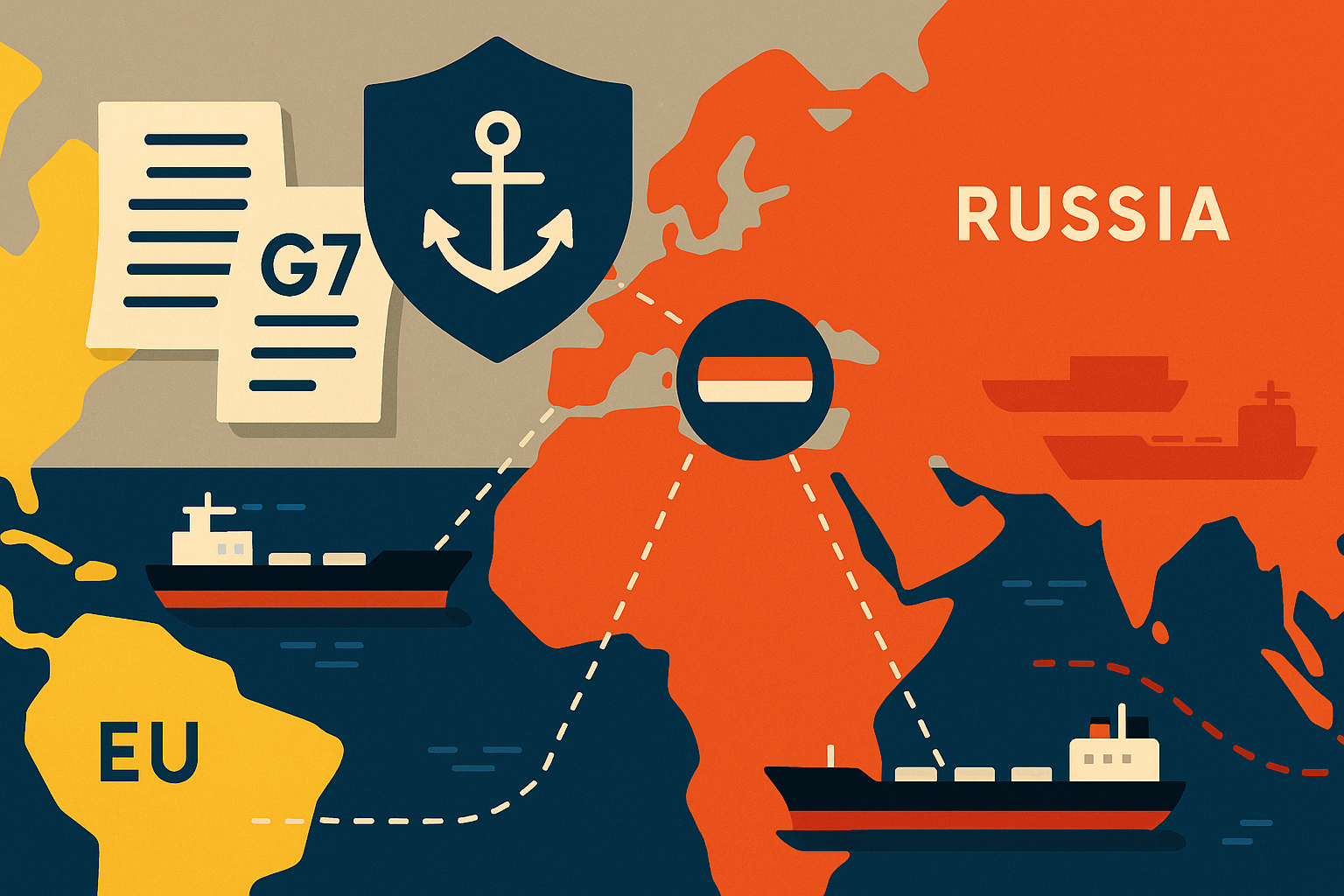
The EU and G7 are evaluating one of the most far-reaching revisions to the sanctions regime on Russian oil since 2022: a potential ban on maritime services crucial to exporting Russian crude, alongside a possible removal of the long-standing price cap. If enacted, the measures could reshape global oil flows, intensify Moscow’s fiscal pressures, and trigger fresh volatility in energy markets from Europe to Asia.
Background: How the Current Price Cap Works
In December 2022, the G7, EU, and Australia formed the Price Cap Coalition, introducing a $60-per-barrel ceiling on Russian crude oil. The enforcement mechanism was elegant in its design: Russia could continue selling oil to third countries, but only if Western companies providing essential maritime services—including Protection and Indemnity (P&I) insurance, ship brokerage, vessel financing, and technical certifications—verified that the oil was purchased at or below the cap.
The rationale was twofold: reduce Russian oil revenues that finance the war in Ukraine while maintaining global oil supply to prevent price spikes that would fuel inflation. The G7 countries historically provide approximately 90% of global maritime insurance and reinsurance services, giving them substantial leverage over international oil trade.
However, compliance has proven challenging. Russia adapted quickly by rerouting exports to Asia on its own vessels, building what has become known as a “shadow fleet” of aging tankers operating outside Western oversight. According to Lloyd’s List Intelligence, the overall fleet working with sanctioned oil from Russia, Iran, and Venezuela encompasses 1,423 tankers, of which 921 are subject to U.S., UK, or EU sanctions.
By late 2024, the price cap’s effectiveness had significantly eroded. In September 2024, the EU, Canada, and UK lowered their cap from $60 to $47.6 per barrel in an attempt to tighten the screws. Yet Russian Urals crude continued trading well above both thresholds, averaging $67.49 per barrel in December 2024 according to the Centre for Research on Energy and Clean Air (CREA), with discounts to Brent crude narrowing to just $5.25 per barrel—far from the steep discounts policymakers had hoped to enforce.
What the EU and G7 Are Now Considering
According to six sources familiar with the matter who spoke to Reuters in December 2024, the G7 and EU are in technical discussions about replacing the price cap with a comprehensive ban on maritime services for Russian oil exports. This would represent the closest Western powers have come to a total ban on dealing with Russian crude and fuel—not just at the import level, but across transportation and maritime services.
The proposed ban would prohibit:
- P&I Insurance: Cutting off protection against oil spills and maritime accidents
- Ship Brokerage: Eliminating Western intermediaries arranging vessel charters
- Vessel Financing and Leasing: Blocking access to Western capital markets for ship acquisitions
- Technical Certifications: Removing quality assurance and compliance verification services
- Flagging and Registration: Denying vessels access to Western maritime registries
British and American officials are reportedly pushing the initiative in technical G7 meetings. Three of six sources indicated the ban could be part of the EU’s next sanctions package, slated for early 2026. The 27-nation EU would prefer to approve the ban together with a broader G7 agreement before incorporating it into the package.
However, timing and implementation remain uncertain. Any final U.S. decision would depend on the approach chosen by the current administration amid ongoing geopolitical developments—a factor that could either accelerate or stall the proposal.
Why This Matters Now
Several factors are driving renewed urgency behind sanctions enforcement:
Evidence of Circumvention at Scale: By mid-2024, Russia’s shadow fleet was transporting over 70% of its seaborne oil exports—89% of crude oil and 38% of petroleum products—according to the Kyiv School of Economics (KSE). The fleet has grown to over 600 vessels, with Russia investing approximately $10 billion since 2022 to acquire aging tankers, predominantly from Western European sellers. Approximately 60% of these vessels were sold by owners in Western Europe, with Greek operators being the single largest source.
Surprising Revenue Resilience: Rather than crippling Russian oil revenues as intended, the sanctions have had diminishing impact over time. CREA estimates that in the first year after price cap implementation, sanctions reduced Russian Urals crude revenues by an average of 23% monthly. However, by the second year of 2024, this effect had plummeted to just 9% monthly. Russian crude oil revenues actually increased by 6% in 2024 compared to 2023, despite a 2% reduction in export volumes—indicating Russia successfully obtained higher prices per barrel.
Rising Enforcement Concerns: Throughout late 2024, vessels owned or insured by G7+ countries continued loading Russian oil at prices above the cap level in all Russian port regions. Some 38% of Russian oil was still being transported by tankers with links to G7 countries, the EU, and Australia, despite the ostensible restrictions. As John Gawthrop, an editor at Argus Eurasia Energy, notes, “It’s a grand gesture that sounds good, and it will no doubt be an extra layer of hassle for Russia. But it won’t kill Russian exports.”
Geopolitical Context: The discussions occur against a backdrop of continued conflict in Ukraine and broader tensions affecting global shipping routes, including disruptions in the Red Sea. The shadow fleet itself has caused multiple incidents—from oil spills in the Black Sea to the grounding of sanctioned vessels in critical waterways like the Bosphorus.
Market Impact Scenarios
Scenario A: Comprehensive Maritime Services Ban
If fully enforced, a ban on Western maritime services would deliver an immediate shock to Russia’s oil export capacity. Currently, over one-third of Russian oil—primarily destined for India and China—relies on Western tankers and services, particularly vessels flagged in EU maritime nations including Greece, Cyprus, and Malta.
The immediate impact would force Russia to either:
- Dramatically expand its shadow fleet to handle an additional 1-2 million barrels per day
- Accept deeper discounts to compensate buyers for increased insurance and operational risks
- Temporarily reduce export volumes until alternative infrastructure is established
Market analysts anticipate this could drive Brent crude prices upward by $10-15 per barrel in the initial months, though the sustained impact would depend on how quickly Russia can reroute flows. Major Asian buyers—particularly Indian refiners who have been purchasing roughly 1 million barrels per day of Russian crude—would face difficult choices about continuing purchases without access to Western maritime services.
Scenario B: Price Cap Removal Without Service Ban
Eliminating the price cap while maintaining service availability would paradoxically legitimize higher Russian revenues. The legal framework that previously allowed Western service providers to handle Russian cargoes would disappear, potentially accelerating the shift toward shadow fleet operations.
This scenario could actually benefit Russia in the short term by removing compliance costs and documentation burdens, while the shadow fleet continues expanding regardless. Industry experts consider this the least likely outcome, as it would represent a policy retreat without clear benefits.
Scenario C: Calibrated Enforcement with Strategic Exemptions
The most probable outcome involves a phased implementation with carve-outs for specific products, routes, or circumstances. Policymakers may exempt refined products used for humanitarian purposes, create grace periods for vessels to exit Russian routes, or allow continued services for specific supply chains deemed critical to global energy security.
This approach would balance pressure on Russian revenues against concerns about triggering an oil price shock that could reignite inflation in Western economies still recovering from the 2021-2023 inflation surge.
Geopolitical Implications
Impact on Coalition Unity
The maritime services ban would test EU unity more severely than previous sanctions packages. Greece, Cyprus, and Malta—whose shipping industries would be most directly affected—may demand substantial transition periods or compensation mechanisms. Any perception that economic pain is distributed unevenly could strain consensus within the 27-member bloc.
Transatlantic alignment also faces challenges. The Trump administration has shown skepticism toward the existing price cap mechanism and declined to support the reduction to $47.6 per barrel implemented by European partners in September 2024. U.S. participation in a maritime services ban is not guaranteed, which could create enforcement gaps and competitive disadvantages for European maritime companies.
Moscow’s Potential Responses
Russia has proven adaptable to sanctions pressure. Potential countermeasures include:
- Output Management: Coordinating with OPEC+ to implement production cuts that support global prices, thereby offsetting revenue losses from forced discounts
- Export Tax Adjustments: Manipulating Russia’s Mineral Extraction Tax (MET) to compensate producers for lower netback prices
- Shadow Fleet Acceleration: Fast-tracking purchases of aging tankers from non-Western sellers, particularly in Asia
- Alternative Insurance Markets: Expanding partnerships with Chinese and Middle Eastern insurers, though these typically cannot match the financial depth of Western P&I clubs
Deputy Prime Minister Alexander Novak has signaled Russia’s readiness to manage supply to support prices, stating Russia would be comfortable with Brent at $80-85 per barrel—well above current levels and substantially above Russia’s fiscal breakeven price estimated at $60-70 per barrel.
Effects on Major Buyers
India has emerged as the largest importer of Russian crude since the invasion, with purchases surging from negligible levels in early 2022 to roughly 1.8-2.0 million barrels per day by mid-2024. Indian private refiners have been particularly aggressive, capitalizing on steep discounts. However, these companies remain integrated into Western financial systems and rely on access to international capital markets. A maritime services ban would force difficult choices between Russian supply and maintaining relationships with Western partners.
China has similarly increased Russian crude imports, with Russian supplies representing about 12% of China’s seaborne crude imports by April 2024. Chinese state refiners—including Sinopec and PetroChina—have generally been more cautious than Indian buyers about exposure to sanctions risks, and have periodically suspended direct purchases from sanctioned Russian entities. However, China’s independent refiners have shown greater willingness to accept shadow fleet deliveries.
Turkey rounds out the major buyers, taking both crude and refined products. Turkish refiners have been instrumental in processing Russian crude that subsequently enters European markets through various loopholes—a flow that maritime services restrictions would complicate substantially.
OPEC+ Dynamics
The maritime services ban discussions coincide with ongoing OPEC+ production management efforts. Russia’s status as a key OPEC+ participant gives Moscow potential leverage: threatening to flood markets or, conversely, offering to support price stability through coordinated cuts.
Saudi Arabia and other Gulf producers face conflicting incentives. Higher oil prices benefit their fiscal positions, but sustained high prices risk accelerating the energy transition and empowering U.S. shale producers. The kingdom’s relationship with Moscow—cooperative within OPEC+ but competitive for market share—adds complexity to how Gulf states might respond to disruptions in Russian oil flows.
Inflation and Energy Security Outlook
For Western policymakers, the maritime services ban represents a high-stakes gamble on the inflation-security trade-off.
Upside Price Risk
Energy market consultants project that a comprehensive ban could lift Brent crude prices by $10-20 per barrel above current levels of approximately $70-75 per barrel, with West Texas Intermediate following closely. This translates to meaningful upward pressure on consumer energy costs:
- Gasoline and Diesel: Every $10 increase in crude prices typically adds 20-25 cents per gallon at the pump
- Heating Oil and Natural Gas: Correlated price increases during winter months
- Petrochemicals: Higher input costs for plastics, fertilizers, and chemical products
These price pressures would ripple through broader inflation indices. The U.S. Federal Reserve and European Central Bank, having fought inflation down from 9%+ peaks to near their 2% targets, would face renewed challenges. Higher energy costs could delay interest rate cuts or even necessitate rate increases if inflation proves persistent.
European Vulnerability
Europe remains particularly exposed despite diversification efforts since 2022. The continent’s industrial competitiveness already suffers from energy costs 2-3 times higher than in the United States. Further oil price increases would squeeze profit margins for energy-intensive manufacturers—chemicals, steel, cement, and automotive sectors—potentially accelerating industrial relocation to lower-cost regions.
European households likewise remain vulnerable. Although direct Russian crude imports have ceased, global oil markets remain interconnected. A $10 per barrel price increase translates to roughly 8-10 euro cents per liter increase in fuel costs—significant for household budgets already strained by cumulative inflation since 2021.
Strategic Reserves and Market Intervention
The U.S. Strategic Petroleum Reserve (SPR), rebuilt to roughly 400 million barrels following the massive 2022 drawdown, provides some cushion against supply disruptions. However, SPR releases are politically sensitive and cannot sustainably offset structural supply issues. European strategic reserves are more limited and fragmented across member states.
Market participants anticipate that any maritime services ban would be accompanied by signals about willingness to deploy strategic reserves—similar to coordinated IEA releases in 2022. The credibility of such commitments would significantly influence how markets price the supply disruption risk.
Expert Commentary and Market Views
Industry analysts and policymakers offer mixed assessments of the maritime services ban proposal.
Bruce Paulsen, a partner at Seward & Kissel and Membership Officer for the IBA Maritime and Transport Law Committee, questions the strategic wisdom: “The price cap policy itself did create a division between operators who play by the rules and this parallel infrastructure. The shadow fleet is more costly and difficult for Russia, I’m sure; if you look at the counterfactual of what they would have received without the sanctions, it’s in the tens of billions without a doubt.”
Energy market specialists note that Russia has demonstrated remarkable adaptability. The country has successfully rerouted approximately 3 million barrels per day of crude exports from European destinations to Asian markets—a massive logistical feat accomplished in under two years. The shadow fleet now numbers over 600 vessels with an estimated total capacity of 64 million barrels, suggesting Russia has invested heavily in circumvention infrastructure.
Thomas J. Biersteker, a senior fellow at the Graduate Institute of International and Development Studies in Geneva, argues that despite imperfect compliance, sanctions have achieved meaningful impact: “Sophisticated circumvention attempts by Russia are a sign that the restrictions are having an impact on limiting Putin’s funds to attack Ukraine.”
However, maritime safety experts voice growing concerns about environmental and security risks. Over 72% of shadow fleet vessels are more than 15 years old, according to CREA, substantially increasing malfunction and spill risks. The December 2024 Black Sea oil spill caused by aging Russian tankers—described as the worst environmental disaster in the region this century—underscores these dangers. Two-thirds of shadow fleet tankers operate with “unknown” insurance coverage, meaning spill remediation costs would fall on affected states rather than insurers.
Key Data Points
Russian Export Volumes:
- Seaborne crude exports: approximately 3.0-3.5 million barrels per day (December 2024)
- Total oil exports (including pipeline): approximately 5.0-5.5 million barrels per day
- Share transported by shadow fleet: 70% (89% of crude, 38% of refined products)
Pricing Dynamics:
- Urals crude spot price: $65-68 per barrel (December 2024)
- Brent crude benchmark: $70-75 per barrel (December 2024)
- Urals discount to Brent: $5.25 per barrel average (December 2024)
- Current G7 price cap: $60 per barrel (original threshold)
- EU/Canada/UK price cap: $47.6 per barrel (revised September 2024)
Shadow Fleet Metrics:
- Total shadow fleet vessels: 600+ tankers (including 400+ crude oil tankers)
- Shadow fleet capacity: 64+ million barrels
- Sanctioned vessels: 921 subject to U.S., UK, or EU sanctions (of 1,423 total vessels transporting sanctioned oil)
- Estimated investment: $10+ billion since 2022
- Average vessel age: 17-19 years
- Share from Western European sellers: ~60% (primarily Greece)
Revenue Impact:
- First-year price cap impact: ~23% monthly reduction in Russian oil revenues
- Second-year impact (2024): ~9% monthly reduction
- 2024 Russian oil revenue change: +6% versus 2023 (despite 2% volume decline)
- Estimated forgone revenue (2022-2024): $14.6 billion on Urals crude exports
Maritime Insurance Market:
- G7 share of global maritime P&I insurance: ~90%
- Shadow fleet with “unknown” insurance: ~67%
Major Buyers (Russian crude, approximate volumes):
- China: 1.8-2.2 million barrels per day
- India: 1.5-2.0 million barrels per day
- Turkey: 300-500 thousand barrels per day
Russian Fiscal Parameters:
- Estimated fiscal breakeven oil price: $60-70 per barrel
- Production cost: ~$15 per barrel average
- Mineral Extraction Tax (MET): Based on port delivery prices with $15/barrel discount to Brent benchmark
Conclusion
The EU and G7 deliberations on a maritime services ban represent the most consequential review of Russian oil sanctions since their inception in late 2022. If adopted, the measures would fundamentally reshape global energy trade patterns, forcing Russia to rely almost entirely on its shadow fleet while compelling major Asian buyers to choose between Russian supply and access to Western maritime services.
The policy faces significant challenges. Russia has proven remarkably adaptive, investing billions to build circumvention infrastructure and leveraging its role in OPEC+ to influence global prices. The shadow fleet, while costly and risky, has enabled Moscow to maintain export volumes and even increase per-barrel revenues as the sanctions’ effectiveness has waned.
For Western policymakers, the decision involves difficult trade-offs between geopolitical objectives and economic risks. A maritime services ban could inflict meaningful pressure on Russian oil revenues—but only if enforcement is rigorous and global cooperation extensive. Half-measures risk the worst of both outcomes: higher energy prices from market disruption without commensurate damage to Russian export capacity.
Market participants will closely monitor several key indicators in coming months:
- Diplomatic signals from G7 technical meetings and EU Council discussions
- Oil price movements and forward curve pricing as traders assess disruption probabilities
- Shadow fleet activity and whether sanctions enforcement significantly reduces operational capacity
- Asian buyer behavior and willingness to absorb increased sanctions risk
- OPEC+ production decisions and Russia’s coordination with Gulf producers
The next sanctions package, expected in early 2026, could mark either a decisive escalation in Western efforts to constrain Russian energy revenues—or a recognition of the limits of sanctions when confronting a major commodity producer with determined buyers and growing circumvention capabilities. The outcome will significantly influence not only the trajectory of the Ukraine conflict but also the evolution of global energy markets and the credibility of economic sanctions as a foreign policy tool.