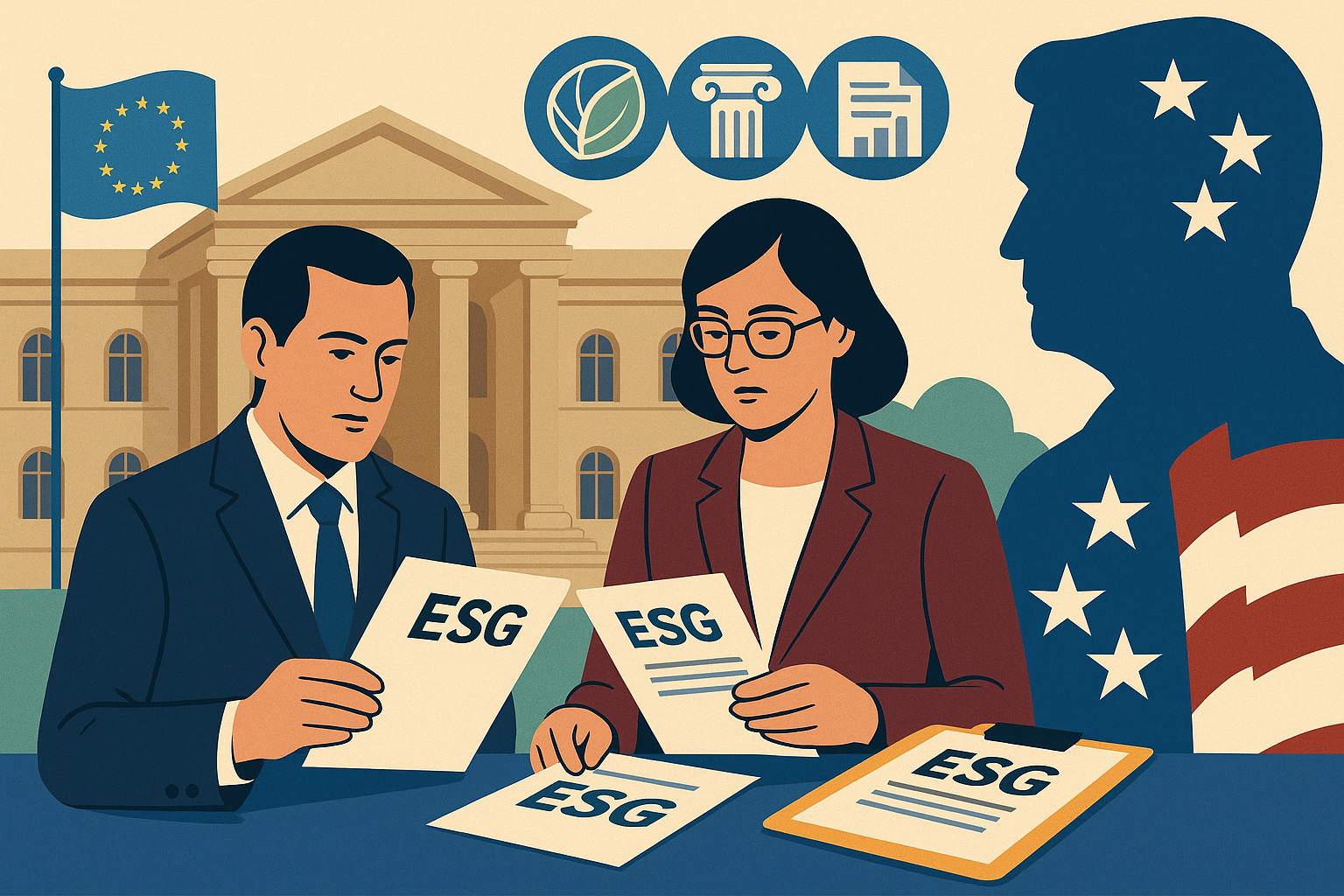
The European Union has unexpectedly retreated from some of the world’s most ambitious ESG rules, agreeing to a sweeping rollback after months of lobbying and political pressure from the United States. The move signals a turning point in the global sustainability agenda: what began as Europe’s regulatory leadership has shifted toward a more defensive posture amid concerns about competitiveness, burdens on companies, and a fractured geopolitical landscape. In November 2025, the European Parliament voted 382 to 249 to dramatically scale back the Corporate Sustainability Reporting Directive (CSRD) and Corporate Sustainability Due Diligence Directive (CSDDD), removing more than 90 percent of companies originally covered by these landmark regulations. This article examines why it happened—and what it means for the future of global ESG standards.
ESG at a Crossroads
For years, the European Union positioned itself as the global standard-bearer for environmental, social, and governance regulation. The CSRD and CSDDD, adopted in 2023 and 2024 respectively, represented the most comprehensive corporate sustainability framework ever attempted, requiring thousands of companies to disclose detailed information about their environmental impacts, human rights practices, and supply chain risks. These directives were central pillars of the EU’s Green Deal—an ambitious plan to make Europe the world’s first climate-neutral continent by 2050.
But by late 2025, that vision collided with harsh political and economic realities. Rising global backlash against ESG, particularly in the United States where Republican-led states have mounted an aggressive anti-ESG campaign, created unprecedented pressure on Brussels. The EU’s regulatory retreat is surprising not just because of its scale, but because it represents a fundamental shift in the balance of power between European policymakers and American political influence. What was once seen as Europe’s competitive advantage in setting global standards has become a liability in an era of geopolitical fragmentation and economic uncertainty.
What Exactly Did the EU Roll Back?
The scale of the November 2025 rollback is staggering. Under the revised framework approved by the European Parliament:
Corporate Sustainability Reporting Directive (CSRD): The reporting threshold has been raised to companies with more than 1,750 employees and €450 million in revenue—up from the original 250 employees. This change excludes approximately 90 percent of companies that were originally in scope. For context, a company with 1,750 employees is roughly the size of a mid-tier regional airline or hospital network, meaning most mid-sized enterprises will escape these requirements entirely.
Corporate Sustainability Due Diligence Directive (CSDDD): The due diligence obligations now apply only to massive corporations with more than 5,000 employees and €1.5 billion in annual revenue—a dramatic increase from the original 1,000 employee threshold. This effectively limits supply chain accountability to Europe’s largest multinationals.
Climate Transition Plans: Perhaps most significantly, the requirement for companies to prepare detailed climate transition plans outlining how their business models align with the Paris Agreement has been eliminated entirely.
Simplified Reporting Standards: The European Financial Reporting Advisory Group (EFRAG) has been tasked with substantially reducing the number of data points required under the European Sustainability Reporting Standards (ESRS), with the Commission abandoning plans to introduce sector-specific standards that many industries had been bracing for.
Timeline Delays: Implementation deadlines have been pushed back by two years for many categories of companies, with non-EU entities and small-to-midsize firms now not beginning CSRD reporting until between 2027 and 2029.
The European Commission initially proposed these changes in February 2025 as part of its “Omnibus I” simplification package, claiming the goal was to boost European competitiveness while maintaining sustainability ambitions. However, the Parliament’s November vote went far beyond the Commission’s original proposal—in October, lawmakers had actually rejected a more moderate compromise deal before ultimately aligning with the European People’s Party’s more aggressive rollback position.
The U.S. Pressure Campaign
The transatlantic pressure that precipitated this rollback has been building for months, representing one of the most coordinated American efforts to influence European regulation in recent memory.
State-Level Opposition: In September 2025, 22 Republican state attorneys general sent a letter to the Trump administration calling the EU’s sustainability directives “European overreach” that would undermine America’s rollback of DEI and ESG programs. Florida Attorney General James Uthmeier and West Virginia Attorney General John McCusky led the coalition, urging President Trump to direct the U.S. Trade Representative to oppose the CSRD and CSDDD.
Direct Corporate Warnings: In October 2025, 16 Republican attorneys general escalated their campaign by sending letters directly to the CEOs of Microsoft, Google, and Meta, warning them that compliance with EU sustainability laws could violate U.S. law and expose them to “lawsuits and government enforcement actions.” The letters argued that the regulations’ “ambiguous and often unascertainable reporting requirements” could trigger antitrust violations and deceptive trade practice charges in the United States.
Legislative Action: Senator Bill Hagerty (R-TN) introduced the PROTECT USA Act in February 2025, which would prohibit U.S. entities from being forced to comply with foreign sustainability due diligence requirements. The legislation, which has gained traction given Republican majorities in both houses of Congress, describes the CSDDD as “a serious and unwarranted regulatory overreach, imposing significant economic and legal burdens on U.S. companies.”
Administration Threats: Despite a framework agreement reached between the EU and the Trump administration in August 2025 pledging to ensure the regulations would not “pose undue restrictions on transatlantic trade,” U.S. officials reportedly threatened EU member states in October with trade and energy supply consequences if the CSDDD was not repealed or substantially revised.
Corporate Lobbying: American business associations, including the U.S. Chamber of Commerce, mounted an intensive lobbying campaign in Brussels, arguing that compliance costs for U.S. companies operating in Europe would be prohibitive and create impossible conflicts between European mandates and American political realities.
This multi-pronged pressure campaign framed ESG not as sound risk management or stakeholder accountability, but as foreign interference in American sovereignty—what the attorneys general called an attempt to impose “European ESG and DEI mandates” that conflict with U.S. law and the Trump administration’s priorities.
Why the EU Changed Course
While U.S. pressure provided the external catalyst, the EU’s dramatic reversal reflects deeper internal tensions that had been building within Europe itself.
Industry Rebellion: European manufacturers, banks, and retail groups had been warning for months that the original CSRD and CSDDD requirements were administratively overwhelming. Industry associations cited compliance costs ranging from €200,000 to €400,000 per year for affected companies—expenses that would hit mid-sized firms especially hard. The complexity of gathering sustainability data across global supply chains, particularly Scope 3 emissions that account for indirect value chain impacts, proved far more challenging than regulators anticipated.
Competitiveness Concerns: European companies increasingly complained that they faced a severe disadvantage compared to U.S. competitors operating under minimal sustainability disclosure requirements. With the U.S. Securities and Exchange Commission abandoning its own climate disclosure rules in February 2025, the competitive imbalance became starker. European CEOs warned that stringent ESG requirements were driving investment and operations away from Europe at a time when the continent desperately needed economic growth.
Political Fragmentation: Rising nationalist and populist sentiment in several EU member states created political headwinds for ambitious climate policies. The European People’s Party (EPP), which holds significant influence in the Parliament, threatened to align with far-right parties if centrist groups didn’t agree to substantial rollbacks. This political realignment forced compromise from center-left parties that had previously championed strong sustainability requirements.
Economic Slowdown: Europe’s sluggish economic growth and declining investment appetite made policymakers more receptive to industry arguments about regulatory burden. President Ursula von der Leyen’s “Competitiveness Compass,” released alongside the simplification proposals, explicitly prioritized reducing administrative costs to boost European productivity—a marked shift from the Green Deal’s climate-first approach.
Implementation Reality: Thousands of companies preparing for CSRD compliance discovered that the practical challenges of data collection, verification, and reporting far exceeded initial expectations. Many firms lacked the internal systems to track the granular sustainability metrics required, while third-party data providers couldn’t supply reliable information for complex supply chains, particularly in developing markets.
European businesses described the situation as facing “impossible demands from Brussels while watching U.S. competitors operate freely”—a narrative that ultimately proved politically unsustainable for EU policymakers trying to maintain industrial competitiveness.
Implications for Global Markets
The EU’s retreat from ESG leadership creates profound uncertainty for global sustainability standards and corporate strategy.
Compliance Cost Relief: For multinational corporations, particularly U.S. companies with European operations, the rollback offers significant near-term financial relief. Removing 90 percent of companies from CSRD scope eliminates hundreds of millions in collective compliance costs. However, the largest companies—those with 1,750+ employees and substantial EU presence—remain in scope and must continue preparing for reporting obligations.
Regulatory Divergence: The transatlantic divide on sustainability disclosure continues to widen. While Europe scales back, some U.S. states like California are moving forward with their own climate disclosure laws (Senate Bills 253 and 261), creating a patchwork regulatory environment. Companies now face the challenge of navigating conflicting requirements across jurisdictions—and in some cases, explicit warnings from U.S. state attorneys general not to comply with European law.
ESG Investment Impact: The rollback complicates life for ESG-focused investors who rely on standardized sustainability data to make allocation decisions. The International Sustainability Standards Board (ISSB) and other standard-setting bodies had been working toward global convergence on disclosure frameworks—an effort now undermined by Europe’s retreat. Asset managers like State Street Global Advisors have already begun bifurcating their approach, withdrawing U.S. operations from climate initiatives while maintaining European commitments.
Supply Chain Transparency: The most significant practical impact may be on supply chain due diligence. With the CSDDD now applying only to companies with 5,000+ employees, pressure on upstream suppliers to provide sustainability data will decrease substantially. This creates a potential blind spot in global supply chains precisely when geopolitical risks and climate impacts are intensifying.
Market Pricing: Financial markets appear to be pricing in reduced regulatory uncertainty as a positive for European equities, particularly in manufacturing and retail sectors that had faced the highest compliance burdens. However, some analysts warn that weakened sustainability disclosure could increase long-term risk by reducing transparency about climate and social exposures.
Winners and Losers
The rollback creates clear beneficiaries and casualties across the corporate and investment landscape.
Winners: Mid-sized European companies escape costly reporting requirements they were unprepared to meet. Large U.S. corporations with EU operations gain relief from regulations that Republican attorneys general had warned could expose them to domestic legal risks. European manufacturing, banking, and retail sectors—which had lobbied aggressively for simplification—see immediate cost savings and reduced administrative burden. Companies that had delayed ESG investments pending regulatory clarity can now scale back sustainability initiatives that no longer face mandatory disclosure.
Losers: ESG-driven investors lose access to standardized sustainability data they need for portfolio construction and risk assessment. NGOs and climate policy advocates see years of advocacy for corporate accountability effectively reversed. Small suppliers that had invested in sustainability data systems to meet anticipated supply chain due diligence requirements may find those investments suddenly less valuable. European leadership on climate policy takes a significant reputational hit, potentially undermining the EU’s influence at international climate negotiations.
The New Normal: What emerges is likely a “race to the middle” in global sustainability standards. Rather than Europe pulling global practice upward through the “Brussels Effect”—where EU regulations become de facto global standards—we’re seeing convergence toward voluntary disclosure frameworks that lack enforcement mechanisms. This benefits companies seeking flexibility but undermines efforts to embed sustainability accountability into corporate governance.
Ironically, market forces may maintain pressure for sustainability disclosure even as mandatory requirements weaken. Banks increasingly embed climate risk in credit models, insurance underwriters price environmental exposures, and supply chain partners demand transparency regardless of regulation. Companies that voluntarily maintain strong ESG practices may find themselves better positioned for long-term resilience even if reporting is no longer mandatory.
What’s Next?
The November vote represents the Parliament’s negotiating position, not final law. Trilogue negotiations between the Parliament, Council, and Commission began in mid-November with the goal of finalizing legislation by year-end 2025. The Council has taken a more moderate stance, closer to the Commission’s original proposal, suggesting difficult negotiations ahead.
Political Uncertainty: The simplified framework still faces potential obstacles. European Greens and center-left parties have warned that the rollback “drives a stake through the heart of Europe’s wider sustainability agenda” and may yet mount resistance in trilogue negotiations. However, the EPP’s alliance with center-right and some far-right parties creates a formidable political bloc supporting simplification.
Transatlantic Relations: The outcome of ongoing EU-U.S. trade discussions will likely influence final decisions. If the Trump administration maintains pressure—or threatens tariffs or other economic consequences—Brussels may feel compelled to make further concessions. The August 2025 framework agreement committed the EU to ensuring regulations don’t “pose undue restrictions on transatlantic trade,” language that could justify even deeper cuts.
Long-Term Trajectory: A critical question is whether this represents a temporary adjustment to reduce near-term compliance burdens, or a structural shift away from Europe’s climate leadership. Commission officials frame the changes as “pragmatic refinements” that maintain long-term sustainability goals while easing short-term pressure. Critics argue it represents capitulation to political and corporate interests at the expense of climate accountability.
Corporate Strategy: Companies should continue preparing for sustainability reporting despite the uncertainty. Even with reduced mandatory requirements, voluntary disclosure remains essential for accessing capital, maintaining supply chain relationships, and managing reputational risk. Firms that maintain robust ESG data systems may find themselves at a competitive advantage if regulations eventually strengthen again—or if market demands for transparency continue regardless of legal requirements.
Global Standard-Setting: The ISSB, OECD, and other international bodies will need to recalibrate their efforts toward global sustainability standards given Europe’s retreat. The vision of converging global frameworks now seems more distant, potentially replaced by a fragmented landscape where sustainability disclosure varies dramatically by jurisdiction and industry.
Conclusion
The EU’s ESG rollback represents far more than technical regulatory adjustment—it reflects profound geopolitical shifts in the balance of power between Europe and America, and between climate policy advocates and those prioritizing short-term economic competitiveness.
Europe’s uncontested role as global ESG rule-setter is clearly fading. The Brussels Effect, where EU regulations become de facto global standards due to market access requirements, has encountered its limits when confronted with determined American political opposition and legitimate concerns about compliance costs. The U.S. pressure campaign succeeded not just because of aggressive lobbying, but because it exploited genuine tensions within Europe about the pace and scope of sustainability regulation.
Yet the long-term direction of corporate sustainability remains undecided. While mandatory requirements may be weakening, market forces continue pushing companies toward greater transparency and accountability. Investors increasingly demand sustainability data for risk assessment, banks embed climate considerations in lending decisions, and consumers expect corporate responsibility on environmental and social issues. The question is whether voluntary market-driven approaches can achieve the systemic change that mandatory regulation was designed to deliver.
For multinational corporations, the new reality is complexity and fragmentation rather than clarity. They must navigate conflicting requirements across jurisdictions, manage contradictory political pressures from U.S. states and European regulators, and make strategic decisions about sustainability investment without clear regulatory guideposts. The next few years will test whether corporate sustainability can thrive in this fractured landscape—or whether the retreat from mandatory requirements marks the beginning of a broader unraveling of ESG as a framework for corporate accountability.
What’s certain is that the era of Europe dictating global sustainability standards is over. What replaces it will emerge from hard-fought negotiations between competing visions of capitalism, sovereignty, and environmental responsibility—negotiations in which American political power has proven unexpectedly decisive.