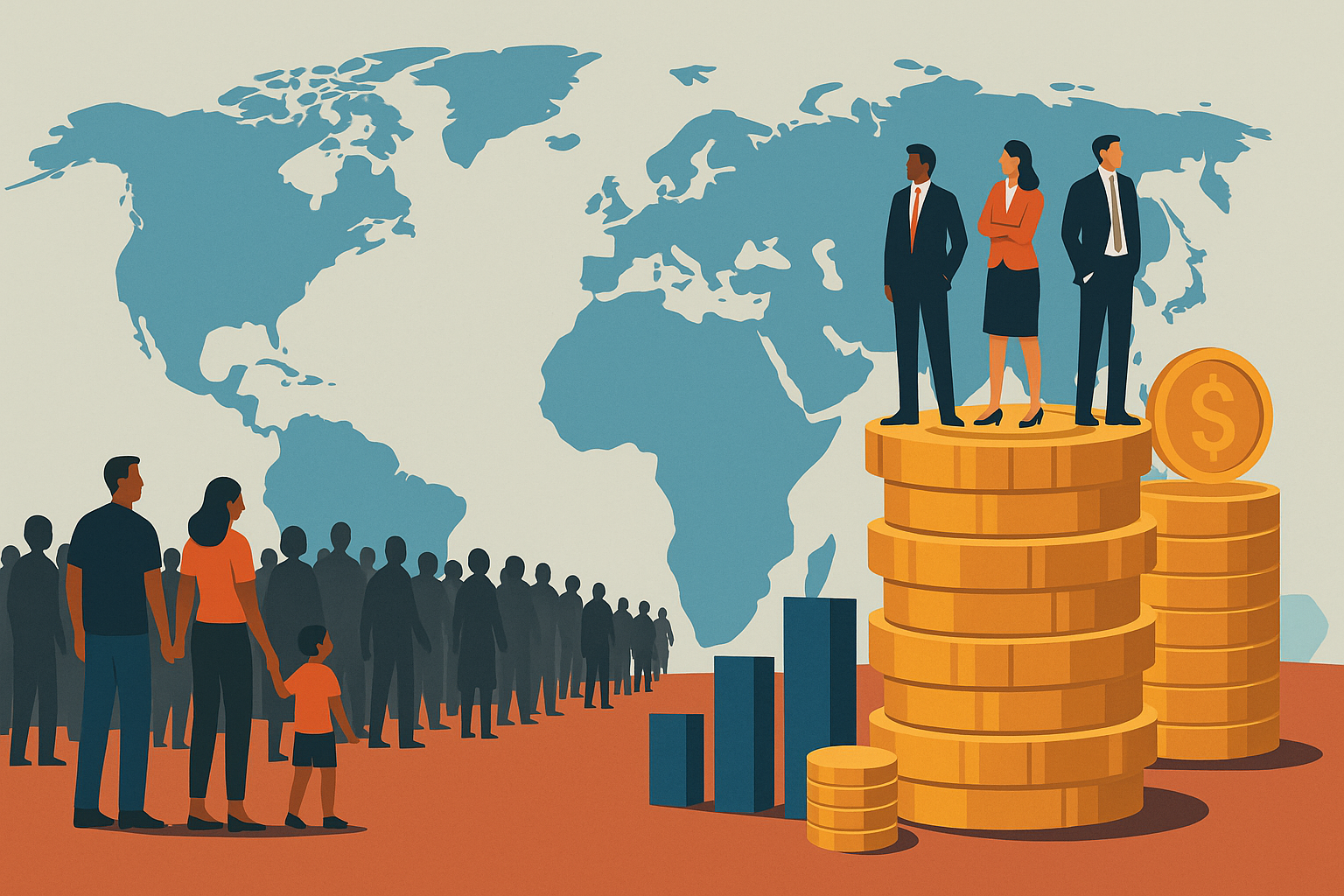
The latest global wealth study paints a stark picture: the world’s richest individuals now own three times more wealth than the poorest half of humanity combined. Beyond headline-grabbing numbers, the report highlights deep structural imbalances that are shaping political tensions, investment flows, and policy debates—from tax reform to social spending—across both advanced and emerging economies.
A New Snapshot of Global Inequality
A small segment of the global elite owns three times more wealth than the bottom half of the world’s population, according to Oxfam’s “Takers Not Makers” report released in January 2025. The findings arrive at a pivotal moment: as the world navigates high interest rates, persistent inflation, and the lingering economic effects of the pandemic, the gap between wealth accumulation at the top and economic struggles at the bottom has reached unprecedented levels.
In 2024, billionaire wealth surged at triple the rate of 2023, with billionaires increasing their wealth by $2 trillion. This acceleration matters now more than ever. Post-pandemic asset price inflation has disproportionately benefited those holding equities and real estate, while wage earners face the dual pressures of high living costs and stagnant real income growth. The concentration of wealth is no longer merely about inequality—it’s reshaping economies, markets, and political systems in real time.
The Numbers Behind the Divide
The data reveals a widening chasm. Over the past year, total billionaire wealth increased by $2 trillion and 204 new billionaires were created—almost four new billionaires per week on average. The speed of wealth accumulation is staggering: each billionaire’s wealth increased by $2 million a day on average in 2024, with the richest 10 men in the world adding $100 million every day to their existing wealth.
Over the past decade, this trend has accelerated dramatically. The poorest 50% of the population consistently lags behind the top 10% of the population in every region, with the gap most pronounced in the Middle East, Latin America, and Africa. According to the World Inequality Database, global income distribution shows that the bottom 50% captures just 8.5% of global income.
Asset price inflation has played a central role. As central banks maintained historically low interest rates through the 2010s and early 2020s, equity markets soared, real estate values climbed, and those holding these assets saw dramatic wealth gains. Meanwhile, wage growth remained tepid. Federal Reserve data indicates that as of Q1 2024, the top 1% of households in the United States held 30.5% of the country’s wealth, while the bottom 50% held 2.5%.
Regional variations underscore different inequality dynamics. The United States leads among developed nations: the United States is the most unequal country in the OECD, with 21% of national income going to the richest 1%. In Europe, inequality remains more moderate but is rising, particularly in the UK and France. Emerging markets present stark contrasts—South Africa ranks as one of the most unequal countries, with the richest 10% capturing 65% of national income, while China has experienced rapid wealth creation alongside growing internal disparities.
What’s Driving the Acceleration in Wealth Concentration?
Four structural forces are converging to accelerate wealth concentration. First, tax structures increasingly favor capital income over labor income. A 2019 study by economists Emmanuel Saez and Gabriel Zucman found that the average effective tax rate paid by the richest 400 families in the US was 23 percent, more than a percentage point lower than the 24.2 percent paid by the bottom half of American households. Corporate tax rates have fallen by roughly a third in recent decades as governments compete to attract investment, while many ultra-wealthy individuals utilize sophisticated tax planning strategies to minimize their obligations.
Second, the current high-interest-rate environment paradoxically reinforces inequality. While higher rates were designed to combat inflation, they disproportionately benefit asset owners who earn returns on bonds, money market funds, and other interest-bearing instruments. Borrowers—disproportionately younger households and small businesses—face significantly higher costs. This dynamic transfers wealth from debtors to creditors, typically flowing from the less wealthy to the more wealthy.
Third, technology and market concentration have created winner-take-all dynamics. Oxfam estimates that 18 percent of the world’s billionaire wealth comes from monopoly sources. Digital platforms, in particular, exhibit strong network effects where market leaders capture disproportionate value. Monopolistic corporations control markets, dictate terms, and set prices with impunity, further enriching their billionaire owners.
Fourth, perhaps most strikingly, the report challenges the meritocracy narrative. Sixty percent of billionaire wealth is now derived from inheritance, monopoly power or crony connections. In 2024, for the first time, there were more billionaires minted through inheritance than entrepreneurship, and every billionaire under the age of 30 inherited their wealth.
Economic Consequences: Growth, Stability, and Social Cohesion
These inequality trends carry significant economic implications. High wealth concentration affects consumption patterns and long-term growth potential. When wealth accumulates at the top, marginal propensity to consume falls—billionaires simply cannot spend money as quickly as they accumulate it. This dampens aggregate demand growth, particularly for everyday goods and services, potentially constraining GDP expansion.
The relationship between inequality and political stability has grown more salient. Across the United States, Europe, and Latin America, rising inequality correlates with increasing political polarization. Voters frustrated with stagnant living standards have supported populist movements across the political spectrum, challenging traditional party structures and policy consensus. The election outcomes in multiple democracies over the past decade reflect this dynamic, with economic anxiety translating into political volatility.
For investors, these trends shape market dynamics and cross-border capital flows. Concentrated wealth creates demand for luxury goods, high-end real estate, and alternative investments. Private equity, venture capital, and hedge funds have flourished serving ultra-high-net-worth individuals. Meanwhile, the richest 1% in the Global North extracted $30 million an hour from the Global South through the financial system in 2023, illustrating how capital flows reinforce global wealth disparities.
The social cohesion costs are equally significant. The number of people experiencing poverty remains essentially unchanged from 1990, despite decades of economic growth and technological advancement. This divergence between aggregate prosperity and lived experience for billions of people strains social contracts and fuels questions about economic system legitimacy.
Policy Landscape: What Governments Are Debating
Policymakers globally are grappling with how to address these trends. Wealth taxes have moved from academic proposals to active political debate. Several European countries maintain wealth taxes, though implementation challenges persist around valuation, enforcement, and capital flight concerns. The OECD has advanced a global minimum corporate tax rate of 15%, representing the first major international tax coordination effort in decades, though critics argue this floor remains too low to meaningfully shift corporate behavior.
Inheritance tax reform generates particular attention given that half of the world’s billionaires live in countries with no inheritance tax for direct descendants. Advocates argue that taxing inherited wealth could prevent the emergence of what Oxfam terms a “new aristocracy,” while opponents raise concerns about double taxation and impacts on family businesses.
Social spending debates center on healthcare, education access, and social protection systems. In 2023, the richest countries allocated around 13% of their national income to social protection, compared to just 1.5% among the bottom 40% poorest countries. This spending gap directly impacts quality of life and opportunity, reinforcing inequality across generations.
For emerging markets, these debates carry additional complexity. Countries reliant on foreign capital inflows must balance addressing domestic inequality with maintaining attractive investment environments. Many face constraints from existing debt burdens and limited fiscal capacity to expand social programs. The tension between attracting capital and ensuring its benefits flow broadly through society remains acute.
Outlook: Is the Wealth Gap Likely to Narrow?
Looking ahead, several factors will shape inequality trajectories. Demographic change presents potential inflection points. Oxfam predicted the emergence of the first trillionaire within a decade, but with billionaire wealth accelerating, the world is now on track to see at least five trillionaires within that timeframe. The concentration continues its upward march.
Artificial intelligence and automation technology present both risks and opportunities for wage distribution. If AI productivity gains flow primarily to capital owners, inequality could accelerate further. Alternatively, if technological change enables broader productivity improvements across the workforce and policy frameworks ensure gains are shared, outcomes could improve for lower and middle-income workers.
The political salience of inequality is rising heading into the 2025-2026 global election cycle. Multiple major democracies face elections where economic fairness, tax policy, and wealth distribution feature prominently. Voter preferences on these issues will significantly influence policy directions. However, translating political pressure into effective policy remains challenging given the complexity of modern economies, capital mobility, and entrenched interests.
Labor market dynamics also matter. In some developed economies, worker shortages have strengthened labor bargaining power, leading to real wage gains for the first time in years. Whether this represents a durable shift or a temporary phenomenon remains uncertain, particularly if economic growth slows or recession emerges.
Conclusion
The latest global wealth inequality data reveals not just a snapshot but a structural reality: wealth concentration has accelerated to levels that challenge economic efficiency, political stability, and social cohesion. The finding that the richest individuals own three times the wealth of the poorest half is not merely a statistic—it represents a fundamental reordering of economic power with profound implications.
For investors, these trends shape market opportunities from luxury goods to political risk assessment. For policymakers, they present urgent questions about tax systems, social spending, and economic governance. For general observers, they illuminate the economic forces reshaping societies and political systems worldwide.
As global economic fragmentation continues—driven by geopolitical tensions, supply chain restructuring, and diverging policy approaches—inequality dynamics will remain central to understanding both economic outcomes and political trajectories. The question is not whether wealth concentration matters, but rather how societies choose to respond to it. The structural nature of the problem suggests that without significant policy interventions, current trends will persist, with all the economic and political consequences that entails.