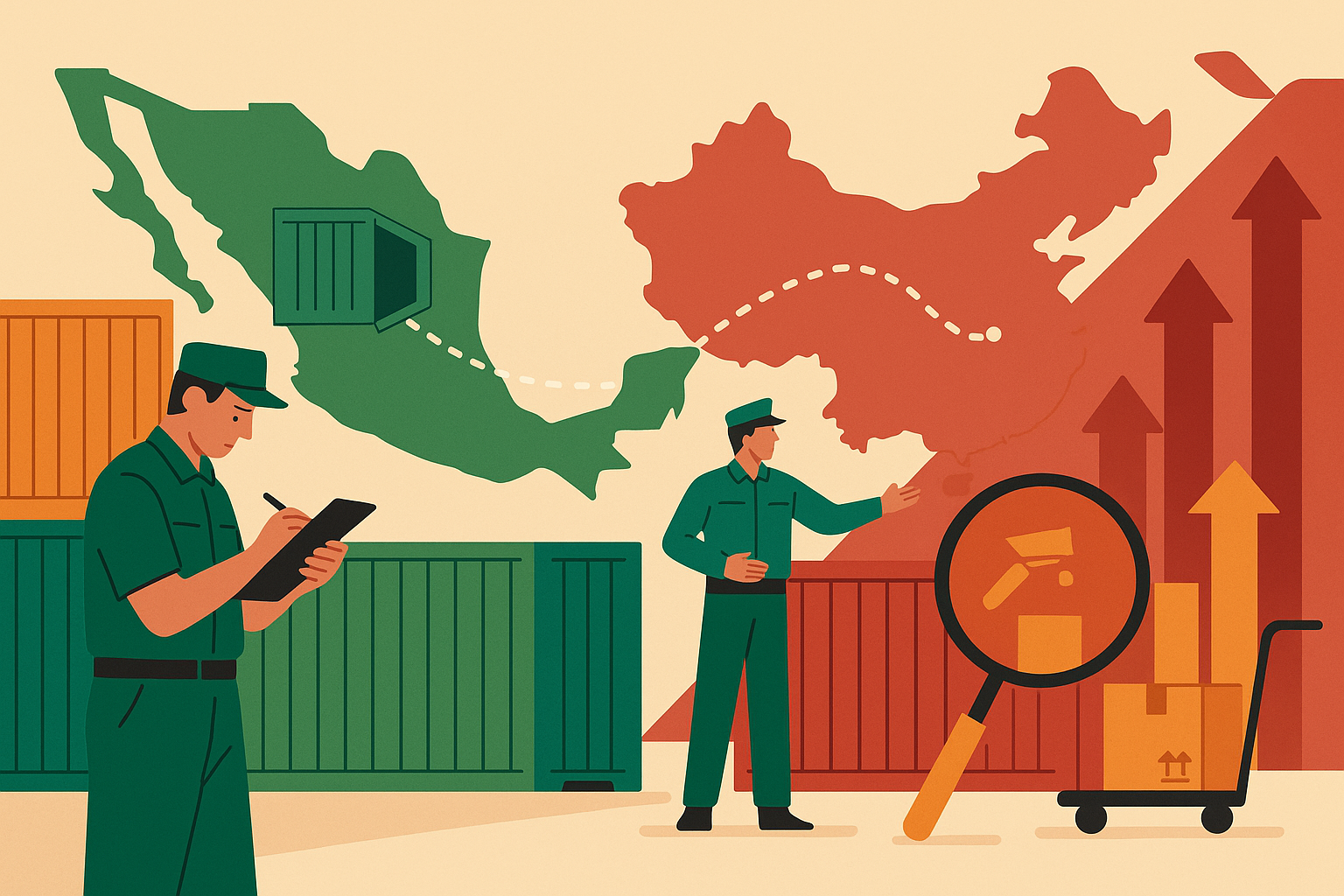
Mexico’s Senate has approved a series of tariff hikes targeting Chinese and other Asian imports, marking one of the country’s most assertive protectionist shifts in years. The move seeks to shield domestic industries from low-cost competition, but it also carries significant implications for U.S.–Mexico trade, nearshoring strategies, and broader geopolitical tensions involving China.
Introduction: Mexico’s Protectionist Turn
For decades, Mexico has positioned itself as a champion of open trade, leveraging its proximity to the United States and membership in the USMCA (United States-Mexico-Canada Agreement) to attract foreign investment and build export-oriented manufacturing capacity. However, the recent Senate approval of tariff increases on imports from China and several other Asian nations signals a notable departure from this stance.
The decision comes amid mounting pressure from domestic manufacturers who argue that cheap Asian imports—particularly from China—have undercut local production and threatened jobs in key sectors such as steel, textiles, and machinery. While Mexico’s government frames the measures as necessary to protect national industry and ensure fair competition, the move has triggered immediate reactions from Beijing and raised questions about the future of North American supply chain integration.
What the Tariff Hike Includes
According to official statements, the new tariff regime targets a range of products across multiple sectors. Steel and aluminum products face some of the steepest increases, with duties reportedly rising by 15 to 25 percentage points in certain categories. Textiles, electronics components, and industrial machinery are also subject to higher levies, though specific rates vary by product classification.
The Mexican Ministry of Economy has justified these measures by citing concerns over dumping practices and the need to level the playing field for domestic producers. Officials argue that many Asian exporters benefit from government subsidies and operate under lower environmental and labor standards, creating an uneven competitive landscape.
Prior to these changes, Mexico’s tariff structure was relatively liberal, with most-favored-nation rates averaging around 4 to 7 percent for manufactured goods. The new increases represent a significant escalation and position Mexico closer to the protectionist policies adopted by the United States in recent years.
China’s Reaction and Growing Trade Frictions
Unsurprisingly, China has responded sharply to Mexico’s tariff hikes. The Chinese Ministry of Commerce criticized the measures as “protectionist practices” that violate WTO principles and harm bilateral economic cooperation. Chinese officials have hinted at potential countermeasures, though specific retaliatory actions have not yet been announced.
This friction occurs against a backdrop of China’s expanding economic footprint in Latin America. Over the past decade, Chinese investment in Mexico has grown substantially, particularly in automotive assembly, electronics manufacturing, and renewable energy sectors. Some Chinese companies have established operations in Mexico explicitly to gain preferential access to the U.S. market under USMCA rules—a strategy now complicated by the new tariffs.
The dispute could escalate through multiple channels. China may pursue a WTO complaint alleging discriminatory treatment, though such proceedings typically take years to resolve. Alternatively, Beijing could leverage its position as a major buyer of Mexican agricultural products—including avocados, tequila, and copper—to pressure Mexico City into negotiations.
Impact on North American Supply Chains
The tariff increases carry profound implications for supply chain strategies across North America. Over the past five years, “nearshoring”—the relocation of production from Asia to Mexico—has become a central pillar of U.S. corporate planning. Companies ranging from automotive giants to electronics manufacturers have invested billions in Mexican facilities to reduce dependence on distant Asian suppliers and capitalize on lower transportation costs and USMCA benefits.
However, many of these nearshoring operations still rely heavily on imported components from China and other Asian countries. A Mexican automotive assembly plant, for instance, might source semiconductors from Taiwan, precision machinery from Japan, and steel inputs from China. Higher tariffs on these imports translate directly into increased production costs, potentially eroding the competitiveness gains that drove nearshoring in the first place.
Moreover, the tariffs interact in complex ways with USMCA rules of origin requirements, which mandate minimum levels of North American content for goods to qualify for preferential treatment. If Mexican manufacturers respond to higher Asian import costs by sourcing more inputs from within North America, this could strengthen regional supply chains—but only if sufficient domestic capacity exists. In sectors where North American suppliers cannot meet demand for specialized components, manufacturers may face difficult choices between absorbing higher costs or restructuring their operations entirely.
Domestic Political and Economic Motivations
The timing and scope of the tariff hikes reflect multiple domestic considerations within Mexico. Industrial lobbies—particularly in steel, textiles, and chemicals—have long complained about unfair competition from Asian imports. These sectors employ significant numbers of workers in politically important regions, giving them outsized influence in policy debates.
With national elections approaching, the government faces pressure to demonstrate responsiveness to concerns about job security and industrial competitiveness. Tariff protection offers a visible, immediate policy response that can be framed as defending Mexican workers and businesses.
However, the measures also carry risks. Higher import costs may fuel consumer price inflation, particularly for goods where domestic alternatives are limited or more expensive. Mexico’s central bank has worked to bring inflation under control following pandemic-era disruptions; new tariff-driven price pressures could complicate monetary policy and affect household purchasing power.
Global Implications: Fragmentation of Trade
Mexico’s tariff hikes fit within a broader pattern of trade fragmentation and economic nationalism that has accelerated since the U.S.-China trade war began in 2018. As Washington has intensified scrutiny of Chinese supply chains—particularly in strategic sectors like semiconductors, electric vehicles, and critical minerals—allied nations face growing pressure to align their trade policies accordingly.
For Mexico, this creates a delicate balancing act. The country’s economic future is inextricably linked to the United States, which purchases roughly 80 percent of Mexican exports. Yet China remains Mexico’s second-largest trading partner and an important source of investment capital. By raising tariffs on Chinese goods, Mexico signals alignment with U.S. concerns about overcapacity and unfair trade practices—but risks antagonizing Beijing and potentially losing access to Chinese technology and capital.
Other emerging markets watching this dynamic may draw lessons about navigating the U.S.-China rivalry. Countries from Southeast Asia to Eastern Europe face similar pressures to choose sides in what increasingly resembles a bifurcating global trading system. Mexico’s experience could provide a template—or a cautionary tale—for how middle powers manage these competing demands.
Outlook: What to Watch in 2025–26
Several key indicators will determine whether Mexico’s tariff strategy succeeds or backfires in the coming years.
First, additional tariff rounds: If domestic industries argue the initial measures are insufficient, pressure may build for further increases or expansion to additional product categories. Such escalation could deepen trade tensions and accelerate supply chain reorganization.
Second, Chinese circumvention strategies: Beijing may respond by increasing direct investment in Mexican manufacturing, effectively bypassing tariffs by producing within Mexico rather than exporting finished goods. This “tariff-jumping” strategy has historical precedent—Japanese automakers famously adopted it to navigate U.S. import restrictions in the 1980s—and could reshape Mexico’s industrial landscape.
Third, sectoral impact assessments: Close attention should be paid to sectors most dependent on Asian inputs, including semiconductors, electric vehicles, and steel-intensive construction. Trade volume data, foreign direct investment flows, and new industrial permit issuances will provide early signals of how supply chains are adjusting.
Finally, broader geopolitical positioning: Mexico’s ability to maintain productive relationships with both Washington and Beijing will be tested. The country’s success in balancing these ties may influence how other nations approach their own strategic choices in an increasingly polarized global economy.
For investors and policymakers, Mexico’s tariff experiment offers a real-time case study in the costs and benefits of economic nationalism. As nearshoring continues to reshape global manufacturing geography, the outcome of Mexico’s gamble will reverberate far beyond its borders.