A Rare Bright Spot in Asia
While much of Asia grapples with slowing growth and mounting trade uncertainties, Vietnam has emerged as a standout performer. Fresh data released in early January 2026 reveals the Vietnamese economy expanded by a remarkable 8.46% in the fourth quarter of 2025, significantly exceeding market expectations of 7.7% and marking the highest quarterly growth rate since the third quarter of 2022. This performance not only defied forecasts but also underscored Vietnam’s resilience in an increasingly fragmented global economy.
The full-year picture is equally impressive. Vietnam achieved 8.0% GDP growth in 2025, building on the robust 7.09% expansion recorded in 2024. This trajectory stands in stark contrast to regional peers facing headwinds from weakening global demand and geopolitical tensions. While the International Monetary Fund and World Bank have moderated their growth forecasts for the region, Vietnam continues to outpace expectations, cementing its status as a critical node in the reconfiguration of global supply chains.
Key Economic Data Behind the Beat
The strength of Vietnam’s economy is broad-based, with all major sectors contributing to growth. Industrial production and construction surged 9.46% year-over-year in the third quarter of 2025, while the services sector expanded 8.56%. Even agriculture, often vulnerable to external shocks, grew by 3.74%. This diversified growth pattern suggests resilience beyond the export-led manufacturing narrative that has traditionally defined Vietnam’s economic model.
Trade flows tell a particularly compelling story. Despite the United States imposing a 20% tariff on Vietnamese goods in early August 2025, exports to America jumped 28% for the full year, rising from $119.6 billion in 2024 to $153.2 billion in 2025. Total exports climbed 17% to reach $475 billion, while imports increased 19% to $455 billion, resulting in a healthy trade surplus of approximately $20 billion.
Manufacturing output has been a cornerstone of this performance. The industrial production index surged 8.8% year-over-year in December 2024, with forecasts pointing to continued expansion. The motor vehicle manufacturing segment alone grew by 27.4% year-to-date in 2025, reflecting both foreign investment and the ambitions of domestic champions like VinFast in international markets.
Tariffs, Trade Tensions, and the Vietnam Advantage
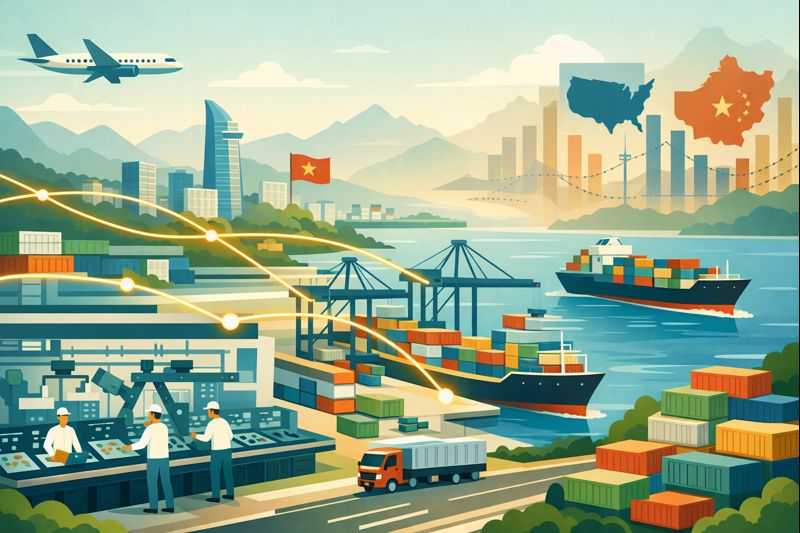
Vietnam’s ability to thrive amid rising tariff pressures is no accident. The country has become a primary beneficiary of the “China+1” diversification strategy as multinational corporations seek to reduce their dependence on Chinese manufacturing. Trade tensions between Washington and Beijing, combined with concerns about supply chain concentration, have accelerated this shift.
The data reveals the magnitude of this reorientation. While China’s foreign direct investment inflows plummeted from $253 billion in 2020 to just $113.4 billion by 2024—a 27% year-over-year decline—Vietnam attracted $38.23 billion in registered FDI in 2024, with actual disbursements reaching a record $25.35 billion, up 9.4% from the previous year. Critically, the foreign-invested sector now accounts for 71.7% of Vietnam’s total exports, generating the entire trade surplus and highlighting the depth of multinational integration.
Even more telling, Chinese firms themselves are relocating production to Vietnam. China ranked third among Vietnam’s top investors in 2024 with $4.73 billion in committed capital and led in newly licensed projects, representing 28.3% of all new FDI initiatives. This pattern underscores Vietnam’s strategic position not just as an alternative to China, but as an extension of East Asian manufacturing ecosystems.
Foreign Direct Investment and Multinational Shifts
Vietnam’s FDI landscape reflects both the scale and sophistication of its manufacturing base. As of December 2024, the country hosted over 42,000 active FDI projects with total registered capital exceeding $502 billion, of which 64.1% had been realized. Singapore topped the investor rankings with nearly $10.21 billion (26% of total FDI), followed by South Korea at $7 billion (18%), China at $4.73 billion (12.4%), Hong Kong at $4.3 billion (11.4%), and Japan at $3.5 billion (9.2%).
The sectoral composition reveals a focus on value-added industries. Processing and manufacturing dominated with $25.28 billion (66% of total FDI), while real estate attracted $6.31 billion (16.5%). Electronics have been particularly prominent, with Vietnam becoming a critical hub for global tech giants. The country’s integration into semiconductor and consumer electronics supply chains has deepened considerably, with major players from Samsung to Apple expanding their Vietnamese footprints.
Geographically, FDI has spread beyond traditional hubs like Ho Chi Minh City and Hanoi. Northern provinces such as Bắc Ninh, Hải Phòng, Hải Dương, and Bắc Giang each attracted significant investment, reflecting infrastructure improvements and deliberate government policies to develop manufacturing clusters across the country. This distribution helps mitigate concentration risks and builds redundancy into global supply chains.
Risks Beneath the Optimism
Despite these impressive achievements, Vietnam faces structural challenges that could constrain future growth. Infrastructure bottlenecks remain a persistent concern. Port congestion, power shortages, and transportation network limitations can inflate costs and delay production timelines. While the government has prioritized infrastructure development—with projects like the upgrade of the Kunming-Haiphong railway and expansion of deep-water ports—keeping pace with surging manufacturing demand requires sustained capital investment.
Labor market dynamics present another challenge. Vietnam’s workforce of 53 million provides a substantial pool of relatively low-cost labor, with average monthly salaries around $302 in 2024. However, wage pressures are building as demand intensifies, and skills gaps in advanced manufacturing, artificial intelligence, and robotics could limit the country’s ability to move up the value chain. With a population exceeding 100 million, educational and vocational training systems must evolve rapidly to meet the demands of high-tech industries.
External demand dependency remains Vietnam’s most significant vulnerability. With goods and services exports accounting for approximately 83% of GDP—the second-highest ratio in ASEAN after Singapore—the economy is highly exposed to global economic cycles. Goods shipments to the United States alone represent roughly 30% of total merchandise exports, making Vietnam particularly sensitive to American trade policies and consumer spending patterns. Any significant downturn in major trading partners could quickly transmit to Vietnamese growth.
The timing of tariff impacts adds further uncertainty. Many analysts expect that export orders frontloaded ahead of anticipated U.S. tariff increases sustained growth through 2025. As this temporary boost fades and higher import prices affect American consumer demand, Vietnamese exporters could face headwinds in 2026. The World Bank has already trimmed its 2025 growth forecast to 6.6%, noting that trade policy uncertainty may weigh on business and consumer confidence.
Market and Regional Implications
Vietnam’s outperformance carries significant implications for regional dynamics and investor positioning. Within ASEAN, Vietnam has solidified its status as a manufacturing powerhouse, with exports growing from $320 billion in 2019 to $475 billion in 2025—a compound annual growth rate exceeding 8%. This expansion has come partially at the expense of other regional competitors, though Indonesia has also captured substantial investment in metals and chemicals processing.
For equity markets, Vietnam’s growth story has attracted increasing attention from global investors seeking exposure to Asian manufacturing and consumption themes. The country’s combination of political stability, favorable demographics, and improving institutional frameworks presents a compelling long-term narrative. However, near-term volatility related to U.S. trade policy and global demand conditions may create entry opportunities for patient capital.
Currency implications are equally important. The Vietnamese dong has remained relatively stable despite significant capital inflows, reflecting careful management by the State Bank of Vietnam. Exchange rate stability has been crucial for maintaining export competitiveness and managing inflation, which reached 3.63% in 2024—within the National Assembly’s target range. However, persistent dollar strength and potential Fed policy shifts could create pressure points requiring delicate policy balancing.
Vietnam’s Place in the New Global Trade Map
Vietnam’s recent performance raises a fundamental question: is this growth sustainable, or merely a cyclical peak driven by temporary supply chain disruptions? The evidence suggests structural factors are at play. The Regional Comprehensive Economic Partnership (RCEP) provides tariff-free access to markets representing 30% of the global population. Free trade agreements with the European Union and United Kingdom offer similar advantages. These institutional foundations create durable competitive advantages independent of short-term trade tensions.
The Vietnamese government’s ambitious targets—including achieving middle-income status by 2030 and high-income status by 2045—reflect confidence in the country’s trajectory. Policy initiatives like Resolution 57-NQ/TW on science, technology, and digital transformation, and Resolution 59-NQ/TW on international integration provide roadmaps for continued development. Recent amendments to investment-related laws aim to remove bureaucratic obstacles and enhance the business environment.
Nevertheless, the path forward is not without risks. Trade policy unpredictability—particularly regarding potential reciprocal tariffs from a Trump administration—creates planning challenges for multinational corporations. A United Nations report warned that aggressive U.S. tariffs could slash up to 20% of Vietnam’s U.S.-bound exports, potentially making it the hardest-hit Southeast Asian economy. Such scenarios would test Vietnam’s diversification strategies and domestic demand development.
For global macro investors, business strategists, and policy watchers, Vietnam represents a critical case study in how smaller economies can navigate great power competition. The country’s success in attracting investment while maintaining political stability and policy continuity offers lessons for other emerging markets. Its deepening integration into East Asian supply chains—particularly with China—demonstrates that the “China+1” narrative is more nuanced than simple substitution.
As global supply chains continue fragmenting along geopolitical lines, Vietnam’s strategic importance will likely grow. The country sits at the intersection of American, Chinese, European, and Japanese economic interests, positioning it to benefit from multiple investment flows simultaneously. Whether this balancing act remains sustainable depends on Vietnam’s ability to navigate great power tensions, develop human capital, and maintain the institutional improvements that have underpinned its recent success.
For now, Vietnam stands as one of the rare bright spots in an uncertain global economy—a testament to strategic positioning, consistent policy execution, and the enduring power of economic fundamentals in an increasingly complex world.