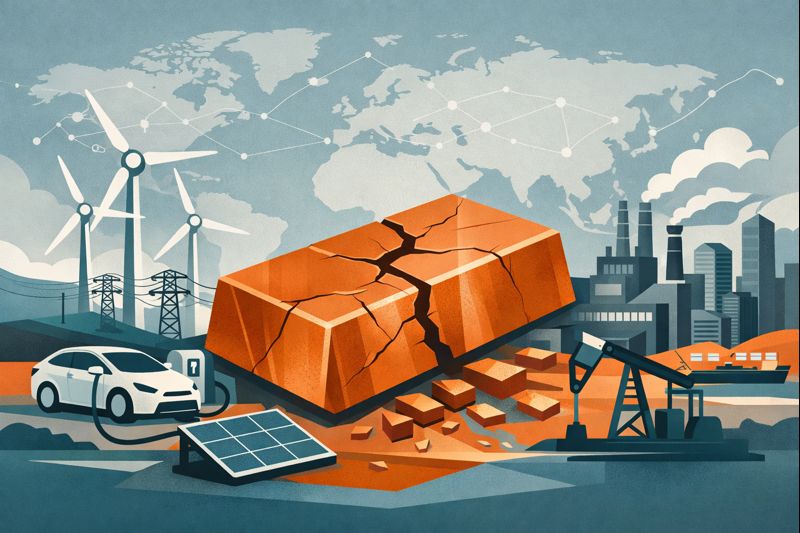
Copper is often called “Dr. Copper” for its ability to diagnose the health of the global economy. Today, it may be signaling something more serious: a structural shortage that threatens to slow energy transition, fuel inflation, and expose vulnerabilities across global supply chains.
According to a comprehensive new study released today by S&P Global, the emerging copper supply deficit constitutes a systemic risk for global industries, technological advancement, and economic growth. The warning comes as copper prices hover near record highs and the race for artificial intelligence, renewable energy deployment, and military modernization creates unprecedented demand pressures.
Why Copper Matters More Than Ever
Copper’s unique properties—exceptional electrical and thermal conductivity, durability, and corrosion resistance—make it irreplaceable in modern infrastructure. As Carlos Pascual, Senior Vice President of Geopolitics and International Affairs at S&P Global Energy, explains: “Copper is the connective artery linking physical machinery, digital intelligence, mobility, infrastructure, communication and security systems; the future availability of copper has become a matter of strategic importance.”
The metal is embedded throughout the economy in ways most people never see. Power grids rely on copper for transmission and distribution networks. Electric vehicles require two to three times more copper than conventional cars—an EV can contain up to 80 kilograms of the metal. Solar panels, wind turbines, and battery storage systems are all copper-intensive. Even the data centers powering artificial intelligence infrastructure demand massive amounts of copper for their electrical systems and cooling infrastructure.
The acceleration of electrification is driving demand to unprecedented levels. S&P Global projects that copper demand will swell to 42 million metric tons by 2040—a 50% increase from current levels. Core economic demand from construction, appliances, transportation, and power generation will reach 23 million metric tons, while energy transition applications including EVs, renewable power, and grid expansion will add another 15.7 million metric tons.
But here’s where the picture becomes troubling: new demand vectors are emerging that weren’t even on forecasters’ radar just a few years ago. The explosive growth of artificial intelligence and data centers is expected to add significant copper consumption, with data center capacity projected to increase nearly fourfold by 2040. Rising defense spending amid geopolitical tensions adds another layer of demand. Combined, AI infrastructure, data centers, and defense spending could add approximately 4 million tons of consumption by 2040.
The Supply Problem
The demand surge would be manageable if supply could keep pace. It cannot.
S&P Global’s analysis reveals a stark reality: global copper production is projected to peak in 2030 at just 33 million metric tons, then decline as existing mines deplete and ore grades deteriorate. This creates a staggering supply deficit—potentially reaching 10 million metric tons by 2040, equivalent to nearly one-quarter of projected demand going unmet.
The mining industry faces a perfect storm of challenges. Decades of underinvestment have left the sector ill-prepared for the coming demand surge. Following the commodity downturn of the 2010s, mining companies prioritized shareholder returns over capital-intensive exploration and development. The result: a weak pipeline of new projects precisely when the world needs them most.
Even when companies commit to new mines, the timeline is punishing. From discovery to first production typically spans 15 to 20 years due to geological complexity, regulatory approvals, environmental reviews, infrastructure requirements, and community engagement processes. Projects approved today won’t produce meaningful copper until the late 2030s—far too late to prevent near-term shortages.
The situation is compounded by declining ore quality. According to BHP, the world’s largest mining company, average copper mine grades have decreased by approximately 40% since 1991. Miners must now extract and process significantly more rock to produce the same amount of metal, driving up costs, energy consumption, and environmental impact.
Geopolitical and environmental constraints add further complications. Copper production is highly concentrated geographically, with Chile and Peru accounting for roughly 40% of global mined supply. Political instability, water scarcity, community opposition, and stricter environmental regulations in key producing regions create persistent supply uncertainty. Recent force majeure declarations at major mines due to accidents, natural disasters, and operational challenges have removed hundreds of thousands of tons from the market, demonstrating the sector’s vulnerability to disruption.
Industry experts estimate that meeting projected demand will require approximately $800 billion in mining investment through 2040 in climate-driven scenarios—a massive capital commitment with no guarantee of adequate returns given price volatility and project risks.
S&P’s ‘Systemic Risk’ Warning
S&P Global’s characterization of copper shortages as a systemic risk marks a significant escalation in tone from previous commodity assessments. Unlike cyclical price spikes driven by temporary demand surges or brief supply disruptions, this represents a structural imbalance between accelerating demand growth and constrained supply expansion.
The distinction matters enormously. Cyclical commodity squeezes typically resolve themselves: high prices incentivize increased production while dampening demand, restoring balance. But when supply expansion is constrained by geological, technical, regulatory, and timeline factors that cannot be quickly overcome, high prices alone cannot solve the problem.
This creates multiple channels through which copper scarcity could transmit systemic risk across the global economy. First, sustained high copper prices would ripple through supply chains, increasing costs for everything from home construction to consumer electronics to renewable energy installations. Second, physical shortages could create bottlenecks that delay or derail critical infrastructure projects, from grid modernization to EV charging networks. Third, geopolitical competition for limited supplies could intensify, potentially leading to trade restrictions, strategic stockpiling, or resource nationalism that further fragments markets.
The timing amplifies the risk. The world is attempting an unprecedented energy transition while simultaneously expanding digital infrastructure and confronting geopolitical tensions. All three imperatives are intensely copper-hungry, yet they’re converging at precisely the moment when copper supply faces its greatest constraints.
Daniel Yergin, Vice Chairman of S&P Global and co-chair of the study, noted the uncertainty inherent in such forecasts: “We would be reluctant to say that this proves now that prices are on a stable higher plane.” Yet market indicators suggest sustained tightness ahead, with refined copper deficits projected at 330,000 metric tons in 2026 according to J.P. Morgan, and BloombergNEF warning that structural deficits could emerge as early as this year.
Economic and Market Implications
The economic implications of sustained copper shortages extend far beyond commodity markets. Inflation is the most immediate concern. Copper’s ubiquity means that rising prices flow through countless products and services. Construction costs increase, raising housing prices. Manufacturing becomes more expensive, lifting consumer goods prices. Clean energy infrastructure projects face budget overruns, potentially slowing deployment.
Central banks confronting inflation would face a difficult dilemma. Traditional monetary policy tools—raising interest rates to cool demand—work poorly against supply-side constraints. Tighter monetary policy cannot conjure new copper mines into existence, yet policymakers may feel compelled to respond to second-round inflation effects.
The impact on climate goals could prove most consequential. The International Energy Agency estimates that mineral demand from clean energy technologies must at least triple by 2030 to meet global climate targets. Copper is particularly critical: the IEA projects that existing mines and projects under construction can meet only 80% of copper needs by 2030 in a net-zero scenario. A significant supply gap could physically constrain the pace of renewable energy deployment, EV adoption, and grid modernization—forcing a choice between climate ambitions and copper availability.
Growth effects would be uneven. Emerging economies pursuing industrialization and infrastructure development could find their progress hampered by both high copper prices and potential allocation issues if shortages intensify. Developed economies focused on energy transition and digital transformation would face similar constraints but with greater financial resources to secure supply.
Financial markets are already pricing in structural tightness. Copper prices surged to record highs above $13,000 per metric ton in 2025, up more than 39% for the year. Major investment banks project prices averaging $12,000-13,000 per ton through 2026, with some analysts seeing potential spikes to $15,000. Mining stocks have rallied sharply, and institutional investors increasingly view copper as a “must-own” commodity exposure for portfolios positioned for energy transition and digitalization.
Who Wins, Who Loses
The copper crunch will create stark winners and losers across the global economy.
Mining nations stand to benefit significantly. Chile, Peru, the Democratic Republic of Congo, Australia, and other major producers could see substantial economic gains from higher prices and increased foreign investment. However, countries like Chile have struggled to capitalize on past copper booms due to infrastructure constraints, labor disputes, and political instability—challenges that may persist.
Major mining companies including BHP, Rio Tinto, Freeport-McMoRan, Anglo American, Glencore, and Southern Copper are positioned to generate windfall profits. Their existing production becomes more valuable, and they control most economically viable expansion projects. The industry’s consolidation wave continues, with major mergers like the proposed Anglo American-Teck Resources combination creating larger entities with combined annual production exceeding 1.3 million tons.
Conversely, manufacturing-heavy economies dependent on copper imports face headwinds. China, which consumes approximately 50% of global refined copper despite producing only 10% of mined supply, confronts both price pressure and potential supply security concerns. The European Union’s designation of copper as a strategic raw material reflects similar anxieties. The United States designated copper a critical mineral in 2025, acknowledging its importance to national security and economic competitiveness.
Clean energy and EV supply chains face particular vulnerability. Automakers transitioning to electric vehicles must secure copper supply while managing other critical mineral constraints for batteries. Renewable energy developers could see project economics deteriorate if copper costs surge. The paradox is acute: the technologies meant to solve the climate crisis depend on materials that may be in critically short supply.
Technology companies operating massive data centers and AI infrastructure also face exposure. Tech giants including Google, Microsoft, Amazon, and Meta are already major electricity consumers; their copper needs for expansion could clash with grid modernization requirements. Some have begun directly supporting mining projects—Google was among the sponsors of the S&P Global study—signaling recognition of supply risks.
Policy and Investment Responses
Governments and industry are beginning to respond to copper supply risks, though the scale and speed of action remain insufficient to prevent near-term tightness.
Strategic stockpiling has emerged as a policy tool. The United States has accumulated significant copper inventories in warehouses, partly in anticipation of potential Section 232 tariffs. Other nations may follow suit, though stockpiling by importers could paradoxically tighten markets further in the short term while providing buffer supply during disruptions.
Industrial policy initiatives are proliferating. The U.S. Inflation Reduction Act includes provisions supporting domestic mining and processing. The European Union’s Critical Raw Materials Act aims to reduce import dependence and boost domestic capacity. China continues expanding its upstream mining investments in Africa and Latin America while developing domestic processing capabilities.
Mining project approvals and permitting reforms are receiving political attention. The U.S. approved Hudbay Minerals’ Copper World project in Arizona after receiving key permits, though permitting timelines remain measured in years or decades for most projects. Some jurisdictions are experimenting with streamlined processes, though environmental and community concerns legitimately require thorough review.
Recycling infrastructure is expanding but slowly. Copper is 100% recyclable without quality loss, and recycling saves up to 85% of the energy required for primary production. The IEA estimates that recycling could reduce primary supply requirements by 10-30% by 2040. Secondary copper’s share of supply could rise from 17% today to 40% by 2050. However, significant end-of-life scrap availability won’t materialize until after 2030, when infrastructure built during recent decades reaches retirement age. Expanding collection, sorting, and processing capacity requires substantial investment, particularly for lower-grade scrap that’s technically challenging to process.
Technological innovation offers multiple pathways to address constraints. Material substitution research is intensifying—aluminum can replace copper in some electrical applications, though with performance trade-offs. Fiber optics have displaced copper in telecommunications. Improved manufacturing efficiency can reduce copper intensity per unit of output. Advanced extraction technologies like AI-optimized process control, coarse particle recovery, and sulfide leaching may boost yields from existing mines.
Investment capital is flowing toward copper assets. Private equity firms, sovereign wealth funds, and institutional investors are increasing allocations to mining projects and companies. The challenge remains that most capital goes toward acquiring existing assets rather than developing new supply, reflecting the long timelines and risks associated with greenfield projects.
Conclusion: Copper as a Litmus Test
The impending copper shortage serves as a litmus test for the feasibility of global energy transition ambitions. If the world cannot secure sufficient copper supply to build out renewable energy, electric transportation, and smart grid infrastructure, climate goals will remain aspirational rather than achievable.
The challenge transcends copper alone. Similar dynamics are playing out across multiple critical minerals—lithium, nickel, cobalt, rare earth elements—each with its own supply-demand imbalances. Copper’s ubiquity and economic significance make it the most visible flashpoint, but it’s symptomatic of a broader materials challenge inherent in shifting from fuel-intensive to material-intensive energy systems.
The S&P Global study’s framing of copper scarcity as a systemic risk should be understood as a call for coordinated action across governments, industry, investors, and civil society. Market mechanisms alone—higher prices incentivizing supply—will be insufficient given the technical, regulatory, and timeline constraints facing mining. Policy interventions, technological innovation, demand management, recycling infrastructure, and potentially difficult trade-offs between competing uses will all be necessary.
For investors, the copper shortage represents both opportunity and risk. Mining companies and producing nations stand to benefit from sustained high prices. Manufacturers and economies dependent on copper-intensive technologies face headwinds. Portfolio positioning increasingly requires explicit views on commodity exposure rather than treating materials as mere inputs.
For policymakers, the imperative is clear: energy transition goals must be reconciled with materials availability. This may require industrial policies supporting domestic mining, international cooperation on supply chain security, investment in recycling infrastructure, technology programs focused on material efficiency and substitution, and honest assessment of deployment timelines given physical constraints.
The copper crunch is not a crisis to be managed but a structural feature of the energy transition that requires fundamental rethinking of how the global economy secures access to the materials that underpin modern technological civilization. Dr. Copper’s diagnosis is unambiguous: the patient faces serious complications, and the prognosis depends on treatments that have yet to be fully prescribed, much less administered.