Introduction
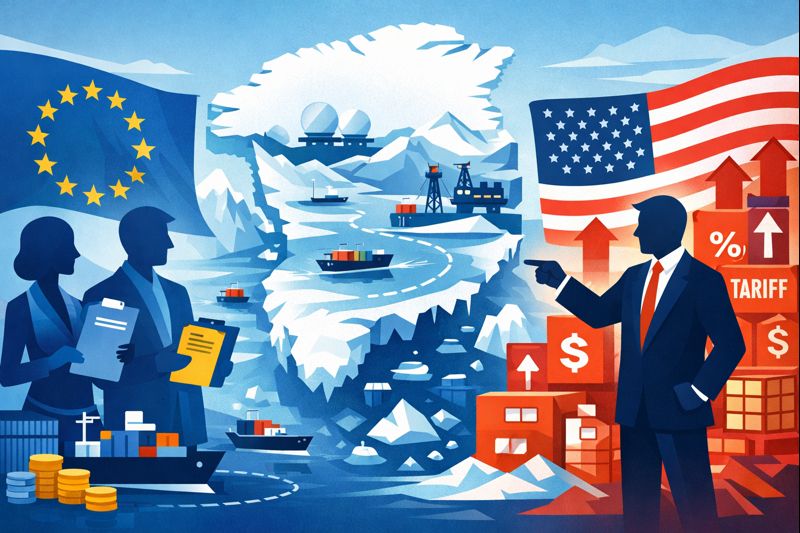
The European Union is preparing retaliatory tariffs worth up to €93 billion ($108 billion) after US President Donald Trump linked geopolitical pressure over Greenland with trade policy. This dispute blends geopolitics, trade policy, and alliance politics, shaking the foundations of the transatlantic partnership built after World War II.
On January 18, President Trump announced he would impose 10% tariffs on eight countries—Denmark, Norway, Sweden, France, Germany, the United Kingdom, the Netherlands, and Finland—starting February 1. These tariffs would increase to 25% on June 1 unless an agreement is reached on the “Complete and Total purchase of Greenland.” This unprecedented move has rapidly escalated tensions among NATO allies and triggered an emergency meeting of EU member state representatives.
What Triggered the Dispute
Trump’s Statements and Their Context
Trump’s latest tariff threat was expressed in response to European countries planning NATO-related military exercises in Greenland. In a social media post, Trump described these exercises as “a very dangerous situation for the Safety, Security, and Survival of our Planet,” asserting that “it is imperative that, in order to protect Global Peace and Security, strong measures be taken so that this potentially perilous situation end quickly, and without question.”
Trump has repeatedly claimed that Greenland is “covered with Russian and Chinese ships” and insists it must come under US control for national security reasons. However, Denmark’s Foreign Ministry responded in a statement: “We agree with the US that we need to do more since the Arctic is no longer a low tension area. That’s exactly why we and NATO partners are stepping up in full transparency with our American allies.”
Why Greenland Matters Strategically
As the world’s largest island, Greenland holds importance across multiple strategic dimensions. Since World War II, it has been a cornerstone of North American defense for the United States. Today, Pituffik Space Base (formerly Thule Air Base) in northwestern Greenland serves as a critical hub for missile early warning, missile defense, and space surveillance operations.
Geographically, Greenland forms the western edge of the GIUK Gap (Greenland-Iceland-United Kingdom), a vital maritime chokepoint for monitoring Russian naval movements in the North Atlantic. Furthermore, as climate change melts Arctic sea ice, two potential shipping routes through the Arctic Ocean—the Northwest Passage and the Transpolar Sea Route—are opening, with Greenland positioned at these strategic junctures.
Economically, Greenland possesses abundant natural resources. Rare earth elements, oil, natural gas, copper, nickel, cobalt, uranium, and graphite lie beneath the ice sheet—materials essential for advanced technologies and military applications. With China currently dominating the rare earth supply chain, the United States views Greenland as an opportunity to strengthen economic security.
EU’s Planned Response
The €93 Billion Tariff Package
Representatives from the EU’s 27 member states held an emergency meeting on January 19 to discuss responses to Trump’s tariff threat. According to reports from the Financial Times and Bloomberg, the EU is preparing retaliatory tariffs on up to €93 billion ($108 billion) worth of US goods.
Crucially, this tariff package is not newly created but was approved last year and had its implementation suspended. In July 2025, the EU and US reached a trade agreement under which the EU removed nearly all tariffs on US products, accepted 15% tariffs on EU exports to the US, and absorbed 50% tariffs on steel and aluminum. Following this agreement, the EU suspended implementation of retaliatory tariffs for six months.
However, Trump’s latest threat has jeopardized the trade agreement’s ratification process itself. Manfred Weber, leader of the European People’s Party (EPP), the largest political group in the European Parliament, stated that “given Donald Trump’s threats regarding Greenland, approval is not possible at this stage,” adding that “the 0% tariffs on US products must be put on hold.”
Legal and Political Mechanisms Inside the European Union
The EU is considering multiple countermeasures. The most immediately executable option is to activate the already-approved €93 billion in retaliatory tariffs on February 6, which would automatically take effect at the end of the suspension period.
Additionally, French President Emmanuel Macron is calling for activation of the EU’s Anti-Coercion Instrument (colloquially known as the “trade bazooka”). Established in 2023, this measure has never been used but was designed to deter or respond to attempts to pressure EU policy through trade restrictions. In practice, it could go beyond tariffs to include market access restrictions, public procurement exclusions, investment limitations, and other targeted measures.
Comparison with Past EU-US Trade Clashes
The EU and US have a long history of trade disputes. In 2002, when the George W. Bush administration imposed 30% tariffs on steel, the EU prepared retaliatory measures and the US ultimately withdrew the tariffs. The Boeing-Airbus subsidy dispute saw both sides impose retaliatory tariffs until a truce was reached in 2021.
However, the current situation fundamentally differs from past trade disputes. Trump is not linking trade policy to purely economic issues but to the geopolitical matter of an ally’s territorial sovereignty. This directly challenges respect for national sovereignty, a basic principle of the post-war international order, which is why EU officials describe it as “a new line has been crossed.”
Why Greenland Is Central
Sovereignty of Greenland and Denmark
Greenland is a self-governing territory within the Kingdom of Denmark, with approximately 56,000 residents (about 90% of Inuit descent). It gained self-rule in 1979, and the 2009 Self-Government Act granted broader authority over domestic matters including education, healthcare, and natural resource development. While the Danish government retains final say over foreign, defense, and security policy, Greenland’s autonomy is growing.
In 2024, Greenland’s government released its Foreign, Defense, and Security Strategy titled “Greenland in the World—Nothing About Us Without Us,” seeking to elevate its independent voice on the international stage. In Greenland’s capital Nuuk, thousands demonstrated against Trump’s ambitions on January 17, chanting “Greenland belongs to the Greenlandic people.”
Danish Prime Minister Mette Frederiksen declared that “Europe will not be blackmailed,” emphasizing that “only Denmark and Greenland decide on issues concerning Denmark and Greenland.”
Arctic Geopolitics and the China-Russia Factor
The Arctic region has become a new frontier of strategic competition among the United States, Russia, and China. Russia is strengthening its military capabilities in the Arctic, and President Vladimir Putin stated in 2024 that Moscow is concerned about NATO’s activities in the Arctic and will enhance its military strength in the region.
In 2018, China declared itself a “near-Arctic state” and released an Arctic strategy that includes building a “Polar Silk Road.” Over the past decade, China has attempted investments in Greenland’s airports, an abandoned naval station, and a satellite ground station, but these ambitions have been largely thwarted by US and Danish geopolitical concerns. However, China’s dominant position in rare earth separation and processing provides it an advantage in accessing Greenland’s rare earth resources through offtake agreements.
While Trump claims that “Greenland is covered with Russian and Chinese ships,” Greenland’s commander stated he has not seen Chinese or Russian combat vessels or warships during his two-and-a-half years in command. Nevertheless, long-term strategic competition in the Arctic is real, and US policymakers’ concerns are understandable to some extent.
Market and Economic Implications
Trade Volumes and Sector-Specific Risks
In 2024, the United States conducted massive trade with European countries. According to US Census Bureau data, the US traded $236 billion with Germany, $147.7 billion with the United Kingdom, $122.27 billion with the Netherlands, $103 billion with France, and tens of billions of dollars each with Sweden, Norway, and Finland.
Tariff impacts could affect a wide range of industries. European automakers, pharmaceutical companies, machinery manufacturers, and luxury brands would be directly affected. On the US side, companies dependent on European imports and exporters to European markets would face retaliatory measures.
Carsten Brzeski, chief economist at ING Bank, expects increased tariffs to shave a quarter percentage point off European GDP this year. “Europe is still dependent on the US in many ways, both from an economic and security point of view,” he notes.
Exchange Rates and Investor Sentiment
The tariff threat has unsettled global markets. The euro and pound have fallen against the dollar, with renewed volatility expected. Business uncertainty has led many US companies to pause hiring in 2025, seeking clarity amid Trump’s unprecedented string of on-again, off-again tariff actions.
Professor Steven Durlauf of the University of Chicago’s Harris School of Public Policy stated, “These actions really do represent an end of the credibility of American commitments. That’s going to have adverse effects on the world economy.” He warns that “uncertainty is the enemy of growth” and that Trump’s unprecedented decisions “make things somewhat irreversible”—allies may lose faith even after a new administration takes office.
Impact on Defense and Energy Sectors
The tariff dispute could also affect NATO defense cooperation. While European countries have increased defense spending in recent years, rising tensions with the US could complicate transatlantic defense industry cooperation. Joint programs like the F-35 fighter jet and missile defense systems could be particularly affected.
In the energy sector, US liquefied natural gas (LNG) plays a crucial role in European energy security. After the Ukraine war, Europe became heavily dependent on US LNG to reduce reliance on Russian gas. If the trade dispute threatens this relationship, it could affect Europe’s entire energy security strategy.
Broader Implications for Transatlantic Relations
NATO Cohesion and Security Cooperation
Trump’s tariff threat over Greenland brings unprecedented tension to the NATO alliance that has existed since 1949. UK Prime Minister Keir Starmer stated that “applying tariffs on allies for pursuing the collective security of NATO allies is completely wrong.”
NATO Secretary General Mark Rutte held a phone conversation with Trump and said, “We will continue working on this, and I look forward to seeing him in Davos later this week,” though he has faced criticism for his recent tendency to sidestep questions about the Greenland issue.
EU foreign policy chief Kaja Kallas warned, “China and Russia must be having a field day. They are the ones who benefit from divisions among Allies.” Indeed, rifts between the US and Europe could weaken Western unity in responding to the Ukraine war and addressing broader geopolitical challenges.
Trade Weaponization and the Return of “Tariff Diplomacy”
Trump’s approach symbolizes a new era of weaponizing trade policy for geopolitical purposes. The Republican president has repeatedly used trade penalties to extract investment commitments or force political concessions from allies and adversaries alike.
Professor Joseph Foudy of NYU Stern School of Business points out that “uncertainty is the problem.” The uncertainty about whether Trump will escalate tariff threats or back out before imposing new duties could steer trading partners away from America long-term.
Erica York, vice president of federal tax policy at the Tax Foundation, notes that the Anti-Coercion Instrument is “a trade defense that was made with countries like China in mind, not allies like the US.” This fact underscores the abnormality of the situation.
What This Signals Ahead of Potential US Political Shifts
This week, when Trump is scheduled to attend the World Economic Forum, will be a crucial diplomatic test. Private talks with European leaders, including European Commission President Ursula von der Leyen, are scheduled for Wednesday and Thursday, and he is expected to join a meeting of Western countries supporting Ukraine.
These talks could represent the last diplomatic opportunity to prevent escalation. However, European officials believe they need to show markets not just words, but the will and capability to defend EU member states’ sovereignty and territorial integrity.
Meanwhile, within the US, a bipartisan group of lawmakers has criticized Trump’s approach. On January 17, a bipartisan delegation of senators and House members visited Greenland and said they had “constructive” conversations with members of Denmark’s parliament. Senators Jeanne Shaheen (D-NH) and Thom Tillis (R-NC) warned in a joint statement: “There is no need, or desire, for a costly acquisition or hostile military takeover of Greenland when our Danish and Greenlandic allies are eager to work with us on Arctic security, critical minerals and other priorities under the framework of long-standing treaties.”
What Comes Next
Diplomatic Off-Ramps vs Escalation Scenarios
Currently, multiple scenarios are possible. The best-case scenario is that diplomatic solutions are found at the Davos talks and Trump withdraws the tariff threat. US Treasury Secretary Scott Bessent dismissed European countries’ threats to nix the trade agreement negotiated last year on NBC’s “Meet the Press,” describing Trump’s approach as strategic leverage and arguing that Europe ultimately depends on US security guarantees.
However, this framing directly collides with the EU’s current political need: to show solidarity with Denmark and the targeted member states, and to convince markets that it has both the willingness and tools to respond.
An intermediate scenario is mutual application of limited tariffs. The US implements the planned 10% tariffs on February 1, the EU responds with €93 billion in retaliatory tariffs, but both sides leave room for gradual de-escalation.
The worst-case scenario is escalation into a full-scale trade war. The US raises tariffs to 25% as promised on June 1, the EU activates the Anti-Coercion Instrument and restricts US companies’ access to the EU market. This could deliver a severe blow to the global economy and destroy the foundations of the transatlantic alliance.
Key Indicators Markets and Policymakers Will Watch
In the coming weeks, market participants and policymakers will watch several key indicators:
January 22-23: Trump’s meetings with European leaders in Davos. The atmosphere and outcomes of these talks will determine the short-term trajectory.
January 23: EU leaders’ emergency summit in Brussels. Whether the EU can present a unified response will be crucial.
February 1: Trump’s tariff implementation deadline. Whether this deadline is met, postponed, or withdrawn will be a critical turning point.
February 6: Automatic trigger date for the EU’s €93 billion retaliatory tariffs. If no diplomatic solution is found by this date, a tariff war becomes reality.
June 1: Scheduled date for US tariffs to increase to 25%. The months leading to this deadline will be the last opportunity for diplomatic resolution.
Additionally, the US Supreme Court’s ruling on whether Trump can use the International Emergency Economic Powers Act (IEEPA) to impose tariffs is important. The Supreme Court appeared skeptical of the Trump administration’s use of this law, as it makes no mention of tariffs. If the ruling goes against Trump, his ability to impose tariffs could be limited, though he could use other laws.
Conclusion
The dispute over Greenland has evolved beyond a simple trade issue into a geopolitical confrontation involving fundamental principles of the post-war international order. The EU’s preparation of €93 billion in retaliatory tariffs demonstrates Europe’s willingness to defend its sovereignty and principles without yielding to US pressure.
The coming weeks will be decisive for the future of transatlantic relations. If a diplomatic solution is found, the alliance may survive, albeit damaged. However, if escalation into a tariff war occurs, the economic and political costs will be immeasurable and will benefit strategic competitors like China and Russia.
Investors, policymakers, and businesses need to carefully monitor this situation and prepare for multiple scenarios. With uncertainty becoming the dominant theme going forward, risk management and flexibility will be key. Why a seemingly distant Arctic island called Greenland has become a central point of contention in the global economy and geopolitics speaks to the enduring importance of geography, resources, and alliances in 21st-century great power competition.