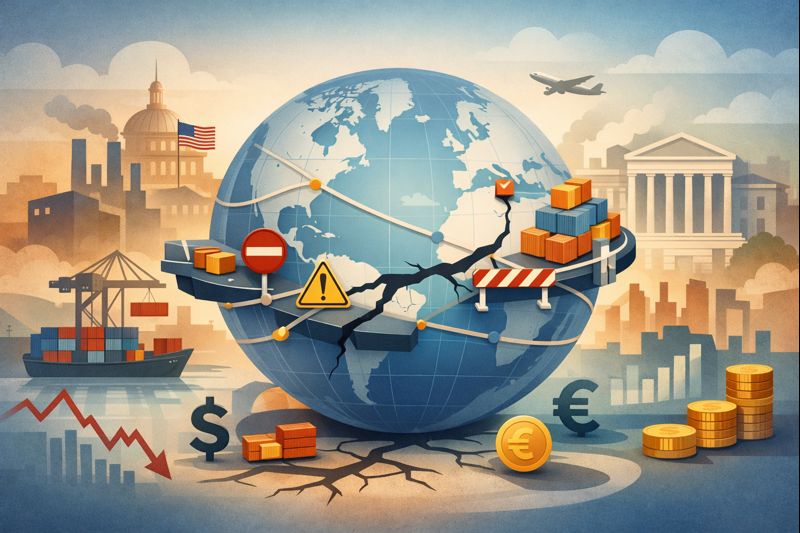
Despite easing inflation and modest growth recovery in parts of the world, the global economy faces a familiar but intensifying threat: trade tensions. According to the chief economist of the International Monetary Fund, rising protectionism and trade barriers are once again becoming a major downside risk to global growth—and this time, the disruption comes at a moment when the international economic system itself appears to be entering uncharted territory.
IMF’s Warning: Trade as a Downside Risk
When the IMF released its World Economic Outlook Update on January 19, 2026, the headline numbers looked reassuringly steady. Global growth is projected at 3.3% for 2026 and 3.2% for 2027, with modest upward revisions driven by artificial intelligence investment and fiscal stimulus in key economies. Yet beneath this surface resilience lies mounting concern.
“Despite some easing, trade tensions remain subject to occasional flare-ups, and policy uncertainty is still significantly higher than it was in January 2025,” the IMF cautioned. Chief Economist Pierre-Olivier Gourinchas was more explicit in his warning: escalating trade tensions coupled with elevated policy uncertainty represent intensifying downside risks that could derail the global recovery.
What makes this moment particularly precarious is timing. Unlike the pre-pandemic era, today’s economy is navigating multiple simultaneous challenges: persistent inflation pressures in some regions, weakening fiscal positions across advanced economies, and mounting geopolitical tensions from Ukraine to the Middle East. Trade disruptions that might have been manageable in isolation now threaten to compound existing vulnerabilities.
The IMF’s own scenario analysis underscores the fragility. If tariffs rise 30 percentage points above current levels for Chinese imports and 10 percentage points for goods from Japan, the eurozone, and emerging Asian economies, global growth in 2026 could be reduced by 0.3 percentage points—a significant hit when baseline projections already fall short of historical norms.
Gourinchas emphasized that if countries enter a phase of escalation and tit-for-tat policies, “that would certainly have even more of an adverse effect on the economy, both through direct channels, but also through confidence, investment, and potentially through a repricing by markets.”
The Return of Protectionism
The engine driving renewed trade tensions is unmistakable: aggressive U.S. tariff policy under President Donald Trump, whose administration has systematically raised duties on imports to levels not seen in generations. As Trump arrived in Davos, Switzerland, this week for the World Economic Forum, the backdrop was a global economic landscape transformed by his “America First” trade doctrine.
Current U.S. tariffs average around 18.5% across all trading partners—dramatically higher than the single-digit rates that characterized the post-World War II free trade era. For Chinese goods, effective tariff rates have climbed to approximately 55%, with Trump threatening additional 100% tariffs on Chinese imports in response to Beijing’s export controls on rare earth elements.
The parallels to the 2018-2019 U.S.-China trade war are obvious, but the differences matter more. That earlier episode unfolded during a period of relatively strong global growth, stable inflation, and low interest rates—conditions that provided cushion for economic disruption. Today’s environment offers no such luxury.
Moreover, Trump’s 2026 tariff threats extend far beyond China. His recent announcement linking tariffs on European nations to Denmark’s refusal to sell Greenland represents a qualitative shift—using trade policy as leverage for territorial ambitions. European Commission President Ursula von der Leyen has labeled such tactics “blackmail,” while NATO allies worry about the implications for transatlantic security cooperation.
Treasury Secretary Scott Bessent and other senior U.S. officials are scheduled to meet with global CEOs at Davos, seeking to provide clarity on U.S. trade policy. Yet the very need for such reassurance highlights how deeply policy uncertainty has penetrated business confidence. Companies planning capital expenditures, supply chain investments, and hiring decisions now face an unpredictable trade environment where longstanding commercial relationships can be upended by presidential pronouncements.
China’s Vice Premier He Lifeng is simultaneously hosting his own reception with global executives at Davos—a clear signal that Beijing sees opportunity in Washington’s aggressive stance to strengthen its own commercial ties and present itself as a more predictable partner.
Economic Channels of Impact
Trade tensions affect the global economy through multiple, reinforcing channels—far beyond the simple arithmetic of tariff revenues.
Inflationary pressure is the most direct mechanism. New research from the Kiel Institute for the World Economy, analyzing 25 million transactions worth $4 trillion, found that U.S. importers and consumers bear approximately 96% of tariff costs, with only 4% absorbed by foreign exporters through reduced prices. The $200 billion surge in U.S. customs revenue since 2025 represents $200 billion extracted from American businesses and households.
Goldman Sachs economists project that tariffs have already pushed core personal consumption expenditure (PCE) inflation higher by 0.44 percentage points in 2025, with an additional 0.6 percentage points expected as the full pass-through materializes. By December 2026, they forecast core PCE inflation at 2.4%—0.4 percentage points above where it would otherwise be.
Investment hesitation and supply chain distortion represent the second major channel. When businesses cannot reliably predict trade policy even six months ahead, capital expenditure decisions naturally become more conservative. Companies delay investments, diversify supply chains at considerable cost, or simply hold cash while waiting for clarity that never arrives.
The IMF notes that businesses have adapted to higher tariff rates by rerouting supply chains, accelerating imports ahead of anticipated duties, and shifting export destinations. While such agility demonstrates private sector resilience, it also reflects enormous resources devoted to navigating policy uncertainty rather than productive innovation.
Productivity and long-term growth risks constitute the third, often overlooked dimension. International trade isn’t merely about exchanging goods—it facilitates knowledge transfer, competitive pressure that drives efficiency improvements, and economies of scale. When trade barriers fragment global markets, these benefits erode.
The Kiel Institute study documented sharp declines in both trade volume and product variety following tariff increases. When tariffs on Brazilian imports suddenly jumped to 50% and Indian tariffs rose from 25% to 50% in August 2025, export volumes to the U.S. dropped by up to 24%—but unit prices remained unchanged, confirming that foreign suppliers maintained prices while losing market share.
This pattern suggests that tariffs are functioning as a consumption tax that reduces choices and raises costs without generating offsetting benefits. Over time, reduced trade integration threatens to lower potential growth rates across the global economy.
Who Pays the Price?
The Trump administration has consistently claimed that foreign countries pay U.S. tariffs, framing the policy as extracting concessions from trading partners while generating revenue at no cost to American households. The empirical evidence tells a starkly different story.
Julian Hinz of Bielefeld University, lead author of the Kiel Institute study, is unequivocal: “There is no such thing as foreigners transferring wealth to the U.S. in the form of tariffs. The data show the opposite: Americans are footing the bill.”
By examining shipment-level data and comparing export prices across different destination markets, researchers identified a clear pattern. When U.S. tariffs increased on Indian goods, Indian exporters charged the same unit prices to U.S. buyers as to European or Canadian purchasers. The tariffs were simply added on top, passed through almost entirely to American importers and consumers.
U.S. importers face a choice: absorb the tariff costs through reduced margins, or raise prices for domestic customers. Goldman Sachs analysis suggests that initially, businesses bore the larger share—but as tariffs persist, price increases become inevitable. The firm projects that by the end of 2025, U.S. consumers will absorb 55% of tariff costs, rising to 70% over time.
For American households, this manifests as higher prices for imported goods and for domestically produced items that compete with imports. The Kiel study estimates tariffs function like a broad consumption tax, disproportionately affecting lower-income families who spend larger portions of their budgets on goods versus services.
For American businesses, tariffs create a double burden: higher input costs that squeeze margins, and reduced competitiveness in global markets as retaliatory tariffs make their exports more expensive abroad. Manufacturing sectors particularly dependent on imported components—including technology hardware, automobiles, and machinery—face especially acute pressure.
Global Spillovers
While the direct economic costs fall primarily on U.S. households and businesses, the indirect spillovers affect the entire global economy.
Emerging markets and export-dependent economies are particularly vulnerable. Countries like Vietnam, Thailand, Malaysia, and Mexico that have built economic development strategies around integration into global value chains now face sudden uncertainty. Export revenues decline, fiscal positions weaken, and development trajectories slow.
The IMF downgraded Brazil’s 2026 growth forecast by 0.3 percentage points to 1.6%, partly reflecting tighter monetary policy necessitated by inflation pressures—themselves partly trade-related. Thailand’s 2026 growth projection of 1.6% marks the lowest among ASEAN economies, reflecting exposure to both U.S. and Chinese demand shocks.
For these economies, the challenge extends beyond immediate trade volume. Capital flows become more volatile as investors reassess risk premiums. Currencies face pressure. And the fiscal space to respond with countercyclical policy narrows just when it’s most needed.
Risks to multilateral trade frameworks represent a more fundamental threat. The post-World War II international economic order rested on a foundation of rules-based trade, multilateral institutions, and broadly shared commitment to progressive liberalization. That consensus has been eroding for years—but aggressive unilateralism by the world’s largest economy accelerates the breakdown.
When tariffs become instruments of geopolitical leverage rather than economic policy, the legitimacy of institutions like the World Trade Organization further diminishes. Countries increasingly pursue bilateral deals, preferential arrangements, and regional blocs—fragmenting the global trading system.
Gourinchas warned that China risks running into even more protectionist policies unless it develops a more balanced growth model relying less on exports and more on internal demand. The implication is stark: the fundamental economic tensions driving trade conflict—China’s export-dependent growth model and America’s massive trade deficits—remain unresolved and may be worsening.
At Davos, European Commission President von der Leyen and other leaders are grappling with how to respond. Retaliation risks escalation. Accommodation might encourage further aggression. The lack of viable middle-ground options highlights how constrained policymakers have become.
What Comes Next
Looking ahead to 2026 and beyond, several scenarios could unfold—none particularly encouraging.
Scenario 1: Continued Escalation would see Trump following through on threatened 100% tariffs against China, additional duties on European imports, and further use of trade policy as geopolitical leverage. Retaliatory measures from affected countries would follow. The IMF’s downside scenario of 0.3 percentage point growth reduction would likely prove optimistic as confidence collapses and financial markets reprice risk assets. Global recession becomes a meaningful possibility.
Scenario 2: Tentative Stabilization reflects the current baseline, where tariffs remain elevated but don’t increase dramatically, and business adaptation continues. Growth remains sluggish but positive. Inflation stays moderately above target in the U.S. while cooling elsewhere. This is essentially the status quo—manageable in the short term but corrosive to long-term dynamism.
Scenario 3: Negotiated De-escalation would involve comprehensive trade agreements that lower tariff rates in exchange for structural reforms. China might boost domestic consumption and reduce export subsidies. The U.S. might accept multilateral frameworks with enforcement mechanisms. Europe could increase defense spending and reduce trade surpluses. This scenario seems politically improbable given current dynamics but remains theoretically possible.
The IMF’s role in this environment is necessarily limited. The Fund can provide analysis, offer policy recommendations, and facilitate dialogue—but it cannot compel sovereign nations to abandon protectionist policies. Gourinchas emphasized that countries should work constructively to promote a stable and predictable trade environment, but acknowledged that the incentives driving current policy often run counter to collective welfare.
A pending U.S. Supreme Court decision on the legality of Trump’s use of emergency sanctions law to impose tariffs adds another layer of uncertainty. If the Court rules against the administration, Trump has signaled willingness to resurrect tariffs under other legal authorities—potentially injecting fresh policy turbulence.
What seems increasingly clear is that the era of trade liberalization has ended. The question now is whether the world enters a period of managed protectionism with some rules and predictability, or descends into a more chaotic environment where trade becomes weaponized in pursuit of broader geopolitical objectives.
Conclusion
The global economy has proven more resilient than many predicted in the face of unprecedented tariff increases. Businesses have adapted, supply chains have adjusted, and growth has remained positive, if unspectacular. The IMF’s chief economist notes that “the global economy is shaking off the trade and tariff disruptions of 2025 and is coming out ahead of what we were expecting before it all started.”
But resilience should not be confused with health. The $200 billion transferred from American businesses and households to the U.S. Treasury represents real economic costs—reduced purchasing power, squeezed margins, and foregone opportunities. The resources devoted to supply chain reconfiguration and policy navigation represent waste that could have funded productive investment.
More fundamentally, the return of trade tensions signals a troubling shift in how economic power is exercised. When tariffs become tools of geopolitical coercion rather than instruments of economic policy, the foundations of international cooperation erode. Trust diminishes. Planning horizons shorten. And the prospects for shared prosperity recede.
For global macro investors, the implications are sobering. Trade policy uncertainty now ranks among the primary drivers of market volatility and economic performance. Asset allocation models must incorporate geopolitical scenarios that would have seemed implausible just a few years ago. Geographic diversification offers less protection when policy shocks are global in nature.
For business leaders, the challenge is navigating an environment where commercial calculations increasingly subordinate to political imperatives. Long-term planning becomes harder. Risk premiums rise. And the returns to lobbying and political engagement potentially exceed returns to innovation and efficiency.
For policymakers, the task is finding ways to arrest the slide toward economic nationalism while addressing the legitimate grievances—inequality, industrial decline, and perceived unfairness—that fuel protectionist sentiment. The alternative is watching the post-war economic order continue its dissolution, with uncertain but likely negative consequences for global welfare.
The IMF’s warning about trade tensions as a major downside risk deserves serious attention. History suggests that when countries abandon cooperative frameworks in favor of zero-sum competition, everyone ultimately loses. Whether today’s leaders can avoid that trap remains the defining economic policy question of our time.