Donald Trump’s decision to nominate former Federal Reserve governor Kevin Warsh as the next chair of the Federal Reserve has reignited debate over the future direction of US monetary policy. Markets are now weighing whether Warsh’s crisis-era experience signals discipline—or a faster pivot toward rate cuts under political pressure.
Why the Fed Chair Matters More Than Ever
The Federal Reserve stands at a critical juncture. After three consecutive rate cuts in late 2025 that brought the federal funds rate down to 3.5-3.75%, the central bank held steady at its January 28, 2026 meeting—but not without internal dissent. Two FOMC members voted for another cut, revealing deep divisions over monetary policy direction.
The stakes have rarely been higher. Inflation remains stubbornly above the Fed’s 2% target, with December 2025 consumer prices rising 2.7% year-over-year. Yet hiring has slowed dramatically, with consensus estimates pointing to average monthly job growth of just 67,000 in 2026. The Fed faces the delicate task of managing a “no-fire, no-hire” economy while navigating unprecedented political pressure from the White House.
Globally, central banks from Tokyo to Frankfurt are watching closely. The Fed’s decisions ripple through currency markets, capital flows, and bond yields worldwide. When the world’s most influential central bank changes leadership, markets everywhere take notice.
Who Is Kevin Warsh?
At 55, Warsh brings an unusual pedigree to the role. Unlike recent Fed chairs, he holds a law degree rather than a Ph.D. in economics. But his credentials run deep: Fed Governor from 2006 to 2011, Morgan Stanley veteran, and economic adviser to President George W. Bush. Most significantly, he served as the Fed’s primary liaison to Wall Street during the 2008 financial crisis, working alongside then-Chair Ben Bernanke to navigate the deepest economic turmoil since the Great Depression.
During that period, Warsh earned a reputation as an inflation hawk—one of the Fed’s most vocal internal critics of aggressive monetary easing. He consistently warned about the dangers of the Fed’s expanding balance sheet, which ballooned from roughly $2.5 trillion when he joined to over $9 trillion at its peak. His 2011 resignation, years before his term was set to expire, came as he grew increasingly skeptical of the Fed’s quantitative easing programs.
“The Fed has been the primary buyer of US Treasuries and other government-backed bonds since 2008,” Warsh noted in a speech last April, reflecting his longstanding concern about central bank overreach. He has repeatedly argued that the Fed’s “bloated balance sheet” distorts asset prices and keeps credit “too easy” for Wall Street while remaining “too tight” for Main Street.
Yet Warsh’s views have evolved—or perhaps become more nuanced. By mid-2025, he was publicly criticizing Powell for moving “too late” on rate cuts, arguing that “interest rates should be lower.” This shift has fueled intense debate about whether Warsh has genuinely changed his philosophy or simply aligned himself with Trump’s political preferences.
Trump, the Fed, and Independence Concerns
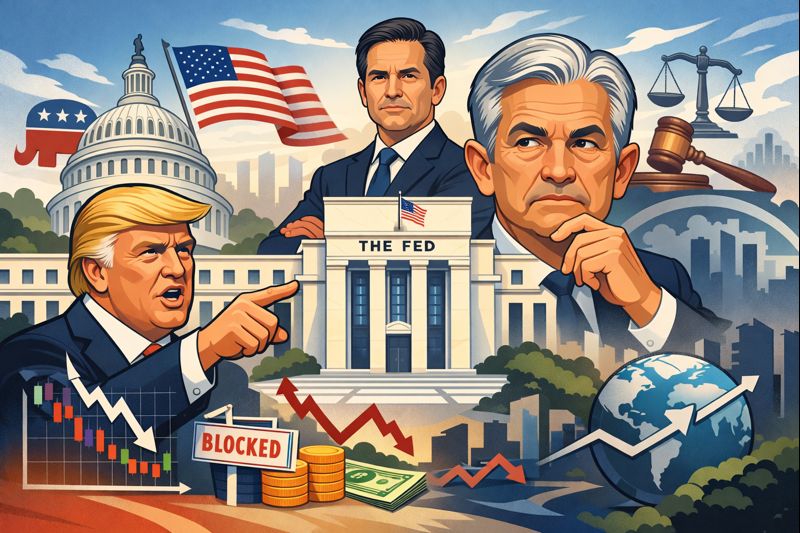
The backdrop to this nomination is unprecedented. Throughout 2025, Trump waged an escalating campaign against Powell and the Fed, publicly calling his own previous appointee a “major loser,” “TOO STUPID,” and a “FOOL” on Truth Social. The president has made no secret of his desire for interest rates as low as 1% or even lower, regardless of inflation risks.
More troubling for institutional norms, Trump’s Justice Department launched a criminal investigation into Powell over the Fed’s headquarters renovation costs—a probe Powell characterized as a “pretext” for political intimidation. The investigation served a subpoena to Powell and sparked rare bipartisan Senate outrage, with Republican Senator Thom Tillis pledging to block any Fed nominee until the matter is resolved.
This political pressure campaign has left markets on edge about Fed independence. An independent central bank, insulated from short-term political pressures, is widely considered essential for credible monetary policy. When that independence appears threatened, bond yields can spike as investors demand higher compensation for inflation risk.
Warsh himself addressed these concerns in an April 2025 IMF speech: “I strongly believe in the operational independence of monetary policy as a wise economy decision. And I believe that Fed independence is chiefly up to the Fed.” Yet his proximity to Trump—and his recent alignment with the president’s policy preferences—inevitably raises questions about how much independence he would truly maintain.
Market Reaction So Far
Financial markets greeted Warsh’s nomination with cautious relief. The Bloomberg Dollar Spot Index surged 0.8% on January 30, its strongest one-day gain since July. Long-term Treasury yields edged higher, with the 10-year note briefly touching 4.28% before settling around 4.25%.
But the most dramatic moves came in precious metals. Gold plunged approximately 9%, while silver crashed 31.4%—its worst single-day decline since March 1980. These assets had surged through 2025 as investors hedged against fears of Fed politicization and dollar instability. Their collapse suggests markets believe Warsh represents continuity rather than radical change.
“Kevin Warsh’s nomination for Fed Chair is exactly what markets were hoping for, as he’s a steady hand, well known in market circles and is expected to maintain the independence of the central bank,” said Richard Saperstein, chief investment officer of Treasury Partners.
Equity markets were more subdued, with the S&P 500 falling 0.4% amid tech stock weakness. Mining stocks suffered alongside precious metals—Newmont down 11.5%, Freeport-McMoRan off 7.5%. Cryptocurrency also retreated, with Bitcoin sliding to around $77,250, its lowest since April.
Critically, interest rate futures markets barely budged. Traders actually slightly increased their bets on two Fed rate cuts in 2026, suggesting that despite Warsh’s hawkish past, markets expect monetary policy to remain on a gradual easing path.
Rate Cuts: Sooner or Later?
This is where Warsh’s nomination becomes genuinely consequential. During his previous Fed tenure, he was among the most hawkish voices, consistently warning about inflation risks even as unemployment approached 10% in the aftermath of the financial crisis. History proved many of his inflation concerns misplaced—deflation, not inflation, was the real threat during much of 2009-2011.
But Warsh in 2026 presents a more complex picture. He has embraced what analysts call “supply-side optimism”—the belief that artificial intelligence and deregulation will drive a productivity boom, allowing for lower interest rates without stoking inflation. This reasoning provides intellectual cover for the rate cuts Trump demands.
“Though traditionally hawkish on inflation, Warsh will argue for more rate cuts by leaning into the argument that productivity gains from AI will allow strong growth without undesirable inflation,” Oxford Economics analysts wrote.
Yet many observers remain skeptical. “In the event of persistent near-3% inflation, our instincts tell us Mr. Warsh will be more preoccupied with how history will view his record than with continuing to pander to the President,” noted Samuel Tombs, chief US economist at Pantheon Macroeconomics.
The institutional structure of the Fed provides some guardrails. Interest rates are set not by the chair alone, but by the 12-member Federal Open Market Committee. Regional Fed bank presidents, who cannot be removed by the president, hold five rotating voting seats. If Warsh arrives with an aggressive cutting agenda, he may find himself isolated—potentially facing the same internal resistance that Powell encountered when Trump demanded faster easing.
Markets currently price in at most two quarter-point cuts in 2026, likely in June and December, bringing rates to around 3%. This would represent a notably more cautious trajectory than Trump desires, but faster than what a purely data-dependent approach might justify given current inflation readings.
Global Spillovers
For international investors, Warsh’s nomination carries significant implications. The dollar’s strength following his nomination signals expectations that US rates will remain relatively attractive compared to other major economies—good news for dollar-denominated assets, challenging news for emerging markets.
Emerging market economies, many of which borrowed heavily in dollars during the low-rate era, face particular sensitivity to US monetary policy. Higher-for-longer US rates can trigger capital outflows as investors redeploy funds to dollar assets, putting pressure on emerging market currencies and bond yields. Countries with large dollar-denominated debt burdens—from Turkey to Argentina to several African nations—could face renewed financing stress.
European and Japanese policymakers will also watch closely. The European Central Bank and Bank of Japan are navigating their own delicate policy balances. If the Fed cuts rates faster than expected, it could ease pressure on these central banks and provide more policy space. Conversely, if Warsh maintains a hawkish stance, it could force other central banks to keep their own rates higher to prevent excessive currency weakness.
The global bond market has already responded. The spread between US and German 10-year yields widened following Warsh’s nomination, reflecting expectations of diverging policy paths. This dynamic could accelerate if Warsh’s supply-side optimism proves correct and the US economy continues to outperform, justifying a different rate trajectory than Europe or Japan.
China represents a special case. With its economy struggling with deflation and weak domestic demand, Chinese policymakers have limited room to respond to Fed policy. A stronger dollar and higher US yields could exacerbate capital flight pressures that China has worked to contain, potentially forcing uncomfortable policy choices in Beijing.
What to Watch Next
Warsh’s confirmation hearing, expected in the spring, will be the first major test. Senate Democrats will press him on Fed independence, seeking concrete commitments on data-driven policymaking. Republicans like Tillis have their own concerns about the Powell investigation. The hearing will provide crucial clues about whether Warsh can articulate a coherent monetary policy framework that satisfies both markets and politicians.
Beyond confirmation, several key indicators will shape the Warsh era:
Inflation trajectory: If inflation remains sticky above 2.5%, Warsh’s hawkish instincts may resurface regardless of Trump’s preferences. But if inflation continues its downward trend, he’ll have cover to support gradual easing.
Balance sheet policy: Warsh has been consistent in advocating for Fed balance sheet reduction. Watch for signals about quantitative tightening pace—faster reduction would tighten financial conditions even as interest rates fall.
Forward guidance: Warsh has criticized the Fed’s heavy reliance on forward guidance and data dependence. He may adopt a more medium-term perspective, potentially reducing the market impact of individual economic releases but increasing uncertainty about near-term policy moves.
FOMC dynamics: Can Warsh build consensus, or will he face a divided committee? Powell’s success owed much to his coalition-building skills. If Warsh arrives with a predetermined agenda, he may alienate colleagues and find himself outvoted.
International coordination: With global trade tensions running high and tariff policies creating cross-border economic friction, how Warsh engages with counterparts at the European Central Bank, Bank of Japan, and People’s Bank of China will matter for global financial stability.
Conclusion: More Than One Individual
Kevin Warsh’s nomination represents more than a simple changing of the guard. It arrives at a moment when central bank independence faces unprecedented peacetime pressure, when inflation has proven more persistent than anticipated, and when global economic policy coordination has frayed under the weight of geopolitical competition.
Markets have so far embraced Warsh as a “safe” choice—an experienced hand who understands crises and financial plumbing. Yet his evolution from inflation hawk to rate-cut advocate raises legitimate questions about whether principle or pragmatism will guide his tenure. The answer may determine not just the path of US interest rates, but the credibility of independent central banking in the world’s largest economy.
For investors, the message is clear: prepare for continued volatility around Fed policy. The Warsh nomination reduces tail risks of truly radical Fed overhaul, but it does not resolve fundamental tensions between political pressure for lower rates and economic data suggesting caution. Markets will parse every speech, every FOMC meeting, every inflation print for clues about which version of Kevin Warsh will ultimately lead the Federal Reserve.
The stakes extend far beyond American borders. From Jakarta to Johannesburg, from Brussels to Beijing, policymakers and investors are watching. In an interconnected global economy, the Federal Reserve’s decisions ripple outward in ways that affect currency values, capital flows, and economic stability worldwide. Kevin Warsh will inherit not just the Fed chair, but a position of unparalleled influence over the global financial system.
As the confirmation process unfolds and Warsh potentially takes the helm in May 2026, one thing is certain: the world will be watching, and the consequences will be felt far beyond Washington.