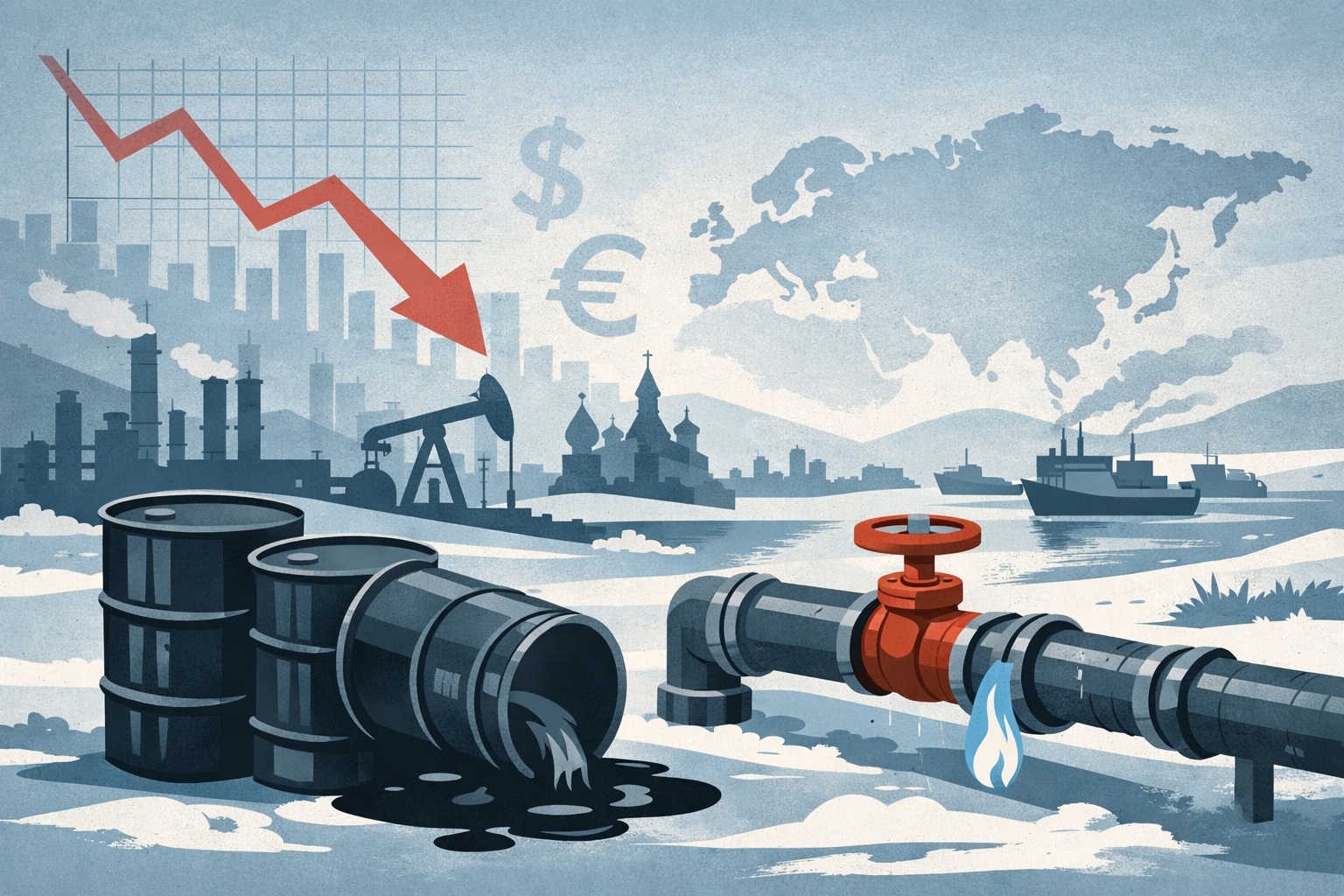
Russia’s fiscal lifeline from oil and gas exports has weakened sharply. January’s revenue figures mark the steepest year-on-year drop since the pandemic, raising questions about the sustainability of Moscow’s war financing and the longer-term reshaping of global energy flows.
What the Numbers Show
The financial pressure on the Kremlin is now quantifiable and stark. Russia’s oil and gas revenues plummeted to 393.3 billion rubles ($5.1 billion) in January 2026, down roughly 50% from the same month in 2025, according to Finance Ministry data released Wednesday. This marks the lowest level since July 2020, when pandemic-induced demand collapse devastated global energy markets.
The January figure continues a trend that defined 2025. For the full year, Russia collected just 8.48 trillion rubles from oil and gas sales, down 24% from 11.13 trillion rubles in 2024 and falling short of the government’s 10.94 trillion ruble budget target by nearly 25%. Energy revenues now account for approximately a quarter of federal budget proceeds, yet even this reduced share is proving difficult to sustain.
The scale of this revenue erosion becomes clearer when compared to wartime peaks. In 2022, buoyed by post-invasion oil price spikes, Russia collected 11.13 trillion rubles from energy exports. The 2025 figure represents a return to 2020 levels, effectively erasing five years of growth in this critical revenue stream.
Why Revenues Are Falling
The decline reflects a convergence of market forces and policy interventions, each compounding the others’ effects.
Western sanctions have intensified significantly. In July 2025, the EU’s 18th sanctions package introduced a new dynamic price cap mechanism, replacing the static $60 per barrel ceiling that had governed since December 2022. Under the new system, the cap automatically adjusts every six months to maintain Russian crude prices at least 15% below prevailing market rates. As of February 1, 2026, the cap stands at $44.10 per barrel, though Russian Urals crude has traded well below even this level in recent months.
Beyond the cap itself, Russia faces mounting discounts in actual transactions. In December 2025, Urals crude fell to $34-40 per barrel at key ports like Novorossiysk, roughly half the $69.70 price assumed in the 2025 budget. By late January, prices had recovered somewhat to the $54-65 range, but remained far below budget assumptions. Indian refiners, previously major buyers, have cut Russian crude imports by 29% month-on-month in December, with some shipments to China selling below $30 per barrel.
Transportation costs have surged as Western maritime services became restricted. The G7 price cap prevents coalition-country shipping, insurance, and financial services from supporting Russian oil transactions above the cap price. While Russia has built a substantial “shadow fleet” of aging tankers to circumvent these restrictions, operating these vessels carries higher insurance costs and greater operational risks. In December 2025, shadow vessels carried 68% of Russian crude exports, up from negligible levels before the invasion, but this shift has added billions in friction costs to Russia’s export operations.
The ruble’s appreciation has further squeezed revenues in domestic currency terms. Russia’s indicative ruble-denominated oil price for tax purposes collapsed 53% year-on-year in December 2025 as the exchange rate strengthened 30.6% from December 2024, mechanically reducing the ruble proceeds from each barrel sold.
Fiscal Pressure on Russia
The revenue shortfall has blown a hole in Russia’s fiscal planning. The 2025 budget deficit reached 5.65 trillion rubles, the largest since at least 1996 and nearly double the original 3% of GDP target. For 2026, the government initially assumed oil and gas revenues of 8.957 trillion rubles, but Deputy Finance Minister Vladimir Kolychev has already acknowledged that further shortfalls are likely. “Could oil and gas revenues end up much lower than our projections? Of course they could. That’s not something we control,” Kolychev stated in January.
To compensate, Moscow has implemented aggressive tax increases. The VAT rate rose to 22% in 2025, explicitly designed to offset declining energy income. Yet even these measures cannot fully bridge the gap. Russia’s National Wealth Fund, the emergency reserve meant to cushion fiscal shocks, held $52.2 billion in liquid assets as of January 1, 2026, down from $113 billion before the invasion. Gazprombank analysts warn the fund could be exhausted within a year if current expenditure and revenue trends persist.
The trade-offs are becoming acute. Military spending remains the budget’s top priority, consuming resources that might otherwise support social programs, infrastructure investment, or household welfare. Economic growth has stalled, with GDP expansion slowing to 0.6% in the third quarter of 2025 from 1.1% the previous quarter. The Central Bank now expects full-year 2026 growth of just 0.5-1.5%, a fraction of the pace needed to maintain living standards amid wartime mobilization and sanctions pressure.
Implications for the Ukraine War
While Russia is not on the verge of economic collapse, the fiscal constraint is tightening the parameters of the possible. As Alexandra Prokopenko of the Carnegie Russia Eurasia Center notes, “It’s still too early to say that the current structure of the economy is forcing Russia to scale back the war,” but the room to maneuver is shrinking.
The Kremlin retains options. It can continue tapping the National Wealth Fund, issue additional domestic debt, or implement further tax increases. Putin has demonstrated a willingness to impose economic pain on the population to sustain military operations. However, each of these measures carries political risks. Higher taxes reduce household consumption and fuel inflation, already a concern with the Central Bank’s policy rate at restrictive levels. Drawing down reserves limits the government’s ability to respond to future shocks.
Energy revenues historically provided Moscow with strategic flexibility, funding both military adventures abroad and social stability at home. The current revenue compression forces harder choices. Maintaining military spending at current levels increasingly means cutting elsewhere, potentially testing the implicit social contract that has underpinned Putin’s rule.
Global Energy Market Impact
For global energy markets, Russia’s fiscal difficulties present paradoxes. Sanctions have constrained Russian revenues without triggering the supply disruption some analysts initially feared. Russian crude continues flowing, albeit at discounts, primarily to Asian buyers who have stepped in as European demand evaporated.
The question for OPEC+ is how this affects production discipline. Russia, as a key member of the alliance, faces pressure to maximize export volumes to offset lower per-barrel prices. Yet OPEC+ recently agreed to keep production relatively flat through early 2026, aiming for market balance despite divergent forecasts. While OPEC projects robust 2026 demand growth of 1.4 million barrels per day, the International Energy Agency forecasts substantially weaker expansion of just 860,000 barrels per day.
This divergence in outlook creates tension. If Russia covertly exceeds production targets to shore up revenues, it could undermine OPEC+ cohesion. Conversely, strict adherence to quotas while facing fiscal stress could intensify Moscow’s search for sanctions workarounds, potentially destabilizing enforcement mechanisms.
For Europe and Asia, energy security calculations continue evolving. Europe has largely decoupled from Russian supplies, replacing pipeline gas with LNG and reducing oil imports. Asian buyers, particularly China and India, have capitalized on discounted Russian crude, but face increasing pressure from Western secondary sanctions. The EU’s July 2025 package banned imports of petroleum products refined from Russian oil in third countries, directly targeting Indian and Turkish refineries that had exploited this arbitrage.
What Comes Next
Can higher oil prices rescue Moscow’s finances? The 2026 budget assumes Urals crude at $59 per barrel, yet most analysts forecast Brent in the $55-62 range, implying continued Urals discounts that keep prices well below budget needs. Goldman Sachs projects Brent at $56, JPMorgan at $58, and the World Bank at $60. Even if global prices rise, Russia’s structural discount to Brent appears entrenched given sanctions pressure and shadow fleet costs.
Tighter enforcement could deepen the squeeze. The dynamic price cap mechanism means Russia’s effective ceiling will continue falling if global prices decline. Western authorities are also ramping up sanctions on shadow fleet vessels, with frequent additions to restricted lists forcing Russia to continuously source new tonnage.
Medium-term, Russia faces a stark choice: accept structurally lower energy revenues and adjust fiscal policy accordingly, or find new mechanisms to evade sanctions and maintain volumes at competitive prices. The first path implies painful domestic adjustments. The second risks escalating economic confrontation with the West while offering no guarantee of success.
What remains clear is that Russia’s energy revenue model has fundamentally changed. The commodity supercycle that once filled Moscow’s coffers has given way to a regime of discounts, sanctions, and fiscal stress. Whether this pressure translates into strategic constraint on the battlefield remains uncertain, but the economic costs of the war are now undeniably mounting.