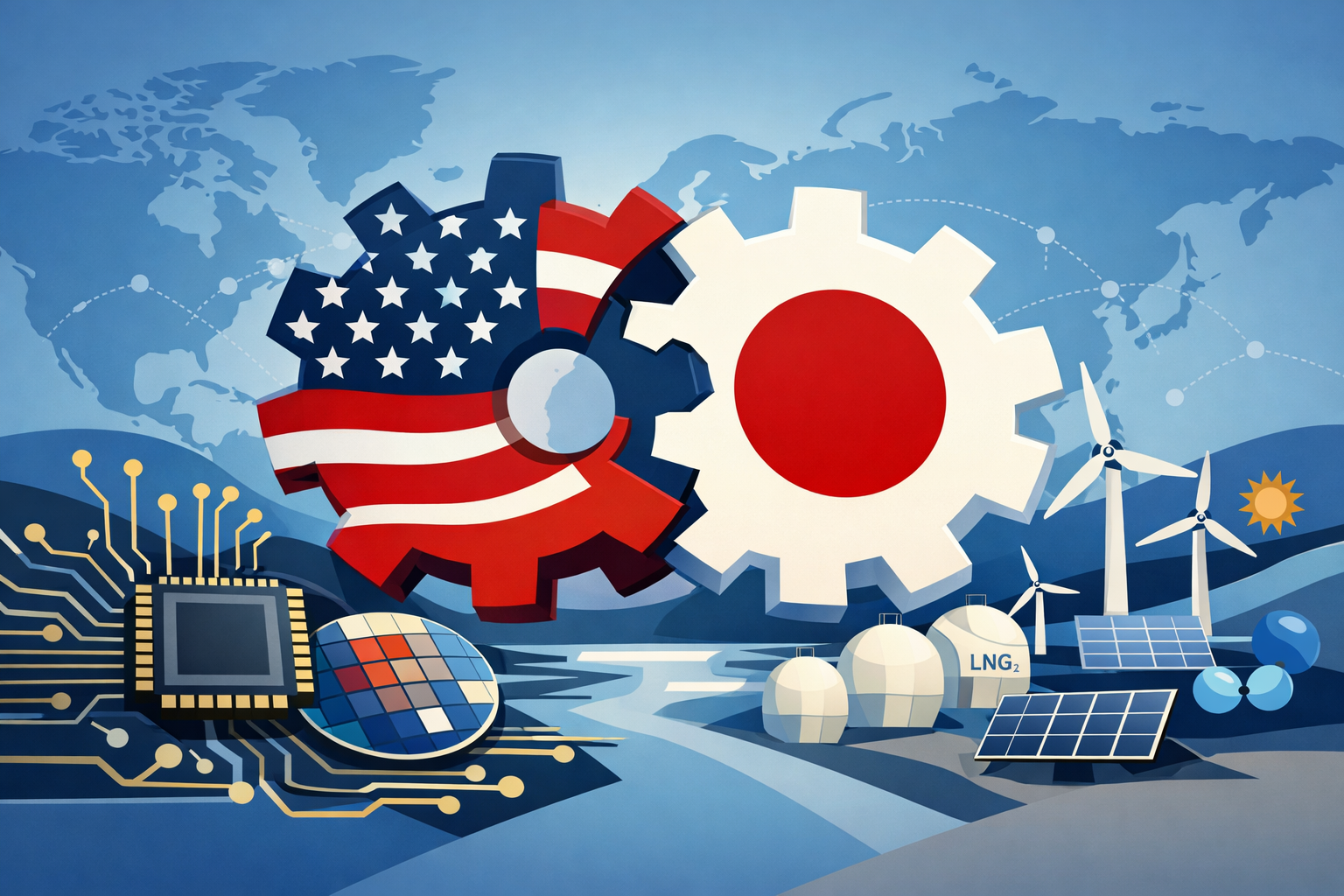
The United States and Japan are preparing to launch the first projects under a $550 billion strategic investment fund targeting energy and semiconductor industries — a move that underscores the accelerating shift from free-market globalization toward state-backed industrial coordination. According to Bloomberg reporting on February 12, 2026, the two governments are closing in on three initial projects: a SoftBank-led data center infrastructure venture, a deep-sea oil terminal in the Gulf of Mexico, and a synthetic diamond operation for semiconductor manufacturing. The initiative signals not just bilateral cooperation, but a deeper restructuring of global supply chains amid rising geopolitical tension.
Why $550 Billion Matters
The sheer scale of this fund deserves pause. At $550 billion, the US-Japan investment vehicle dwarfs any single industrial policy initiative undertaken by either country in recent memory. The US CHIPS and Science Act, celebrated as a landmark when signed in 2022, allocated roughly $52 billion for semiconductor manufacturing and research — less than one-tenth of this new fund. Japan’s own semiconductor revitalization packages over fiscal years 2021 through 2023 totaled approximately four trillion yen, or around $27 billion. Even the Inflation Reduction Act’s energy provisions, while broader in scope, operate on a fundamentally different scale from what is being assembled here.
The fund was born from trade negotiations that began in mid-2025 after the Trump administration imposed steep tariffs on Japanese goods under the International Emergency Economic Powers Act (IEEPA). Japan ultimately pledged the $550 billion in exchange for a reduction in tariffs from 25% to 15%. A memorandum of understanding signed in September 2025 formalized the structure: an investment committee chaired by the US Commerce Secretary would recommend projects, with final decisions resting with the President. The Japan Bank for International Cooperation (JBIC) and Nippon Export and Investment Insurance (NEXI) would serve as primary financing vehicles on the Japanese side, with JBIC’s newly created Japan Strategic Investment Facility drawing on dollar-denominated bonds, government yen loans, and — most significantly — Japan’s $1.3 trillion in foreign currency reserves as a supplemental backstop.
The fund covers nine strategic sectors: semiconductors, pharmaceuticals, critical minerals, metals, shipbuilding, energy (including pipelines), artificial intelligence, quantum computing, and automobiles. All investments must be deployed before January 19, 2029, creating an unusually compressed timeline for capital allocation at this magnitude.
Energy Security: Beyond Oil and Gas
Energy-related projects appear to dominate the early pipeline, and for good reason. Japan imports approximately 87% of its total primary energy supply, with fossil fuels generating over 60% of its electricity — one of the highest dependency ratios among OECD nations. Close to 100% of its crude oil and coal is imported, while its LNG import dependency stands at roughly 98%. This structural vulnerability, amplified by Japan’s geography and its continued reliance on Middle Eastern energy shipments through chokepoints like the Strait of Hormuz, makes energy diversification an existential priority.
Among the highest-profile early commitments, Westinghouse’s construction of AP1000 nuclear reactors and small modular reactors — involving Japanese suppliers including Mitsubishi Heavy Industries — could be worth up to $100 billion. A parallel small modular reactor project involving GE Vernova and Hitachi was framed at a similar scale. These nuclear initiatives reflect a convergence of interests: Japan gains diversified energy partnerships and export opportunities for its reactor component manufacturers, while the US accelerates its own nuclear energy revival.
The fund’s energy ambitions extend well beyond nuclear. LNG infrastructure, hydrogen supply chains, pipeline development, and critical mineral extraction for energy storage all fall within scope. For Japan, which has long worried about the bankability of overseas energy projects, JBIC-backed loan guarantees significantly de-risk participation. The broader Indo-Pacific energy architecture stands to be reshaped if even a fraction of these commitments materialize, creating new supply corridors that reduce dependence on geopolitical chokepoints.
Semiconductor Strategy: De-risking China
The semiconductor dimension of the fund is equally strategic, if more technically complex. Japan’s share of global semiconductor sales has declined from over 50% in the 1980s to roughly 10% today, even as the country retains formidable dominance in upstream segments of the value chain. Japanese firms control approximately 88% of the global market for semiconductor coater/developers, 53% for silicon wafers, and 50% for photoresists. Companies like Shin-Etsu Chemical and SUMCO hold roughly 90% of the global silicon wafer market, while Tokyo Electron remains one of the world’s premier semiconductor equipment manufacturers.
This asymmetry — diminished in chip fabrication but irreplaceable in materials and equipment — makes Japan the ideal partner for a US-led semiconductor supply chain restructuring. The fund’s semiconductor projects target multiple nodes of the value chain simultaneously. The synthetic diamond project among the first three finalists is emblematic: synthetic diamonds are vital to semiconductor and high-precision manufacturing, representing the kind of unglamorous but critical input that supply chain strategists worry about most.
Japan’s own semiconductor ambitions add another dimension. Rapidus, the government-backed consortium, commenced gate-all-around 2nm test production in mid-2025, aiming for commercial output by 2027. TSMC’s fabrication facility in Kumamoto is expanding. The $550 billion fund creates a framework for these domestic efforts to interconnect with US capacity building, particularly in areas where China’s export restrictions on rare earth minerals and legacy semiconductors — most recently in October 2025 — have exposed vulnerabilities.
The alignment with US export controls on advanced semiconductor technology to China is implicit but unmistakable. By channeling investment into US-Japan semiconductor corridors, both governments are constructing an alternative supply architecture that can function even under intensifying technology restrictions.
The China Factor
Beijing’s shadow looms over every aspect of this fund. The strategic competition framing is barely concealed in official communications, with the memorandum of understanding explicitly targeting sectors where Chinese dominance or coercive potential poses risks. China’s restrictions on rare earth minerals, gallium, germanium, and legacy semiconductors have provided a steady drumbeat of justification for supply chain diversification.
The fund does not represent full decoupling — a concept that most policymakers in both Washington and Tokyo have quietly abandoned as impractical — but rather a deliberate bifurcation of critical supply chains. The goal is resilience, not autarky. Japan still relies on China for most of its supply of gallium, germanium, graphite, and rare earth metals, inputs that are vital for compound semiconductors, electric vehicles, renewable energy, and defense technology. Substituting these suppliers will be extraordinarily difficult and expensive, which is precisely why a mechanism of this scale was deemed necessary.
China’s likely response will calibrate to the perceived threat. Beijing has already demonstrated willingness to weaponize its dominance in critical minerals as a bargaining tool. The Nexperia legacy semiconductor export restrictions in late 2025, which threatened to disrupt large segments of the global automotive industry, served as both a warning and a preview. A $550 billion commitment to building alternatives will likely accelerate rather than deter further Chinese counter-measures, creating a feedback loop of industrial policy escalation.
Market Implications
For investors, the fund creates identifiable tailwinds across several sectors and geographies. Semiconductor equipment makers — particularly Japanese firms like Tokyo Electron, Advantest, and Disco Corporation — stand to benefit from expanded fabrication capacity in both countries. US semiconductor firms involved in advanced node manufacturing will find additional demand pull, while materials suppliers across the Japan-US corridor gain long-term visibility.
Energy infrastructure represents perhaps the most immediate investment theme. Nuclear component manufacturers, LNG terminal operators, pipeline companies, and critical mineral miners all sit within the fund’s stated scope. Westinghouse’s involvement, along with Mitsubishi Heavy Industries and GE Vernova, signals that large-cap industrial names will anchor the project pipeline.
The yen-dollar dynamic adds another layer. JBIC’s reliance on dollar-denominated bonds means significant dollar demand from Japanese institutions, while the potential drawdown of Japan’s foreign reserves introduces a variable into currency markets that traders will need to monitor. The fund’s compressed timeline — all capital deployed by January 2029 — implies front-loaded investment flows that could meaningfully influence cross-border capital patterns.
For Asian emerging markets, the implications are mixed. Countries positioned as alternative manufacturing bases — Vietnam, India, Indonesia — may benefit from spillover diversification. However, nations heavily integrated into China-centric supply chains could face pressure to choose sides in an increasingly bifurcated industrial landscape.
What This Means for the Global Economy
The $550 billion US-Japan fund is the most concrete manifestation yet of a structural shift in how advanced economies approach industrial policy. The era in which governments trusted markets to optimize supply chain efficiency is giving way to one in which strategic resilience commands a premium — and a budget.
This normalization of industrial policy carries profound implications for global capital allocation. When two of the world’s largest economies jointly commit half a trillion dollars to reshoring and friend-shoring critical industries, it signals to every multinational that the rules of engagement have changed. Efficiency-optimized supply chains concentrated in a single geography now carry political risk premiums that CFOs can no longer ignore.
The fund also raises legitimate governance questions. Critics have noted that the investment structure effectively circumvents congressional appropriations, granting the executive branch near-total discretion over how foreign capital is deployed within the United States. The 90-10 profit retention split favoring the US, combined with enforcement provisions that threaten tariff increases if Japan declines to fund approved projects within 45 business days, has drawn scrutiny from legal scholars and fiscal watchdogs. Execution risks remain significant: labor shortages estimated at 750,000 additional technicians needed by 2030, regulatory hurdles, and the sheer complexity of coordinating hundreds of billions across two bureaucracies within a compressed timeframe all present challenges.
Yet for all these uncertainties, the directional signal is clear. The US-Japan strategic fund is not an anomaly — it is a template. Expect similar bilateral and multilateral investment vehicles to emerge across the allied network as governments race to build the industrial capacity that a fragmenting global order demands. The question is no longer whether states will intervene in supply chains, but how effectively they can do so before the next disruption tests their resilience.