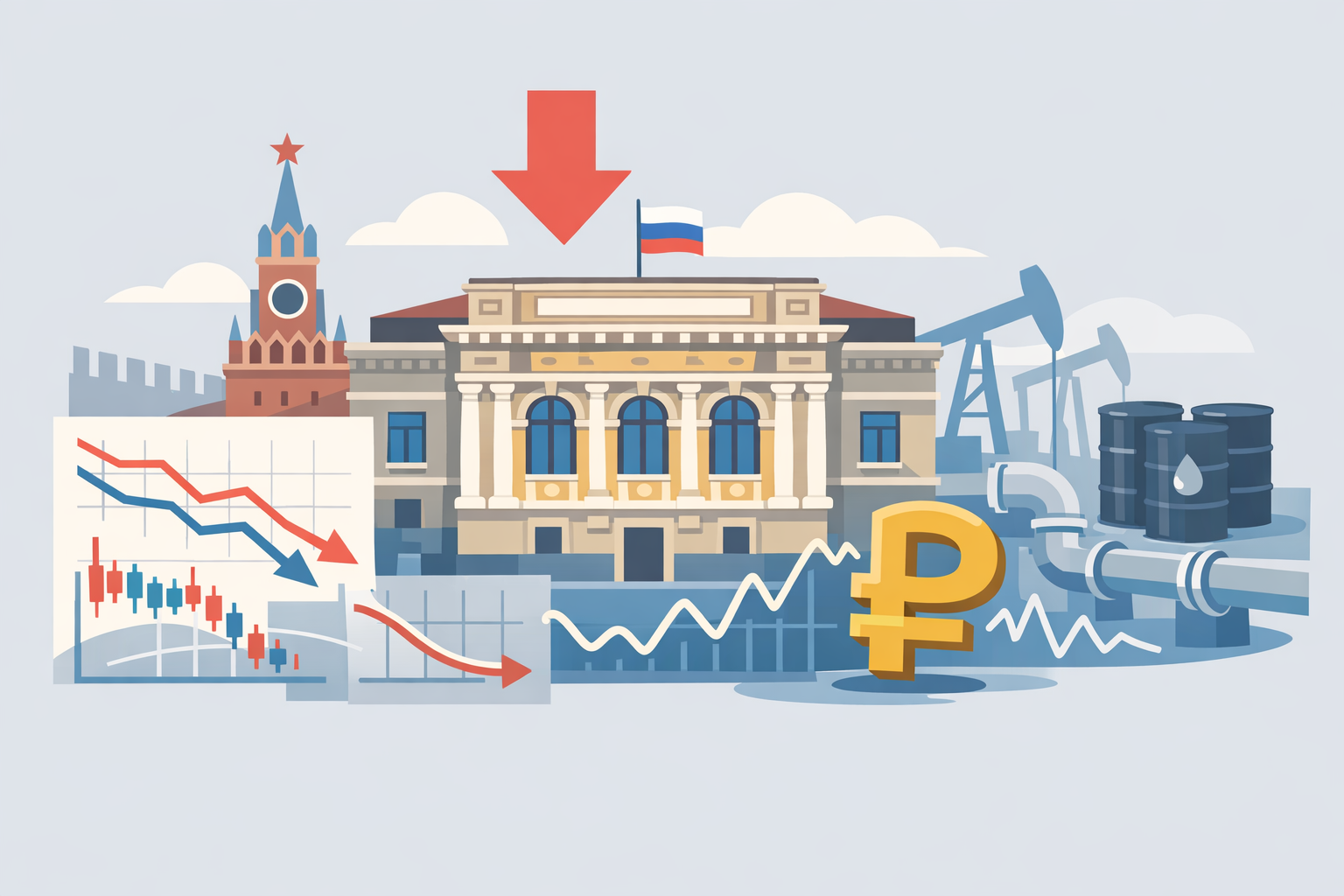
On February 13, Russia’s central bank lowered its benchmark interest rate for the sixth consecutive time, trimming the key rate by 50 basis points to 15.5 percent. The decision caught much of the market off guard — only two of eight economists surveyed by Bloomberg had expected a cut, with the majority forecasting a hold. But for Governor Elvira Nabiullina and the Bank of Russia’s board, the calculus was clear: a slowing economy and tightening fiscal reality now outweigh the risks of persistent inflation.
The move marks the latest step in an easing cycle that began last June, when the rate stood at a punishing 21 percent — a level reached in the feverish months of 2024 as the Kremlin’s wartime spending machine drove demand far beyond the economy’s productive capacity. Since then, the central bank has shaved 5.5 percentage points off borrowing costs. And yet, relief for Russian businesses remains modest at best. Real interest rates are still deeply restrictive, credit conditions remain tight, and the broader economic picture is growing murkier by the month.
The Growth Problem
Russia’s GDP expanded by just 1 percent in 2025 — a sharp deceleration from the roughly 4 percent growth recorded in both 2023 and 2024. That earlier performance, often cited by the Kremlin as evidence of economic resilience, was largely an artifact of massive military expenditure. Defense orders flooded factories with contracts, pushed wages higher in labor-scarce regions, and created a temporary demand boom. But as central bank officials now acknowledge, the economy overheated, and the hangover has arrived.
Third-quarter GDP growth in 2025 was essentially flat — just 0.1 percent on a quarterly basis. The civilian economy, squeezed between elevated borrowing costs and a strong ruble that undermined export competitiveness, has been the main casualty. Business leaders have warned for months that the combination of high rates and a robust currency is creating conditions that stifle investment and weigh on longer-term growth prospects. The central bank’s own updated forecast projects GDP growth of just 0.5 to 1.5 percent for 2026.
In her post-decision press conference, Nabiullina acknowledged that inflation expectations remain stubbornly elevated — stuck at around 13.7 percent among households — but emphasized that the underlying disinflation trend is intact. Seasonally adjusted price growth slowed to an average of 3.9 percent annualized in the fourth quarter of 2025, dropping below the bank’s 4 percent target for the first time in years. Annual inflation stood at 6.3 percent as of early February, though January’s reading was distorted by a 2-percentage-point hike in value-added tax and expanded VAT coverage for small businesses.
The central bank treated that January price spike as a one-off. Nabiullina argued that once the VAT effect fades, the disinflationary trajectory will reassert itself, with underlying inflation expected to fall to 4 percent in the second half of 2026. But she tempered expectations, noting that the decline in inflation expectations would be slow and that a “smoother trajectory for rate reduction” would be required.
Sanctions and the Oil Revenue Squeeze
If the growth slowdown is one half of the equation, the fiscal squeeze from sanctions is the other — and it is arguably the more consequential.
Russia’s oil and gas revenues, which account for roughly a quarter of federal budget income, have collapsed. In January 2026, combined oil and gas tax receipts fell to 393.3 billion rubles — roughly $4.3 billion. That figure was 32 percent below the government’s own target and barely half the amount collected in January 2025. Bloomberg calculations based on finance ministry data show oil-related taxes alone halving year-over-year, dropping to the lowest monthly take since the pandemic-era crash of 2020.
Three forces are driving the shortfall. First, global oil prices have softened, with Brent crude trending around $58-62 per barrel — well below the levels that supported Russia’s fiscal expansion in 2023-2024. Second, U.S. sanctions imposed in October 2025 on Rosneft and Lukoil, which together account for roughly half of Russia’s crude production, have widened the discount on Russian export grades. The spread between Urals blend and the Brent benchmark ballooned to as much as $25 per barrel in December, pushing the effective price of Russian crude below $40. Third, the ruble’s 45 percent rally through the first half of 2025, driven by tight monetary policy and capital flow restrictions, has eaten into ruble-denominated revenue from oil exports.
The result: Russia’s budget deficit in January alone jumped to nearly half of the full-year 2026 target of 3.8 trillion rubles. The National Wealth Fund, which had provided a buffer in earlier years, has been drawn down to approximately 2.9 trillion rubles in net liquid assets — insufficient to cover a sustained revenue shortfall. The central bank has now slashed its assumed oil price for tax purposes from $55 to $45 per barrel, signaling that policymakers are bracing for a prolonged squeeze.
Adding to the pressure, the European Commission recently proposed a full ban on shipping services for Russian oil — a step beyond the G7 price cap — while a new U.S. bill, the DROP Act, introduced on February 11, would mandate sanctions on any foreign entity involved in purchasing or facilitating Russian petroleum products. If enacted, these measures could further restrict the already-constrained channels through which Russia moves its crude to buyers in India and China, who together absorb roughly 85 percent of Russian oil exports.
The Ruble Puzzle
One of the stranger features of Russia’s current economic landscape is the ruble’s resilience. After losing 37 percent of its value against the dollar in 2024 — a year marked by sanctions on the Moscow Exchange and Gazprombank — the currency staged a dramatic recovery, gaining as much as 45 percent by mid-2025. It has remained relatively stable since, trading in the range of 77-82 rubles per dollar in recent months.
The strength is partly a product of policy choices. Capital controls, which have been in place since 2022, limit outflows. The central bank’s restrictive monetary stance has kept carry trade dynamics favorable. And imports have been sluggish, reflecting the broader economic slowdown and the government’s push for import substitution. A large share of Russia’s foreign trade is now settled in rubles — nearly 60 percent of exports and 56 percent of imports as of late 2025 — further reducing demand for foreign currency.
But the strong ruble is a double-edged sword. It compresses oil and gas revenues in ruble terms, weakens export competitiveness for non-energy sectors, and reduces import duty receipts. Some analysts argue the currency is overvalued, with fair value closer to 90-100 rubles per dollar. If rate cuts accelerate and oil prices remain depressed, a correction is likely — though the timing and magnitude are difficult to predict given the opacity of Russia’s post-sanctions financial system.
Global Implications
For global commodity markets, the near-term impact is nuanced. Russia continues to pump crude at high volumes — in line with OPEC+ allowances — but the growing difficulty of moving and insuring that oil is adding friction costs that get passed along the supply chain. Approximately 125 million barrels of Russian crude are currently sitting in tankers at sea, and very large crude carrier rates have spiked to $125,000 per day as sanctioned vessels compete for dwindling capacity.
For emerging-market watchers, Russia’s trajectory serves as a case study in wartime monetary policy under sanctions. The central bank has managed to bring inflation down from a peak well above 8 percent without triggering a full-blown recession — but the cost has been economic stagnation, a hollowing out of the civilian sector, and growing dependence on fiscal measures (tax hikes, forced lending) that distort price signals and erode private sector confidence.
The question now is whether Russia is entering what some analysts have termed “stagflation-lite” — a sustained period of minimal growth coupled with inflation that refuses to converge on target. The central bank forecasts an average key rate of 13.5 to 14.5 percent for 2026, with further easing to 8-9 percent only by 2027. That implies tight conditions for at least another year, even as the growth engine sputters.
What Comes Next
Nabiullina signaled at her press conference that further cuts remain on the table, but that the pace will be data-dependent. Larger steps — or a pause — are both possible depending on how inflation evolves once the VAT shock dissipates. The next rate decision is scheduled for March 20.
For markets, the key variables to monitor are the oil price trajectory (particularly the Urals discount), the fate of ongoing sanctions legislation in Washington and Brussels, the ruble’s behavior as rates decline, and any developments in the Ukraine peace talks that could alter the sanctions calculus entirely. Geneva negotiations are slated for February 17-18, and any progress — or lack thereof — will ripple through Russian asset prices.
Russia’s central bank has navigated the past three years with more skill than many predicted. But the room for maneuver is narrowing. Growth is stalling, the fiscal cupboard is thinning, and the external environment is turning less forgiving. The easing cycle will continue — the question is whether it will be enough.