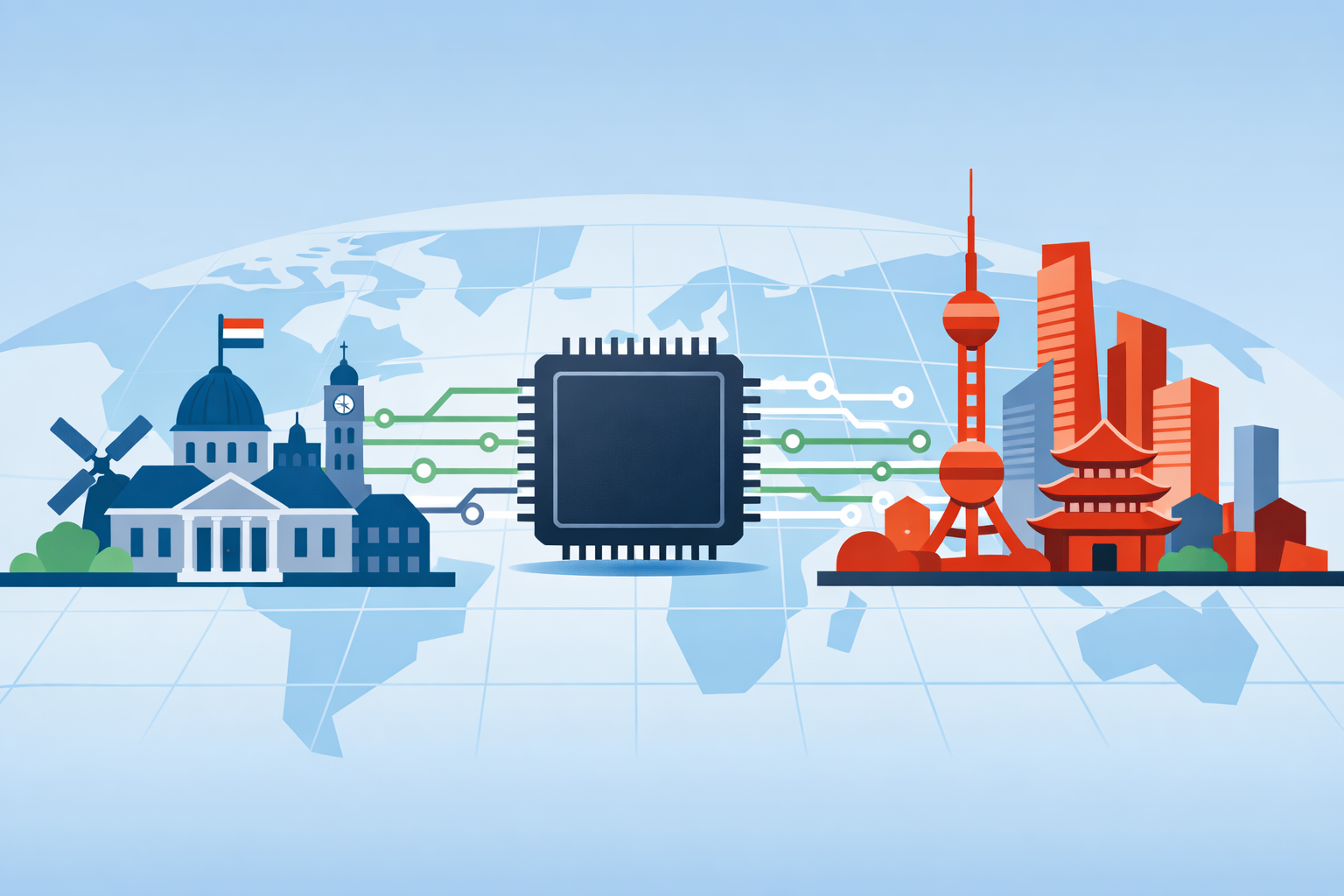
China’s call to safeguard semiconductor supply chain stability following a Dutch court ruling involving Nexperia underscores a broader reality: the fragmentation of the global tech ecosystem is no longer a future risk—it is unfolding in real time.
On February 13, 2026, China’s Ministry of Commerce declared that restoring the “smooth, stable operation of the global semiconductor supply chain” is a matter of “utmost urgency.” The statement came in response to the Dutch Enterprise Chamber’s decision, days earlier, to order a formal investigation into alleged mismanagement at Nexperia BV and to uphold the suspension of Zhang Xuezheng, founder of Nexperia’s Chinese parent company Wingtech Technology. Beijing urged The Hague to “create favorable conditions for enterprises from both countries to resolve internal disputes through constructive negotiations.”
The language was diplomatic. The implications are anything but.
The Nexperia Saga
The roots of this dispute trace back to September 30, 2025, when the Dutch Ministry of Economic Affairs took the extraordinary step of invoking the Goods Availability Act—a seldom-used emergency statute—to seize operational control of Nexperia. It was the first time this law had been applied in a technology case. Dutch officials cited “serious governance shortcomings” and acute risks that critical technological capabilities could be transferred out of Europe. The order suspended Wingtech’s shareholder voting rights, placed them under an independent court-appointed trustee, and barred Nexperia from relocating assets, appointing executives, or making strategic decisions without ministerial approval.
Nexperia is not a cutting-edge chipmaker. It specializes in high-volume production of legacy semiconductors—discrete components, logic chips, and MOSFETs—used widely in automotive systems, consumer electronics, and industrial equipment. Headquartered in Nijmegen, the company traces its lineage through Philips and NXP Semiconductors. Wingtech acquired it for $3.63 billion in 2018, before the Netherlands had established a formal national security investment screening mechanism—a gap that has since come under sharp political scrutiny.
The trigger for Dutch intervention appears to have been intelligence suggesting that Wingtech’s leadership was preparing to shift wafer production to China, a move that would have hollowed out Europe’s access to a key node in its own semiconductor supply chain. Dutch Economic Affairs Minister Vincent Karremans later confirmed he learned of the plan on September 18 and acted within twelve days.
Beijing’s retaliation was swift. On October 4, 2025, China’s Ministry of Commerce issued an export control notice prohibiting Nexperia’s Chinese operations from shipping finished components and sub-assemblies to its European and global customers. The move sent immediate shockwaves through the European automotive industry, prompting the European Automobile Manufacturers’ Association (ACEA) to issue a rare public statement calling for EU government action to address the resulting chip shortage. BMW CEO Oliver Zipse acknowledged production disruptions before his company managed to stabilize supply lines.
The situation has since partially de-escalated. China walked back some export restrictions, and the Dutch government relinquished certain oversight provisions. But the two halves of Nexperia—its Chinese and European operations—remain functionally separated, and the February 2026 court ruling deepens rather than resolves the standoff.
Why Semiconductors, Why Now
Semiconductors sit at the intersection of virtually every strategic competition playing out in the 21st century. They are the substrate of artificial intelligence, the nervous system of electric vehicles, and a prerequisite for modern defense capabilities. A country that loses access to reliable chip supply doesn’t just face economic inconvenience—it faces structural vulnerability.
China accounts for roughly 28–34% of global semiconductor consumption, depending on how one measures the market—making it the world’s largest buyer of chips. Yet Chinese device makers held only about 6.3% of global market share in 2024, a gap that Beijing’s “Made in China 2025” initiative and successive rounds of the National IC Industry Investment Fund (the “Big Fund,” now in its third phase at $47.5 billion) have been racing to close. Progress has been uneven: China’s foundry capacity already exceeds domestic demand at certain nodes, but at the leading edge—7nm and below—domestic manufacturers remain two to three years behind Taiwan and South Korea, constrained above all by the absence of ASML’s extreme ultraviolet lithography machines, which remain under strict export control.
What makes the Nexperia case distinctive is that it does not involve leading-edge chips at all. It involves mature-node semiconductors, the workhorse components that keep factories running and cars on the road. This is the battleground shifting. Mature chips may lack the glamour of AI accelerators, but their ubiquity makes them strategically indispensable—and their supply chains politically exploitable.
Structural Decoupling Accelerates
The Nexperia dispute is best understood as one node in a rapidly densifying network of tech restrictions flowing in both directions across the Pacific—and increasingly across the Atlantic.
On the Western side, the trajectory is clear. The United States has enacted successive rounds of semiconductor export controls since October 2022, tightening restrictions on advanced chips, high-bandwidth memory, and semiconductor manufacturing equipment destined for China. In December 2024, Washington added 140 Chinese semiconductor firms to its Entity List, including Wingtech itself. The September 2025 “Affiliates Rule” extended these restrictions to any entity at least 50% owned by a listed company—a provision that directly ensnared Nexperia. The Netherlands, under sustained U.S. pressure, has restricted ASML’s most advanced lithography exports to China since 2023. Japan has imposed parallel controls on chipmaking equipment.
On the Chinese side, retaliation has centered on critical minerals. Since mid-2023, Beijing has progressively tightened export controls on gallium (where China controls 98% of global primary supply), germanium, antimony, graphite, rare earth elements, and superhard materials. The October 2025 escalation was the most sweeping yet, extending controls to rare earth processing equipment, production technologies, and—for the first time—asserting extraterritorial jurisdiction over foreign-made products containing Chinese-origin rare earth inputs. The November 2025 Trump-Xi agreement in Busan temporarily suspended some of these measures for one year, but the legal architecture remains fully intact and can be reactivated on short notice.
Europe finds itself caught in the middle, dependent on American chip design IP and East Asian fabrication capacity while consuming roughly 20% of global chips but producing only about 9%. The EU Chips Act, committing approximately €43 billion in public and private funding, represents Brussels’ attempt to reduce this exposure—but building fabs takes years, and strategic autonomy in semiconductors remains more aspiration than reality.
Market Implications
For investors, the Nexperia affair crystallizes several themes that are likely to shape portfolio positioning in 2026 and beyond.
First, geopolitical risk premiums in semiconductor equities are no longer episodic—they are structural. ASML, whose stock has become a real-time barometer of U.S.-China technology tensions, expects its China business to decline significantly in 2026 as export controls bite deeper. The company guided for China revenues at roughly 20% of total sales for 2025, down from peaks above 40% in some quarters. Equipment makers with heavy China exposure—including Tokyo Electron and Applied Materials—face similar headwinds.
Second, the mature-chip segment, long considered a commodity backwater, is being repriced as a strategic asset. European and Japanese automakers discovered during the Nexperia disruption what COVID-era shortages had already hinted at: supply security for legacy chips cannot be taken for granted. Companies that control or can guarantee access to mature-node capacity—Infineon, STMicroelectronics, NXP—may command premium valuations as supply chain reliability becomes a selling point.
Third, the commodity dimension of the semiconductor value chain deserves closer attention. Gallium, germanium, rare earths, and high-purity silicon are not just raw materials—they are geopolitical instruments. China’s demonstrated willingness to weaponize its dominance over these inputs (even if temporarily walked back) means that any sustained disruption in U.S.-China relations could trigger commodity price spikes that cascade through the semiconductor, defense, and clean energy sectors simultaneously.
Looking Ahead
The Nexperia case is a microcosm, but it illuminates a macro trend. The global semiconductor supply chain, optimized over decades for efficiency and cost, is being reengineered around principles of national security and strategic resilience. This transition will be expensive, inflationary, and politically fraught. It will produce winners—companies and countries positioned at critical chokepoints—and losers, those caught without alternatives when the next restriction lands.
What stands out about China’s February 2026 statement is not its content, which was predictable, but its framing. Beijing is no longer merely protesting individual actions; it is positioning itself as a defender of global supply chain stability—even as it builds the domestic capacity to operate independently of that chain. The contradiction is deliberate. It preserves diplomatic leverage while buying time for the localization programs that, if successful, will eventually render the leverage unnecessary.
For markets, the operative question is no longer whether tech decoupling will happen, but how fast, how deep, and at what cost. The answer, case by case and chip by chip, is becoming clearer.