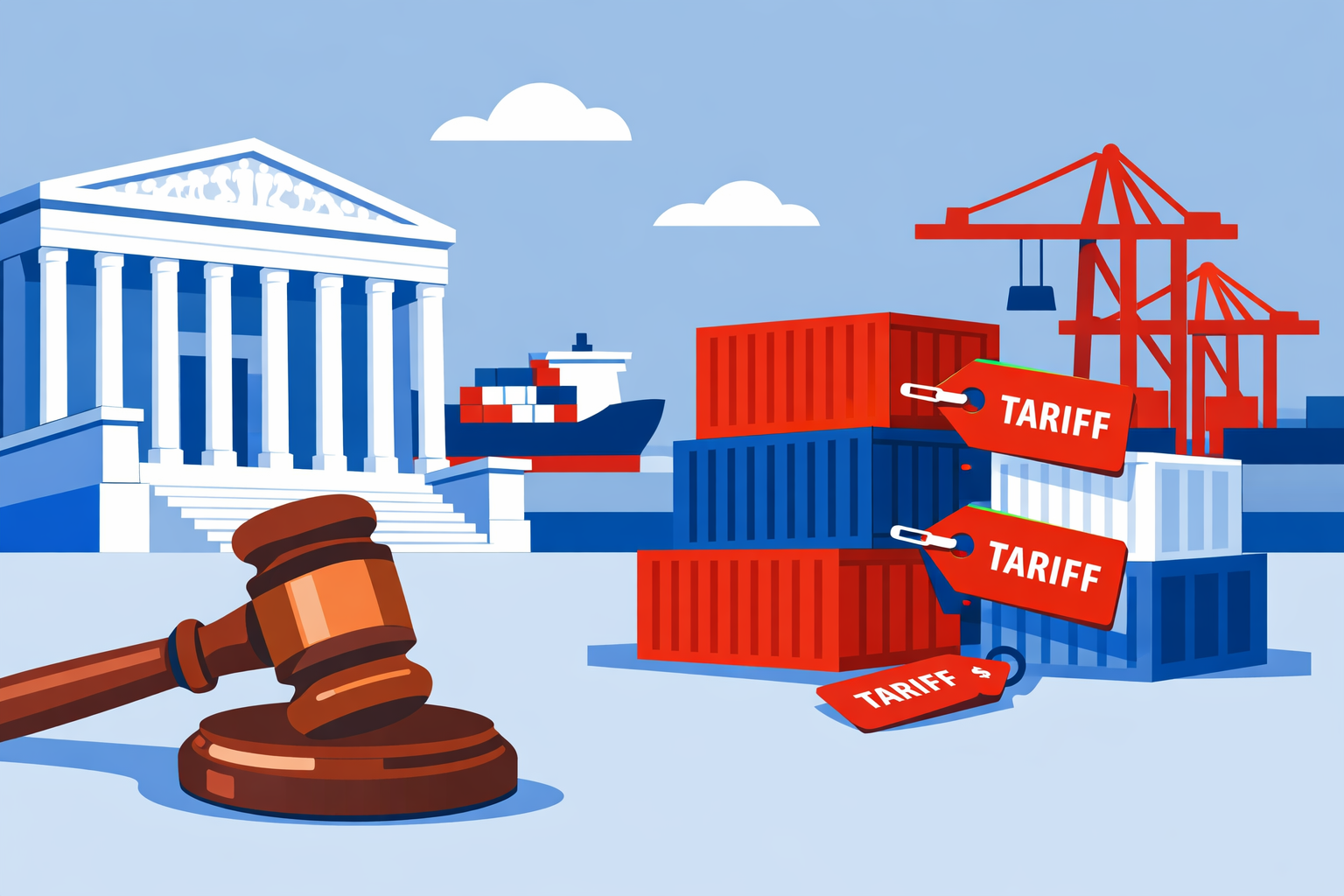
The US government will stop collecting tariffs deemed illegal by the Supreme Court, shaking trade policy and raising questions about Trump’s tariff strategy. Here’s what it means for markets and global trade.
On February 20, 2026, the US Supreme Court delivered its most consequential economic ruling in years. In a 6-3 decision in Learning Resources, Inc. v. Trump, the Court held that the International Emergency Economic Powers Act (IEEPA) does not grant the president authority to impose tariffs — striking down the legal foundation for the bulk of President Trump’s trade agenda.
The ruling invalidated a sweeping set of import duties in place since early 2025, including the “Liberation Day” reciprocal tariffs and fentanyl-related levies on China, Canada, and Mexico. Within hours, the administration announced a replacement: a 10% global tariff under Section 122 of the Trade Act of 1974, later raised to 15%. Markets rallied, China signaled cautious reassessment, and US Customs scrambled to update its systems.
What the Supreme Court Actually Ruled
The case centered on whether IEEPA — a 1977 statute designed for economic sanctions and asset freezes during national emergencies — could be stretched to cover tariffs. The Trump administration argued that the law’s authority to “regulate … importation” plainly included the power to impose import duties. Chief Justice John Roberts, writing for the majority, disagreed.
Roberts was joined by Justices Sotomayor, Kagan, Gorsuch, Barrett, and Jackson — a coalition that crossed ideological lines. The majority emphasized that IEEPA contains no mention of tariffs or duties, and that no previous president had ever used the statute to levy them. The Constitution assigns the taxing power to Congress, and the Court found no clear authorization for the executive to impose taxes of “unlimited amount, duration, and scope.”
The decision was narrow in scope but enormous in impact. It did not touch tariffs imposed under other legal authorities — Section 232 tariffs on steel, aluminum, copper, automobiles, and semiconductors remain intact. But the IEEPA-based duties accounted for the lion’s share of new tariff revenue. US Customs and Border Protection reported collecting roughly $133.5 billion under IEEPA authority through December 2025, and the Penn Wharton Budget Model estimates IEEPA receipts were running at approximately $500 million per day before the ruling.
Immediate Policy Response
The administration moved fast. At a White House press conference the same afternoon, Trump called the decision “deeply disappointing” and said he was “ashamed” of the majority justices — including two he had appointed. He announced an immediate 10% global tariff under Section 122, which he raised to 15% over the weekend via Truth Social.
But Section 122 is far more constrained than IEEPA. It carries a 150-day time limit without congressional approval and was designed for balance-of-payments emergencies, not broad trade policy. Treasury Secretary Scott Bessent insisted the administration would leverage multiple existing tariff statutes to maintain “virtually unchanged tariff revenue in 2026.” The administration also pointed to ongoing Section 301 investigations into China’s trade deal compliance.
On the ground, implementation has been messy. US Customs and Border Protection had not updated its systems as of the weekend following the ruling. An estimated 211,000 containers worth $8.2 billion that arrived in US ports between Friday and Sunday were still subject to IEEPA rates. Importers have a 10-day payment window and can file corrections once the system updates, but brokers expect processing delays given the unprecedented scale.
The refund question looms even larger. The Supreme Court did not rule on whether tariffs already collected must be returned, remanding that issue to the US Court of International Trade. Estimates of the potential liability vary widely: Morgan Stanley pegs it at around $85 billion, while the Penn Wharton Budget Model puts the figure as high as $175 billion. Justice Kavanaugh warned the process would likely be a “mess.” Major companies including Costco, Crocs, and Revlon have already filed lawsuits seeking full refunds, though there is no mechanism for consumers to directly recoup higher prices they absorbed.
Implications for Trump’s Trade Doctrine
The ruling strikes at the heart of a strategy built on unilateral executive action. Since taking office for his second term, Trump had relied on IEEPA’s broad emergency language to bypass Congress entirely — adjusting tariff rates on individual countries at will, sometimes multiple times in a single week. That flexibility is now gone.
The remaining legal tools are narrower and slower. Section 232 (national security) requires Commerce Department investigations. Section 301 (unfair trade practices) involves lengthy USTR review. Section 122 is capped at 150 days. None offer the speed, scope, or unilateral discretion that IEEPA provided.
The Court’s reasoning drew on the “major questions doctrine” — the principle that executive agencies cannot claim sweeping authority from vague statutory language without explicit congressional authorization. Roberts noted the “lack of historical precedent” for IEEPA-based tariffs as a “telling indication” that the claimed power exceeded legitimate executive reach.
Market Reaction and Business Impact
Wall Street’s initial response was cautiously positive. The S&P 500 rose 0.69% to close at 6,909.51; the Nasdaq gained 0.9%; the Dow added 230 points. Tariff-exposed sectors outperformed, with the Dow Jones Transportation Average jumping roughly 1% and Amazon shares rising nearly 2.6%. Treasury yields rose across maturities, with the 10-year reaching 4.09%. The dollar initially spiked but ended the session lower. Futures fell Sunday night as investors digested Trump’s replacement tariffs.
The Yale Budget Lab estimates the ruling dropped the average effective US tariff rate from roughly 17% to about 9%. The remaining tariff burden falls most heavily on metals, vehicles, and electronics. For the average household, the ruling translates to roughly $800 in annual savings from reduced price pressures.
For businesses, the picture remains complicated. Supply chain decisions made over the past year cannot be easily reversed, and the 150-day clock on Section 122 tariffs introduces fresh planning uncertainty.
China’s Calculated Response
Beijing’s reaction has been measured. China’s Ministry of Commerce said it is conducting a “full assessment” of the ruling and urged Washington to remove “relevant unilateral tariff measures,” adding that US tariffs “violate international trade rules and US domestic law.”
The timing is significant. Trump is scheduled to visit Beijing on March 31 for a three-day summit with Xi Jinping — the first presidential visit to China since 2017. Before the ruling, China faced IEEPA-based tariffs totaling an additional 20% on top of existing duties. Now, Beijing faces the same 15% global rate applied to US allies, with a statutory expiration date attached. Goldman Sachs estimates the ruling implies a net reduction of about 5 percentage points in US tariffs on China.
Chinese analysts have been direct. Fudan University’s Wu Xinbo noted that commitments China made during earlier tariff negotiations — such as purchasing 25 million tons of US soybeans — were predicated on a framework now invalidated. Beijing also retains its own leverage, including restrictions on rare earth mineral exports critical to US defense and technology industries.
What Comes Next
Several threads will shape the coming months. The refund litigation at the Court of International Trade will determine whether the government must return some or all of the $130–175 billion in IEEPA tariff revenue collected since 2025. The process is unprecedented.
The administration’s ability to reconstitute tariffs under alternative authorities — Section 301 investigations, additional Section 232 actions, or new legislation — will be tested. Trump has said he plans to “determine and issue new and legally permissible tariffs” in the coming months. Meanwhile, the ruling shifts the trade debate into congressional territory just as the 2026 midterms approach, where tariffs served as a signature campaign issue.
The Supreme Court did not end the tariff era. It did, however, force a reset — constraining executive tools, introducing massive fiscal uncertainty, and altering leverage dynamics in every active trade negotiation from Beijing to Brussels. For investors, businesses, and policymakers, the trade landscape of early 2026 looks very different from what anyone anticipated a week ago.