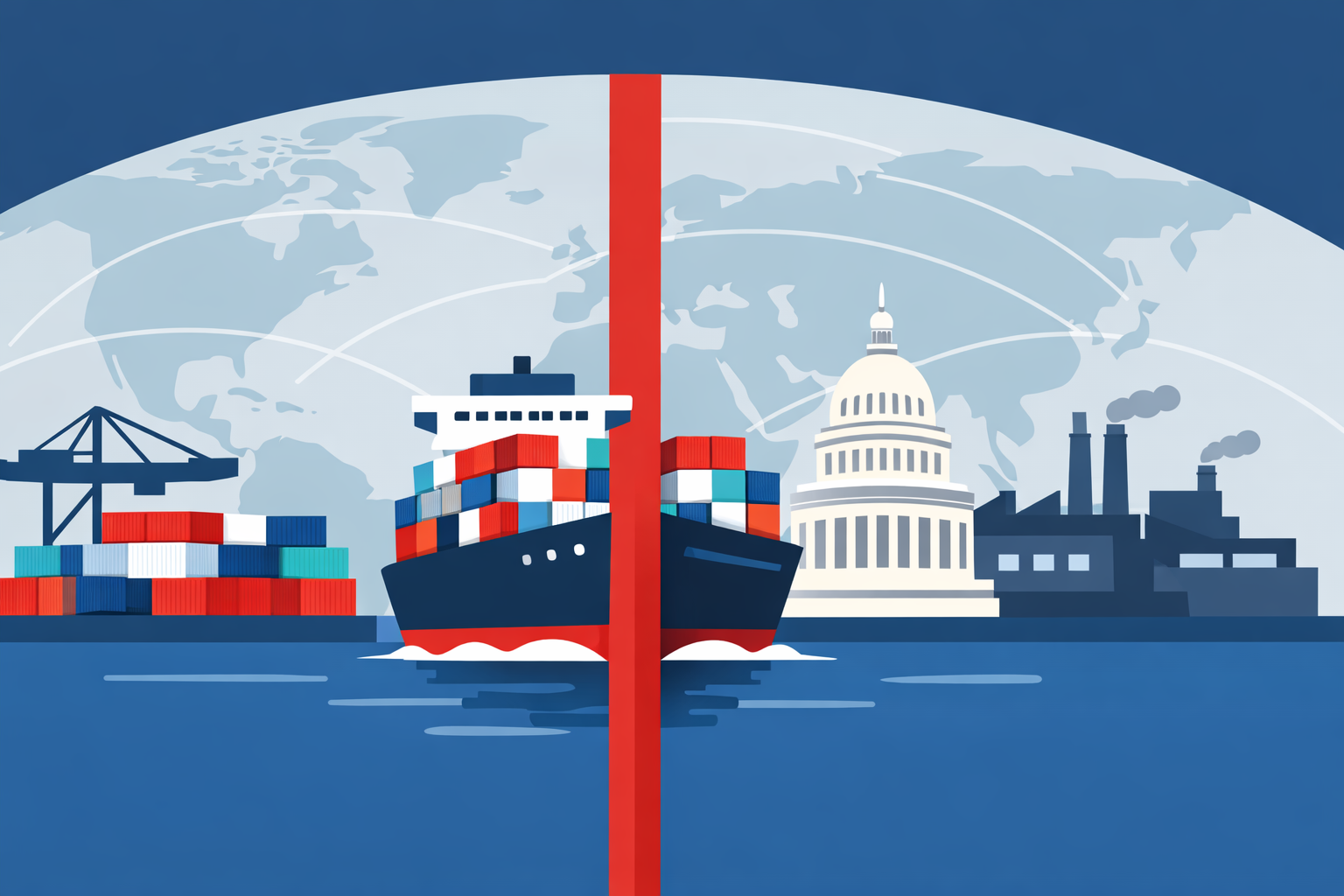
Donald Trump’s universal tariff, imposed under emergency powers days after the Supreme Court struck down his original trade agenda, marks a dramatic — and legally constrained — reset of U.S. trade policy. For markets, businesses, and allies, the uncertainty may be worse than the tariff itself.
When the United States imposes a universal 10% tariff on global imports, it is not merely adjusting trade policy — it is rewriting the architecture of global commerce. President Donald Trump’s sweeping measure, which took effect at 12:01 a.m. EST on February 24, 2026, marks one of the most aggressive pivots in U.S. trade strategy in decades, raising urgent questions about inflation, retaliation, and the future of the rules-based trading system.
But context matters enormously here. This is not the tariff Trump wanted. It is the tariff he could salvage.
What Exactly Has Changed?
On February 20, the U.S. Supreme Court ruled 6-3 that Trump had exceeded his authority when he used the International Emergency Economic Powers Act (IEEPA) to impose sweeping “reciprocal” tariffs across the globe — the legal backbone of his signature trade agenda since April 2025. Within hours, Trump signed an executive order imposing a new universal 10% tariff under Section 122 of the Trade Act of 1974 — a statute that has never before been used for this purpose.
The differences between the old regime and the new one are significant. Section 122 allows the president to impose tariffs of up to 15% — but only for 150 days. After that, Congress must authorize any extension. The original IEEPA-based tariffs had no such time limit and were calibrated country by country, with rates as high as 125% on Chinese goods.
The new tariff is a blunt instrument by comparison: 10% on virtually all imports, with exceptions carved out for certain agricultural products (beef, tomatoes, oranges), critical minerals, pharmaceuticals, some electronics, and passenger vehicles. Tariffs under Section 232 (steel, aluminum) and Section 301 (China-specific) remain in force. Trump said on Saturday he would raise the rate to 15% — the legal maximum under Section 122 — “effective immediately,” but as of Tuesday morning, no formal directive had been issued to implement the increase.
That gap between rhetoric and legal reality is now a defining feature of U.S. trade policy.
The Market Response: Volatility With a Caveat
Financial markets reacted to the Supreme Court ruling itself with cautious optimism on Friday. The S&P 500 rose 0.69%, the Nasdaq gained 0.9%, and the Dow added 231 points. Retailers, appliance makers, and logistics companies — businesses directly exposed to tariff costs — were among the day’s strongest performers.
That mood soured over the weekend. Trump’s announcement of the 15% hike sent markets into retreat on Monday: the Dow dropped 822 points (1.66%), the S&P 500 fell 1.04%, and the Nasdaq shed 1.13%. Gold surged 3.4%, climbing above $5,200 per troy ounce as investors sought haven assets. Bitcoin slid more than 5%, continuing a decline that has seen the cryptocurrency lose roughly 47% since its October 2025 high above $126,000.
The dollar weakened against major currencies. Bond yields edged higher but stayed contained. Chinese equities, interestingly, rallied: the Hang Seng closed up 2% on Monday, as investors speculated that Beijing might seek to renegotiate its existing tariff truce with Washington from a position of improved leverage.
Market strategists, however, counseled restraint. Ed Yardeni, president of Yardeni Research, described Section 122 as a “rubber mallet” compared to the “sledgehammer” of IEEPA. Angelo Kourkafas of Edward Jones argued the 10-15% rate is unlikely to have a meaningful impact on economic activity, and urged investors not to overreact. Hugh Dive of Atlas Funds Management was blunter: “Sit on hands and do nothing. This is just noise.”
Whether it remains noise depends entirely on what comes next.
Inflation and the Fed’s Dilemma
The inflationary implications of a universal 10% tariff are real but probably modest in isolation. The Tax Foundation estimated that Trump’s IEEPA-era tariffs added approximately $1,000 in annual tax burden to the average U.S. household in 2025. A flat 10% duty on a narrower base — given the exemptions for pharmaceuticals, vehicles, and some electronics — would generate less inflationary pressure.
Still, the U.S. imported $4.33 trillion in goods and services in 2025. Even a 10% duty on a portion of that flow represents a meaningful cost increase for businesses that will, in many cases, pass those costs on. The sectors most exposed include consumer goods, industrial inputs, and intermediate components — the building blocks of domestic manufacturing.
The Federal Reserve, already navigating sticky core inflation at 3% year-on-year, faces a familiar dilemma. Tariff-driven price increases are, in economic terms, a supply-side shock — they push prices up while simultaneously dampening growth. Fed Governor Christopher Waller recently signaled he would not be surprised by negative job growth in the near term. Q4 2025 GDP came in at just 1.4% annualized, well below consensus.
If the tariff regime persists and expands, the Fed may find itself holding rates higher for longer than markets currently expect. If it expires in 150 days without congressional extension, the inflationary impulse could prove transitory — but the uncertainty alone may be enough to delay investment decisions across the corporate sector.
Global Response: A Web of Fraying Agreements
The international reaction has been swift and deeply skeptical.
The European Union froze ratification of the Turnberry Agreement — the landmark U.S.-EU trade deal struck in Scotland last July — after an emergency session of the European Parliament’s trade committee on Monday. Committee chair Bernd Lange declared that the U.S. had breached the agreement, citing multiple changes to tariff rates since the deal was signed: the expansion of metals tariffs to hundreds of derivative products, the Greenland-related tariff threats in January, and now the Section 122 levy.
An EU assessment found that the new tariff raises duties on some European exports — including cheese and agricultural products — above the ceiling agreed in the Turnberry deal. The European Commission’s position is unequivocal: the bloc expects the U.S. to honor its commitments. ECB President Christine Lagarde warned that the disruption to transatlantic trade — valued at approximately €4.6 billion per day — could be severe. The EU’s Anti-Coercion Instrument, a retaliatory mechanism, is reportedly on the table.
Japan’s Trade Minister Ryosei Akazawa asked the U.S. to ensure that new measures would not leave Tokyo with harsher conditions than its previously negotiated framework. India cancelled a planned round of trade talks in Washington. China, facing potential renegotiation of its November 2025 tariff truce with the U.S. (which reduced bilateral tariffs to 10% each), called on Washington to abandon tariffs entirely.
The UK, whose trade deal with the U.S. included a baseline 10% rate, faces the odd prospect of losing its competitive advantage if Washington raises the universal rate to 15%. The deal that was supposed to offer certainty now offers none.
Congressional Pushback and the Refund Question
The Supreme Court’s ruling opened a second front: the question of refunds. The Penn Wharton Budget Model estimates the U.S. government collected approximately $175 billion under the now-invalidated IEEPA tariffs — roughly $1,300 per household.
Senate Democrats moved quickly. On Monday, Senators Ron Wyden, Ed Markey, and Jeanne Shaheen introduced the Tariff Refund Act of 2026, backed by 22 Democratic co-sponsors including Minority Leader Chuck Schumer. The bill would require U.S. Customs and Border Protection to process refunds with interest within 180 days, prioritizing small businesses. It also directs importers and large corporations to pass refunds on to their customers.
The bill has virtually no chance of becoming law with Republican majorities in both chambers. But its political purpose is clear: Democrats are framing the struck-down tariffs as an illegal tax, and the refund question as a test of whether the administration will return the money. Treasury Secretary Scott Bessent has argued that refund decisions belong to the courts, not the executive branch. Trump himself estimated the litigation could take “five years.”
For Republicans heading into November’s midterm elections, this is uncomfortable terrain. The party had planned to run on the income tax cuts signed into law in 2025. Democrats now have a counternarrative: the administration collected billions in duties that the Supreme Court deemed unlawful, and refuses to give it back.
Supply Chain Recalibration — Again
For multinational corporations, the Section 122 tariff is less a new challenge than an extension of the one they have been managing since April 2025.
The 2025 trade deficit of $901.5 billion — essentially unchanged from 2024 — suggests that the first round of tariffs did more to rearrange trade flows than to reduce the overall imbalance. The deficit with China fell from $296 billion to $202 billion, but deficits with Vietnam ($178 billion, up from $123 billion) and Taiwan ($147 billion, up from $74 billion) widened sharply. The pattern is familiar from 2018-2019: tariffs on China redirected trade through third countries rather than bringing production home.
Corporate strategy has evolved accordingly. The “China plus one” model — maintaining Chinese capacity while diversifying to Vietnam, India, or Mexico — has become standard. Mexico’s nearshore advantage, reinforced by the USMCA framework, makes it a natural beneficiary of continued U.S.-China friction. India’s manufacturing push under the Production-Linked Incentive scheme is attracting fresh investment in electronics and pharmaceuticals.
But the universal nature of the Section 122 tariff complicates the diversification calculus. If the 10% rate applies everywhere, the comparative advantage of shifting production out of China diminishes — at least until country-specific tariffs are rebuilt through other legal channels.
Three Scenarios
Scenario One: Managed Transition. The 10% tariff holds for 150 days. The administration uses the window to negotiate bilateral agreements under other statutory authorities (Section 301, Section 232, or new congressional legislation). Most existing trade deals are preserved in modified form. Market impact: limited. The dollar stabilizes. Exporters and multinationals recover. Gold retreats from highs.
Scenario Two: Escalation. Trump raises the rate to 15% and pursues additional tariffs through Section 301 investigations (which the administration has already launched). The EU activates its Anti-Coercion Instrument. China renegotiates or abandons its tariff truce. Congress fails to extend Section 122 authority, creating a cliff-edge at the 150-day mark. Market impact: significant. Equity volatility rises. The dollar weakens further. Defensive sectors and gold outperform. Emerging market exporters face capital outflows.
Scenario Three: Political Retreat. With midterm elections approaching in November and tariffs polling poorly, the administration quietly lets the Section 122 duties lapse or reduces them. Ed Yardeni’s prediction — that the “whole tariff approach gets buried between now and the midterms” — proves prescient. Market impact: broadly positive. Risk assets rally. The trade policy premium in equities dissipates.
The Structural Question
The immediate market reaction may be manageable. The 10% rate is, in historical terms, significant but not catastrophic. What matters more is the signal it sends about the durability of U.S. trade commitments.
The Turnberry Agreement was supposed to be the template — a negotiated framework that gave businesses on both sides of the Atlantic the clarity they needed to plan. Barely seven months later, the legal underpinning of that framework has been invalidated and the replacement mechanism is temporary, contested, and already the subject of judicial and legislative challenges.
For global macro investors, the risk is not the 10% tariff itself. It is the demonstrated willingness of the executive branch to impose, retract, and reimpose trade barriers on timelines measured in days, using whatever statutory authority survives judicial scrutiny. As ECB President Lagarde observed, it is a bit like driving: you want to know the rules of the road before you get in the car.
Right now, nobody knows the rules. And the car is already moving.
Sources:
- Financial Times — Donald Trump’s global tariff takes effect at 10%
- Bloomberg — EU Warns That Trump’s New Tariff Policy Breaks Trade Agreement
- Bloomberg — Trump’s 10% Levy Takes Effect as US Rebuilds Tariff Wall
- Reuters — US Senate Democrats introduce bill to force refunds of Trump tariffs deemed illegal
- CNBC — Trump announces new 10% global tariff after raging over Supreme Court loss
- CNBC — EU, UK warn Trump trade deals are at risk
- CNBC — U.S. has breached trade deal, top EU lawmaker tells CNBC
- U.S. Bureau of Economic Analysis — U.S. International Trade in Goods and Services, December and Annual 2025
- Penn Wharton Budget Model — IEEPA tariff refund estimates
- Congressional Research Service — Presidential 2025 Tariff Actions: Timeline and Status