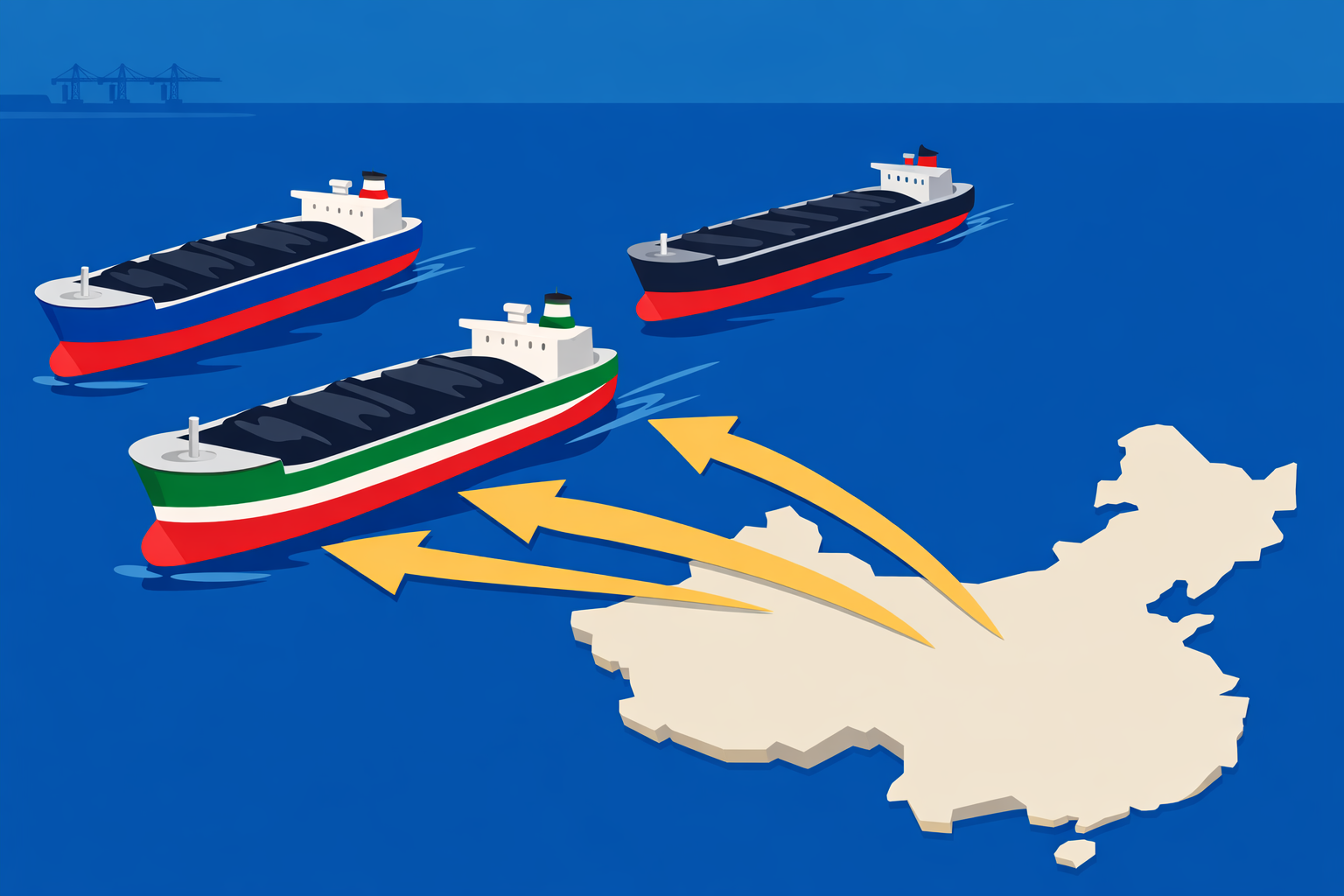
Russia and Iran are locked in a quiet price war for China’s oil market—and the barrels are piling up at sea. As India retreats from Russian crude purchases under pressure from a new U.S. trade deal, displaced cargoes are flooding eastward, forcing Moscow and Tehran to offer steeper discounts to a shrinking pool of Chinese buyers. Meanwhile, tens of millions of barrels sit idle on tankers off Asian coastlines, a visible symptom of a global supply imbalance that is testing OPEC+ strategy and reshaping the geopolitics of energy.
The Discount Deepens
The numbers tell a stark story. Russia’s ESPO blend—shipped from the Kozmino port in the Far East to Shandong’s independent refineries—has widened to nearly $9 per barrel below ICE Brent, up from the $7–$8 range that prevailed through much of late 2025. Urals crude, Russia’s flagship grade shipped from Baltic Sea ports, is trading at an even steeper $12 per barrel discount to Brent, with traders expecting the gap to grow further.
Iran is feeling the squeeze too. Its benchmark Iran Light grade has been changing hands at roughly $8 below Brent in recent months, up from around $6 last September. The widening reflects not just sanctions pressure but intensifying competition: Russian barrels displaced from the Indian market are now crowding into the same Chinese buying channels that Iranian crude has relied on for years.
The trigger is geopolitical. The U.S.–India trade deal, announced in early February, effectively links lower American tariffs for Indian goods to a freeze on Indian purchases of Russian oil. India’s imports from Russia could drop by 40% from January levels to around 600,000 barrels per day, according to Rystad Energy estimates. That is a massive volume of crude suddenly looking for a new home—and China is the only realistic destination at scale.
Barrels on the Water
Floating storage—crude oil sitting on tankers at sea for more than seven days, effectively in limbo—has surged to levels that unnerve market participants. Iranian crude in floating storage doubled from roughly 18 million barrels in August 2025 to over 36 million barrels by November, according to Kpler data. In Asia alone, oil in floating storage climbed by 20 million barrels in two months to reach 53 million barrels by late 2025, with much of it originating from Russia, Iran, and Venezuela.
The picture has only grown more complex in 2026. Shadow fleet VLCCs (Very Large Crude Carriers)—the aging, often anonymously flagged tankers that move sanctioned oil outside mainstream shipping networks—saw their employment collapse in January. Many now sit in floating storage offshore Asia, unable to find buyers willing to take delivery. Kpler’s Q1 2026 tanker outlook describes these vessels as seeking employment “primarily in the Iranian trade—the only remaining market of scale.”
What makes floating storage so consequential is its dual nature. On one hand, stranded barrels represent supply that is not reaching the market, acting as an inadvertent buffer against a price crash. On the other, if those barrels eventually find buyers—through new sanctions workarounds, fresh Chinese import quotas, or a relaxation of enforcement—they would hit an already oversupplied market with force. Gunvor CEO Torbjörn Törnqvist put it bluntly at ADIPEC late last year: if all sanctions were to disappear, “this market would clearly be quite oversupplied.”
China’s Bargaining Power
For China, this is a buyer’s paradise with strategic undertones. The world’s largest crude importer brought in a record 11.6 million barrels per day in 2025, and an estimated 22% of those imports—over 2.6 million barrels per day—were sanctioned crudes from Russia, Iran, and Venezuela. China’s independent refiners, the so-called “teapots” of Shandong province, are the most aggressive buyers of deeply discounted feedstocks, constrained mainly by government-issued import quotas rather than price sensitivity.
The savings are enormous. Analysts estimate China saves roughly $8 billion annually on discounted Russian oil and $7 billion from Iranian crude—a combined $15 billion windfall that helps cushion an economy still navigating post-pandemic headwinds. And as competition between sanctioned suppliers intensifies, those discounts are widening further.
But this strategy carries risk. Beijing is concentrating its energy supply chain on politically exposed sources. Over 80% of Iran’s crude exports now flow to China. Russia has become China’s single largest oil supplier. The collapse of Venezuelan exports following the U.S. intervention in January 2026 demonstrated how quickly a supply line can be severed. As one Columbia University analysis noted, what began as a clever circumvention of Western sanctions could become a strategic liability—regime risk, not supply scarcity, is now China’s primary energy vulnerability.
China’s state-owned refiners appear to recognize this. Sinopec and PetroChina have largely avoided sanctioned barrels since late 2025, following new U.S. sanctions on Rosneft and Lukoil. The national oil companies are building at least 169 million barrels of new storage capacity through 2026, suggesting Beijing is preparing for potential supply disruptions even as it continues to exploit current discounts.
OPEC+ in a Bind
The flood of discounted sanctioned crude creates a structural headache for OPEC+. The alliance reaffirmed plans to keep production flat through Q1 2026, but the IEA’s January report painted a sobering picture: global oil supply could exceed demand by nearly 4 million barrels per day this year—an unprecedented annual surplus. Observed global oil stocks rose by 470 million barrels in 2025 alone.
Brent crude has averaged around $63 per barrel in Q1 2026, with recent spikes above $71 driven almost entirely by U.S.–Iran tensions rather than supply–demand fundamentals. The EIA forecasts Brent will average just $58 for the full year, potentially falling below $55 in 2027. For Saudi Arabia, which needs oil revenues to fund its Vision 2030 agenda, these numbers are uncomfortable.
The kingdom has responded with tactical maneuvering—reportedly restricting exports specifically to the United States to engineer drawdowns in American commercial inventories, the most transparent and closely watched stockpile data in the world. But the play is limited. Global floating storage remains at multi-year highs, non-OPEC+ supply growth from the Americas (the U.S., Brazil, Guyana, Canada) continues at roughly 1.3 million barrels per day, and the EV transition is slowly eroding demand growth in Europe and China.
OPEC’s own admission of a potential supply surplus in 2026—reversing years of bullish forecasts—was a watershed moment. It acknowledged what the market already sensed: the cartel’s ability to manage global prices is being eroded by forces it cannot control—sanctioned barrels moving through shadow channels, non-OPEC production growth, and a structural demand slowdown.
The Sanctions Paradox
Perhaps the most striking irony is that Western sanctions, designed to squeeze revenue from Russia and Iran, are simultaneously enriching China and undermining OPEC+ cohesion. Between March 2022 and mid-2024, China saved an estimated $16 billion on Russian crude alone, according to calculations by Russia Matters at Harvard. The price cap mechanism, intended to limit Moscow’s oil revenue while keeping Russian barrels on the market, effectively transferred wealth from Russia to its remaining buyers.
Enforcement remains spotty. Ship-tracking data shows that at least 34 tankers linked to sanctions evasion sailed under the Cook Islands flag in 2024–2025, with registration available remotely through what AFP described as a beachside office next to a pizza shop. The shadow fleet has grown to roughly 200 VLCCs—about 100 officially sanctioned, another 100 that have carried sanctioned barrels in recent months.
The U.S. has shown a willingness to escalate: seizing tankers near Venezuelan waters, imposing new designations on Chinese port infrastructure, and linking India’s trade deal to Russian oil restrictions. But each enforcement action creates new displacement effects, pushing barrels into floating storage or forcing them through ever more circuitous routes—which in turn deepens China’s leverage as the buyer of last resort.
What Comes Next
The oil market in 2026 is caught between two forces: a structural surplus that points toward lower prices and a geopolitical risk premium—centered on Iran and the Strait of Hormuz—that keeps Brent from sliding into the $50s. The EIA estimates that a $10-per-barrel Iran risk premium is currently embedded in prices.
For investors, the implications are layered. Energy equities face margin compression if Brent trends toward the high-$50s. Emerging market currencies tied to oil revenues—the Russian ruble, the Nigerian naira, the Colombian peso—remain vulnerable. Tanker stocks may benefit from the inefficiencies created by shadow fleet dynamics and extended voyage times, but the sector’s outlook depends heavily on enforcement trajectories.
The deeper question is whether the current architecture of oil sanctions is sustainable. China’s import machine continues to absorb discounted barrels at record pace. Russia and Iran, facing no alternative buyers at scale, will keep cutting prices to maintain market access. And OPEC+, caught between revenue needs and market share concerns, has fewer tools to stabilize a market that increasingly operates on two parallel tracks—one governed by published benchmarks and alliance agreements, the other by shadow fleets, opaque STS transfers, and yuan-denominated settlements.
The barrels on the water are not just a logistical footnote. They are the physical manifestation of a global energy order in transition—one where sanctions, pricing power, and strategic stockpiling have become as important as geology and extraction costs.