Oil traders have seen geopolitical shocks before. But Iran’s latest warning — that it will attack any vessel attempting to pass through the Strait of Hormuz — targets one of the world’s most critical energy arteries. This is no longer about regional conflict. The stakes now reach into inflation forecasts, central bank strategy, and the outlook for global growth.
On March 2, Ebrahim Jabari, a senior adviser to the commander-in-chief of Iran’s Islamic Revolutionary Guard Corps (IRGC), declared the strait closed and threatened to set ablaze any ship that attempted transit. The warning came as Tehran retaliated against coordinated US-Israeli strikes under Operation Epic Fury, launched on February 28, which struck military infrastructure, nuclear sites, and killed Supreme Leader Ali Khamenei.
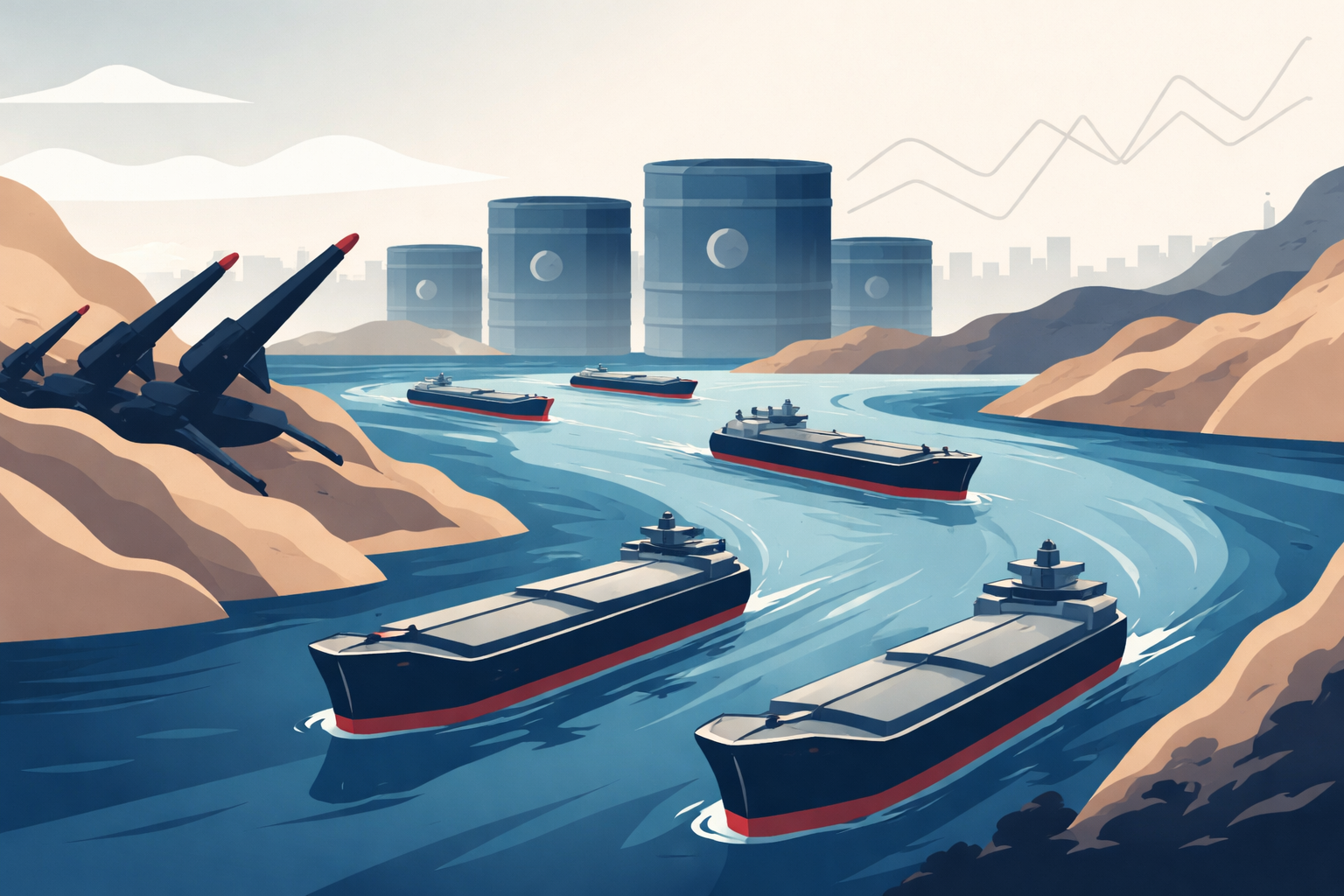
The Strait of Hormuz, roughly 33 kilometres wide at its narrowest point between Iran and Oman, carries approximately 20 million barrels of oil per day — about a fifth of global supply. It is also a vital corridor for liquefied natural gas: Qatar, which accounts for roughly 20 percent of global LNG exports, ships nearly all of its volumes through the waterway. When these flows are disrupted, the economic transmission runs fast: oil prices spike, inflation expectations shift, bond yields reprice, currencies move, and equities sell off.
That transmission is already well underway.
The Market Reaction So Far
Brent crude surged roughly 8 to 13 percent in initial trading, settling near $78.70 per barrel, with West Texas Intermediate climbing above $71. European natural gas prices exploded — up nearly 50 percent at one point — after QatarEnergy halted LNG production following Iranian drone strikes on its facilities. Asian LNG benchmarks followed, with the JKM-TTF spread widening as buyers scrambled for alternative supply.
Ship-tracking data tells the story on the ground. Maritime intelligence firm Windward reported that tanker traffic through the strait has effectively collapsed. As of March 2, no tankers were broadcasting AIS signals in the primary shipping lanes. At least 150 crude and LNG tankers dropped anchor in open Gulf waters. Maersk, Hapag-Lloyd, CMA CGM, and Japanese lines NYK, Mitsui O.S.K., and Kawasaki Kisen all suspended Hormuz transits. War-risk insurance has been withdrawn for the corridor, and protection and indemnity cover was pulled effective March 5, making passage economically unviable even before considering the physical threat.
At least three tankers were struck near the strait, including one set ablaze off the coast of Oman. The IRGC claimed responsibility for a drone attack on the Athe Nova tanker. CENTCOM has maintained that the strait remains technically open, but the distinction between a formal blockade and a de facto closure has become academic. For the shipping industry, the risk calculus is identical.
The Inflation Channel
Energy price spikes feed directly into headline consumer prices. Every $10 per barrel increase in oil is estimated to add roughly 0.2 percentage points to the US Consumer Price Index. For Europe, the exposure is more acute.
ECB Chief Economist Philip Lane, in an interview with the Financial Times published on March 3, warned that a prolonged conflict would produce upward pressure on inflation and weigh on economic activity. He pointed to a December 2023 ECB scenario analysis that modelled a disruption to one-third of Strait of Hormuz oil and gas flows: in that exercise, oil prices would surge more than 50 percent to around $130 per barrel, eurozone growth would fall by 0.6 percentage points in the following year, and inflation would rise by more than 0.8 points.
The timing is uncomfortable. Eurozone inflation came in at 1.9 percent for February — an unexpected uptick from 1.7 percent in January. Before the war, ECB economists had projected inflation would drift slightly below the 2 percent target through 2027. That trajectory is now in question.
European gas reserves are already unusually low heading into the restocking season. Traders are watching closely: if Qatar’s LNG production remains offline, Europe will need to compete aggressively for cargoes this summer, driving prices higher at precisely the wrong moment.
Central Bank Dilemma
For the ECB, the conflict arrives just as the Governing Council had been debating its next move on rates. In February, a rate cut was shelved due to geopolitical uncertainties. The next policy meeting is scheduled for March 18-19, and the outbreak of war makes easing even less likely. ECB President Christine Lagarde acknowledged the risks publicly on March 2, noting the bank is monitoring the situation closely for economic consequences. Lane was more pointed: underlying inflation remains above target, and wage growth has been slightly firmer than expected. He stated plainly that he sees no argument for taking risks on inflation.
Markets appear to agree. Pricing currently implies no change to the ECB’s 2 percent deposit rate for the remainder of 2026.
The Federal Reserve faces a parallel bind. Before the conflict, markets had priced an 80 percent probability of a rate cut at the March meeting. Those odds have collapsed to near zero. The ISM Manufacturing Prices Index leapt to 70.5, reinforcing the stagflationary signal. The Powell Fed was already cautious on inflation — the January FOMC minutes tilted hawkish — and an energy shock only reinforces the case for holding. Turkey’s central bank provides a preview of the pressure on emerging markets: it sold an estimated $8 billion in foreign exchange on March 3 and saw overnight rates spike roughly 300 basis points.
The SPR Question
The Trump administration has signalled no immediate plans to release oil from the Strategic Petroleum Reserve. The reserve currently holds approximately 415 million barrels — a little over half its capacity — following record drawdowns under the Biden administration in 2022. Secretary of State Marco Rubio indicated a programme to mitigate energy costs would begin, but offered no specifics.
Kevin Book of ClearView Energy Partners framed the constraint clearly: in a supply crisis, duration matters. A full Hormuz disruption could outlast the combined strategic reserves of the United States and other IEA member nations. OPEC+ has pledged to increase output by 206,000 barrels per day, but a critical portion of Gulf spare capacity sits behind the very chokepoint that is now effectively closed. Saudi Arabia’s East-West Pipeline and the UAE’s Fujairah pipeline offer partial bypass routes, but throughput limitations mean they cannot offset a full strait closure.
What Comes Next
The range of outcomes remains wide, and markets are pricing accordingly. At one end, the US military’s destruction of Iranian naval assets — President Trump claimed nine warships sunk — could degrade Tehran’s ability to sustain the blockade. Energy Aspects founder Amrita Sen argued that US and Israeli military superiority would prevent a permanent closure. But she added a critical caveat: sporadic attacks on individual tankers are far harder to prevent, and that alone is enough to keep most commercial operators away.
At the other end, a sustained disruption that lasts weeks rather than days would push Brent well above $100 per barrel, according to analysts at Barclays and Goldman Sachs. The Atlantic Council’s Landon Derentz noted that during US operations in Iraq from 2003 to 2011, crude averaged roughly $72 per barrel in nominal terms — above $100 adjusted for inflation — and the global economy still grew. But that comparison has limits: the current shock is layered on top of existing tariff uncertainty, fragile consumer confidence, and central banks that have less room to manoeuvre.
The most consequential variable is not whether the strait formally reopens. It is how long the insurance market stays closed. War-risk premiums, not Iranian gunboats, are doing the work of blockade right now. Until underwriters return to the corridor, the physical geography of the strait matters less than the financial architecture surrounding it.
For energy security planners, the crisis is already prompting a structural reassessment. Alternative pipeline routes are being stress-tested for the first time this decade. China’s strategic crude reserves, accumulated during years of oversupply, position Beijing as a potential swing actor. And the assumptions underpinning global LNG contracts — that Qatari cargoes would flow predictably through Hormuz — are being revisited in real time.
The strait may not stay closed for long. But the repricing of risk it has triggered will outlast the crisis itself.