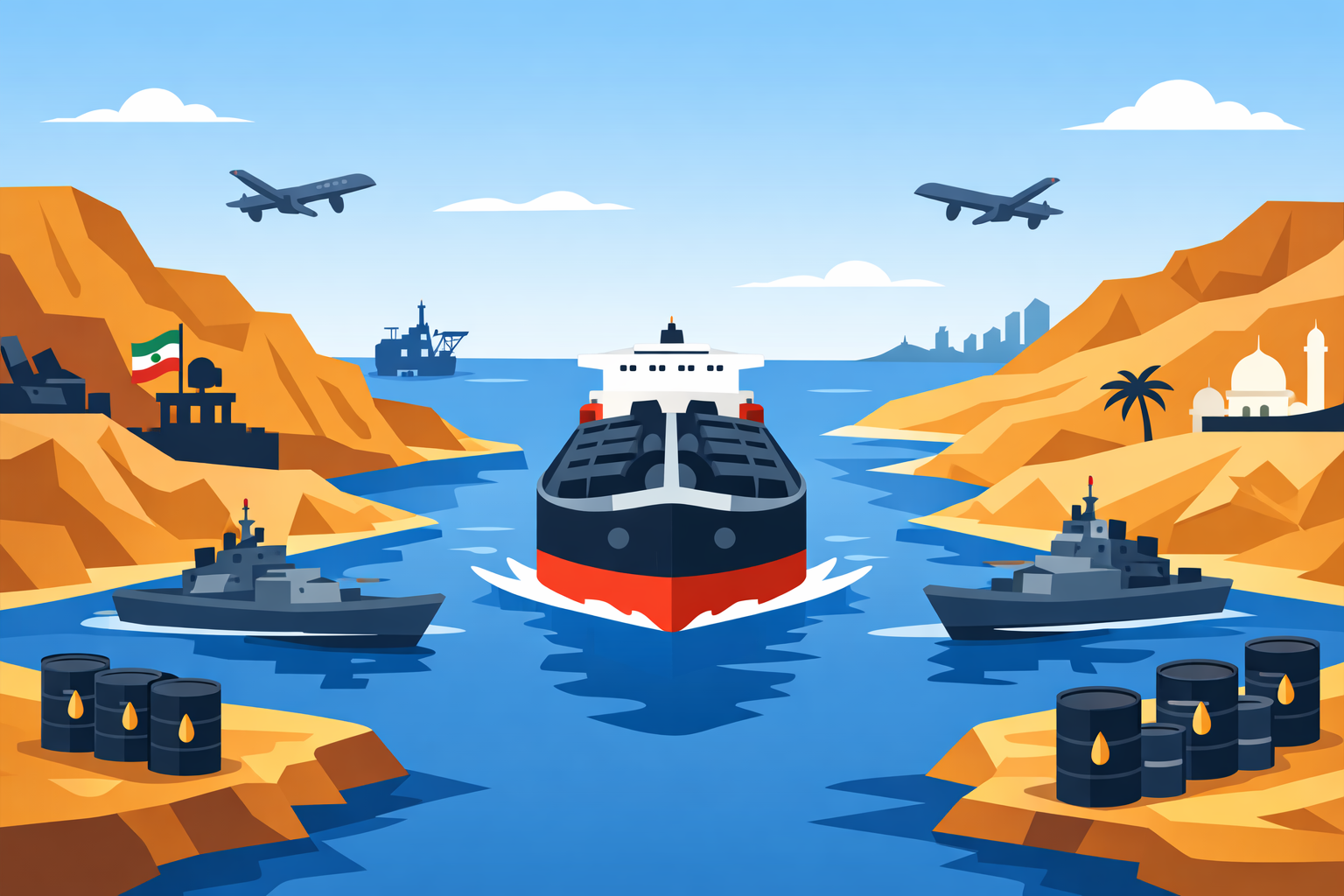
The stretch of water between Iran and Oman is only about 21 miles wide at its narrowest point. Two shipping lanes, each roughly two miles across, carry tankers in opposite directions. In normal times, roughly 20 million barrels of oil and petroleum products move through this passage every day — about one-fifth of what the world consumes. As of this week, almost nothing is getting through.
On March 2, 2026, a senior IRGC commander confirmed that the Strait of Hormuz was closed to maritime traffic, warning that any vessel attempting to pass would be targeted. On March 4, IRGC Navy official Mohammad Akbarzadeh doubled down, declaring that the strait was under “the complete control of the Islamic Republic’s Navy.” Ship-tracking data tells the same story: tanker traffic through the strait has fallen to near zero, with over 200 vessels stranded outside the waterway and major container lines — Maersk, MSC, CMA CGM, Hapag-Lloyd — suspending all transits.
This is no longer a hypothetical scenario that analysts game out in risk reports. It is happening now.
How We Got Here
The crisis traces directly to Operation Epic Fury, the coordinated U.S.–Israeli airstrikes launched on February 28 against Iranian military installations, nuclear sites, and leadership targets. The strikes killed Supreme Leader Ali Khamenei, an event without precedent in the Islamic Republic’s history. Iran’s response was immediate: retaliatory missile and drone barrages struck Israeli cities, U.S. military bases in the UAE, Qatar, and Bahrain, and — critically — Gulf energy infrastructure. Qatar’s state-owned QatarEnergy ceased LNG production at its Ras Laffan and Mesaieed facilities after drone attacks. Storage facilities at Fujairah and Oman’s Duqm port were also hit.
Within hours of the initial strikes, the IRGC began broadcasting warnings on VHF radio channels: no ships would be permitted to pass. At least three tankers were struck near the strait in the days that followed, including one off Oman’s coast that was set ablaze. The message was clear enough. Even before Iran formally declared the strait closed, insurers began withdrawing coverage. Protection and indemnity insurance — the financial backbone of commercial shipping — was pulled for transits beginning March 5, effectively making passage economically impossible regardless of physical risk.
The Insurance Blockade
This is a detail that deserves emphasis, because it reveals how modern energy disruptions actually work. Iran did not need to deploy a full naval blockade or mine the strait the way it did during the 1980s Tanker War. It needed only to create enough risk — through selective drone strikes, missile threats, and radio warnings — for insurers and shipping companies to make a commercial calculation.
War-risk premiums had already climbed from 0.125% to between 0.2% and 0.4% of ship insurance value per transit in the days before the strikes. For a very large crude carrier, that translates to a quarter of a million dollars in additional cost for a single passage. Once P&I coverage was withdrawn entirely, the calculus tipped. No insurer, no transit. The strait is technically open water. In practice, it is closed.
Energy consultancy Kpler described the situation bluntly: the insurance withdrawal is doing the work that a physical blockade has not. For cargo flows, the outcome is largely the same.
What the Markets Are Saying
Brent crude, which closed near $73 per barrel on the Friday before the strikes, surged as high as $84 in the days following. As of Tuesday, March 4, it was trading around $81 after briefly easing when President Trump announced that the U.S. Development Finance Corporation would offer political risk insurance for tankers transiting the Gulf. WTI crude followed a similar trajectory, settling around $74–75.
These are significant moves, but they are not — yet — the catastrophic spike that a sustained closure would produce. Barclays warned clients that Brent could reach $100 per barrel if disruptions persist. UBS analysts put the figure higher, noting that a prolonged blockade with damage to export infrastructure could push spot prices above $120. For context, one analyst at Responsible Statecraft estimated that even a single day of full blockade could theoretically double prices from pre-crisis levels.
Part of the reason markets haven’t panicked further is the cushion of global stockpiles. China, the world’s largest crude importer, entered this crisis with 7.6 million tons of LNG inventory and substantial crude reserves. The IEA estimates that global spare production capacity sits near 4 million barrels per day through 2026, concentrated in Saudi Arabia and the UAE. OPEC+ has pledged to increase output by 206,000 barrels per day.
But here is the catch: much of that spare capacity sits behind the very chokepoint that is currently blocked. Saudi Arabia’s East-West Pipeline to the Red Sea has a theoretical capacity of 7 million barrels per day, but terminal infrastructure at Jeddah limits actual throughput. The UAE’s Fujairah bypass pipeline offers partial relief but cannot substitute for full tanker access. Iraq, OPEC’s second-largest producer, is in the worst position — its southern export terminal at Basra depends entirely on Hormuz access, and there is no meaningful alternative route.
Who Gets Hurt
The geographic distribution of pain is strikingly uneven. About 84% of crude oil and condensate shipments through the strait were destined for Asian markets in 2024. China alone imports roughly 5 million barrels per day via this route, while also buying more than 80% of Iran’s own oil exports. India faces what Kpler analysts describe as a “dual physical and financial shock” — over half its LNG imports are Gulf-linked, and its oil import contracts are Brent-indexed, meaning a Hormuz-driven crude spike simultaneously lifts both oil costs and LNG contract prices.
South Asia is acutely exposed. Pakistan and Bangladesh source virtually all their LNG from Qatar and the UAE. Pakistan has already requested that Saudi Arabia reroute crude supplies through the Red Sea port of Yanbu. Nomura’s research flagged Thailand, India, South Korea, and the Philippines as the most vulnerable Asian economies to sustained high oil prices.
European natural gas futures have jumped more than 20–30% as the disruption hits Qatar’s LNG exports, which represent about 20% of global trade. U.S. natural gas spot prices have risen more modestly, reflecting America’s domestic production capacity and newer LNG terminal infrastructure that buffers the shock.
The Russia Factor
One underreported dimension: the crisis significantly improves Russia’s competitive position in crude markets. With Middle Eastern barrels facing logistical disruption, both India and China have strong incentives to increase purchases of Russian crude, which ships via alternative routes. India, facing the most acute near-term supply exposure, is likely to pivot immediately toward Russian barrels. China, which had recently been moderating its Russian crude intake, may well reverse that restraint. Moscow stands to benefit from a price spike it did nothing to engineer.
What Comes Next
The situation remains deeply uncertain. On one hand, President Trump has signaled willingness to talk with Iran, and his offer of U.S. government-backed insurance for tanker transits represents an attempt to restore shipping without resolving the underlying conflict. On the other hand, Tehran’s leadership is in disarray following Khamenei’s death, and it remains unclear who is making strategic decisions or whether the IRGC will act independently of any civilian diplomatic channel.
Most analysts are pricing in a spike-and-partial-recovery pattern — Brent settling back into the $70–80 range by the end of this week if no further escalation occurs. But that scenario assumes a lot: that Iran does not strike additional Gulf infrastructure, that shipping insurers resume coverage, that the IRGC stands down its threats. If any of those assumptions break, the path toward $100 oil — or beyond — opens quickly.
There is also a structural concern that extends beyond this week’s crisis. Even before Operation Epic Fury, global spare capacity was concentrated in a small number of Gulf producers whose export routes all converge on a single 21-mile-wide passage. The vulnerability has been known for decades. The difference now is that it is no longer theoretical. The world is seeing, in real time, what happens when the single most important chokepoint in global energy trade is taken offline — not by a naval fleet, but by a combination of drones, radio warnings, and insurance spreadsheets.