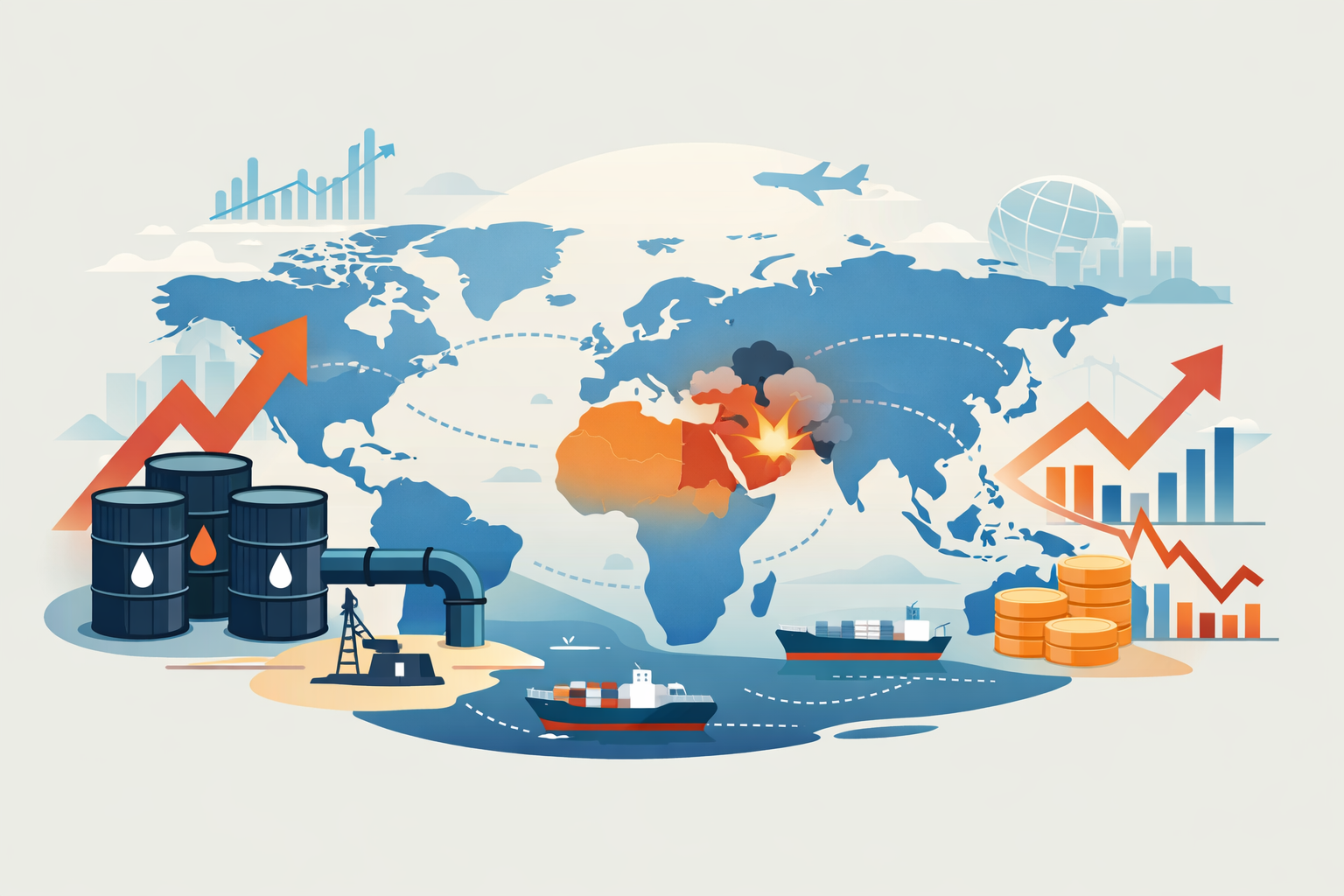
The escalating conflict in the Middle East is rapidly turning into a major test for the global economy.
The International Monetary Fund’s Managing Director, Kristalina Georgieva, issued a stark warning on Thursday: if the war proves prolonged, it carries “obvious potential to affect global energy prices, market sentiment, growth, and inflation, placing new demands on policymakers everywhere.” Speaking at the Asia in 2050 Conference in Bangkok, Georgieva framed the conflict not as a regional shock but as a structural challenge—another episode in what she described as a world entering “a potentially prolonged period of flux.”
For most of the world, uncertainty about the Middle East had already been background noise. Now it’s front-page risk.
The Oil Shock Is Already Underway
Oil is the most direct economic transmission channel, and the market has moved decisively. Brent crude has risen roughly 36% since the start of 2026, according to LSEG data, surging from around $73 a barrel before U.S. and Israeli strikes on Iran began to a mid-week high above $85. As of Wednesday, Brent was trading near $83 a barrel—its highest settlement since early 2025.
The critical variable is the Strait of Hormuz. About 20% of global petroleum and LNG passes through this narrow waterway off Iran’s southern coast every day. Iran declared the strait closed following the initial strikes, and while vessels technically can still pass, insurers have effectively halted coverage for transiting ships. The practical result: tanker traffic has stalled.
Iraq—OPEC’s second-largest producer—has already cut output by roughly 1.5 million barrels per day, lacking both storage space and export routes. Qatar declared force majeure on LNG exports on Wednesday, with analysts estimating it could take at least a month for volumes to normalize. These are not hypothetical disruptions. Physical barrels have been affected.
Barclays analysts warned clients in a note this weekend that Brent could reach $100 per barrel as the situation escalates. UBS went further, flagging scenarios where prompt prices exceed $120. Bank of America put the threshold for European natural gas breaking 60 euros per megawatt hour squarely in play if the Strait disruption persists. Energy Aspects’ Amrita Sen, speaking to CNBC, suggested prices would likely consolidate around $80 “for some time”—and that was before Wednesday’s further gains.
Saudi Arabia has contingency plans to reroute crude via its East-West pipeline to the Red Sea, bypassing Hormuz. But that pipeline’s terminal infrastructure at Jeddah limits throughput well below what the strait handles. Strategic petroleum reserves exist precisely for moments like this. The question is how long they can act as a buffer.
Central Banks Caught Off Guard
This shock arrives at a particularly awkward moment for monetary policymakers. After the most aggressive rate-hiking cycle in decades, central banks in the U.S. and Europe had been edging toward easing. That path just became significantly more complicated.
U.S. inflation stood at 2.4% in January—above the Federal Reserve’s 2% target, but manageable. Former Treasury Secretary Janet Yellen noted on Monday that the Iran situation puts the Fed “even more on hold, more reluctant to cut rates than they were before.” President Trump’s tariffs, already projected to push annual inflation to at least 3% according to Yellen’s own estimates, now have energy price pressure piling on top.
The European Central Bank faces a similar bind. Higher oil prices feed directly into headline inflation, complicating any further easing just as the eurozone economy was showing signs of stabilizing. The ECB’s data-dependent approach, so carefully telegraphed over the past year, suddenly looks harder to execute cleanly.
Emerging markets may face the sharpest adjustment. Many are net oil importers with limited fiscal buffers and currencies already under pressure from dollar strength and U.S. tariff uncertainty. Nomura’s macro research team noted that governments across Asia may resort to subsidies, fuel tax cuts, and price controls to cushion consumers—but Rob Subbaraman, the bank’s head of global macro research, framed it bluntly: “Which ‘negative’ do you want: higher inflation or worse fiscal?”
That is precisely the kind of question that keeps finance ministers awake at night.
Markets Are Responding, But Not Panicking—Yet
Equity markets have reacted with characteristic ambivalence. S&P 500, Nasdaq, and Dow futures all fell more than 1% at Monday’s open, while energy stocks rallied sharply—Exxon and Chevron up more than 4% in pre-market trading, European majors including Shell and TotalEnergies following suit. Defense stocks surged. Safe-haven flows lifted U.S. Treasuries and gold.
The market’s relative composure reflects a bet that the conflict resolves quickly. Traders, as one energy analyst noted, are “seeing this through a slightly shorter-term lens”—geopolitical shocks that come and go without lasting supply damage. The precedent from Iran’s 12-day conflict with Israel in June 2025, which ended with a ceasefire, supports that reading.
But the current conflict is materially different. It is not a contained exchange of strikes. U.S. and Israeli forces have systematically targeted Iranian air defense, naval capabilities, and leadership, reportedly killing Supreme Leader Ali Khamenei. Tehran has responded with missile strikes across multiple Gulf states. The conflict has already widened: a U.S. strike hit an Iranian warship off Sri Lanka on Wednesday. The U.S. Senate has declined to invoke the War Powers Act, effectively backing the military campaign.
Duration, not just intensity, is the variable that will determine economic damage.
Supply Chains Beyond Oil
Energy prices are the headline, but the economic ripple effects extend further. LNG disruption is already putting pressure on European gas markets, which surged more than 20% since the conflict began. Industrial manufacturers across Europe and Asia with energy-intensive production processes face a sharp upward cost shock.
Asian economies are disproportionately exposed. According to Kpler data, roughly three-quarters of oil transiting Hormuz in 2025 went to China, India, Japan, and South Korea. India is already seeking alternative energy supplies; some Chinese refineries are bringing maintenance schedules forward. The IMF’s Georgieva specifically highlighted energy security as the key vulnerability for Asia: “For most of Asia, what is at stake is energy security and, through that, confidence.”
Russia’s competitive position in oil markets is, perversely, improving. With Middle Eastern barrels facing logistical disruption, both India and China have strong incentives to deepen reliance on Russian crude—a shift that carries its own set of geopolitical complications for the West.
Global shipping more broadly is under pressure. Insurance premiums for vessels anywhere near the Gulf have hit six-year highs. Rerouting cargoes adds time and cost. The supply chain fragility exposed during COVID has not fully healed, and this shock is arriving through a different chokepoint but with similar structural consequences.
The Bigger Picture: A More Shock-Prone World
The IMF has been consistent in its messaging: the global economy is entering a period of structural instability, not just cyclical volatility. “We live in a more shock-prone world, a world of higher uncertainty,” Georgieva said in June. That warning looks prescient now.
The baseline for 2026 was already fragile. Global growth had been revised down due to U.S.-China trade tensions and Trump’s tariff regime. Debt levels in major economies remain elevated. Geopolitical fragmentation—supply chains decoupled from efficiency in favor of resilience, trade blocs hardening, multilateral institutions under strain—has made the global economy less adaptable than it was a decade ago.
Into that environment, a full-scale conflict involving the world’s most critical oil-transit chokepoint is not a tail risk. It is the scenario that risk managers had modeled and hoped not to see.
KPMG’s U.S. energy strategy leader Angie Gildea captured the tension well: strategic reserves, rerouted cargoes, and elevated inventories are genuine buffers—”but those are stopgaps.” The critical variable, she wrote, is duration. A few weeks of disruption is manageable. A prolonged conflict with sustained Strait closure is a different economic proposition entirely.
IMF First Deputy Managing Director Daniel Katz, speaking at the Milken Institute earlier this week, acknowledged it remains too early to quantify the full economic impact. The honest answer is that nobody knows. What is clear is that the range of outcomes is wide, the downside scenarios are severe, and the global economy—already carrying significant weight from trade fragmentation and accumulated debt—has limited room to absorb them.
The world has managed oil shocks before. It has managed regional wars before. Managing both simultaneously, against a backdrop of elevated inflation, tightening fiscal space, and deteriorating geopolitical cohesion, is the test that is now underway.