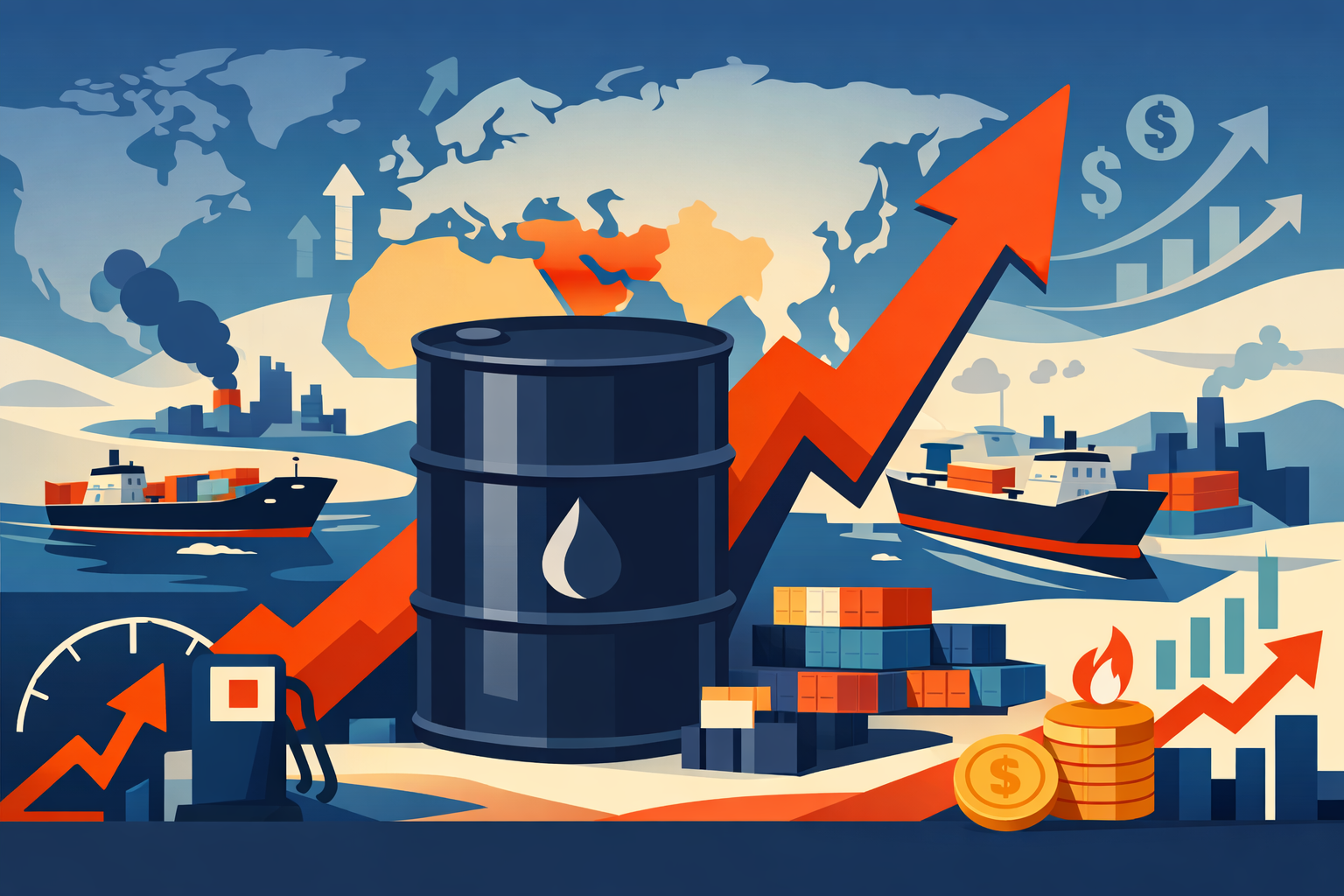
Oil is no longer just rising. It has broken back into the center of the global economic story. Crude prices briefly topped $119 a barrel last week — the highest since 2022 — as the widening conflict between the United States, Israel, and Iran disrupted supply through one of the world’s most critical shipping chokepoints. Governments are scrambling to respond. The IMF is warning of renewed inflation pressure. And markets are being forced to reckon with a question many had hoped was behind them: what happens when energy shocks return at the worst possible time?
This is not a routine commodity swing. What makes this moment dangerous is its context. The global economy was already navigating fragile growth, sticky inflation, and an uncertain path toward lower interest rates. An oil shock of this scale has the potential to complicate all three at once.
What Triggered the Surge
The immediate cause is geopolitical. The expanding U.S.-Israeli military campaign against Iran has disrupted shipping through the Strait of Hormuz, the narrow waterway through which roughly a fifth of the world’s oil supply passes daily. Reuters reported that the strait was effectively shut, sending shockwaves through energy markets.
Brent crude surged roughly 14 percent to settle around $105.71 a barrel. West Texas Intermediate rose about 13 percent to $103.06. Both benchmarks briefly exceeded $119 intraday before pulling back — but even the settled prices represent a dramatic repricing of global energy costs in a matter of days.
Traders are not just reacting to current disruption. They are pricing in the risk that supply losses could deepen or persist. When oil markets move on geopolitical fear, the uncertainty premium tends to stay elevated until the threat clearly recedes. That has not happened yet.
Why Oil Shocks Spread Far Beyond Energy Markets
A spike in crude prices might seem like a story confined to commodity desks and energy companies. It is not. Oil remains the single most important input price in the global economy, and when it moves sharply, the effects ripple outward fast.
The transmission is straightforward. Higher crude prices push up the cost of fuel and transportation. That feeds into logistics, manufacturing, food production, and the price of virtually every physical good that moves by truck, ship, or plane. Airlines feel it immediately. So do farmers, freight companies, and anyone who fills a tank.
For consumers, this means higher prices at the pump, in grocery stores, and eventually across a range of everyday goods and services. For businesses, it means rising input costs at a time when many were already struggling to protect margins. And for central banks, it means an unwelcome new source of inflationary pressure arriving just as they were hoping to ease policy.
This is why equity and bond markets react to oil spikes well before the hard data shows up in inflation prints. Markets price expectations, and the expectation right now is that the path ahead just got harder.
The Inflation Problem Returns
The IMF moved quickly to flag the risk. Managing Director Kristalina Georgieva warned that the Middle East conflict could push global inflation higher, noting that a 10 percent increase in oil prices sustained for most of the year could add roughly 40 basis points to global inflation.
Forty basis points may sound modest in isolation. In practice, it is significant. For economies where inflation has been slowly declining toward central bank targets, an additional 0.4 percentage points could mean the difference between rate cuts arriving on schedule and being pushed back by months.
The implications are broad. If inflation falls more slowly, central banks in the U.S., Europe, and across Asia will have less room to cut interest rates. The “soft landing” narrative — the idea that inflation could return to target without a recession — becomes harder to sustain. Mortgage rates stay elevated for longer. Corporate borrowing costs remain high. Consumer confidence, already fragile in many countries, takes another hit.
Georgieva captured the mood plainly: “We are seeing resilience tested again by the new conflict in the Middle East.” She also urged governments and institutions to prepare for scenarios they might prefer not to consider — to “think of the unthinkable and prepare for it.”
Governments Are Already Responding
The speed of official responses tells you how seriously this shock is being taken. Across Asia, governments have moved to shield consumers and stabilize domestic markets. Measures include fuel-price caps, the removal of import tariffs on energy products, and budget allocations to absorb part of the price increase before it reaches households.
At the international level, G7 countries have begun discussing a coordinated release of emergency oil reserves — a tool used sparingly and typically only when supply disruptions are considered severe enough to threaten economic stability.
These steps can soften the near-term blow. Price caps and subsidies buy time for consumers. Reserve releases can temporarily ease physical supply tightness. But none of them solve the underlying problem. As long as the Strait of Hormuz remains constrained and regional production is at risk, the structural supply gap persists. Policy responses are palliative, not curative.
Market Winners and Losers
Not every sector loses from an oil spike. Energy producers — particularly those outside the conflict zone — stand to benefit from higher revenues. Commodity-linked assets and inflation-sensitive plays, such as certain real estate investment trusts and commodity funds, may also find support. For oil-exporting nations, higher prices improve fiscal balances, at least temporarily.
The losers, however, are more numerous and more visible. Airlines are among the most exposed; fuel is their largest variable cost, and airline shares came under immediate pressure as crude rose. Transportation and logistics companies face similar margin compression. Consumer discretionary sectors — retail, leisure, hospitality — suffer as household purchasing power erodes.
Import-dependent economies are especially vulnerable. Countries that rely heavily on energy imports, including much of East and Southeast Asia and parts of Europe, face deteriorating trade balances, currency pressure, and a direct pass-through to domestic prices. For these economies, the oil shock is not abstract. It arrives in utility bills, food prices, and transport fares.
What to Watch Next
The situation remains fluid, and a few key variables will determine whether this remains a sharp but temporary disruption or evolves into a longer-lasting economic headwind.
First, the Strait of Hormuz. Whether it reopens to normal shipping traffic — and how quickly — is the single most important near-term factor. Second, regional production losses. If output from Gulf producers is further curtailed by the conflict, the supply gap widens regardless of what happens at the strait.
Third, the response from reserve-holding nations. A coordinated release from the G7 and allied countries could temporarily ease the physical market, but its scale and timing matter enormously. A token release will not move prices much. A large, sustained one could help — but also depletes a strategic buffer that may be needed later.
Fourth, inflation expectations. If consumers and businesses start to expect higher inflation, that shift in psychology can become self-reinforcing, making it harder for central banks to hold the line. Bond yields and inflation-linked securities will signal whether that is happening.
And fifth, central bank language. Watch for any shifts in tone from the Federal Reserve, the European Central Bank, and the Bank of Japan. If policymakers begin hedging their forward guidance or explicitly citing energy risks, it will confirm that the oil shock is entering the monetary policy calculus.
The Bigger Picture
The world economy was not in a comfortable position before this crisis. Growth was uneven, disinflation was incomplete, and the path to lower interest rates was already narrow and uncertain. What the oil surge does is inject a new source of risk — one driven not by domestic demand or monetary conditions, but by geopolitics.
That distinction matters. Demand-driven inflation can be addressed, at least in theory, by tightening policy. A supply shock caused by war is different. Central banks cannot drill for oil or reopen a shipping lane. They can only react to the inflationary consequences — and their tools for doing so come with their own costs.
The economic significance of this moment lies not just in the price of a barrel of crude. It lies in the uncertainty the crisis injects into every forward-looking decision — from central bank rate paths to corporate investment plans to household budgets. When the source of inflation shifts from something manageable to something unpredictable, the entire risk calculus changes.
For now, markets are watching. Governments are acting. And the question hanging over the global economy is no longer whether oil prices matter — it is how long this matters, and how far the damage spreads.