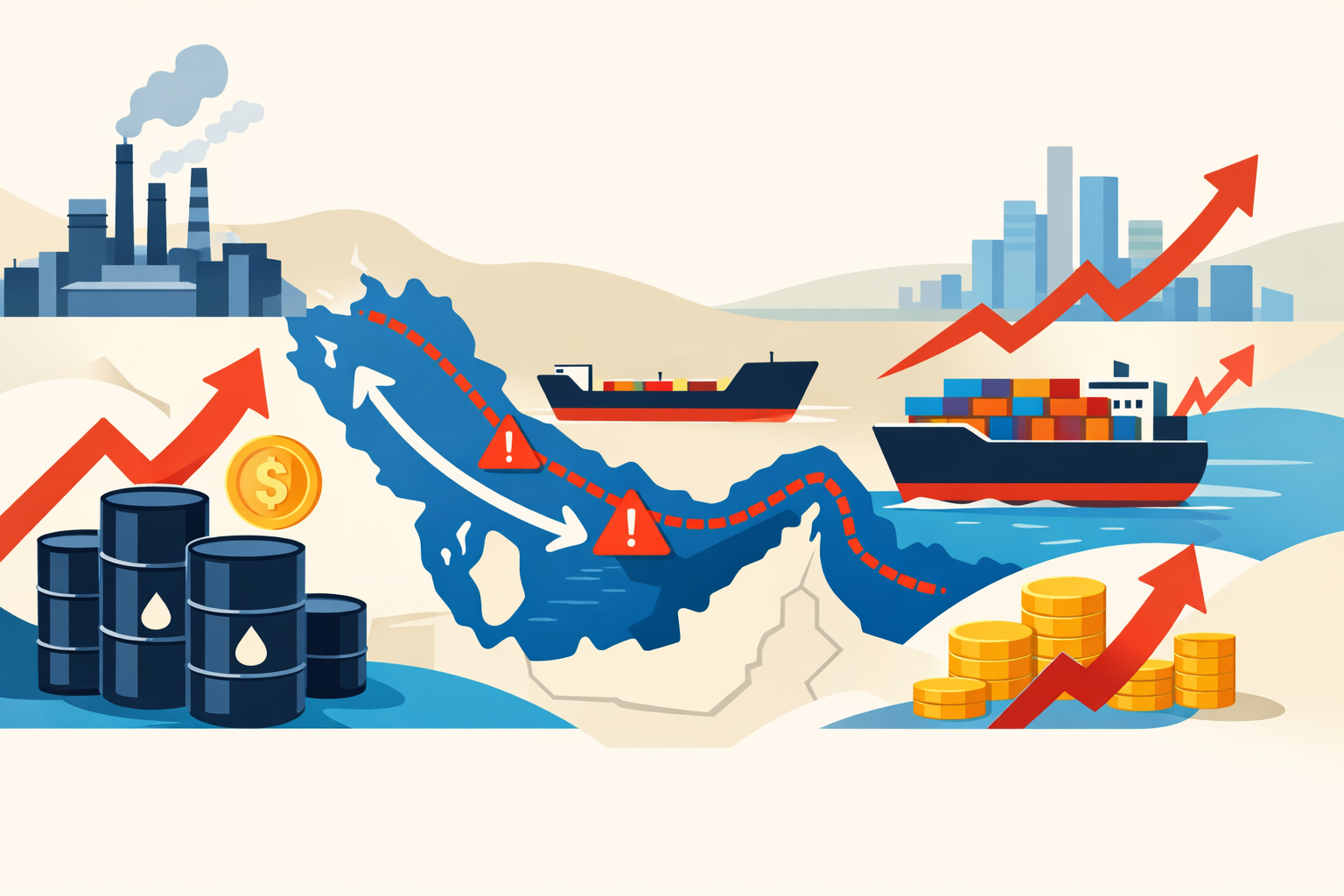
When Saudi Aramco — the world’s largest oil exporter — uses the word “catastrophic,” it is not hyperbole. It is a risk assessment. And the risk Aramco is now flagging, an extended closure of the Strait of Hormuz, is one that would ripple far beyond the tanker lanes of the Persian Gulf.
The warning from Aramco CEO Amin Nasser, that a prolonged blockage of the strait could have “catastrophic consequences” for global oil markets, marks a meaningful shift in how the energy industry is framing the Iran conflict. This is no longer being discussed merely as a regional flare-up with temporary market implications. It is being discussed as a potential structural disruption — the kind that takes months, not days, to repair.
A Chokepoint the World Cannot Afford to Lose
The Strait of Hormuz is a narrow waterway — at its tightest, barely 33 kilometers wide — separating Iran from the Arabian Peninsula. Through it passes roughly one-fifth of the world’s oil supply: Saudi Arabian crude, Qatari LNG, Emirati oil, and the exports of Iraq and Kuwait. There is no realistic alternative route for most of that volume. The pipelines that exist bypass the strait only partially and lack the capacity to substitute at scale.
That concentration of energy flow through a single geographic point has long been considered one of the most acute vulnerabilities in the global commodities system. Insurance markets, shipping companies, and energy traders have priced that risk for decades — almost always assuming it would never fully materialize. The current situation is testing that assumption in real time.
What makes a Hormuz disruption particularly damaging is not just the question of physical oil supply. It is the machinery that surrounds it. Marine insurers have already begun pulling back from the region. When war risk insurance becomes unavailable or prohibitively expensive, tanker operators cannot sail regardless of whether the physical passage is open. The effect on supply is essentially the same: oil stops moving.
A Market That Swings on Words
Brent crude surged to nearly $120 a barrel at the height of the crisis, a level not seen since Russia’s invasion of Ukraine sent energy markets into shock in 2022. Then, in a single session, oil tumbled more than 7% after comments from former President Donald Trump suggesting possible de-escalation in the Middle East. By that point, prices had retreated to around $92 a barrel.
That whiplash tells its own story. Markets are not pricing a stable geopolitical outlook; they are pricing the daily news cycle. The structural risk to supply — the physical constraints on tanker movement, the retreat of insurance underwriters, the rerouting of shipping traffic — does not disappear because a political figure signals optimism. It merely gets temporarily discounted.
This is a pattern energy markets have seen before. Sentiment can turn on a single headline. The underlying vulnerability does not.
The Economic Transmission Belt
For most readers, an oil-price number on a financial news feed is abstract. The real-world translation is less so.
Crude oil is the feedstock for an enormous range of economic activity. Fuel prices at the pump are the most visible channel, but they are far from the only one. Airlines operate on jet fuel; higher energy costs feed directly into airfares. The chemicals sector — which supplies inputs to plastics, fertilizers, and pharmaceuticals — is heavily dependent on oil derivatives. Automotive manufacturing, long-haul trucking, agricultural machinery: all of it runs on refined products priced off crude.
Shipping costs add another layer. When tanker operators face higher insurance premiums or route around a conflict zone, freight rates rise across the board. Container shipping rates — still elevated in global memory from the pandemic-era supply-chain crisis — are sensitive to energy cost shocks. A prolonged Hormuz disruption could push those rates higher again, adding yet another inflationary layer to the goods that stock supermarkets, auto dealerships, and electronics retailers across Europe, Asia, and North America.
The secondary effects on food prices deserve particular attention. Much of the world’s fertilizer supply is produced using natural gas — a commodity that also transits the region in large volumes as liquefied natural gas (LNG). Qatar, which passes a significant share of its LNG exports through Hormuz, is one of the world’s top LNG suppliers. A disruption to that flow would hit energy prices in Europe and Asia, but it could also, with a lag, pressure food production costs in vulnerable economies where fertilizer is already expensive.
Policymakers Are No Longer on the Sidelines
The fact that G7 energy ministers and European Union leaders moved quickly to convene emergency coordination calls on soaring energy prices is significant. This is the point where a market story becomes a policy story — and the two operate on different timescales.
The EU’s exposure is acute. Europe imports more than 90% of its oil and around 80% of its natural gas. Since Russia’s invasion of Ukraine in 2022, European governments have spent billions restructuring their energy supply chains, locking in LNG contracts and building storage capacity. A major new disruption in the Persian Gulf would stress test all of that, arriving before the continent has fully digested the previous shock.
Policy responses being discussed include releases from strategic petroleum reserves — the emergency oil stockpiles that governments maintain precisely for situations like this — as well as fuel tax adjustments and emergency LNG procurement. These tools can cushion a short-term shock. They cannot, however, replace the roughly 20% of global oil supply that flows through the Strait of Hormuz if that channel remains compromised for an extended period.
The Problem No Central Bank Wants
Perhaps the most consequential dimension of this crisis, from a macroeconomic standpoint, is what a renewed energy-price shock would do to monetary policy.
Central banks in Europe, Japan, and across Asia had spent much of the past year cautiously engineering a path toward interest-rate cuts after a sustained battle with post-pandemic inflation. The European Central Bank (ECB) and the Bank of Japan (BOJ) were both navigating this transition carefully, trying to ease financial conditions without reigniting inflationary pressure. A sharp and sustained rise in energy prices disrupts that calculus entirely.
The central-bank dilemma is textbook but no easier to navigate for being familiar: a supply-side energy shock simultaneously pushes prices up and growth down. It is stagflationary by nature. Cut rates to support growth, and you risk embedding higher inflation expectations. Hold rates to contain prices, and you deepen any economic slowdown. There is no clean answer.
For Europe, where energy import dependence is structural and growth was already fragile heading into this year, the combination of higher fuel costs, slowing trade, and tighter financial conditions is a particularly uncomfortable one. Japan faces a similar bind, having only recently begun to unwind its decades-long ultra-loose monetary policy.
More Than a Price Spike
Aramco’s language — “catastrophic consequences” — invites scrutiny precisely because of who is saying it. A company of Aramco’s standing does not use that framing casually. The concern being signaled is not simply that oil might become expensive for a month or two. It is that a prolonged Hormuz disruption could produce second-order effects that markets and governments have not yet fully priced: a lasting contraction in tanker capacity serving the region, a restructuring of global energy trade routes, and an extended period of supply-chain uncertainty that feeds inflation in ways that are slow to reverse.
Oil-price spikes, historically, have tended to be self-correcting. Demand falls, producers ramp up elsewhere, and prices eventually moderate. What is harder to reverse is the damage done during the period of disruption itself — the investment plans shelved, the contracts repriced, the inflation expectations that once embedded in wage negotiations and supply-chain contracts tend to linger.
That is the economic reality behind the headline. The Strait of Hormuz is not just a shipping lane. It is a load-bearing pillar of the global energy system. And right now, that pillar is under pressure in a way that has not been seen in decades.