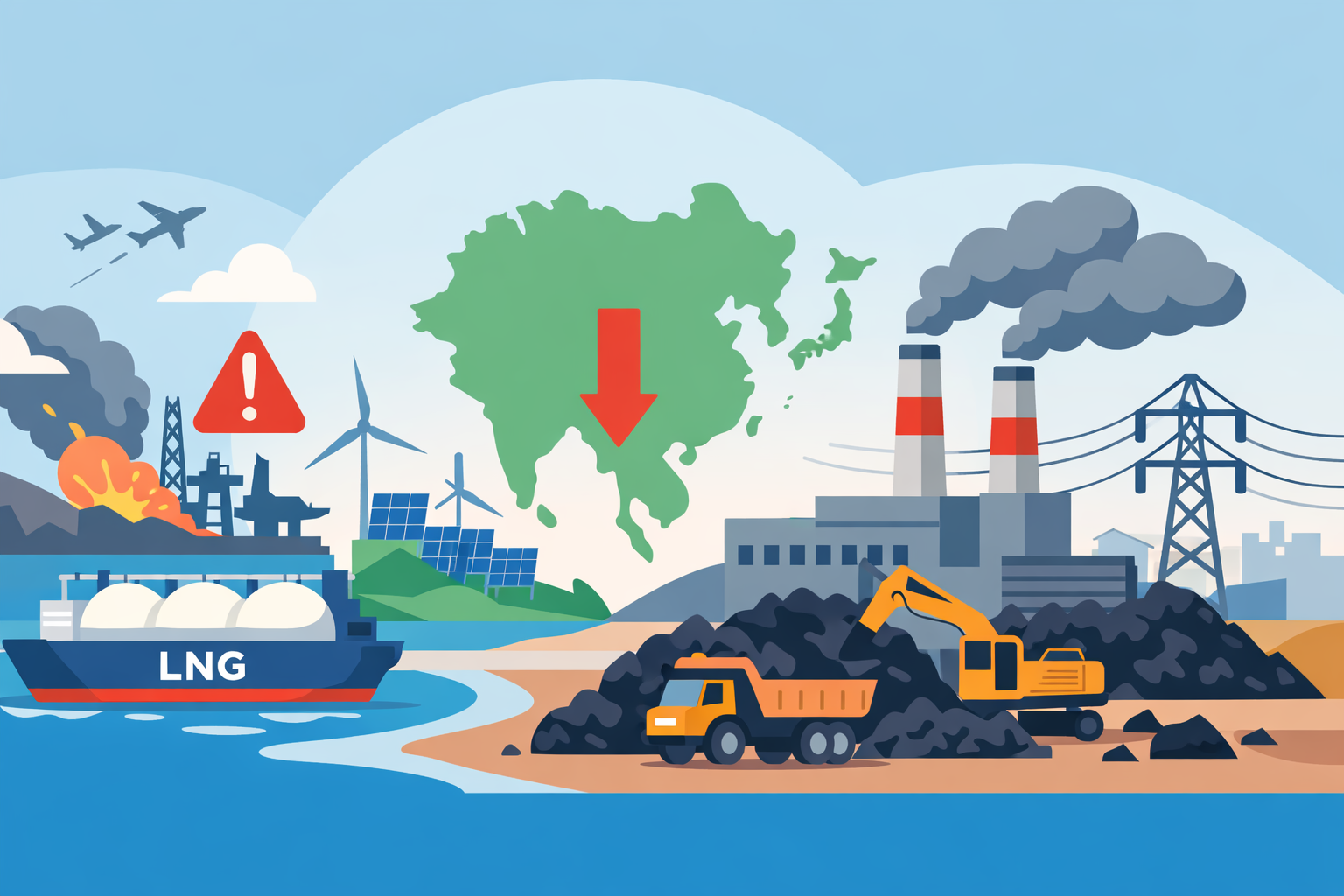
Middle East conflict is choking LNG supply and pushing Asian utilities back toward coal, revealing how energy security and price shocks can derail the region’s transition plans.
Asia’s energy transition has run into a brutal geopolitical reality. As the U.S.-Israeli war on Iran chokes LNG flows through the Strait of Hormuz, utilities across the region are falling back on the fuel they know can still keep the lights on: coal.
The shift is not just a short-term market reaction. It reveals how fragile Asia’s energy security remains — and how quickly decarbonization goals can be sidelined when supply shocks hit.
The Immediate Shock
Spot LNG prices in Asia have doubled to three-year highs since shipping through the Strait of Hormuz ground to a near-halt and Qatar — the world’s second-largest LNG exporter — suspended shipments. QatarEnergy declared force majeure on exports after Iranian drone strikes damaged facilities at Ras Laffan Industrial City and Mesaieed Industrial City on March 2, setting off a chain reaction through global LNG markets.
Roughly 20% of the world’s fossil energy trade passes through the Strait of Hormuz. When that chokepoint closes, there is no quick workaround. LNG is semi-fungible at best: it requires specialized ships, regasification terminals, and long lead times to redirect. Unlike oil, which can be rerouted through pipelines or strategic reserves, disrupted LNG cargoes leave importing countries with fewer options and less time.
Asian utilities responded the way utilities do when fuel gets scarce and expensive. They switched. Coal is available. It is storable. Its supply chains run through different geographies and different chokepoints. And for most power systems in Asia, coal-fired capacity is already built and paid for — it simply needs to be dispatched harder.
Why Asia Is Especially Exposed
Asia was structurally vulnerable to exactly this kind of shock. The region’s gas demand growth had already been slowing before the war began: the International Energy Agency reported that Asia Pacific gas consumption expanded by less than 1% in 2025, the weakest pace since the energy crisis of 2022. Tight supply fundamentals, elevated prices, and competition with European buyers for flexible LNG cargoes had already been squeezing Asia’s price-sensitive importers.
The war has now turned a difficult market into a crisis. Wood Mackenzie cut its 2026 forecast for Asian LNG imports from 12.4 million metric tons of growth to just 5 million, assuming a two-month disruption to Middle East supply. War-driven supply shortfalls are expected to trigger outright demand destruction across the region, with prices likely to remain elevated and volatile even after the fighting stops.
But the pain is not evenly distributed. South Asian economies — Bangladesh, Pakistan, and parts of India — face the most acute stress. These are markets where LNG affordability was already precarious and where the infrastructure for gas-to-power remains underdeveloped. Southeast Asia sits in the middle: countries like Thailand, the Philippines, and Vietnam have meaningful LNG exposure but also significant domestic coal capacity they can lean on. Northeast Asian importers — Japan, South Korea, and to some extent China — face supply-security calculations rather than immediate crisis, thanks to larger stockpiles, diversified contracts, and more resilient grid infrastructure.
Country by Country, the Same Pattern
The responses playing out across the region tell a consistent story: coal first, questions later.
Bangladesh is increasing coal-fired power generation and coal-based power imports, according to daily government data for March. Pakistan is pushing harder on domestic energy sources, aided by recent solar capacity additions that helped it avoid a repeat of the rolling blackouts that followed Russia’s 2022 invasion of Ukraine. Pakistan’s Power Minister Awais Leghari has framed the current strategy as building on lessons from that earlier crisis.
In Southeast Asia, the Philippines is ramping up coal-fired output while slashing gas-fired generation. Vietnam’s state utility EVN is actively negotiating coal supply contracts. Thailand is boosting output from its largest coal plant to conserve LNG reserves.
Further north, the picture is more nuanced but still coal-supportive. South Korea has announced plans to remove ceilings on coal-fired generation and increase nuclear output as a dual hedge. Japan’s JERA — the world’s largest LNG buyer, handling roughly 35 million metric tons per year — told Reuters it will maintain coal-fired generation at high utilization rates. JERA’s Global CEO Yukio Kani warned that if the crisis deepens, restarting dormant coal plants and asking consumers to conserve energy may become necessary.
Kani’s framing was notably measured: he acknowledged there is no immediate LNG shortage, but said it would be “far too optimistic” to assume the situation resolves quickly. JERA is already in discussions with long-term suppliers about additional procurement. Meanwhile, KOGAS — South Korea’s state gas corporation — signed an MOU with JERA to deepen cooperation on supply management, including LNG cargo swaps, in a sign that Northeast Asia’s two largest buyers are coordinating their response.
China, the world’s largest energy importer, is better positioned than most. Its onshore crude stockpiles are estimated at 1.2 billion barrels, and it has rapidly electrified its economy — including the world’s largest EV fleet — reducing its marginal exposure to fossil fuel disruptions. But China too can fall back on coal if needed, and it has vast domestic reserves to draw on.
The Market Arithmetic Behind the Switch
The economics of the fuel switch are straightforward. Asia’s benchmark thermal coal price has risen 13.2% this month — a meaningful move, but dwarfed by the surge in LNG prices. For now, coal import demand is being muted by the fact that major buyers like China, India, Japan, and South Korea are drawing on ample stockpiles and long-term contracts. The coal rally may be limited in the near term.
But relative pricing is what matters for dispatch decisions. When spot LNG doubles in price, coal-fired generation becomes dramatically cheaper per megawatt-hour. That gap drives fuel-switching at the plant level, regardless of what national energy plans or climate pledges might say. Utilities make dispatch decisions in real time, and the arithmetic right now strongly favors coal.
This is the second time in four years that Asian utilities have found themselves in this position. The 2022 energy crisis after Russia’s invasion of Ukraine triggered a similar wave of coal switching. The pattern is becoming structurally familiar — and that has implications for how investors, policymakers, and utilities think about long-term fuel commitments.
What This Means for the Transition
Here is the central contradiction: natural gas has been losing share in Asia’s power generation for nearly a decade. Ember data shows that renewables growth has been steadily eroding gas-fired generation’s role across the region, even as global energy majors have poured billions into LNG supply projects banking on Asian demand growth.
The war has not reversed that underlying trend. If anything, the repeated exposure to supply shocks may accelerate it. Analysts note that rising fuel import costs strengthen the case for domestically generated renewable energy — solar and wind do not transit chokepoints. Pakistan’s recent solar buildout is already paying off in reduced LNG vulnerability. Over time, this logic may prove more powerful than the short-term return to coal.
But the short term matters enormously. Grid reliability depends on dispatchable generation, and in most Asian power systems, that means fossil backup. Renewable additions cannot be fast-tracked overnight to replace missing LNG cargoes. Coal fills the gap because coal is there.
The result is that decarbonization in Asia does not move in a straight line. It moves in fits and starts, with emergency reversions to coal whenever the imported fuel supply chain breaks. Each reversion complicates the narrative, locks in emissions, and forces difficult political recalculations.
The Investment Overhang
One of the most consequential long-term effects may be on LNG import infrastructure. High costs and infrastructure constraints have already led to widespread delays and cancellations of proposed LNG import capacity in South Asia. Global Energy Monitor reported last week that $107 billion in LNG infrastructure investments could be at risk in the region.
If repeated shocks keep undermining confidence in LNG reliability and affordability, the investment calculus shifts. Some of that capital may redirect toward domestic coal where it remains politically acceptable, nuclear expansion in countries that can support it, faster renewables-plus-storage deployment, or broader diversification of LNG supply contracts away from Middle Eastern dependence.
JERA’s recent moves illustrate the diversification logic. The company signed a 27-year LNG supply agreement with QatarEnergy earlier this year — a vote of long-term confidence in the relationship — but is now simultaneously seeking additional procurement from non-Gulf suppliers. Venture Global, the second-largest U.S. LNG exporter and a JERA supplier, just greenlighted phase 2 of its CP2 project in Louisiana, which its CEO says should start production next year.
The message from the market is clear: LNG is not going away, but its supply base needs to be wider, more resilient, and less concentrated in geopolitically fragile corridors.
The Lesson That Keeps Repeating
The real takeaway from Asia’s coal pivot is not simply that coal is back. Coal never fully left. In a region where hundreds of millions of people still depend on affordable, reliable electricity from existing coal plants, the fuel has always been one supply shock away from a resurgence in dispatch.
The deeper lesson is that energy security remains the first priority for Asian policymakers — ahead of climate targets, ahead of investor narratives about the energy transition, ahead of long-term decarbonization roadmaps. When imported fuel chokepoints can upend planning overnight, governments will reach for whatever keeps the grid stable and the bills manageable.
That does not make the transition impossible. It makes it uneven, messy, and vulnerable to the kind of geopolitical disruption that is becoming a recurring feature of global energy markets rather than an exception. Anyone betting on a smooth, linear path from coal to gas to renewables in Asia needs to account for the fact that the path runs through the Strait of Hormuz — and right now, that strait is closed.