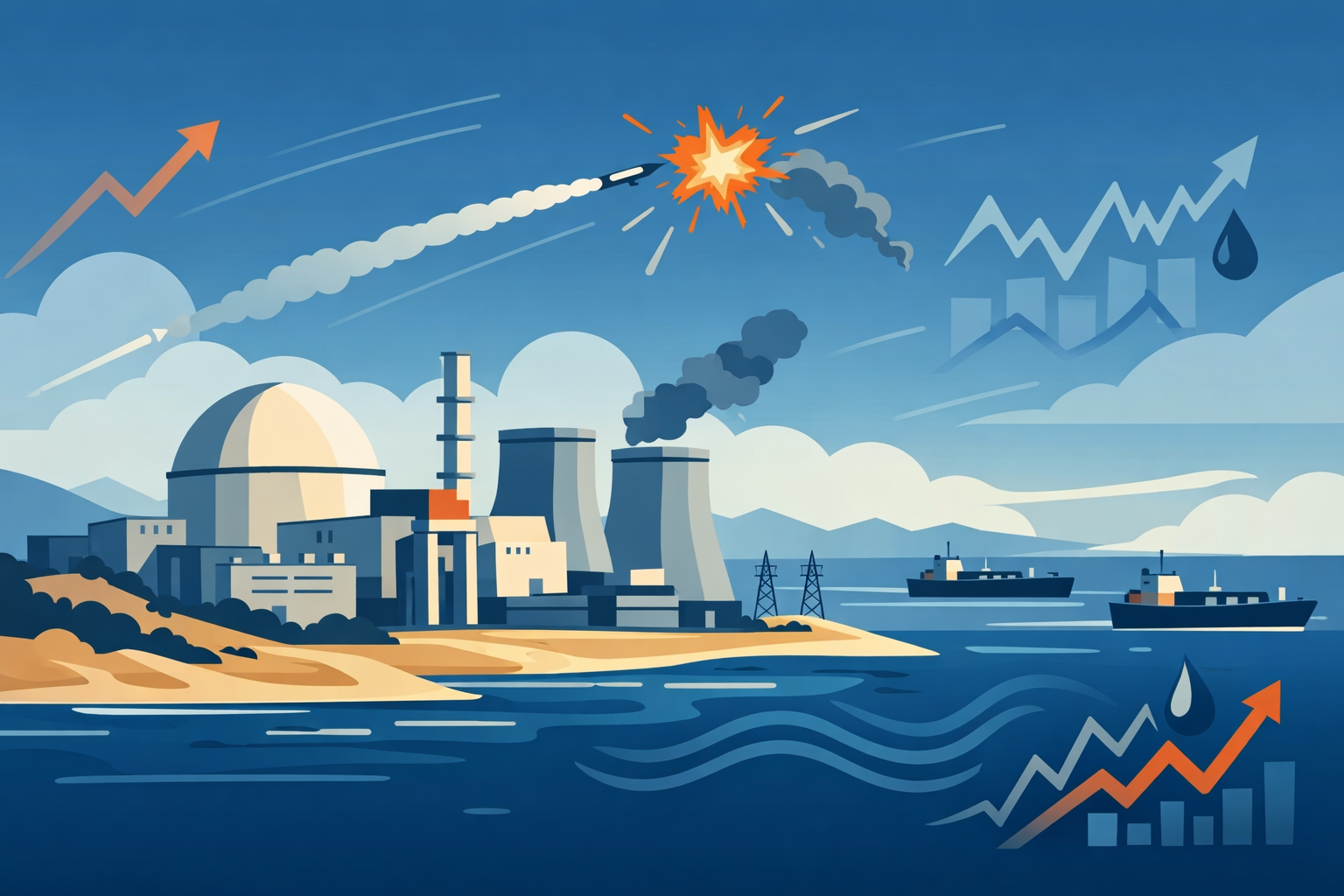
A projectile hit the premises of Iran’s Bushehr nuclear power plant on Tuesday evening, according to the International Atomic Energy Agency. No damage to the plant and no injuries to staff were reported. In ordinary circumstances, a near-miss with no physical consequences might register as a footnote in a fast-moving conflict. But Bushehr is not an ordinary target. Once military action comes close enough to touch an operating nuclear facility, the economic story around the entire conflict changes shape.
The IAEA’s statement was characteristically spare. It confirmed that Iran had informed the agency of the strike and that IAEA Director General Rafael Grossi had renewed his call for “maximum restraint during the conflict to prevent risk of a nuclear accident.” Rosatom, the Russian state nuclear corporation that built and operates the reactor, said the projectile struck near the metrology service building—close to the plant’s operating power unit—at around 6:11 p.m. local time. No Rosatom personnel were harmed, and radiation levels remained normal.
That is the good news. The less reassuring part is what the incident signals about the trajectory of the broader conflict and, with it, the stability of global energy markets.
Bushehr is Iran’s only operating nuclear power plant. Situated on the country’s southern Persian Gulf coast, roughly 17 kilometers southeast of the city of Bushehr, it generates around 1,000 megawatts of electricity using a Russian-designed reactor that has been supplying the grid since 2011. About 480 Rosatom employees remain on site, following two rounds of earlier evacuations, with preparations underway for a third.
The plant’s strategic sensitivity goes beyond its function as a power station. It sits in a region that matters enormously for global energy logistics. The Persian Gulf and the Strait of Hormuz—through which a significant share of the world’s seaborne oil flows—are close enough that any incident at Bushehr reverberates through the calculations of shipping insurers, oil traders, and central bank risk models simultaneously. A military event that touches nuclear infrastructure in this geography is not just a battlefield development. It is a signal that the conflict’s reach now extends to assets whose disruption carries consequences far beyond any conventional military target.
Attacks near operational nuclear facilities raise a category of fear that ordinary strikes do not. Even when the reactor itself is untouched, the proximity introduces the possibility—however remote—of radiation release, emergency shutdowns, evacuation crises, and a diplomatic escalation that moves faster than the military situation on the ground. The symbolism matters as much as the shrapnel.
For investors and policymakers, the key question is not whether the plant was damaged. It is how the incident changes the distribution of possible outcomes they need to price. Markets do not wait for worst-case scenarios to materialize. They start repricing as soon as those scenarios feel more plausible.
The transmission mechanism is straightforward. Conflict escalation near Gulf energy infrastructure feeds directly into fears about shipping route disruption and insurance costs, which in turn push crude oil risk premiums higher. Those premiums do not require an actual supply cut to take hold. They expand on probability—on the market’s assessment that the chance of a serious disruption has increased, even if the disruption has not yet occurred.
The Bushehr incident sharpens that assessment. If the conflict can reach nuclear-related infrastructure, the reasoning goes, it can potentially reach other critical facilities too: export terminals, pipeline junctions, refining capacity. Each incremental step closer to those assets makes the risk premium harder to unwind.
Oil price shocks transmit into consumer prices with uncomfortable speed. Fuel costs feed directly into transport and logistics expenses, which then pass through into manufacturing inputs and retail prices. Countries that import the bulk of their energy—much of Europe, Japan, South Korea, large parts of South and Southeast Asia—feel the effects within weeks, not months. February’s U.S. consumer price index already showed rising housing costs but had not yet captured the full impact of higher oil, a lag that makes the next few readings politically and economically consequential.
For central banks, the timing is difficult. Policymakers who were already managing fragile growth trajectories and cautiously navigating rate decisions now face a renewed commodity shock risk layered on top of existing pressures. The U.S. Federal Reserve is widely expected to hold rates at its current meeting, with analysts noting that geopolitical risk and oil-driven inflation are clouding the outlook. The European Central Bank, the Bank of Japan, and other major institutions face similar dilemmas: how to anchor inflation expectations when the price of the world’s most important commodity is being driven by events that no monetary policy tool can control.
This is the point at which the Bushehr incident stops being a Middle Eastern story and becomes a global one. A motorist in Frankfurt, a factory manager in Osaka, and a trucking company in São Paulo may never have heard of Bushehr. They will notice if their fuel bill rises further because markets have decided that nuclear-adjacent conflict in the Gulf demands a larger risk cushion in the price of crude.
Several indicators will tell the story from here. Oil benchmarks—Brent crude and WTI—are the most visible, but intraday volatility patterns may be more revealing than headline prices, since they capture how quickly traders are adjusting positions in response to each new development. Shipping and tanker insurance rates in the Gulf are another critical signal: a jump in war-risk premiums for vessels transiting the Strait of Hormuz would suggest the market sees a meaningful probability of disruption to physical trade flows.
Safe-haven assets such as gold and the U.S. dollar tend to strengthen when geopolitical risk intensifies, and their behavior in the coming days will offer a gauge of broader investor anxiety. Airline stocks, transport companies, and energy-intensive manufacturers are the equity sectors most exposed to a sustained oil premium. And any official statement from the IAEA, Iran, Gulf states, or major powers regarding escalation or restraint will be parsed immediately for implications about what comes next.
The IAEA’s involvement gives this incident a weight that ordinary battlefield reporting does not carry. The agency’s carefully worded confirmation that a projectile hit the plant’s premises—phrased as information received from Iran, not as an independent verification—places the event into the framework of international nuclear oversight rather than routine military communiqués. Russia has already lodged a formal protest with Israel and called for de-escalation around the facility. Rosatom’s CEO, Alexei Likhachev, warned previously that a direct strike on Bushehr could produce a regional-scale disaster, citing 70 tons of active nuclear fuel and 210 tons of spent fuel at the site.
The diplomatic significance is real. Even a non-damaging incident near a nuclear plant can intensify international pressure for restraint from governments that might otherwise be inclined to let the conflict run its course. It can also sharpen divisions: between those calling for immediate de-escalation and those arguing that deterrence requires continued military pressure. The Bushehr strike—whatever its origin—has widened the conversation from battlefield tactics to the question of whether this conflict risks crossing a threshold that all parties would prefer to avoid.
It is important to be precise about what has and has not happened. There was no nuclear leak, no reactor damage, and no confirmed contamination. The IAEA’s statement relies on information from Iran and does not constitute independent confirmation of the strike’s nature or origin. Neither Iran nor Russia has published images of the damage. The immediate physical consequences, as reported, were none.
But the strategic meaning of the incident is not diminished by the absence of physical damage. The Bushehr strike matters because it shifts the boundary of what is now considered possible in this conflict. Before Tuesday evening, the plant had been untouched—including during the twelve-day war between Israel and Iran in June 2025, when the U.S. struck three Iranian nuclear enrichment sites but left Bushehr alone. That distinction has now been blurred.
What markets, policymakers, and informed readers should watch is not simply whether another projectile lands near Bushehr. It is whether the incident accelerates the broader repricing of risk that has been building since the conflict began in late February. Nuclear-adjacent risk has entered the market narrative in a concrete way that it had not before. The next moves—from the IAEA, from governments, from the combatants themselves—will determine whether this remains an isolated scare or becomes the opening of a more dangerous chapter in the economics of this war.