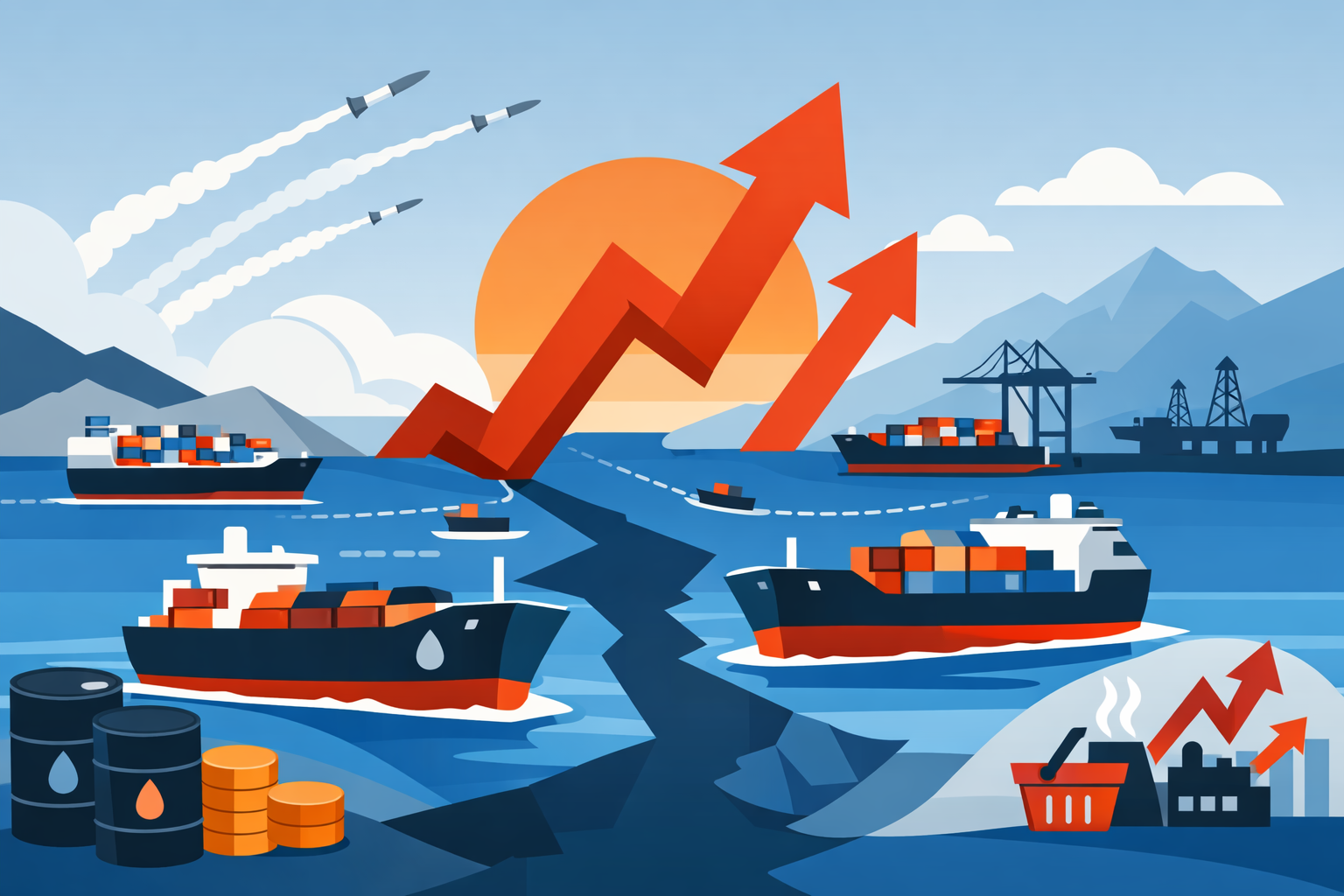
Iran’s latest missile barrage against Israel is not just another escalation in a regional war. It is a reminder that global markets are now trading the Middle East as a direct macroeconomic risk—through oil supply, shipping disruption, and the possibility that inflationary pressures return just as major economies were hoping for relief.
On March 24, Iran launched fresh waves of missiles at Israel, hours after Donald Trump claimed that “very good” talks to end the war were under way. Tehran denied any dialogue had taken place. Iran’s parliamentary speaker, Mohammad Bagher Ghalibaf, called Trump’s remarks an attempt to “manipulate the financial and oil markets.” The Iranian foreign ministry acknowledged receiving messages via mediators but insisted no negotiations were happening.
That sequence—hope, denial, more missiles—captures exactly why this conflict has become a macro story, not just a military one.
The oil channel
Start with the most immediate transmission mechanism: crude prices. As of March 24, Brent was trading around $102 per barrel, up from $101.44 the previous day. WTI hovered near $90–95. Those numbers tell a story of persistent elevation, not a spike-and-retreat. A month ago, before Operation Epic Fury began on February 28, Brent sat below $73. The move since then—roughly 40 percent—has been driven almost entirely by supply disruption risk centered on the Strait of Hormuz.
Here’s what happened in just the last few days. On March 23, oil fell over 11 percent after Trump suggested diplomacy was in play. Traders briefly priced in de-escalation. Then Iran publicly rejected the claim and launched another barrage. Prices reversed. Brent bounced back above $100.
That whipsaw matters. It shows markets are not settling into a new equilibrium. They are lurching between fragile hope and hard reality, and the amplitude of these swings—daily ranges exceeding 5 percent—is far outside normal volatility. The market is in backwardation, a structure that signals acute short-term tightness in physical supply.
Hormuz is the real trigger
The bilateral exchange of fire between Iran and Israel is dangerous. But for the global economy, the Strait of Hormuz is what turns a regional war into a worldwide shock. Roughly 20 percent of the world’s oil and a significant share of global LNG passes through this narrow waterway. Iran partially closed it in the early days of the conflict, and tanker traffic has slowed dramatically, with reports of over 150 ships stranded in the region at various points since the war began.
This is not theoretical risk. It is already biting.
Iran has struck energy infrastructure across the Gulf—refineries in Kuwait, gas facilities in Qatar, oil operations in Abu Dhabi. The attack on Qatar’s Ras Laffan LNG terminal, which can supply roughly a fifth of the world’s liquefied natural gas, forced a shutdown and caused what QatarEnergy described as “extensive damage.” Kuwait’s Mina Al-Ahmadi refinery, the country’s largest, has been hit by Iranian drones on multiple occasions. The UAE has reported intercepting hundreds of missiles and over 1,700 drones since the war began.
In other words, this is no longer just about whether oil can move through Hormuz. Iran is actively targeting the energy production capacity of its Gulf neighbors. That changes the calculus. Even a ceasefire would not immediately restore damaged infrastructure.
Beyond the barrel price
Crude above $100 does not simply mean expensive gasoline, though it means that too. The price feeds through a chain of costs that touches almost every sector. Transport, petrochemicals, aviation fuel, fertilizer, plastics, shipping freight—all are linked to the cost of oil and gas.
The International Energy Agency called the situation the “greatest global energy security challenge in history.” That phrasing may seem dramatic, but consider the scale. IEA member countries have agreed to release 400 million barrels from strategic reserves. The United States alone committed 172 million barrels from the Strategic Petroleum Reserve. Those releases failed to push Brent below $100. When the largest coordinated emergency supply response in history cannot meaningfully dent prices, the market is telling you something about the severity of the disruption.
European natural gas prices have also surged, with the TTF benchmark jumping sharply after the attacks on Ras Laffan. For Europe, which spent three years diversifying away from Russian pipeline gas toward LNG, the disruption of Qatari supply is a painful irony. Asian buyers, who absorb the bulk of Qatar’s LNG exports, face the same problem.
The downstream effects are predictable and painful. Central banks that were cautiously signaling rate cuts—or at least pausing their tightening cycles—are now watching energy-led inflation reassert itself. The European Central Bank has already flagged commodity pass-through to core consumer prices as a concern. The Federal Reserve, which had been navigating toward a softer landing, faces renewed imported inflation pressure at precisely the wrong moment. None of this is speculative: these are the mechanical consequences of a sustained oil shock above $100.
Why the diplomacy whiplash matters for markets
Trump’s public claim about talks did something specific: it briefly repriced risk downward. Oil fell over 11 percent in a single session. Stocks rallied. For a few hours, markets behaved as if the worst might be over.
Then Iran denied the talks, fired more missiles, and the relief evaporated. Trump extended his deadline for Iran to reopen the Strait of Hormuz by five days, warning that otherwise “we’ll just keep bombing our little hearts out.”
For traders and policymakers, the lesson is unsettling. Diplomatic signals can move prices fast, but if those signals collapse just as quickly, the net effect is heightened volatility without resolution. Markets can handle bad news. What they struggle with is the uncertainty of not knowing whether peace signals are real or performative. Iran’s speaker of parliament explicitly accused Trump of market manipulation. Whether that accusation is fair is beside the point—the perception that diplomacy is being used as a price lever is itself destabilizing.
The gap between rhetoric and reality is now a macro variable. Every time a headline suggests talks, traders reprice. Every time that headline collapses, they reprice again. The friction costs of that cycle—in hedging, in insurance premiums, in shipping rerouting—are substantial and growing.
The regional map is expanding
This conflict stopped being bilateral weeks ago. Iran has struck targets in Kuwait, Bahrain, the UAE, Qatar, Saudi Arabia, and Jordan. Gulf states that invested decades in positioning themselves as stable commercial and financial hubs are now dealing with air raid sirens and refinery fires. The UAE alone has intercepted hundreds of missiles and drones. Kuwait has reported civilian deaths. The death toll across the region continues to climb.
For investors with exposure to Gulf real estate, tourism, logistics, or financial services, the calculus has changed fundamentally. Reports describe a mass exodus of foreign residents from cities that were, until recently, considered safe havens for capital and talent. The long-standing assumption that Gulf commercial infrastructure was insulated from regional conflict no longer holds.
Pakistan has announced emergency austerity measures to conserve fuel. Bangladesh has imposed limits on vehicle refueling after panic buying created artificial shortages. India received a temporary U.S. waiver to buy stranded Russian oil cargoes. These are not theoretical spillovers—they are happening now, in real economies, affecting real households.
What comes next
The honest answer is that no one knows how long this lasts. The EIA’s latest forecast assumed Brent staying above $95 for the next two months before falling below $80 by the third quarter—but that projection rests on the modeled assumption that the conflict winds down and production recovers. If it doesn’t, the numbers get much worse.
What is clear is that the Middle East crisis has become a global macro transmission mechanism. Oil, gas, shipping insurance, freight rates, refinery margins, inflation expectations, central bank credibility—all of these are now hostage to a war that shows no reliable path to de-escalation. The important question is no longer whether markets have noticed. It is whether policymakers, central bankers, and corporate planners are adequately pricing in the possibility that a regional conflict can feed back into global inflation, growth, and monetary expectations for longer than anyone initially assumed.
The missiles will eventually stop. The economic damage they set in motion will take much longer to repair.