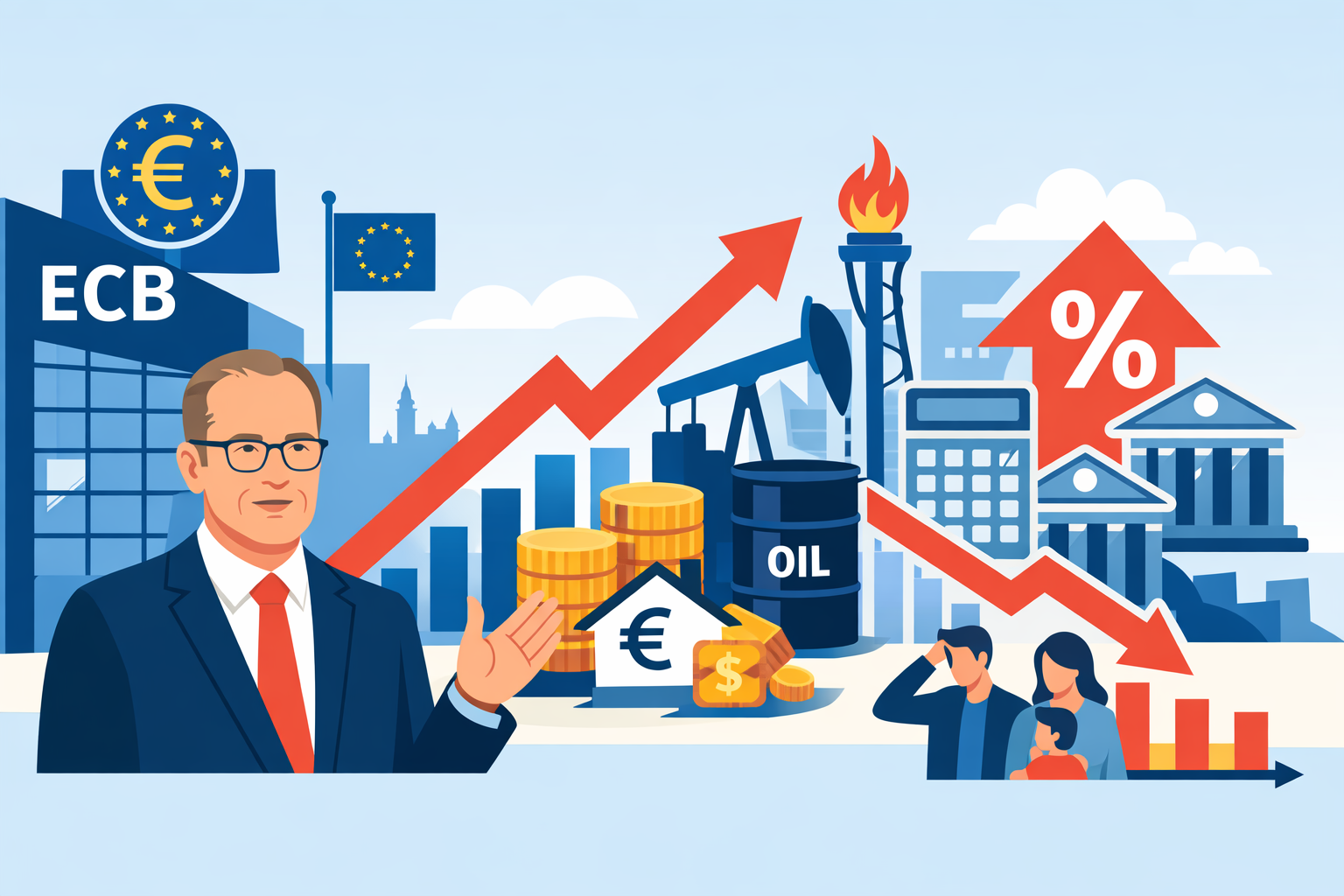
Joachim Nagel has reopened the debate over eurozone interest rates. One week after the European Central Bank held rates steady at its March 19 meeting, the Bundesbank president said on March 26 that an April hike is now “an option” if the inflation fallout from the Middle East conflict worsens. The remark is not a commitment, but it lands differently than the usual central-banker hedging. It moves the conversation from watchful caution to a concrete near-term policy possibility — and it tells markets that the ECB’s rate-cutting cycle, which many investors assumed was locked in for 2026, may be over before it really began.
The timing matters. Europe is once again staring at the familiar policy trap it thought it had escaped: imported energy inflation colliding with fragile growth, forcing the central bank to choose between defending price stability and protecting an economy that is already losing momentum.
What changed in a week
When the ECB announced its rate decision on March 19, the three key policy rates were left unchanged. The accompanying statement acknowledged that the war in the Middle East had made the economic outlook “significantly more uncertain,” and it flagged the conflict as creating “upside risks for inflation and downside risks for economic growth.” That language was cautious but not alarming. It read like a central bank buying time.
Nagel’s comments a week later suggest the Governing Council’s internal temperature is rising faster than the public statement let on. Calling an April hike “an option” — even while stressing it is “just one option” — is a signal that at least part of the council is preparing for a scenario where standing still is no longer tenable. Markets have taken note. Reuters reported that traders are increasingly treating additional ECB tightening as plausible, not just as a tail risk.
Why energy still dictates the inflation story
The euro area never fully insulated itself from the energy vulnerability that defined the 2022–2023 inflation surge. Europe imports the vast majority of its oil and a large share of its natural gas. When crude prices climb — oil moved above $105 a barrel on March 26, driven by Middle East risk repricing — the effects do not stay confined to petrol stations. They ripple through transport costs, manufacturing inputs, food supply chains, fertilizer prices, and household utility bills.
The ECB understands this transmission well. What worries policymakers is not a temporary fuel-price spike in isolation but the danger of second-round effects: the process by which higher input costs push up wages, which in turn feed into broader pricing across the economy. Once that loop takes hold, inflation becomes self-sustaining and far harder to reverse. Nagel’s warning was aimed squarely at this risk. He wants to prevent energy-driven price pressures from becoming entrenched in expectations and wage-setting behavior.
That distinction — between a one-off cost shock and a durable shift in the inflation regime — is the analytical question that will determine what the ECB does next.
The growth side of the ledger
The problem for Frankfurt is that inflation is only half the picture. The other half looks increasingly weak. Reuters reported that consumer confidence in Germany, France, and Italy has deteriorated as the conflict raises cost-of-living fears. Households are growing more pessimistic about their purchasing power, and higher energy costs are eroding real incomes before any rate increase even takes effect.
This creates the textbook euro-area dilemma. If the ECB tightens policy to contain inflation expectations, it raises borrowing costs for households and businesses at precisely the moment when spending and investment are already softening. Mortgage rates rise. Corporate credit becomes more expensive. Construction slows. The risk of tipping a fragile economy into outright contraction goes up.
But if the ECB does nothing while energy prices keep climbing and inflation expectations start drifting upward, it risks losing the credibility it spent 2023 and 2024 rebuilding. For a central bank, credibility is not an abstraction — it is the mechanism through which forward guidance actually works. If firms and workers stop believing the ECB will keep inflation near 2%, they start pricing and bargaining accordingly, and the job of restoring stability becomes vastly more expensive.
Nagel’s comments suggest he is more worried about the credibility risk than the growth risk, at least for now. Whether the rest of the Governing Council shares that view is the open question heading into April.
Financial stability: contained, but not ignored
ECB Vice President Luis de Guindos added a second layer to the discussion on March 26. He said the direct impact of the Middle East conflict on Europe’s financial system appears contained for the time being. Banks are well capitalized, and the immediate transmission channels — direct exposures to conflict-zone assets — are limited.
But de Guindos did not stop there. He warned that interconnected markets, elevated asset valuations, leveraged borrowers, and the growing role of non-bank financial institutions could amplify shocks if the conflict persists or escalates. The concern is not a banking crisis triggered by a single event, but a scenario in which prolonged uncertainty, higher energy costs, and tighter financial conditions interact in ways that stress parts of the financial system that are harder to monitor and harder to backstop.
This is not the base case. But the fact that the ECB’s vice president is publicly naming it as a possibility tells you something about the institution’s level of anxiety. The financial stability lens adds urgency to the monetary policy debate: if rates go up and growth slows, credit stress could surface in corners of the market — leveraged real estate, private credit, or thinly capitalized non-bank lenders — that are already stretched.
What markets are pricing
The shift in ECB language is already visible in market pricing. Euro-area bond yields rose on March 26 as investors moved to price in a higher probability of tightening. Oil above $105 reinforced the repricing, because energy is the variable that connects geopolitics to inflation to monetary policy in the most direct way.
For investors, the things to watch are straightforward: sovereign bond yields across core and peripheral eurozone economies, the euro exchange rate (a stronger euro would help dampen imported inflation but hurt exporters), European bank stocks (which benefit from wider margins but suffer if credit quality deteriorates), and energy-sensitive sectors such as industrials, transport, and chemicals.
The broader point is that Nagel’s remarks have re-established two-way risk in ECB rate expectations. For most of early 2026, markets were pricing cuts or an extended hold. Now, the distribution of outcomes has widened. That repricing may be more consequential than any single rate decision, because it changes borrowing conditions across the economy immediately, regardless of what the ECB formally announces in April.
What to watch before the next meeting
Several indicators will determine whether Nagel’s hawkish tone spreads across the Governing Council or fades as a minority view.
First, inflation expectations — both market-based measures and survey data. If households and firms start revising their price expectations upward, the case for action strengthens materially. Second, oil and gas prices. A sustained move higher in energy costs, especially if the Middle East conflict escalates further, would make the ECB’s inflation forecast obsolete almost immediately. Third, wage data and negotiated pay settlements across major eurozone economies. The ECB has been clear that wages are the key transmission channel it is watching. Fourth, consumer sentiment and growth indicators. A sharp deterioration in spending and business confidence would complicate the case for hiking, even if inflation is rising.
And finally, watch the commentary from other Governing Council members — Christine Lagarde, Philip Lane, Olli Rehn, François Villeroy de Galhau, de Guindos himself. If the hawkish tone remains confined to Nagel and a few allies, April is likely another hold. If the language shifts more broadly, the probability of action rises considerably.
The core tension
Nothing about the ECB’s next steps is predetermined. Nagel opened a door; he did not walk through it. The Governing Council’s posture has become more conditional, more reactive to events in the Middle East, and more nervous about the inflation outlook than it appeared even a few days ago.
The deeper issue is structural. Europe remains exposed to energy shocks in a way that the United States, with its domestic production base, largely is not. Every time oil spikes on geopolitical risk, the ECB faces a version of the same dilemma: tighten into weakness, or risk letting inflation take root. There is no clean answer, only tradeoffs — and Nagel’s March 26 comments are a reminder that those tradeoffs are live again.