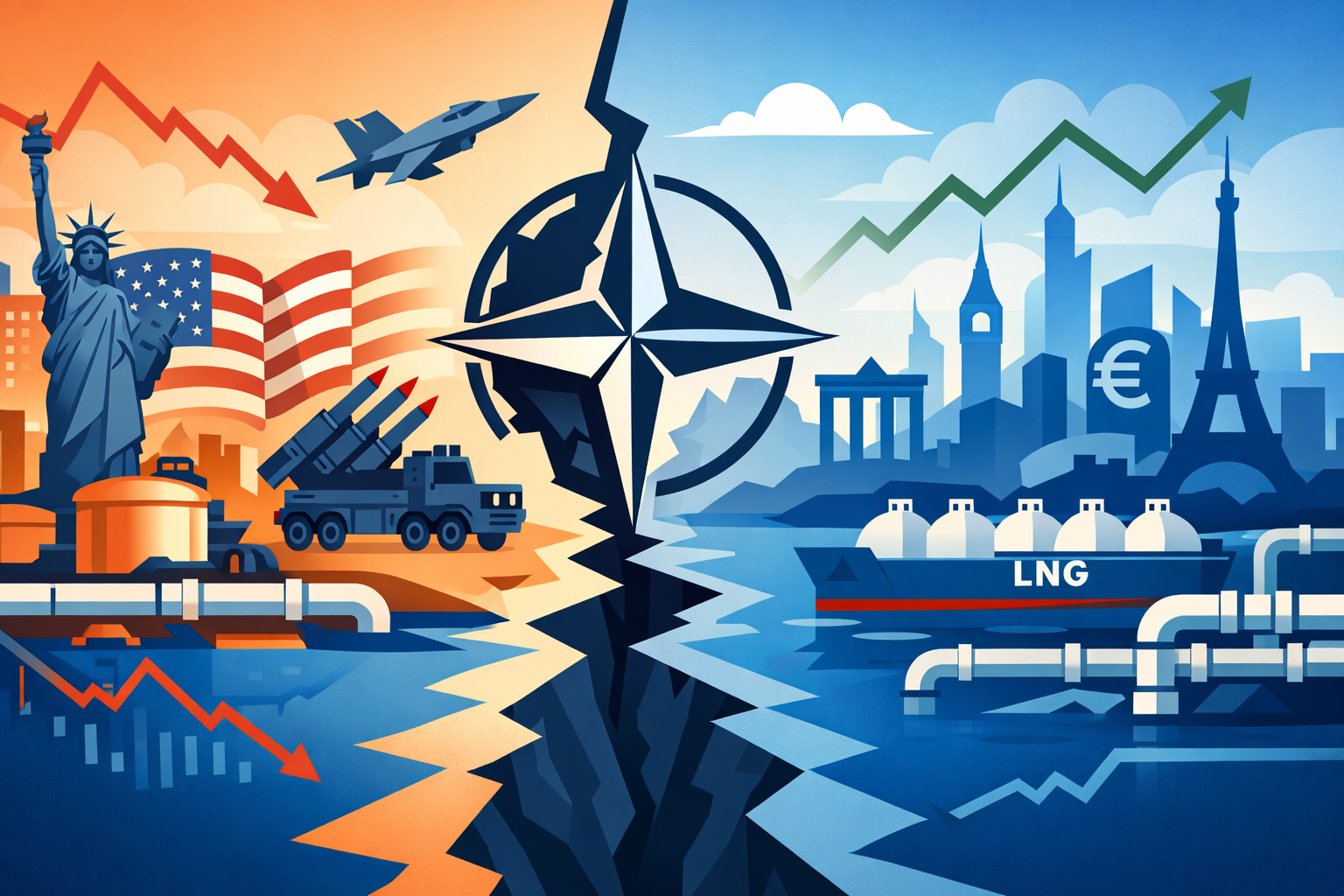
A U.S. president openly reconsidering NATO membership would once have sounded unthinkable. In April 2026, amid war in the Middle East, a near-total closure of the Strait of Hormuz, and widening transatlantic bitterness over who should bear the costs of all of it, it is suddenly a live economic story as well as a strategic one.
In an interview published today by Britain’s Daily Telegraph, President Donald Trump described NATO as a “paper tiger” and said that withdrawing the United States from the alliance was now “beyond reconsideration.” He pointed to European allies’ refusal to support U.S.-Israeli military operations against Iran, their reluctance to send warships to reopen the Strait of Hormuz, and their denial of basing rights and overflight access to U.S. aircraft. Trump added that he had long harbored doubts about the alliance’s value: “I was never swayed by NATO.”
This was not an improvised aside. It followed remarks by Secretary of State Marco Rubio on Monday, who said Washington would need to “reexamine” its relationship with NATO once the Iran war concludes. And on Tuesday, Defense Secretary Pete Hegseth was asked directly at a Pentagon briefing whether the United States still stood behind NATO’s collective defense commitment. His answer was extraordinary: “As far as NATO is concerned, that’s a decision that will be left to the president.”
That sequence — from the president to the nation’s top diplomat to the Pentagon — is what turns a rhetorical provocation into something markets and governments may have to start pricing in.
Why NATO Matters Economically
NATO’s Article 5 — the principle that an armed attack on one member is an attack on all — is one of the most important security guarantees in the modern world. It has only been invoked once, after the September 11 attacks, when allied forces joined the United States in Afghanistan. More than 1,100 non-American troops were killed in that war, a fact that complicates Trump’s claim that allies were not “there for us.”
But Article 5’s economic significance goes beyond its military history. The guarantee of collective defense has functioned for decades as an implicit risk suppressor across Europe. It shapes how investors price sovereign debt, how governments plan infrastructure, how defense budgets are set, and how companies evaluate long-term capital allocation on the continent. Remove that guarantee — or simply make it ambiguous — and a wide range of assumptions about European stability come under pressure.
This is not about whether NATO members have spent enough on defense. Many had not. All 32 members now meet the alliance’s 2% of GDP spending threshold, and under pressure from Washington, NATO’s target has been raised to 5% by 2035. Germany alone has earmarked roughly €108 billion for defense in 2026, a 25% year-on-year increase. The issue is that even dramatically higher spending cannot instantly replace the deterrence value of a credible American security commitment.
Legal Limits — and Why They May Not Matter Much
A formal U.S. withdrawal from NATO is not something a president can do unilaterally, at least in theory. Congress addressed this in late 2023 through Section 1250A of the National Defense Authorization Act, which prohibits the president from suspending, terminating, or withdrawing from NATO without either a two-thirds vote in the Senate or a separate act of Congress. The law also blocks the use of any federal funds for such a withdrawal unless those conditions are met.
The North Atlantic Treaty itself contemplates a withdrawal process as well — Article 13 requires one year’s notice.
But the legal guardrails may matter less than the political and perceptual ones. A president who publicly calls NATO a paper tiger, whose defense secretary refuses to reaffirm Article 5, and whose secretary of state openly questions the alliance’s value is already weakening NATO’s credibility in ways that no statute can easily repair. Markets respond to signals, not just to legal mechanics. And adversaries — particularly Russia — calibrate their risk assessments the same way.
Where Markets Feel It
The most direct transmission channel is European defense. The continent’s rearmament cycle was already well underway before today’s headlines. European defense stocks — Rheinmetall, BAE Systems, Thales, Leonardo, Saab — have surged in 2026 as governments scrambled to rebuild military capacity after decades of underinvestment. Analysts at Bernstein have noted that while U.S. defense firms still account for roughly 60% of European countries’ military spend, the tilt toward domestic suppliers is accelerating precisely because of doubts about the durability of U.S. commitments. Any further erosion of confidence in NATO’s future would likely reinforce that shift and push European defense valuations higher.
Energy is the second channel, and it is already under acute stress. The near-total closure of the Strait of Hormuz since late February has disrupted roughly 20% of global oil flows and a similar share of LNG trade. Brent crude is trading near $116 a barrel. European gas prices have risen more than 70% since the conflict began. The EU estimates an additional €13 billion in fossil fuel import costs. Trump’s statement today that the U.S. has no interest in helping reopen the strait — “what happens in the strait, we’re going to have nothing to do with” — turns energy anxiety into a structural concern about who, if anyone, will underwrite European energy security going forward.
The currency and rates picture is more complicated. In the near term, U.S. Treasuries and the dollar may benefit from safe-haven flows. But over a longer horizon, the spectacle of a U.S. president threatening to abandon a 77-year-old alliance raises questions about institutional reliability that do not serve dollar-denominated assets well. For European sovereign bonds, the risk is most concentrated in countries that sit closest to Russia — the Baltics, Poland, Finland — and those whose fiscal capacity to rearm is most constrained. If U.S. backing begins to look genuinely uncertain, peripheral and security-exposed European debt could face renewed scrutiny.
Europe’s Dilemma
Europe is being pushed toward a level of defense autonomy it has discussed for decades but never seriously pursued. The challenge is enormous. Germany has committed to reaching 3.5% of GDP in core defense spending by 2029, six years ahead of NATO’s guideline, but building real capability — training pipelines, ammunition stocks, deployable forces, integrated command structures — takes far longer than passing a budget.
Countries differ sharply in their capacity and willingness to act. France, Europe’s most militarily sovereign major power and the world’s second-largest arms exporter, has the industrial base to lead. The UK has allowed U.S. bombers to use British bases for defensive missions but has explicitly refused to be drawn into the Iran war. Spain and Italy have gone further, denying basing rights and in Spain’s case closing its airspace to U.S. aircraft involved in Iran operations — moves that have drawn sharp rebukes from Washington but reflect domestic political constraints.
A less reliable U.S. security umbrella would accelerate three debates in Europe simultaneously: defense integration, energy resilience, and industrial strategy. Each is politically divisive. Together, they amount to a fundamental reassessment of the European economic model that has prevailed since the Cold War.
Bigger Than One Quote
It is worth pausing on why this matters more than Trump’s previous NATO criticism, which stretches back to his first term and was often dismissed as posturing.
The difference now is context and institutional reinforcement. Trump’s words today are backed by his secretary of state, who says NATO’s value must be “reexamined.” They are reinforced by his defense secretary, who would not reaffirm Article 5 on camera. They come against the backdrop of a hot war in the Middle East in which European allies have actively refused to participate. And they arrive at a moment when Europe is already dealing with an energy supply shock, a fertilizer price spike, mounting inflation, and the unresolved question of Ukraine.
This layered accumulation of pressure is what makes the story economically significant. Individual quotes can be walked back. Institutional ambiguity cannot. When the Pentagon declines to confirm that the United States would defend its allies, that is a data point that enters the calculations of every government, every investor, and every adversary watching.
The Credibility Problem
NATO’s greatest asset has always been credibility — the belief, shared by allies and adversaries alike, that an attack on one member would produce a collective response. That credibility does not require perfection. It requires consistency. And it is far easier to erode than to rebuild.
The biggest near-term effect of Trump’s remarks may be psychological and financial rather than legal. No withdrawal will happen tomorrow. Congress has erected barriers. The treaty requires a year’s notice. But if investors, governments, and adversaries begin pricing in a less dependable American commitment, Europe’s economic assumptions could shift well before any formal exit process begins. The cost of a weaker NATO is not measured in troop deployments alone. It is measured in risk premiums, capital flows, energy contracts, and the quiet recalculation of what it means to do business on a continent whose security architecture just became a little less certain.