Investors tuned in to Donald Trump’s national address on April 1 hoping for something specific: a timeline, a diplomatic signal, a hint that the five-week-old war with Iran was reaching a negotiated conclusion. They got the opposite.
Trump told the nation the U.S. would hit Iran “extremely hard” over the next two to three weeks. He offered no ceasefire framework, no plan to reopen the Strait of Hormuz, and no indication that Washington viewed the strait’s closure as its problem to solve. Crude oil, which had actually dipped before the speech on speculation that de-escalation was near, reversed violently. By mid-morning in New York on April 2, WTI crude had surged 13% to $113.08 a barrel. Brent rose 8% to $109.29. U.S. stock futures dropped hard—S&P 500 futures fell 1.6%, Nasdaq futures lost over 2%—and Asian markets, which absorbed the speech in real time, closed sharply lower across the board.
The sell-off was not about battlefield developments. It was about what the speech did not contain.
What Markets Were Listening For—and Didn’t Hear
Before Trump spoke, there had been a brief, tantalizing opening. Iranian President Masoud Pezeshkian had posted an open letter addressed directly to Americans, stressing that Iran bore no enmity toward the U.S. and had acted in self-defense. Trump himself had claimed on Truth Social that Iran’s leader had asked for a ceasefire. Wall Street rallied on Tuesday, posting its best day since May.
Then the speech closed that window. Trump signaled escalation, not de-escalation. He said the war was “nearing completion” but gave no specific endpoint—a formula he has used before. More critically, he made no commitment to reopening the Strait of Hormuz, instead telling countries dependent on Gulf oil to “build up some delayed courage” and “just take it.”
Takashi Hiroki, chief strategist at Monex in Tokyo, captured the market reaction precisely: the speech offered no concrete details about ending hostilities and no outline for a ceasefire. That absence is what moved prices.
Why Hormuz Changes Everything
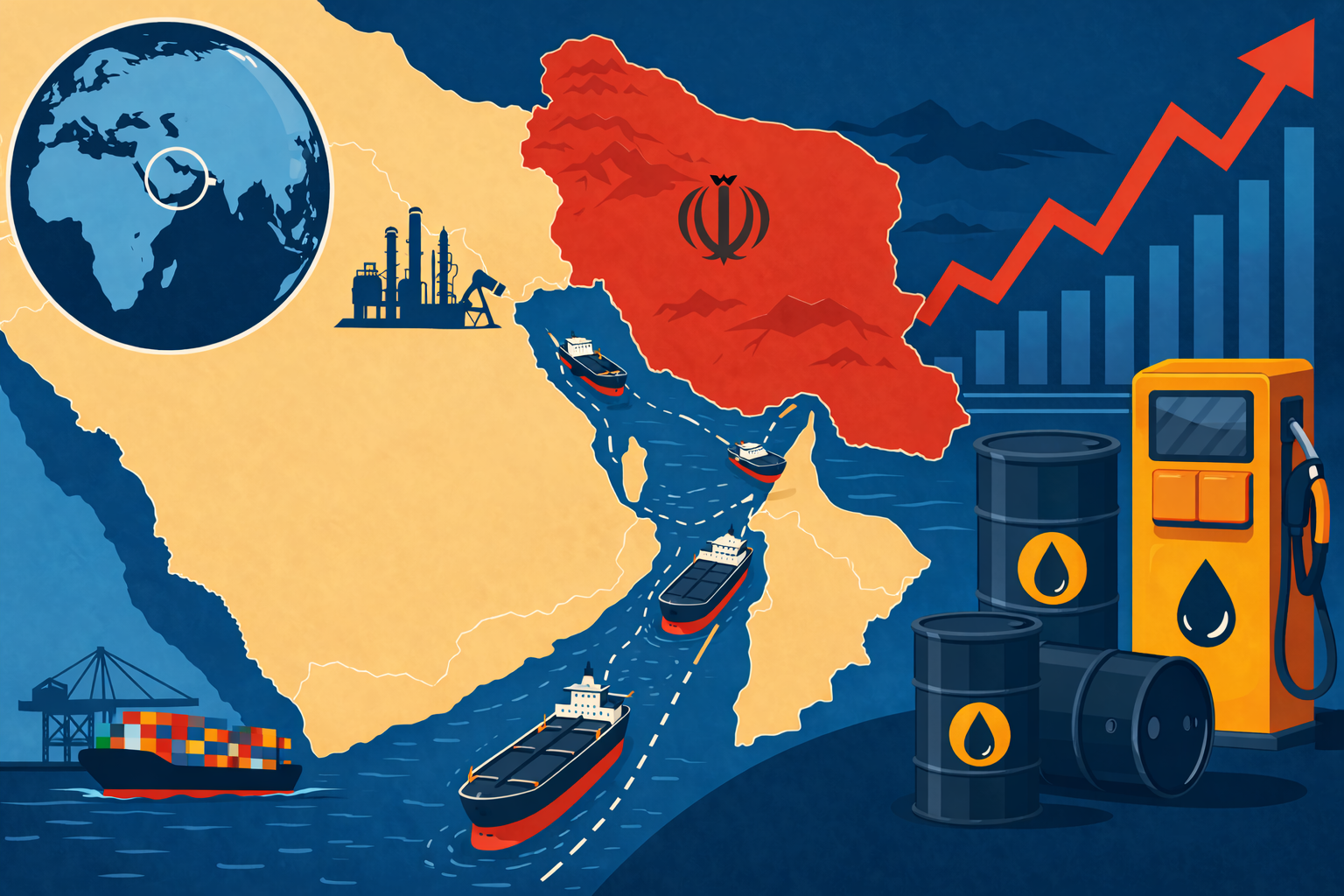
The Strait of Hormuz is a 21-nautical-mile-wide passage between Iran and Oman. It is the only sea route out of the Persian Gulf. In 2025, roughly 20 million barrels per day of crude oil and petroleum products moved through it—about 25% of global seaborne oil trade, with nearly 80% headed to Asia. On top of that, around 20% of the world’s liquefied natural gas trade transited the same corridor, most of it from Qatar.
Since the war began on February 28, Iran’s Revolutionary Guard Corps has effectively shut the strait to Western-allied shipping. Traffic has collapsed by over 95%. The IEA has called it the largest oil supply disruption in history.
What makes this different from a conventional supply shock is the lack of workarounds. Only two bypass pipelines exist: Saudi Arabia’s East-West Petroline, which can push up to 7 million barrels per day to the Red Sea port of Yanbu but has limited terminal capacity, and the UAE’s Abu Dhabi Crude Oil Pipeline to Fujairah on the Gulf of Oman. Combined, the IEA estimates these offer only 3.5 to 5.5 million barrels per day of available bypass capacity. That covers barely a quarter of what Hormuz normally handles. Iraq, Kuwait, Qatar, Bahrain, and Iran itself have no pipeline alternatives at all.
Saudi Arabia has ramped up Petroline flows from under 800,000 barrels per day in January to roughly 2.9 million barrels per day as of late March. It is a meaningful effort. It is nowhere near enough.
How an Oil Shock Becomes an Economic Shock
When crude prices spike, the effects do not stay in commodity markets. They ripple outward through a well-understood but painful chain.
First, refining margins widen as processors compete for scarce supply. Then gasoline and diesel prices rise—U.S. average gas prices have already crossed $4 a gallon for the first time since 2022. Shipping and freight costs climb as bunker fuel gets more expensive and marine insurance premiums spike for Gulf-linked routes. These costs pass into consumer goods, food logistics, and industrial inputs.
From there, the pressure becomes macroeconomic. Inflation expectations shift. Bond yields react. Central banks, which had been cautiously moving toward or maintaining rate cuts, suddenly face a policy dilemma: do they tighten to fight energy-driven inflation, or hold steady to support growth that is already weakening?
In Europe, the signals are already visible. Eurozone headline inflation jumped to 2.5% in March from 1.9% in February, driven largely by a nearly 5% surge in energy costs. Germany’s leading economic institutes have cut growth forecasts and raised inflation projections. In South Korea, consumer prices rose 2.2% year-on-year in March, pushed higher by soaring fuel costs. South Korean President Lee Jae-myung has urged parliament to pass a 26.2 trillion won ($17.3 billion) supplementary budget to cushion what he called the worst energy security threat the country faces.
This is the mechanism that turns a regional conflict into a global drag.
Asia Sits in the Path of the Storm
The geography of Hormuz dependence is starkly lopsided. China and India together receive 44% of all crude oil transiting the strait. Japan imports roughly 90–95% of its crude from the Middle East, with 70–74% passing directly through Hormuz. South Korea is similarly exposed.
Asian stock markets registered the damage immediately. Tokyo’s Nikkei 225 fell 2.4%. South Korea’s KOSPI dropped 4.5%. The MSCI gauge of emerging-market Asian equities slid 2.3%. Southeast Asian markets—Malaysia, Indonesia, Singapore, Taiwan—all declined. These are import-dependent economies that absorb every dollar of oil price increase as a direct cost.
Europe, while not as directly dependent on Hormuz crude, faces its own pressures. The continent is competing with Asia for redirected LNG cargoes at a time when gas markets were already tight after the post-Ukraine rebalancing. Higher energy costs feed directly into industrial production costs, particularly in Germany and Italy.
The United States is better insulated as a net energy exporter, but not immune. Higher gasoline prices erode consumer spending power. Inflation persistence complicates the Federal Reserve’s path. And the S&P 500 just posted its worst quarterly performance since September 2022. Markets have not registered a single weekly gain since the war began.
The Diplomacy Gap
What made April 2 especially unsettling was the widening gap between the scale of the crisis and the diplomatic response.
On the same day Trump’s speech was rattling markets, Britain’s Foreign Secretary Yvette Cooper convened a virtual meeting of more than 40 countries to discuss options for reopening the strait. The United States did not attend. The group included the UK, France, Germany, Italy, Japan, Canada, the UAE, Bahrain, and others—a broad coalition but one without the military capacity to force the strait open while fighting continues. French President Emmanuel Macron said explicitly that a military operation to open Hormuz was “unrealistic” and would expose ships to Iranian coastal defenses.
Cooper said military planners from several countries would meet separately to prepare for the post-conflict phase, including mine clearance and shipping reassurance. But that presupposes the fighting stops, and Trump’s speech suggested it would not—at least not for several more weeks.
Meanwhile, at the United Nations, Bahrain’s effort to secure a Security Council resolution authorizing enforcement measures to protect commercial shipping in the strait has stalled, with Russia, China, and France raising objections.
The result is a situation where the country that launched the war is not attending the meeting to fix its most damaging economic consequence, while the countries most affected lack the tools to act alone.
Three Scenarios to Watch
Where this goes from here depends on which of three paths materializes.
The first is a diplomatic off-ramp. If some form of ceasefire or de-escalation emerges—possibly brokered outside the U.S.-Iran bilateral channel—shipping could gradually resume. Even so, analysts at HSBC warn that depleted global inventories would leave the oil market structurally tighter for months, and a risk premium would persist well beyond any initial reopening.
The second is a prolonged disruption at roughly the current level. The Reuters poll of 38 analysts, conducted in March, lifted the 2026 Brent forecast to $82.85 per barrel from $63.85 in February—a $19 increase, the steepest single-month revision in the poll’s 21-year history. But that average assumes some recovery in the second half. If the strait stays effectively closed through the second quarter, actual spot prices will remain far above that average.
The third is a deeper supply shock. John Paisie of Stratas Advisors has warned that if the strait remains closed for another month with no resolution in sight, Brent could move toward $190 a barrel. OPEC+ output is projected to fall by up to 11 million barrels per day in the second quarter as producers with no export route are forced to shut in production. The IEA has already triggered a record release of 400 million barrels from strategic reserves—a measure designed to buy time, not to solve a structural shortfall.
Beyond the Headline
The numbers on the screen on April 2—Brent at $109, WTI above $113, the Nikkei down 2.4%, KOSPI down 4.5%, U.S. futures deep in the red—are not just the market processing a speech. They are the market processing a realization.
This crisis was already the largest oil supply disruption in history. What changed overnight is that markets lost whatever residual confidence they held that Washington had a plan to end it quickly or to ensure the strait reopens. The burden of resolution has been explicitly shifted to countries that lack the military leverage to deliver it.
That shift matters because oil shocks do not stay contained. They move from tanker routes to refineries to gas pumps to grocery bills to central bank meetings. The International Rescue Committee warned this week that the current disruption threatens to surpass the food security shock triggered by Russia’s invasion of Ukraine in 2022. Global demand growth forecasts for 2026 have already been cut, with estimates ranging from just 120,000 to 800,000 barrels per day as high prices and economic headwinds slow consumption.
Markets are no longer pricing a brief geopolitical scare. They are pricing the possibility that a military crisis has become a macroeconomic one—and that the off-ramp, if it comes, may arrive too late to prevent the damage from spreading.