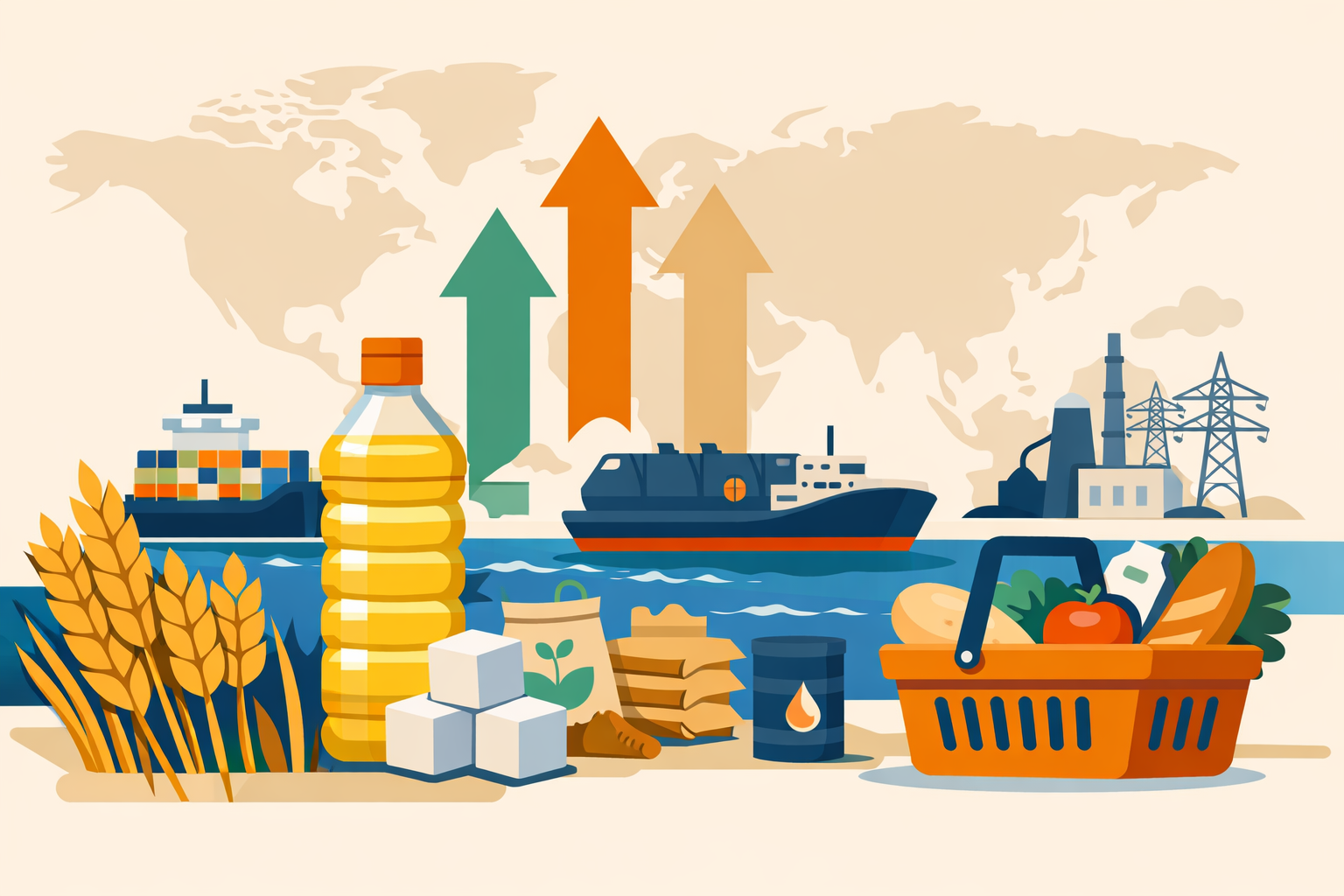
What the Data Actually Showed
Not all food categories moved the same way in March, which is worth paying attention to.
Sugar led the surge, with the FAO Sugar Price Index jumping 7.2 percent in a single month. The reason illustrates exactly how tightly food and energy are now interlinked: markets began pricing in expectations that Brazil — the world’s dominant sugar exporter — would redirect more of its sugarcane harvest toward ethanol production, because rising international crude oil prices make biofuel more economically attractive. Brazil did not have to do anything yet. The expectation was enough to move global sugar prices.
Vegetable oils were close behind, with the FAO Vegetable Oil Price Index rising 5.1 percent, its third consecutive monthly gain and now 13.2 percent above year-earlier levels. Palm, soy, sunflower and rapeseed oil all rose, again driven in significant part by the biofuel demand spillover from crude oil. Wheat prices climbed 4.3 percent, reflecting drought-related crop deterioration in the United States and, critically, early expectations of reduced plantings in Australia — a consequence of higher fertilizer costs making intensive cultivation less financially viable. The FAO Cereal Price Index as a whole rose 1.5 percent.
There was one downward exception: rice prices fell 3.0 percent, pushed lower by harvest timing, weaker import demand, and currency depreciation against the dollar in several key importing countries. But rice moving in the other direction does not soften the picture much. The commodities that rose — wheat, sugar, vegetable oils — are staples with enormous reach across global food systems.
The Chain That Links Oil Wells to Grocery Bills
To understand why an energy shock in the Near East can eventually show up in a supermarket in Cairo, Karachi, or Lima, it helps to trace the transmission chain.
Crude oil prices drive freight costs directly: container ships, bulk carriers, and tankers all run on fuel. Higher freight costs lift the price of any food commodity that crosses an ocean to reach its consumer, which describes the vast majority of internationally traded wheat, soy and edible oils. Crude oil also feeds into the cost of natural gas, which is the primary feedstock for producing nitrogen fertilizers — ammonia, urea, ammonium nitrate — the inputs that underpin the yield potential of most of the world’s major crops. When nitrogen fertilizer becomes expensive or difficult to source, farmers face a choice that is not only economic but strategic: keep planting the same crops with fewer inputs and accept lower yields, shift toward less fertilizer-intensive varieties, or reduce planted area altogether.
That last point is where FAO Chief Economist Máximo Torero has focused his concern. “Price rises since the conflict began have been modest, driven mainly by higher oil prices and cushioned by ample global cereal supplies,” he said. “But if the conflict stretches beyond 40 days with high input costs with current low margins, farmers will have to choose: farm the same with fewer inputs, plant less, or switch to less fertilizer-intensive crops. Those choices will hit future yields and shape our food supply and commodity prices for the rest of this year and all of the next.”
This is not an abstract warning. Planting decisions made now — or not made — show up in harvests six to twelve months later. The current global cereal supply situation is, by FAO’s own assessment, broadly comfortable: the agency projects global cereal production in 2025 at a record 3.036 billion metric tonnes, up 5.8 percent year on year, with the world cereal stocks-to-use ratio for 2025/26 forecast at 32.2 percent. That buffer matters. It is one of the reasons the current price increase has not yet become a crisis. But a buffer consumed slowly is still a buffer being consumed.
Why Central Banks Should Be Watching
Monetary policymakers cannot fix a supply shock. No interest rate decision changes the depth of a drought in Kansas or the cost of shipping fertilizer through a contested strait. But food inflation interacts with the inflation challenge in ways that matter regardless.
The practical problem is that food inflation is one of the most immediate and politically visceral forms of price pressure that households experience. Unlike a rise in mortgage rates, which is felt gradually and unevenly, a jump in bread prices is noticed weekly. It is felt by almost everyone, including the large share of the global population that spends 30 percent, 40 percent or more of its income on food. When food prices rise persistently, inflation expectations tend to shift — and once expectations shift, the job of bringing them back down becomes significantly harder.
Central banks in emerging markets face a particular version of this problem. Many of them are already managing elevated debt loads, weak currencies against the dollar, and the residual scars of the 2021–2022 global inflation cycle. For a country that imports a large share of its wheat or edible oils and whose currency has weakened in recent months, the March FAO reading is not just a commodity market event — it is a domestic inflation risk that arrives pre-amplified by the exchange rate.
There is also the question of sequence. Energy shocks tend to be sharp and, to some degree, self-correcting: when oil gets expensive enough, demand slows, and prices eventually pull back. Food inflation tends to be stickier. Supply cannot be quickly ramped up if planting decisions have already been made, if soil has been under-fertilized, or if a crop cycle has been missed. This asymmetry — energy price up fast, food price down slow — is part of what makes a food inflation episode potentially more durable than the shock that triggered it.
Who Feels It First and Hardest
The distributional impact of food price increases is not even. Import-dependent economies in North Africa, the Middle East, and parts of Sub-Saharan Africa are among the most exposed. Countries like Egypt, Tunisia, Lebanon and Pakistan import large shares of their wheat and edible oil requirements and have limited fiscal capacity to absorb the difference through subsidies or currency support. For governments already managing tight budgets, a sustained rise in import costs for staple foods is not just an economic problem — it is a social stability question.
Within countries, the pressure falls hardest on lower-income households that spend a higher proportion of their earnings on food and have less capacity to substitute or absorb price increases. An average-income household in a wealthy country that spends 10–12 percent of its budget on food can absorb a 7 percent sugar price rise as a rounding error. A household spending 40 percent of its income on food cannot.
FAO data also showed that logistical constraints are already limiting market access in parts of the Near East, with ovine and poultry meat prices declining partly as a result. Disruption to supply chains in a conflict zone rarely stays neatly confined to that zone.
What Would Make This Worse
The current situation has important cushions. Global cereal stocks are high. Rice production is heading toward a record. The March price increases, while broad-based, are far below the extremes seen in 2022.
But conditions can change, and several scenarios could push food inflation from a manageable second-order risk to something more serious. A prolonged conflict that keeps energy and fertilizer costs elevated through the planting seasons in the northern hemisphere would be the central scenario to watch. Alongside that, any additional freight disruption in key chokepoints — not just the Strait of Hormuz but also routes through the Red Sea and the Suez corridor — would layer logistics costs onto commodity costs. And if lower input use by farmers in 2026 results in significantly weaker harvests in late 2026 and into 2027, the current comfortable stock picture could look quite different by then.
FAO has flagged that the conflict escalation, with associated higher energy and fertilizer prices and disruptions to supply chains, has introduced additional uncertainty into the outlook for wheat and maize. That is careful institutional language, but it is not a trivial observation. It means that the comfortable cereal supply numbers currently providing a cushion are not guaranteed to persist.
A War-Driven Shock Rarely Stays in One Sector
The broader point — and the one easiest to lose in the data — is that energy shocks do not respect sectoral boundaries. The 2021–2022 episode made that clear: what began as a post-pandemic energy crunch became a global food crisis when Russia’s invasion of Ukraine disrupted Black Sea grain exports. The mechanism this time is different, but the underlying logic is the same. Higher oil prices raise the cost of producing food, transporting food, and processing food. Given enough time — and the key question is always how much time — that cost increase works its way through into the prices consumers actually pay.
March’s FAO reading is not a crisis. It is a signal. The conflict in the Near East has already crossed the threshold where its effects are confined to energy markets. If it persists long enough to change planting decisions in Australia, in the United States, in Ukraine, or across North Africa, the food price story in 2027 could look quite different from the one we are telling today.
Food inflation is politically sensitive in a way that few other economic indicators match. Governments have fallen over bread prices. Central banks have lost credibility over food-driven inflation expectations. Households that feel the pressure on their grocery bills do not distinguish between demand-driven and supply-driven inflation — they just notice that things cost more. Right now, the buffers are holding. That is the good news. The challenge is that those buffers are not permanent, and the clock on planting decisions is already running.
Sources: FAO Food Price Index, March 2026 release; FAO Newsroom, “FAO Food Price Index rises in March as Near East conflict raises energy costs,” April 3, 2026; Reuters markets coverage, April 3, 2026; Reuters Breakingviews analytical commentary, March 31, 2026.