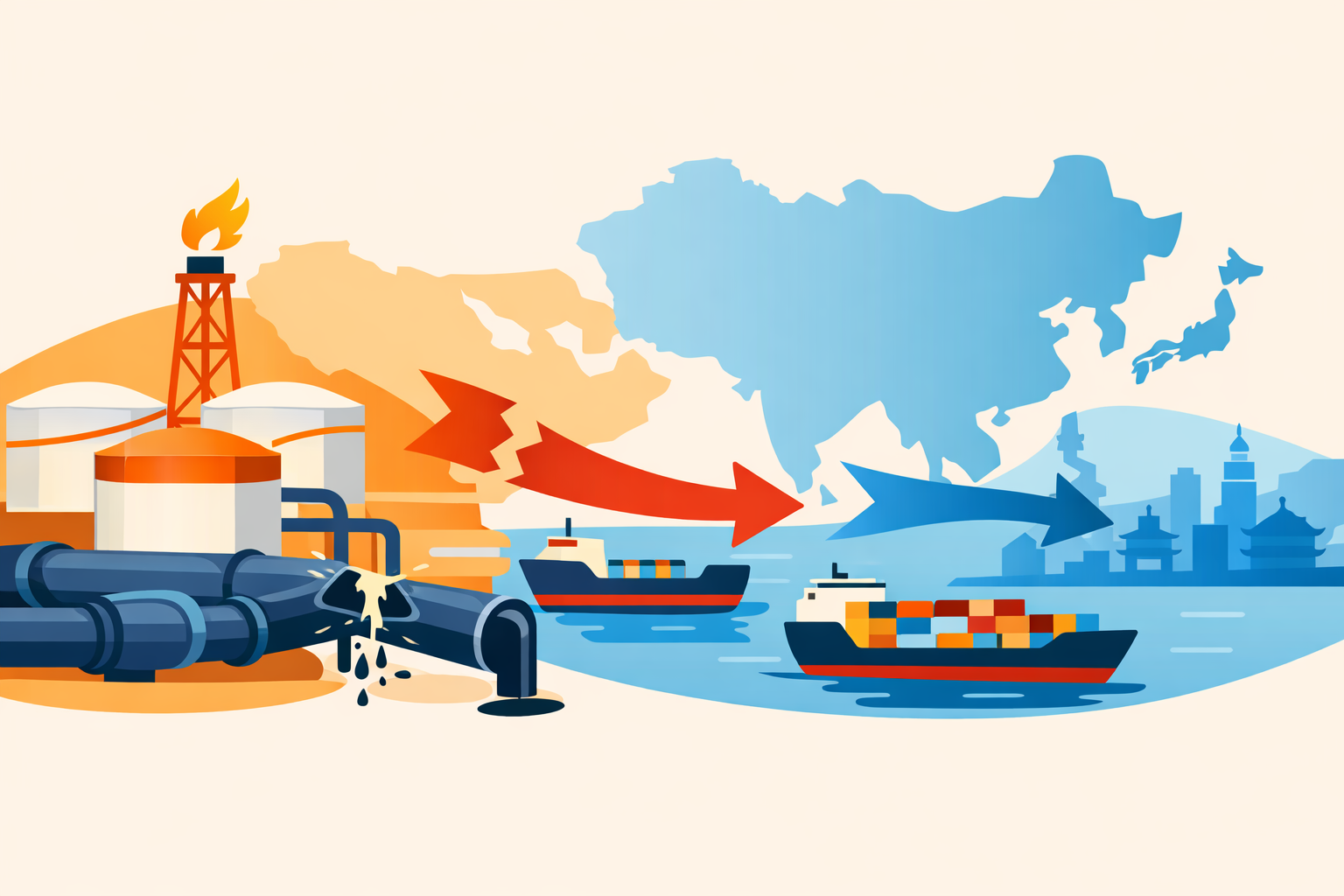
Attacks on Saudi energy infrastructure have cut oil output and pipeline flows, raising inflation and policy risks across Asia’s oil-importing economies.
The latest attacks on Saudi Arabia’s energy infrastructure are not just another geopolitical headline. Saudi Arabia has said the strikes reduced the kingdom’s oil production capacity by around 600,000 barrels per day — a significant hit on its own. But the deeper concern is what happened simultaneously: throughput on the East-West Pipeline was cut by roughly 700,000 barrels per day, impairing the main route Saudi Arabia uses to move crude without passing through the Strait of Hormuz.
That combination is what makes this incident different from a routine facility outage. It is, as analysts quoted by Reuters have described it, a “dual shock” — one that hits both the production side and the logistics side of the global oil system at the same time.
A dual shock, not a single disruption
It is tempting to focus on the production number alone. Losing 600,000 barrels per day of capacity in a market already watching OPEC+ supply decisions closely is enough to push prices higher. But the pipeline damage adds a second layer. Even crude that remains technically available becomes harder and more expensive to move when a critical bypass route is partially offline.
The East-West Pipeline was built for exactly the kind of scenario the region now faces: a way to ship Saudi crude from the Gulf coast to the Red Sea terminal at Yanbu, avoiding the chokepoint at Hormuz. When that alternative is impaired, the global system doesn’t just lose barrels — it loses flexibility. Shipping routes narrow. Freight costs rise. Insurance premiums climb. And the perception of reliable supply, which matters as much as actual barrels in a forward-looking market, takes a hit.
This is why analysts have framed the event as structurally more important than a localized facility outage. The world is dealing with both less oil and fewer safe ways to move what remains.
Why Asia is especially exposed
The supply-side story is a Gulf story. The demand-side consequences land most heavily in Asia.
Japan, South Korea, India, China, Thailand, the Philippines — these are economies that import the vast majority of their crude oil, and a large share of it originates in or transits through the Middle East. When supply tightens and shipping costs rise, the effect doesn’t stay confined to a line item on a refinery’s balance sheet. It filters into manufacturing input costs, transport fuel, electricity generation, and — critically — food distribution. In economies where food and fuel make up a large share of consumer price baskets, even a moderate and sustained rise in crude prices can shift headline inflation by several tenths of a percentage point within months.
This is where the Saudi disruption stops being a commodity story and starts becoming a macroeconomic one. A sustained rise in imported energy costs widens current-account deficits in net importers, weakens currencies, and puts pressure on both consumer prices and producer prices simultaneously. For countries like India and the Philippines, where central banks have only recently brought inflation back toward target, the timing could hardly be worse.
The central-bank dilemma
The IMF’s Managing Director, Kristalina Georgieva, has already flagged the tension. Central banks, she has said, must balance energy-driven inflation against softening demand — a formulation that neatly captures the bind policymakers now face.
The problem is familiar but no less difficult for being so. If inflation rises because of an external supply shock — oil prices, freight costs, insurance — then raising interest rates does very little to fix the underlying cause. Monetary policy cannot produce more barrels or reopen a pipeline. But if central banks do nothing and price expectations begin to drift upward, the risk is that a temporary shock becomes embedded in wages and contracts, making the problem more persistent.
This is the classic stagflation-style dilemma. Tightening financial conditions could slow already-fragile growth. Holding steady could allow imported inflation to spread through the economy. There are no clean answers, and the policy response will vary by country. India’s Reserve Bank, the Bank of Korea, and Bank Indonesia are all watching slightly different inflation dynamics, but all face the same fundamental question: how much of this energy shock should policy try to absorb, and how much should it pass through?
Why the pipeline matters more than people think
Most readers will grasp “oil fields attacked” intuitively. Fewer will immediately understand why the pipeline angle is so significant.
The East-West Pipeline — running roughly 1,200 kilometres from the eastern oil-producing region to the Red Sea port of Yanbu — exists as a strategic hedge. It allows Saudi Arabia to export crude even if the Strait of Hormuz becomes contested, disrupted, or too expensive to insure. In a period when Hormuz is already under heightened scrutiny because of broader regional conflict, losing partial throughput on the bypass route deepens the sense of logistical vulnerability. There is no easy substitute. Rerouting tankers around the Arabian Peninsula adds days and costs. Building new pipeline capacity takes years.
The practical effect is that the global oil transport system has become a little less resilient at precisely the moment when resilience matters most. That is a risk that doesn’t show up immediately in spot prices but sits in the background of every forward contract, insurance quote, and strategic petroleum reserve calculation.
What to watch next
Several markers will determine whether this remains a short-term disruption or becomes a more lasting economic factor.
First, repair timelines. How quickly Saudi Aramco can restore both production capacity and pipeline throughput will set the tone for markets. The longer the outage persists, the more it becomes priced into medium-term supply expectations.
Second, follow-on attacks. A single incident can be absorbed. A pattern of strikes on energy infrastructure would force a structural repricing of Gulf supply risk — with consequences far beyond a single week’s headlines.
Third, Brent crude behaviour. If prices remain elevated above recent ranges, the pass-through into Asian inflation becomes more than hypothetical. Energy import bills rise, currencies come under pressure, and fiscal authorities face harder choices about fuel subsidies and reserve releases.
Fourth, freight and insurance costs. These are the quieter transmission mechanisms. Even before crude prices move, rising war-risk premiums on tankers transiting the Gulf or the Red Sea tighten effective supply and raise the landed cost of oil in Asian ports.
Fifth, policy responses. Whether Asian governments react with subsidy extensions, strategic reserve releases, or verbal intervention will signal how seriously they view the risk. The IMF has already noted that demand for Fund support related to the broader Middle East conflict could rise to between $20 billion and $50 billion — a figure that underscores the macroeconomic, not merely sectoral, nature of the shock.
A test of resilience
It is worth resisting the urge to treat this as a straightforward price-spike story. The deeper question is whether Asia’s major oil-importing economies can absorb another imported energy shock without reopening the inflation cycle they have spent two years trying to close.
The region came through the post-2022 energy adjustment with considerable difficulty — central banks raised rates aggressively, governments expanded fuel subsidies at significant fiscal cost, and consumers absorbed real-income losses. Much of that adjustment is now behind them. But the mechanisms that transmitted that earlier shock — oil to transport to food to CPI — have not changed. If anything, the current situation is more complex, because it involves not just higher prices but diminished confidence in the physical routes that keep oil flowing.
The vulnerability, in the end, is not simply about the price of a barrel. It lies in how quickly an attack on infrastructure in the Gulf can travel through shipping lanes, refinery margins, central-bank models, and household budgets on the other side of the Indian Ocean. That speed, more than any single price move, is what policymakers and investors should be watching.