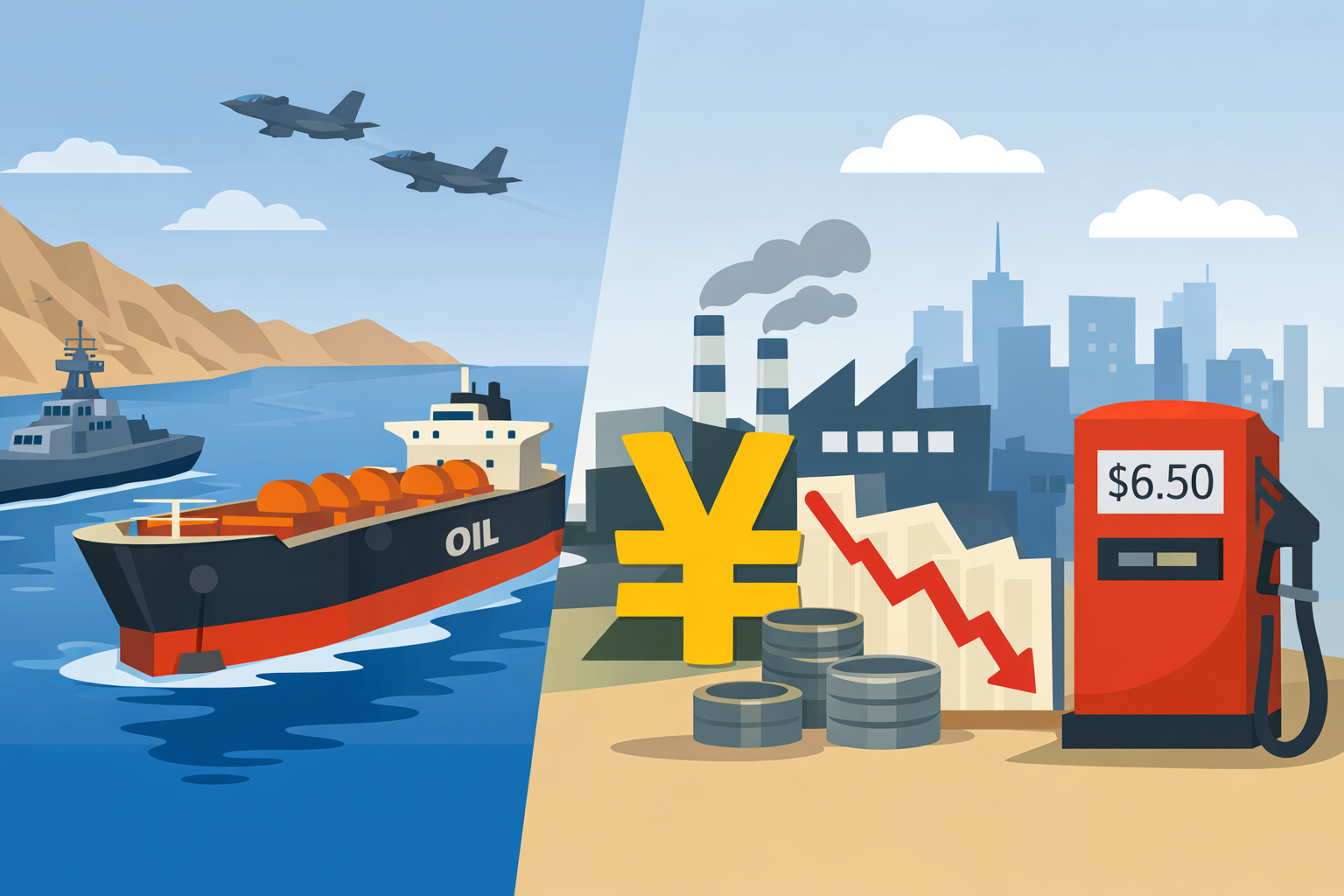
When tension rises in the Gulf, Asia usually pays first. The latest Hormuz shock — President Trump’s order on Sunday to impose a U.S. naval blockade targeting Iranian ports — is reviving a familiar but dangerous chain reaction: higher crude prices, weaker currencies, more expensive imports, and harder choices for central banks already struggling to balance inflation against fragile growth.
Brent crude jumped as much as 8.6% on Monday to above $103 a barrel. West Texas Intermediate surged even harder, topping $104. These are headline numbers. But they understate the real stress. In the physical spot market — where refiners actually buy barrels for delivery — North Sea Forties Blend hit a record $147 per barrel on April 10, a $50 premium over Brent futures and above the previous peak from the 2008 financial crisis. That gap between paper and physical prices is the clearest signal that the supply disruption is not a theoretical risk. It is already here.
The Trigger
The immediate cause is the collapse of weekend peace talks in Pakistan. Vice President JD Vance said Iran refused to commit to halting its nuclear weapons program. Trump responded by ordering the Navy to blockade all maritime traffic entering and exiting Iranian ports, effective Monday at 10 a.m. Eastern. CENTCOM clarified that the blockade targets ships going to and from Iran specifically and will not impede transit through the strait to non-Iranian destinations. But the distinction may matter less than the reality on the ground: tanker traffic through Hormuz has already fallen to a fraction of normal levels since the war began on February 28, and roughly 10 million barrels per day of crude production remains stranded or constrained in the Gulf.
The Strait of Hormuz normally handles about 20% of global seaborne oil and a similar share of liquefied natural gas. In 2024, an estimated 84% of crude shipments passing through the strait were headed for Asian buyers. That single number explains why this crisis lands hardest in the region.
Asia’s Structural Exposure
Japan, South Korea, India, China, Thailand, the Philippines, Pakistan — the list of Asian economies dependent on Gulf energy imports is long, and the vulnerability runs deep. Japan sources roughly 75% of its oil imports from the Middle East, nearly all of it passing through Hormuz. South Korea and India are similarly exposed. China, the world’s largest crude importer, receives about 40% of its oil through the strait.
The pain is not evenly distributed. Malaysia, as a net energy exporter, stands to benefit from higher prices. But for the region as a whole, the balance is overwhelmingly negative. Nomura flagged Thailand, India, South Korea, and the Philippines as the most vulnerable to an oil price shock, given their high import dependence and limited domestic production.
And the problem extends well beyond crude. QatarEnergy declared force majeure on LNG exports after Iranian drone strikes damaged the Ras Laffan complex in March — damage that may take three to five years to fully repair. Asian LNG spot prices have surged more than 140% since the conflict began. Pakistan, which relies on Qatar and the UAE for 99% of its LNG imports, and Bangladesh, at 72%, face the most acute supply risk. Even Japan and South Korea, with somewhat lower Gulf LNG dependence, hold only two to four weeks of reserves at stable demand levels.
From Crude to Consumer Prices
A geopolitical supply shock does not stay in the oil market. It moves fast, and it moves broadly.
Higher crude costs feed directly into fuel prices, which push up transport and freight costs, which raise the price of everything that moves by ship, truck, or plane. Petrochemical feedstocks become more expensive, lifting the cost of plastics, packaging, and industrial inputs. Electricity prices rise in economies that depend on oil or gas-fired generation. Food prices climb because fertilizer — roughly 30% of internationally traded fertilizer transits Hormuz — becomes scarcer and costlier. Airlines face margin pressure. Utilities pass costs to households.
Japan’s producer price index for March already showed oil and coal product prices rising 7.7% month-on-month, with chemical products up 1.7%. The import price index jumped 7.9% year-on-year in yen terms. These are the leading indicators of what is coming for consumer prices.
The risk, in short, is inflation re-acceleration — arriving just as several Asian economies had hoped the worst of post-pandemic price pressure was behind them. Wood Mackenzie estimated that a sustained Brent average of $90 a barrel would limit global GDP growth to less than 2%. At $100, growth drops to 1.7%. At $200 — a scenario some traders no longer dismiss — the world economy contracts.
The Currency and Central Bank Problem
A stronger dollar makes everything worse for Asia’s importers. On Monday morning in Asia, the dollar index rose as much as 0.5% to its highest level in a week. The Australian dollar fell 0.8%. The Indian rupee and South African rand dropped more than 0.7%. Japan’s 10-year government bond yield jumped 5.5 basis points to 2.49%, the highest in almost three decades.
When the dollar strengthens and local currencies weaken, the cost of importing dollar-priced oil rises even further in domestic terms. It is a compounding mechanism: the oil shock becomes a currency shock becomes a broader inflation shock.
Central banks face a genuine dilemma. Tighten policy to defend the currency and anchor inflation expectations, and you risk crushing growth that is already fragile. Hold steady or ease, and you risk letting inflation expectations drift higher, especially if energy costs stay elevated for months.
Japan is the clearest illustration. BOJ Governor Kazuo Ueda said Monday that financial markets are unstable and crude oil prices are rising sharply due to Middle East tensions, calling for vigilance. His comments were closely watched for signals ahead of the BOJ’s April 27–28 policy meeting. But the war has complicated the BOJ’s rate path considerably. For a country that imports nearly all of its oil, the surge in crude is the wrong kind of inflation — cost-push, not the demand-pull variety the BOJ has been trying to cultivate through wage growth. Hiking rates to combat oil-driven inflation would do little to address the supply shock itself, while adding pressure to an economy already absorbing the blow. Analysts at Nomura warned that the risk of policy mistakes is relatively high in Japan, Europe, and the United States under current conditions.
The BOJ is widely expected to cut its growth forecasts and revise inflation projections upward at the April meeting. Whether it hikes rates remains, as former BOJ board member Seiji Adachi put it, a tough call when the economic impact of the war remains unclear.
Market Consequences Across Asia
Asian equity markets opened broadly lower on Monday, though the magnitude was relatively muted compared to the early days of the crisis — most major benchmarks fell around 1%, suggesting investors have already priced in considerable geopolitical risk. The MSCI Emerging Markets Index dropped as much as 1.2%.
Under the surface, the sectoral effects are sharper. Airlines, transport operators, energy-intensive manufacturers, and consumer-facing companies absorb the heaviest pressure. Bond markets are caught between competing forces: the instinct to buy safe-haven government debt, and the inflation-driven case for higher yields. In Japan, the result has been yields rising to multi-decade highs — a combination that strains corporate borrowers and mortgage holders alike.
For commodity exporters within Asia — Indonesia, Malaysia, parts of Australia — higher energy prices provide a partial offset. But the regional balance remains decisively negative. The supply shock hits more economies than it helps, and the second-round effects through inflation, currencies, and trade balances amplify the damage beyond the initial energy cost increase.
Why This Matters Beyond Energy
The deeper story here is not just about oil. It is about Asia’s economic model under stress.
Decades of rapid growth built on imported energy, export-oriented manufacturing, and deep integration into global supply chains created enormous prosperity. But the same model creates structural vulnerability when a single chokepoint — 21 miles wide at its narrowest point — is effectively shut down. The IEA’s coordinated release of 400 million barrels of emergency reserves has helped cushion the blow since March, but those buffers are approaching their limits. If normal flows do not resume soon, the supply shortfall could widen to 10–11 million barrels per day, a deficit without precedent in the modern oil market.
The crisis also tests whether the disinflation progress of the past two years was durable or merely a function of favorable supply conditions. If energy prices remain elevated through the second half of 2026, inflation forecasts across Asia will need to be revised upward, and the policy frameworks that central banks built around a return to stability will come under renewed strain.
What to Watch
The coming weeks will be shaped by a handful of variables: whether the U.S. blockade leads to military escalation or becomes a lever for renewed negotiations; how quickly — or slowly — tanker traffic through Hormuz normalizes; what happens to Brent and physical crude pricing as strategic reserve drawdowns approach their limits; and whether Asian central banks begin signaling a shift in their rate paths.
Shipping insurance and freight costs are another early indicator. If premiums keep rising, it signals that the market does not believe the disruption is temporary.
For Asia, the Strait of Hormuz is not a distant battlefield. It is the supply line that connects tanker routes to household budgets, factory floors, and the next monetary policy meeting. The distance between the Gulf and the consequences has never been shorter than it is right now.