As tensions around the Strait of Hormuz intensify, the global economy is confronting a risk it has long feared but never quite experienced at this scale: a sustained energy supply shock triggered by the physical closure of the world’s most important oil chokepoint. With roughly a fifth of global seaborne crude and liquefied natural gas flowing through this narrow waterway, the disruption is no longer theoretical. It is repricing markets, rewriting inflation forecasts, and forcing central banks into impossible trade-offs.
Why Hormuz Matters More Than Ever
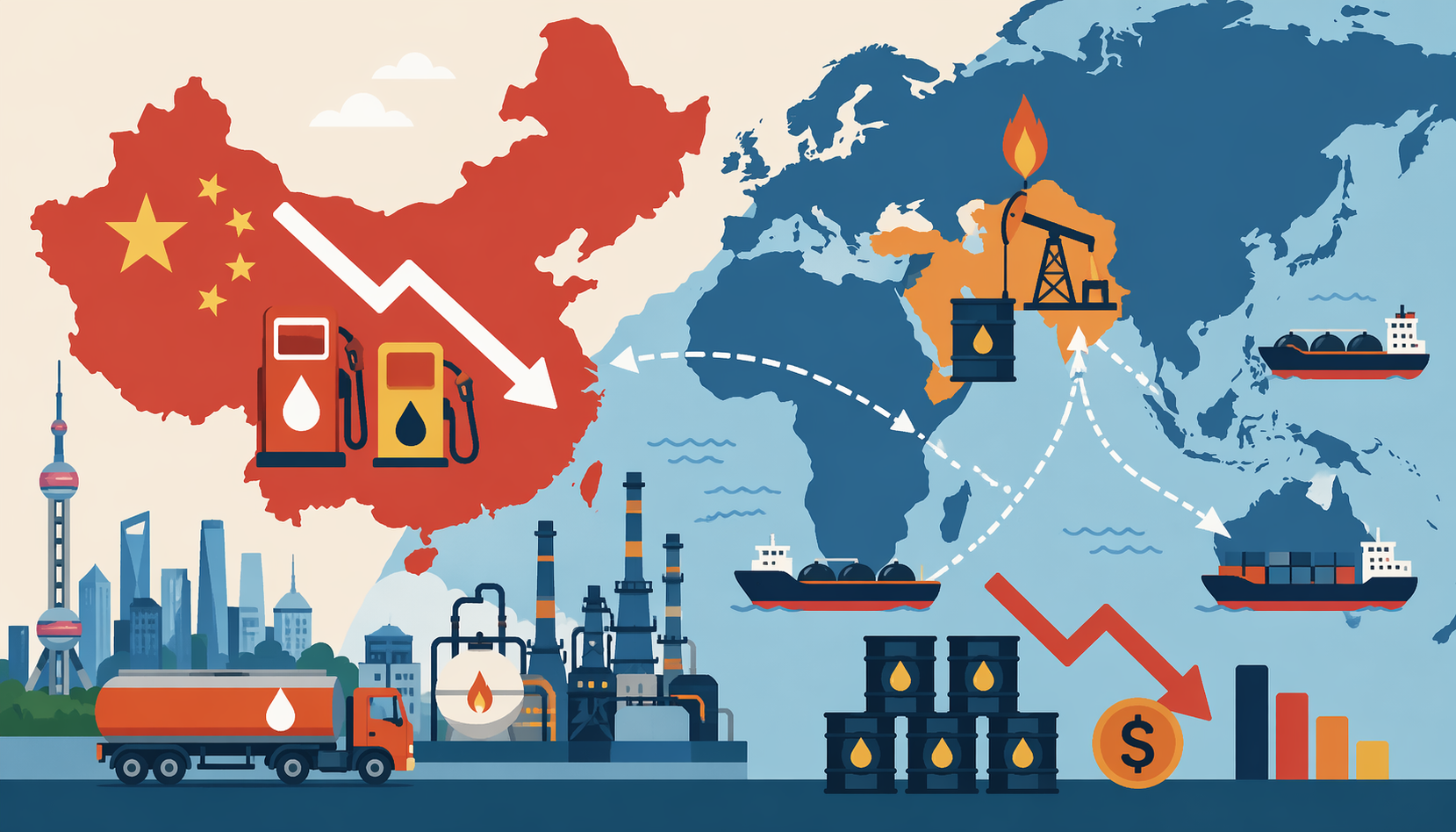
The Strait of Hormuz has always been the pressure point of global energy. Before the current crisis, approximately 25% of the world’s seaborne oil trade and 20% of its LNG passed through this 33-kilometer-wide channel between Iran and Oman. Gulf producers — Saudi Arabia, the UAE, Kuwait, Qatar, Iraq — depend on it as the primary route for their hydrocarbon exports. Asian importers depend on it even more: China, India, Japan, and South Korea collectively account for roughly 75% of the oil and 59% of the LNG that transits the strait.
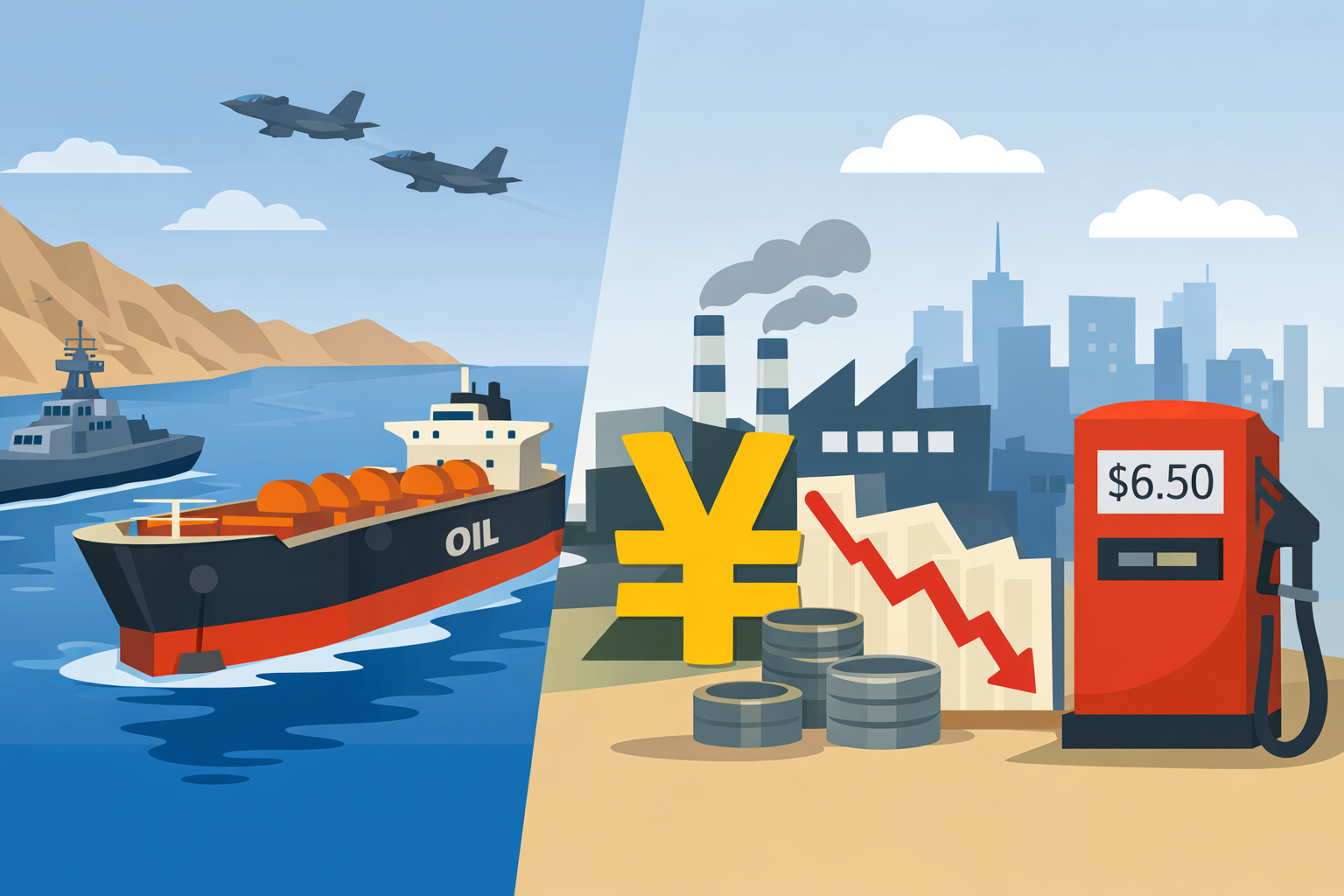
What makes the current crisis different from past scares is that the strait has actually closed. Following the launch of Operation Epic Fury on February 28, 2026 — coordinated US-Israeli airstrikes on Iran — Tehran retaliated by restricting and then shutting down commercial transit through the waterway. Tanker traffic dropped by 70% in the first days, then effectively fell to zero. On March 27, the IRGC formally announced that transit was prohibited for vessels headed to or from US and allied ports. Over 230 oil-laden tankers have been stranded, unable to sail.
This is not a theoretical risk premium being priced into futures contracts. This is a physical supply collapse.
The Market Shock
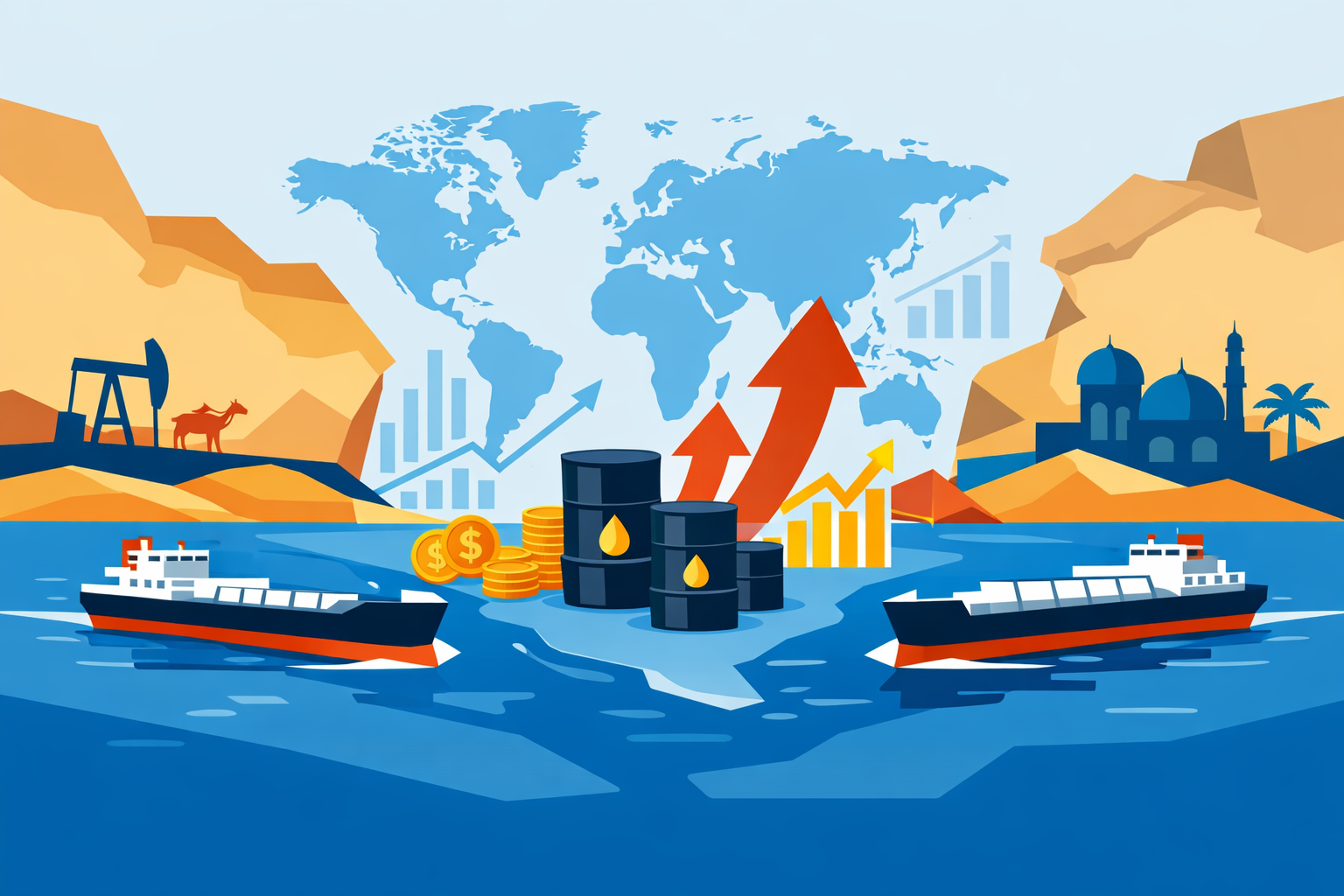
The oil price response has been historic. Brent crude surpassed $100 per barrel on March 8 — the first time in four years — and kept climbing. By late March, the International Energy Agency was calling it the largest supply disruption in the history of the global oil market, eclipsing even the 1973 Arab embargo in its speed and severity. Collective production losses from Kuwait, Iraq, Saudi Arabia, and the UAE reached at least 10 million barrels per day by mid-March.
The price trajectory has been anything but smooth. A brief ceasefire on April 8 sent Brent plunging below $90. On April 17, Iran’s foreign minister announced the strait was fully open to commercial traffic, triggering a further 10% drop. But the optimism lasted less than 48 hours. By April 19, Iran had reimposed restrictions, citing US breaches of the ceasefire terms. US forces fired on and seized an Iranian-flagged cargo vessel in the Gulf of Oman. As of April 20, Brent is trading around $95 per barrel — up more than 40% year-on-year — with WTI near $89.
Goldman Sachs has warned that if the strait remains largely closed for another month, Brent could average above $100 for the entirety of 2026, potentially reaching $120 in the third quarter. Analysts increasingly regard $200 per barrel as a plausible tail risk, not a fantasy.
The damage extends well beyond crude. War-risk insurance premiums for tankers transiting the strait had already tripled before the closure. LNG spot prices have spiked as QatarEnergy — the world’s largest LNG exporter, entirely dependent on Hormuz for shipments — declared force majeure on all contracts and began shutting down liquefaction plants. Jet fuel and diesel prices have more than doubled, reflecting refinery dependence on specific grades of Gulf crude. Aluminum, fertilizer, and even helium markets are experiencing supply shocks through the same chokepoint.
Inflation Returns to the Table
The timing is brutal. After two years of painful but largely successful disinflation following the post-pandemic and post-Ukraine price surges, central banks were finally in sight of their targets. Rate cuts were being priced in across developed markets. Consumer inflation expectations were settling.
That trajectory has now been disrupted. The IMF’s April 2026 World Economic Outlook, released just last week, raised its global headline inflation forecast to 4.4% — up 0.6 percentage points from January — under its reference scenario, which assumes a short-lived conflict and a moderate 19% increase in energy commodity prices. Under the adverse scenario, inflation rises to 5.4%. Under the severe scenario — extended disruption into 2027 with de-anchored expectations — it exceeds 6%.
A Dallas Fed working paper published in early April modeled the US inflation impact specifically. A one-quarter closure of the strait would push WTI to $110 per barrel and add roughly 0.7 percentage points to headline PCE inflation. A two-quarter closure would see WTI peak at $132, with headline PCE inflation rising by nearly 1.5 percentage points. The pass-through to gasoline prices is swift and direct: US average gasoline prices have already climbed from $2.98 per gallon on February 28 to $4.11 in mid-April, a 38% increase in less than two months.
For energy-importing economies in Asia and Europe, the exposure is even more acute. Japan’s refiners source approximately 95% of their crude from the Gulf, with about 70% of that transiting Hormuz. Japanese refiners have already requested government releases of strategic stockpiles. The Kiel Institute’s quantitative trade model estimates that a full Hormuz closure raises global energy prices by 5.4% and food prices by 2.7% in the short run — with the effects roughly doubling if Saudi alternative export routes also prove insufficient.
The food channel is critical and underappreciated. Higher energy costs feed directly into fertilizer production, transportation, and processing costs. The Kiel Institute describes it as a cascade: energy shock to chemicals to fertilizers to food security — three crises compressed into one chokepoint.
Central Banks Face an Impossible Trade-Off
For the Federal Reserve, the European Central Bank, and the Bank of Japan, the Hormuz crisis presents a dilemma with no clean answer. Cut rates to support weakening growth, and risk fueling an inflationary spiral. Hold rates steady or tighten, and risk tipping already fragile economies into recession.
The IMF’s own modeling suggests that under its severe scenario, the federal funds rate would need to rise by 50 basis points in 2026 and a further 100 basis points in 2027 — a dramatic reversal from the rate cuts that markets had been pricing in just weeks ago. The institution explicitly flags the risk of wage-price spirals, particularly in countries where inflation expectations remain poorly anchored.
The comparison to 2022 is instructive but imperfect. When Russia’s invasion of Ukraine sent commodity prices surging, central banks were dealing with already overheated labor markets, abundant household liquidity, and post-pandemic demand surges. The subsequent synchronized tightening achieved disinflation without triggering a global recession — widely regarded as a policy success. Today, labor markets are softer, balance sheets are normalized, and pre-shock inflation pressures are more subdued. That’s the good news.
The bad news is that the 2022 episode left scars. Price levels remain permanently higher. Consumers are sensitized to inflation. And critically, inflation expectations may be more fragile than they appear — the IMF notes they have become more sensitive to new price increases precisely because the memory of the last surge is still fresh.
For emerging market central banks, the calculus is even harder. Currency depreciation against the dollar — driven by capital flight to safe havens — amplifies the domestic cost of imported energy, creating a feedback loop between exchange rate pressure and inflation. Several emerging economies now face the prospect of raising rates to defend their currencies at exactly the moment their growth is decelerating.
Broader Economic Spillovers
The damage is not confined to energy markets and inflation statistics. The IMF downgraded its 2026 global growth forecast to 3.1% under the reference scenario — a sharp cut from the 3.4% it was preparing to announce before the war. Under the adverse scenario, growth falls to 2.5%. Under the severe scenario, 2.0% — not just this year, but next year as well.
The regional dispersion is severe. The Middle East and Central Asia forecast was slashed by 2 percentage points to just 1.9%. Iran’s economy is projected to contract by 6.1%. Even Saudi Arabia, an energy exporter theoretically benefiting from higher prices, saw its forecast cut from 4.5% to 3.1% — because its ability to export is itself constrained by the very disruption that is raising prices. The eurozone growth forecast dropped to 1.1%, below pre-war estimates.
Aviation has been significantly disrupted. The closure of airspace over key corridors between Africa, Asia, and Europe has forced airlines to reroute flights on longer paths, adding fuel costs and journey time. Major Middle Eastern airports that collectively handle around 15% of global air traffic have been shut. The effects ripple through tourism, business travel, and cargo supply chains.
Consumer sentiment is deteriorating rapidly. Higher energy and food prices erode purchasing power, particularly for lower-income households with less capacity to absorb price increases. Corporate margins are being squeezed as input costs rise faster than firms can adjust pricing. Trade balances are worsening for import-dependent economies like Japan, India, and much of Southeast Asia.
Temporary Shock or Structural Shift?
The critical question — the one that determines whether this becomes a manageable disruption or a genuine turning point — is duration.
The IMF’s reference forecast explicitly assumes a short-lived conflict that resolves in the second half of 2026, with energy prices normalizing by year-end. The institution’s chief economist has acknowledged that with each passing day without resolution, the world is drifting further from that baseline. The ceasefire agreed on April 8 was supposed to involve the reopening of the strait. It has not held. As of today, Iran and the US are exchanging fire around the waterway, with the next round of talks expected in Pakistan this week.
Even if a durable ceasefire is reached, the return to normal will not be instantaneous. QatarEnergy has warned that restarting LNG liquefaction plants takes weeks. ADNOC’s CEO Sultan Al Jaber disclosed that Iranian attacks on the UAE’s Habshan gas complex — on April 3 and April 8 — have damaged production infrastructure. UAE oil output had already fallen by more than half. Rebuilding capacity, restoring insurance confidence, and convincing shipowners to transit the strait again will take months, not days.
There is a deeper structural question beneath the immediate crisis. The Hormuz shock has exposed what the Kiel Institute calls a vulnerability that runs deeper than energy security — a bottleneck mechanism where a single chokepoint closure simultaneously produces an energy shock, a manufacturing shock, and a food security emergency. Policymakers who treat these as separate risks will underestimate the total impact.
For energy-importing nations, the lesson is landing hard. Japan’s near-total dependence on Gulf crude transiting a single waterway is not a new vulnerability, but it has never been tested at this scale. The crisis is already accelerating conversations about strategic reserves, pipeline diversification, alternative supplier relationships, and — inevitably — the pace of the energy transition.
Whether this proves to be a temporary spike or a structural repricing depends on decisions being made right now, in Tehran, Washington, and Islamabad. The IMF has put it plainly: the current situation demands a swift cessation of hostilities and the reopening of the strait. Without that, the damage compounds daily — in higher prices, tighter supply, weaker growth, and harder choices for every economy connected to global energy markets.
Which, at this point, is all of them.