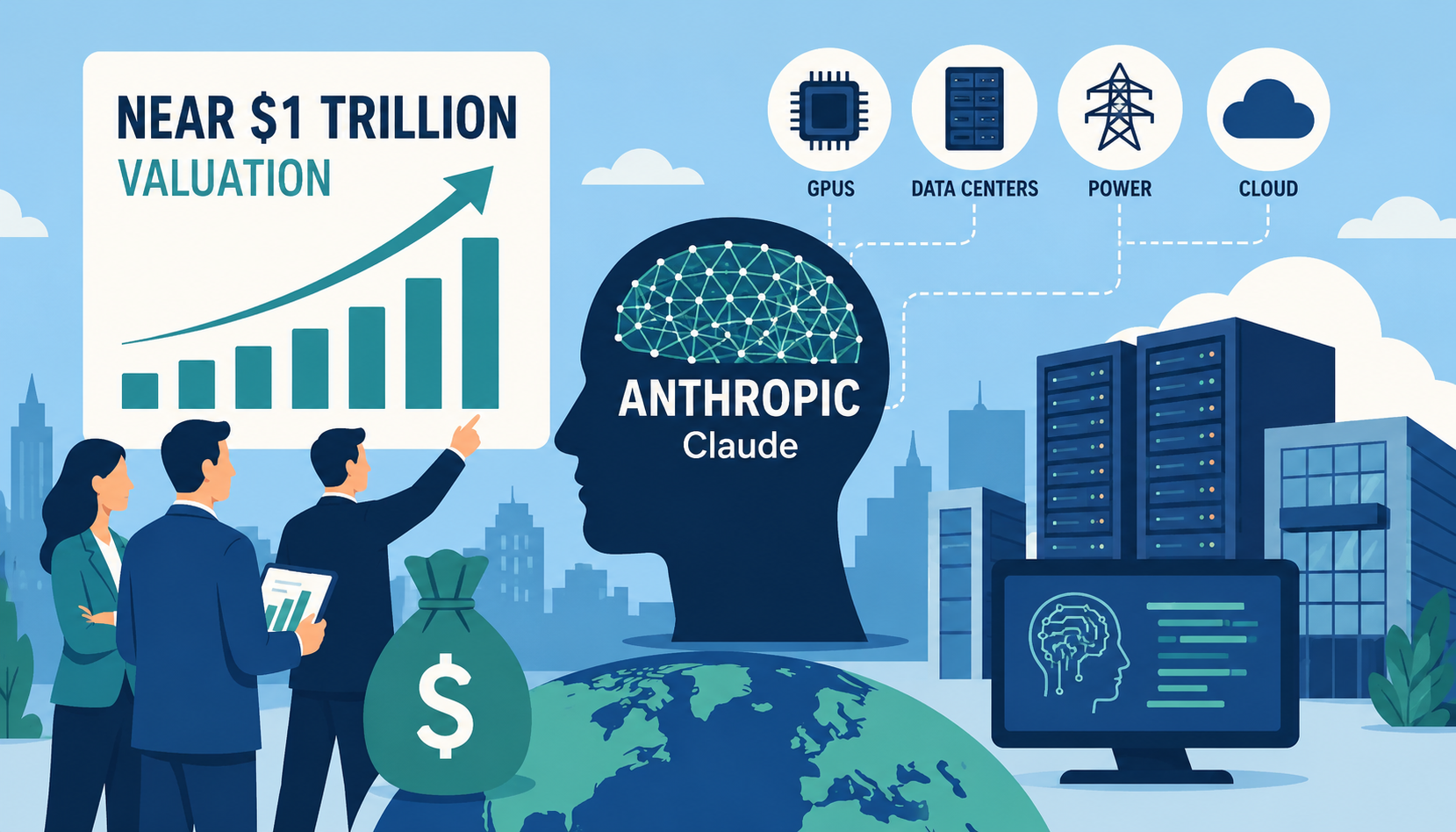
The headline number is the one everyone will remember: nearly a trillion dollars. The Financial Times reported on May 8 that Anthropic, the AI lab behind Claude, is in early talks about a fundraising round this summer that could lift its valuation to nearly $1 trillion and put it ahead of rival OpenAI. Reuters and Bloomberg quickly followed with their own confirmations. Yahoo Finance
But the more revealing detail is buried one line down. The money, according to the FT, is meant to fund a major expansion in computing capacity. That single phrase tells you almost everything you need to know about where the AI industry is heading — and why this valuation, however eye-watering, is no longer really a story about software. Yahoo Finance
From challenger to potential trillion-dollar private company
Anthropic’s climb has been astonishing even by frontier-AI standards. The company was founded in 2021 by former OpenAI researchers, and as recently as January 2025 was reportedly valued at around $60 billion. By September of that year, a Series F had pushed it to $183 billion. Then came February 2026, when Anthropic announced a Series G that was, by any measure, historic in scale: $30 billion in Series G funding led by GIC and Coatue, valuing Anthropic at $380 billion post-money. Anthropic
That round ranked as the largest venture deal of 2026 and the second-largest of all time, trailing only OpenAI’s $40 billion raise the year before. At the time, Anthropic disclosed that run-rate revenue is $14 billion, with this figure growing over 10x annually in each of those past three years. Run-rate revenue — annualizing the most recent month or quarter — is not the same as audited annual revenue, but the velocity is unambiguous. Anthropic
By April, Reuters was reporting that the figure had jumped again to roughly $30 billion. Whatever skepticism investors might bring to private-market growth stories, the operating base under this valuation has shifted enormously in just a few months.
If the rumored $50 billion raise lands anywhere near a $1 trillion mark, it would push Anthropic past OpenAI’s most recent valuation on paper. That is a symbolic threshold the AI industry has been edging toward for two years. It is now within reach.
The money is for power, not code
Why does a software company need tens of billions of dollars in cash? Because frontier AI is no longer really a software business in the traditional sense.
Training and serving the largest models requires GPUs by the hundreds of thousands, multi-gigawatt data centers, multi-year electricity contracts, and bespoke chip-supply arrangements. Anthropic itself has illustrated the math: in early May the company disclosed a SpaceX compute agreement that, according to TECHi, gives it access to more than 300 megawatts of capacity and over 220,000 NVIDIA GPUs within the month. Google has separately committed up to $40 billion at a $350 billion valuation, with the first $10 billion upfront and the remaining $30 billion tied to performance benchmarks. Amazon has put in $5 billion with an option for as much as $20 billion more. TECHiYahoo Finance
Each of those numbers is, in essence, a compute deal dressed up as an equity transaction. The economics of frontier AI now look less like SaaS and more like steel, refining, or chemicals: enormous upfront capital, long depreciation cycles, dependence on grid capacity and physical real estate, and exposure to commodity prices for chips and electricity.
That is the deeper meaning of a near-trillion-dollar valuation. Investors are not just paying for a chatbot. They are paying for first claim on the next decade’s compute supply.
Enterprise demand is doing the heavy lifting
The other half of the story is who is paying for all that capacity. Anthropic’s growth narrative is no longer driven by consumer fascination with talking AI; it is driven by businesses installing Claude into workflows they cannot easily roll back.
In its February announcement, the company said the investment will fuel the frontier research, product development, and infrastructure expansions that have made Anthropic the market leader in enterprise AI and coding. That positioning matters because enterprise revenue tends to be stickier, more recurring, and far more lucrative per user than consumer subscriptions. CFO Krishna Rao captured the framing in a single line: “Claude is increasingly becoming more critical to how businesses work.” AnthropicCrunchbase News
The numbers behind that claim are striking. Anthropic disclosed in February that the number of customers spending over $100,000 annually on Claude (as represented by run-rate revenue) has grown 7x in the past year, and that two years ago, a dozen customers spent over $1 million annually with Anthropic, and today that number exceeds 500. Eight of the Fortune 10 are now Claude customers. Claude Code, the company’s AI coding agent, alone reportedly crossed $2.5 billion in run-rate revenue. AnthropicGIC
Wall Street has noticed. Axios reported that institutional investors are increasingly favoring AI companies with strong enterprise stories — Anthropic and Google in particular — over those that look more reliant on consumer engagement. The market is starting to discriminate among AI firms based on the quality of their revenue, not just the popularity of their chatbot.
Who wins, who loses
A capital cycle this large has second-order effects that ripple far beyond San Francisco. The most obvious beneficiaries are the picks-and-shovels names: NVIDIA and other chip designers, hyperscale cloud providers, custom-silicon foundries, data center developers, and, increasingly, electricity utilities and grid operators sitting next to where new AI campuses get built. Real estate, water, transformers, and high-voltage transmission have quietly become inputs to the AI economy.
The pressured side is also visible. Traditional enterprise software vendors face the awkward question of whether a Claude- or ChatGPT-powered competitor can deliver their product at lower cost. Smaller AI startups risk being priced out of the compute market entirely, since long-term GPU and power contracts now go to whoever can write the biggest checks. And public-market investors who have spent the past year buying AI exposure through cloud and chip names are now staring at private valuations that imply those public stocks may already be cheap — or wildly overextended, depending on who is right about future demand.
Bubble or industrial buildout
This is where the analytical caution matters. A near-trillion-dollar private valuation is not a small stretch from $380 billion. At a roughly $30 billion run-rate, the implied multiple sits somewhere in the high twenties — not unreasonable for a hypergrowth software company, but unusual for one whose business model now requires industrial-scale capex to keep growing.
The bull case writes itself: enterprise lock-in, scarce frontier-model talent, strategic importance to governments, and a revenue curve that has bent sharply upward for three straight years. The bear case is harder to dismiss. Margins on compute-heavy AI services are still poorly understood. Regulatory pressure is mounting. Model capabilities may commoditize faster than the multiples imply. And private-market valuations have a habit of sprinting ahead of operating reality — until they don’t.
It also bears repeating that the FT framed these as early-stage talks. Bloomberg, reporting separately, noted the potential valuation could top $900 billion and that Anthropic has not accepted any offers. Rounds of this magnitude routinely shrink between leak and close. Let’s Data ScienceLet’s Data Science
A global story, not a Silicon Valley one
What is no longer in doubt is that frontier AI has become a question of state-level resources, not just venture capital. The investors crowding into Anthropic’s recent rounds — Singapore’s GIC, Abu Dhabi’s MGX, Qatar Investment Authority, BlackRock-affiliated funds, JPMorgan, Morgan Stanley — read more like a list of sovereign and systemic financial actors than a typical Sand Hill Road syndicate. Capital from the Gulf, Singapore, and Wall Street is flowing into U.S.-built models running on chips manufactured in Taiwan and powered by American electricity. Each of those nodes is now a strategic chokepoint.
Governments are beginning to treat leading AI labs less like software startups and more like strategic infrastructure — closer in profile to TSMC or a major energy utility than to Slack or Dropbox. That reframing is what makes the near-trillion-dollar number more than tabloid copy.
The real test embedded in Anthropic’s reported valuation is not whether one company is worth $1 trillion. It is whether private markets, sovereign investors, and cloud incumbents now believe that frontier AI firms are the next generation of industrial-scale platforms — companies that earn their place not through software margins, but through control of compute, energy, and enterprise workflows at a scale most of the tech industry has never had to operate at before.
If that bet is right, today’s headline number will look conservative. If it is wrong, it will be remembered as the moment the AI cycle stopped pricing models and started pricing power plants.