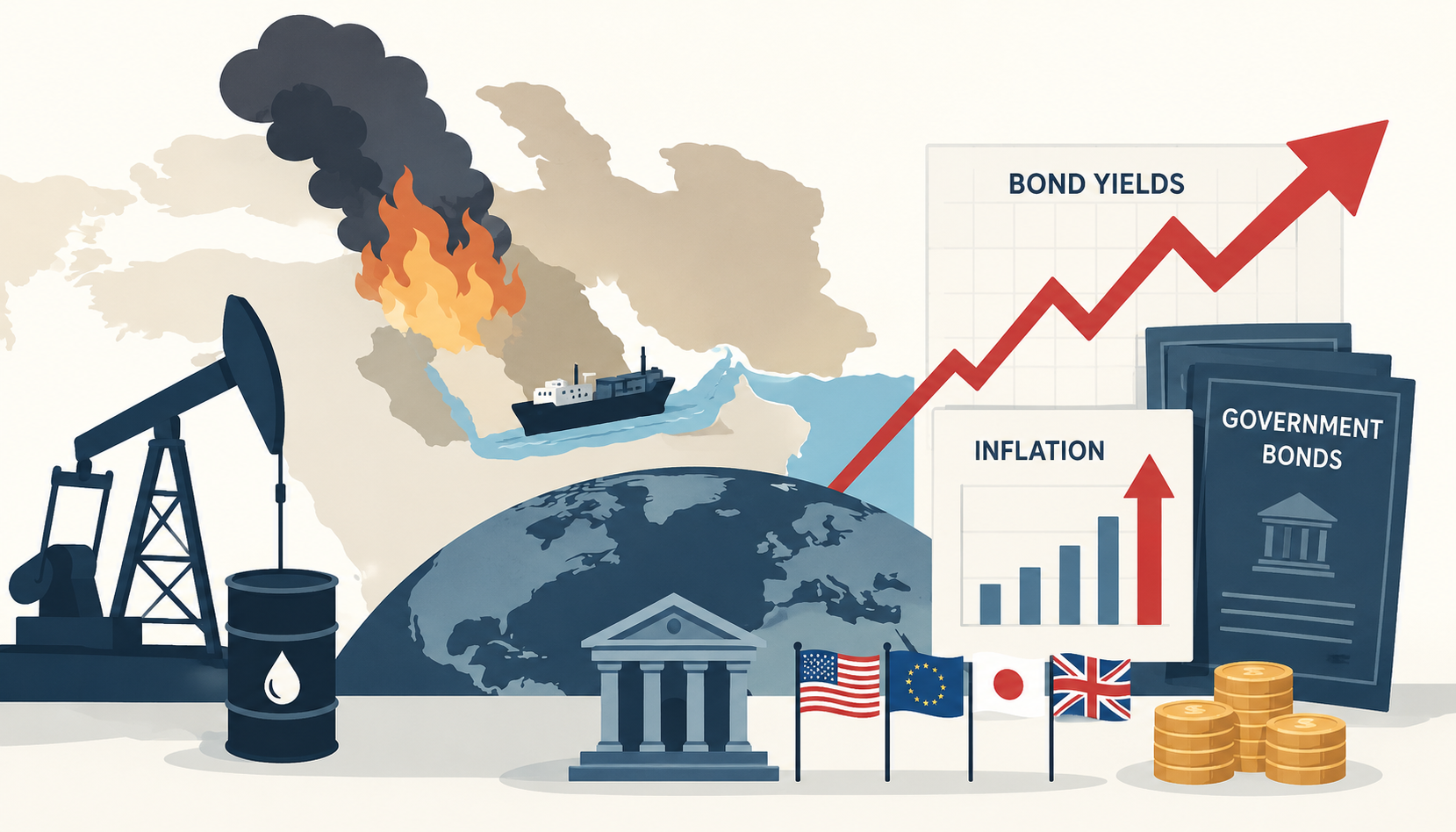
A selloff in government bonds from Tokyo to New York is turning the Iran war into a broader test of global financial stability. What began as an energy-supply shock is now feeding into inflation expectations, central bank pricing, and fiscal-risk concerns, forcing investors to ask whether the era of easier rate cuts has been pushed further out of reach.
A bond market that no longer believes in rate cuts
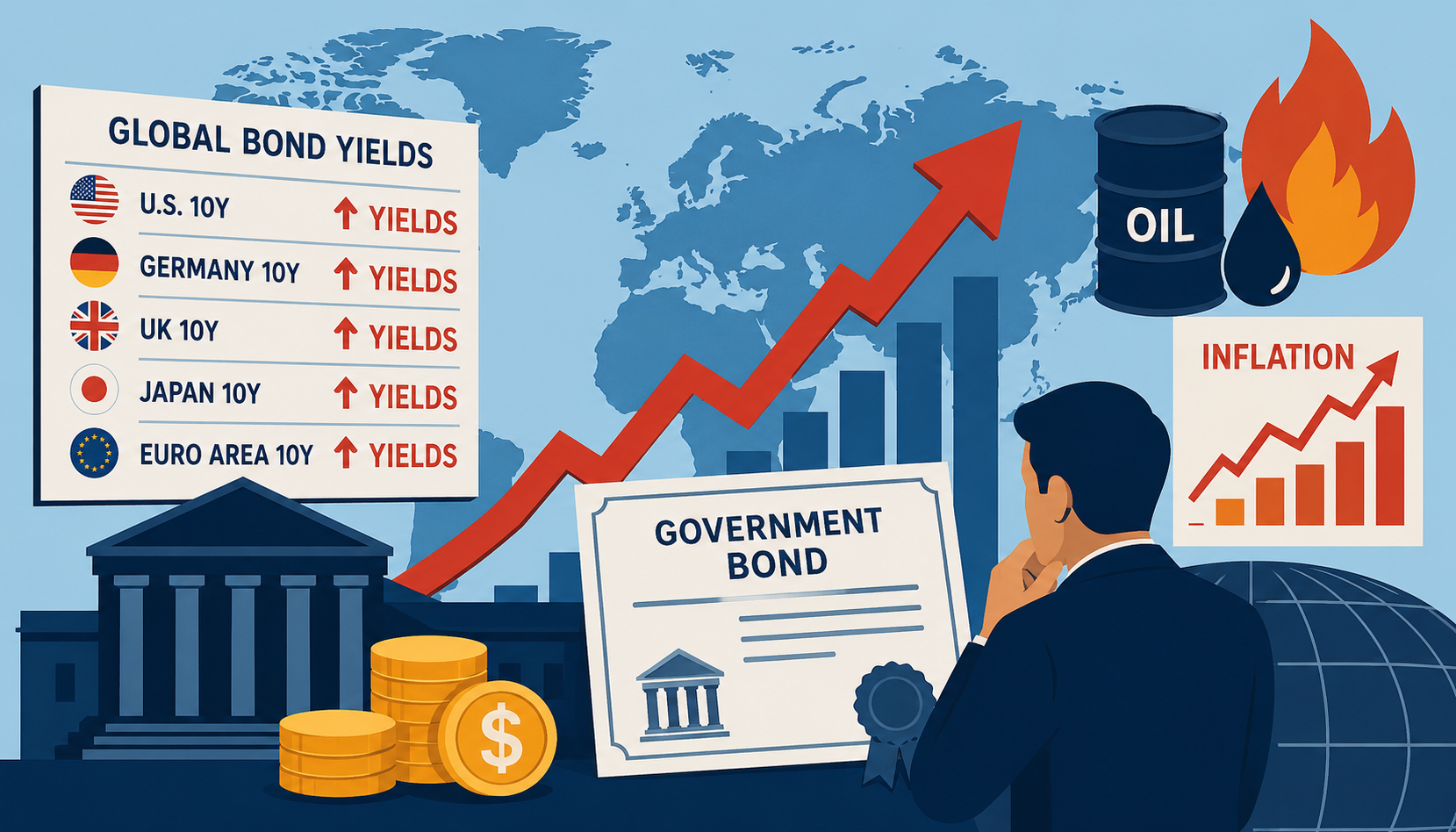
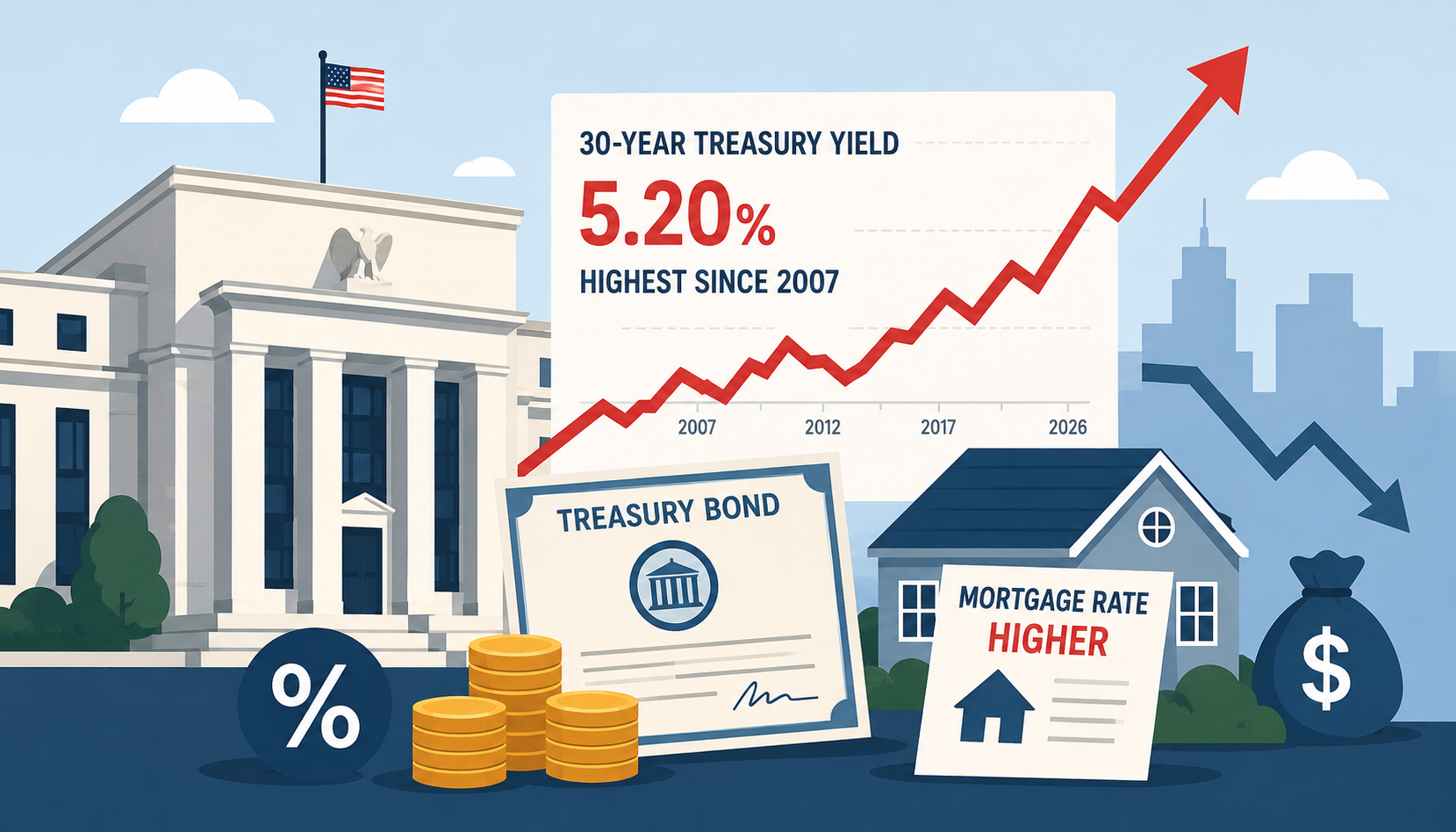
On Monday, May 18, government bonds extended losses across the major markets. The 10-year U.S. Treasury yield climbed to its highest since February 2025 at 4.631% after a more than 20-basis-point jump the previous week, the 2-year yield reached a 14-month high of 4.105%, and the 30-year yield touched 5.159%, a one-year peak. In Tokyo, the 10-year Japanese government bond yield brushed 2.800%, a level not seen since 1997, while the 30-year JGB set a record high above 4.20%. Germany’s 10-year Bund hit 3.193%, a 15-year top.
The trigger was not a fresh monetary policy statement. It was a renewed climb in Brent crude to around $111 a barrel after a drone strike at a UAE nuclear power plant deepened doubts about a near-term end to the Iran war. According to the CME FedWatch tool, markets are now pricing in better than a 50% probability that the Federal Reserve will raise rates by December — a remarkable shift, given that the same instruments were priced for cuts only weeks ago.
Why does this matter beyond the bond desks? Bond yields rise when investors demand more compensation for either inflation or risk, or both. Higher yields push up mortgage rates, corporate borrowing costs, and the cost of servicing public debt. They also re-rate equity valuations, because future cash flows are discounted at higher rates. When the move is global and simultaneous, it tightens financial conditions for almost every borrower in the world at once.
The energy shock is doing the work
The transmission mechanism is straightforward, and it runs through the Persian Gulf. The International Energy Agency’s May 2026 Oil Market Report describes a supply shock with no real precedent: cumulative oil supply losses from Gulf producers already exceed one billion barrels, with more than 14 million barrels per day shut in. Global observed inventories drew by 129 million barrels in March and a further 117 million barrels in April. OECD on-land stocks alone fell by 146 million barrels in April, equivalent to a 4.9 million-barrel-per-day drawdown.
Speaking in Paris on Monday on the sidelines of the G7 finance ministers’ meeting, IEA Executive Director Fatih Birol warned that commercial inventories would last “several weeks, but we should be aware of the fact that it is declining rapidly,” and that the 2.5 million barrels per day being released from strategic reserves “are not endless.” He added that the onset of the northern hemisphere planting and travel seasons would accelerate the drawdown of diesel, jet fuel, fertilizer, and gasoline stocks.
That last point matters. An oil shock raises headline inflation directly through gasoline, but it also moves through fertilizer, freight, petrochemicals, and food prices with a lag. The 2026 episode has, on top of that, a gas dimension: the IEA’s Middle East topic page notes that LNG flows from Qatar and the UAE have been reduced by over 300 million cubic meters per day since March 1, a loss of more than 2 billion cubic meters per week. Asian gas prices have risen sharply to attract spare cargoes. For energy-importing economies, that is a tax on real incomes.
The U.S. is leaning hard on its own buffer. According to the U.S. Energy Information Administration’s Today in Energy update, the Department of Energy released 17.5 million barrels from the Strategic Petroleum Reserve between the weeks ending March 20 and April 24, with a single-week draw of 7.1 million barrels — the largest since October 2022. The U.S. release of 172 million barrels is part of a coordinated 400 million-barrel global drawdown agreed by IEA members in March.
Central banks face a tightening trade-off
Energy shocks are usually treated by central bankers as supply disturbances they can “look through.” Anchored long-term inflation expectations, the conventional view holds, should allow them to focus on second-round effects rather than the headline number. That doctrine is now being stress-tested.
The European Central Bank’s April 30 monetary policy decision held rates at the deposit-facility level of 2.00% but explicitly stated that “the upside risks to inflation and the downside risks to growth have intensified.” Lagarde framed the position in plain terms at the press conference: “the longer the war continues and the longer energy prices remain high, the stronger is the likely impact on broader inflation and the economy.” Asked on Monday in Paris whether she was worried about the bond rout, she replied that worrying was part of her job — measured, but not dismissive.
The Bank of Japan, for its part, kept its policy rate at 0.75% in late April but raised its FY2026 core inflation forecast to 2.8% from 1.9%, while cutting growth to 0.5% from 1%. The 6-3 vote saw three members push for a hike to 1%. Board member Kazuyuki Masu has since publicly called for rate increases “as soon as possible.” With the 10-year JGB at multi-decade highs and Tokyo reportedly preparing a supplementary budget to subsidize energy costs, the gap between hawkish data and an officially patient policy stance is widening.
The Fed is in a particularly awkward spot. Front-end Treasury pricing now reflects a real probability of hikes, not cuts, even though growth signals are mixed. Term premia — the extra yield investors demand for holding longer-dated debt — are rising across curves. That is the bond market saying it sees more uncertainty, not just higher expected short rates.
Fiscal risk: the second leg of the rout
Higher yields are a market story until they meet a fiscal balance sheet. Then they become a credit story.
Japan illustrates this clearly. Reports that the Takaichi government is preparing a supplementary budget for FY2026 to cushion the oil-price shock have coincided with the steepest part of the JGB selloff. Société Générale analysts warned, as quoted in market commentary, that fiscal risks “are just beginning” and that longer-dated JGBs are likely to remain under pressure. With public debt above 250% of GDP and a still-weak yen — trading around 159 to the dollar — the room for fiscally financed energy subsidies is narrower than the headlines suggest. Finance Minister Satsuki Katayama told reporters in Paris that she had been instructed by Prime Minister Takaichi to “minimize various risks” relating to the rise in long-term interest rates.
This pattern is not unique to Japan. Any country running large primary deficits, with significant near-term refinancing needs and elevated energy import dependence, is now refinancing at materially higher rates. UK gilts touched an 18-year high of 5.187% last week. French OAT spreads remain wide. Emerging-market sovereigns face a double hit: higher external borrowing costs and, in many cases, currency depreciation against a still-firm dollar.
G7 coordination under strain
The G7 finance ministers’ meeting hosted by France’s Roland Lescure in Paris on May 18-19 was, by design, an attempt to put a coordinated face on the response. Treasury Secretary Scott Bessent pressed counterparts to align on sanctions to “strangle Iran’s economy,” and the agenda explicitly covered the Hormuz crisis, public-debt dynamics, and critical-minerals supply chains. Representatives from India, South Korea, Brazil, and Kenya were invited as guests, alongside ministers from the UAE, Syria, Qatar, and Ukraine. According to Reuters reporting, Lescure also indicated agreement that the IMF and World Bank would need to “step up their game” for the countries most exposed to the Middle East shock.
But coordination on energy and sanctions has tangible limits. The U.S. has just extended for a second time a 30-day waiver allowing purchases of Russian seaborne oil by “energy-vulnerable” countries — a step EU officials publicly criticized in Paris. Bundesbank President Joachim Nagel told reporters that policymakers can do “a lot” to calm markets, but central bankers cannot offset a real supply shock; they can only choose which costs to absorb. The political reality is that each major economy faces a slightly different inflation-growth mix, which means slightly different policy reactions, which in turn produces the kind of divergent, jumpy yield action that markets are now pricing.
Market implications: where this is likely to go
The transmission channels worth watching are familiar but worth setting out plainly:
- Bonds. Higher yields, steeper curves, rising term premia, and heightened sensitivity to fiscal news. The Japanese super-long sector is the canary; the 30-year JGB’s record high tells you something structural is changing in the global duration market.
- Currencies. The dollar’s traditional safe-haven role is partially offset by higher U.S. inflation expectations. The yen remains pressured; commodity-linked currencies of net energy exporters have firmed.
- Equities. Higher discount rates compress valuations, especially for long-duration growth stocks. The AI-led rally of recent weeks is now being tested against a tightening of financial conditions it did not anticipate.
- Commodities. Oil and refined products remain the central inflation variable. North Sea Dated traded in a near-$50 range in April, an extraordinary measure of physical market dysfunction.
- Emerging markets. Energy importers with thin reserves and large external financing needs are the most exposed. The G7’s pledge to lean on the IMF and World Bank reflects an awareness of how quickly the shock can spill into balance-of-payments stress.
Analyst’s View
Credit risk and refinancing pressure deserve more attention than they are getting. When sovereign yields rise this quickly and globally, the second-order effects on credit are rarely visible in spreads first. They show up in coverage ratios, in refinancing schedules, and in the political calculus around energy subsidies versus fiscal consolidation. The most exposed sovereigns are not the ones with the highest debt ratios in absolute terms — they are the ones with short average maturities, large near-term redemption walls, and limited central bank credibility to anchor expectations. For practitioners doing IFRS 9 staging on Middle East and emerging-market exposures, the question is no longer whether qualitative overlays are warranted; it is how to distinguish between sovereigns where the shock is transitory and those where it tips the trajectory of debt sustainability.
Country-risk differentiation will intensify. This shock does not affect all economies symmetrically. Net energy exporters with low debt — parts of the GCC, Norway, some Latin American producers — see their fiscal positions improve. Net energy importers with high debt and weak currencies — Japan, the UK, several frontier markets in sub-Saharan Africa and South Asia — face a compound stress. The historic profile most vulnerable to this configuration is the energy-importing emerging economy with thin FX reserves, sizable hard-currency external debt, and a recent track record of fuel and food subsidies. That is precisely the profile the World Bank and IMF will be asked to backstop.
Position-wise, markets are moving from rate-cut optimism to inflation hedging, but with caveats. The repricing of Fed pricing toward hikes, of ECB pricing toward further holds, and of BOJ pricing toward earlier tightening is rational given the data. But it is unstable. A credible end to the Hormuz disruption — even a partial, phased reopening — could collapse front-end yields just as quickly as the shock pushed them up. The asymmetric trade is not betting on the direction of yields; it is positioning for the fact that whatever path central banks take, term premia and volatility will stay elevated. Inflation-linked debt, shorter duration, and selective exposure to commodity-linked currencies look like the more durable hedges. Long-duration growth equities and heavily indebted sovereigns sit on the other side of that risk.
The bond rout is not, on its own, a crisis. It is a repricing — of inflation, of fiscal capacity, of central bank credibility, and of the assumption that the post-2022 disinflation was sustainable. Whether the repricing stops here depends on something well outside the bond market itself: a tanker, a strait, and a war.