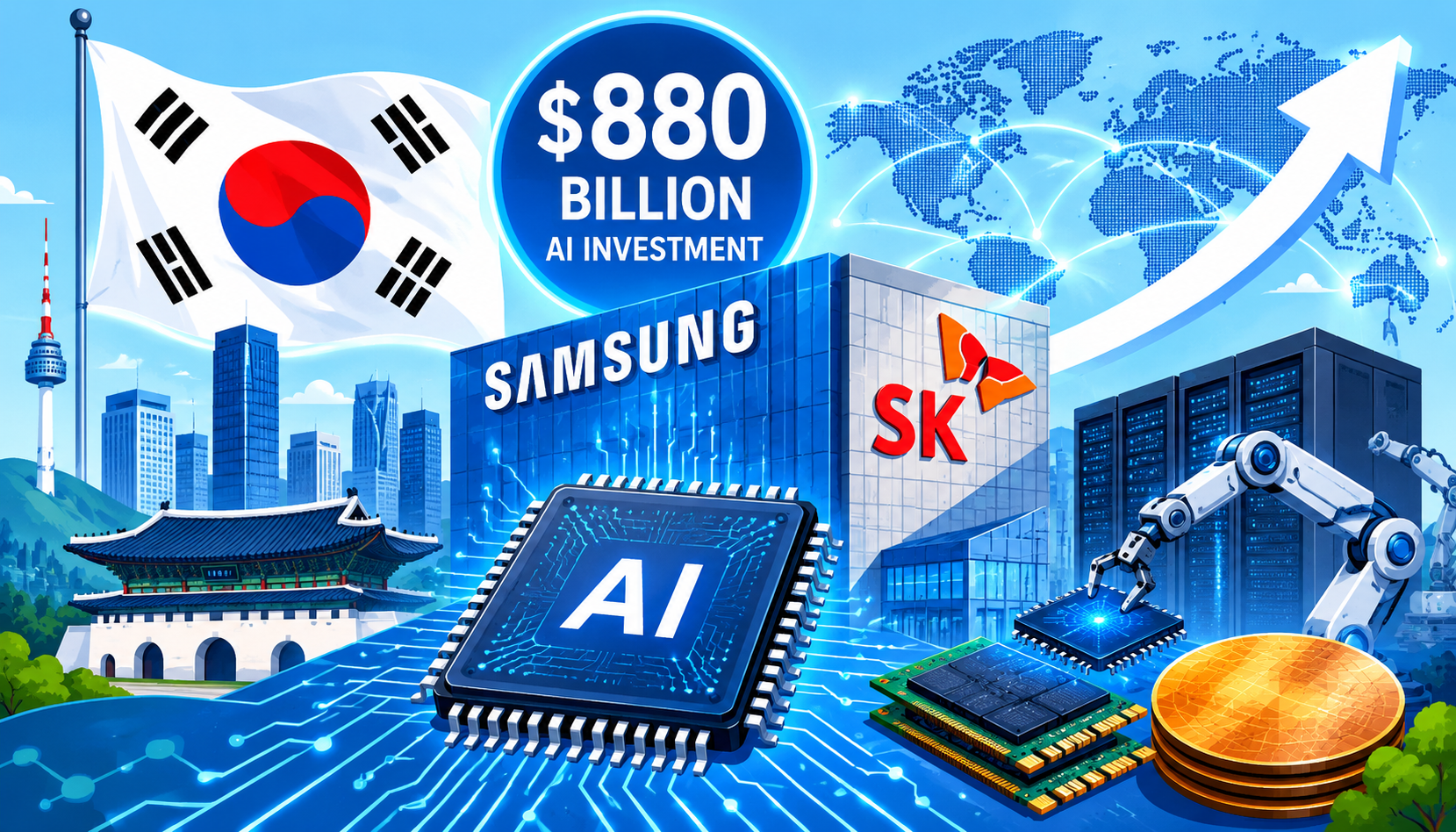
South Korea is making an aggressive bet that the next phase of global growth will be built on AI chips, memory, and data infrastructure. On June 29, 2026, President Lee Jae Myung stood at the presidential office in Seoul flanked by Samsung Electronics Chairman Lee Jae-yong and SK Group Chairman Chey Tae-won and unveiled a spending program that, even by the inflated standards of the AI build-out, is hard to absorb: at least 1,350 trillion won — roughly $880 billion — committed by companies including Samsung and SK Hynix to semiconductors and data centers. The government framed the package as a “great leap forward” resting on a “triple axis” of chips, physical AI, and AI data centers.
The headline number deserves scrutiny before applause. It is not a single corporate check; it is an orchestrated figure that bundles fab construction, packaging, and power-hungry data centers, layered across a decade and across several firms. But the direction of travel is unambiguous. This is industrial policy dressed as a survival strategy.
Why the $880 billion figure matters
Context helps. At about $880 billion, the envisioned outlay represents close to 5% of South Korea’s 2024 GDP — a concentration of national capital in one sector that few advanced economies would attempt. Reporting from the Korea Economic Daily and others suggests the combined commitments could eventually reach 2,000 trillion won, or around $1.3 trillion, if Samsung’s and SK’s full decade blueprints are counted.
The figure matters less as a precise accounting line than as a signal. South Korea is telling the market it intends to defend its position at the top of the memory hierarchy at almost any cost, and it is doing so while demand is white-hot rather than waiting for the cycle to turn.
Samsung and SK at the center of Korea’s AI strategy
The two companies sit at the heart of the plan because they sit at the heart of the global memory market — together they produce roughly two-thirds of the world’s memory chips. Their grip on high-bandwidth memory (HBM) — stacks of DRAM that feed data to AI accelerators — is what makes them indispensable to every hyperscaler training large models.
The most concrete piece of Monday’s announcement: Samsung and SK Hynix will invest 800 trillion won ($518 billion) with suppliers to build two new chip fabrication sites each in the country’s southwest, anchored on Gwangju and South Jeolla province. Samsung’s separately reported decade-long blueprint runs to about 1,000 trillion won ($648 billion), spanning fabs, AI data centers, advanced packaging, batteries, and displays, with roughly 300 trillion won earmarked for the new southwestern fabs and a further tranche for the existing Yongin cluster. SK Group, for its part, cited an even larger envelope split between AI data centers and semiconductor supply.
Data centers form the third pillar. SK, GS Group, and Naver are expected to put up 550 trillion won to build 8.4 gigawatts of AI capacity by 2029, with another 10 gigawatts targeted by 2035. The geography is deliberate: the southwest has historically trailed the Seoul region economically, and routing fabs there serves Lee’s pledge to rebalance growth away from the capital.
A national strategy, and a contested one
The government is not a passive cheerleader. The Ministry of Trade, Industry and Energy said it will double semiconductor capacity in the Seoul capital area within five years and pull forward fab construction timelines — work once scheduled for the late 2040s — by up to twelve years, to the mid-2030s. A dedicated special semiconductor law is set to take effect in August. State support will cover power, water, land, and workforce, the bottlenecks that usually decide whether a fab cluster ever reaches volume.
The strategy is not without domestic friction. The opposition has argued that siting the second cluster in Honam — the liberal Democratic Party’s electoral stronghold — reflects politics more than industrial logic, and that chipmakers are being nudged toward locations they would not choose commercially. SK Hynix’s chairman, notably, said the firm still needs time to finalize a southwestern site and secure infrastructure, a reminder that announcement figures and shovel-ready projects are not the same thing.
The competitive backdrop
The Korean move lands inside a global subsidy race. Washington has channeled tens of billions through the CHIPS and Science Act; China is reportedly drafting a five-year, roughly $295 billion chip blueprint. Sustained over a decade, Korea’s commitment would approach the capital budgets of US hyperscalers like Microsoft. For 2026 alone, Samsung has already flagged more than $70 billion in capacity and research spending.
The demand backdrop explains the urgency. South Korea’s exports jumped 53.2% year-on-year in May 2026 to a record $87.75 billion, the fastest pace since January 1984, with semiconductor shipments surging 169.4% to a record $37.16 billion. Trade Minister Kim Jung-kwan noted the country had run a trade surplus for twelve consecutive months. When the cash is flowing this hard, deferring investment looks riskier than overbuilding.
Market impact
The market’s response was more sober than the rhetoric. On the day, Samsung shares fell about 4.8% and SK Hynix erased a near-6% drop to close down 1.6%, with the broader Kospi recovering intraday losses. Investors, in other words, treated the plan as a long-dated capex commitment with execution risk attached rather than an instant earnings catalyst — a reasonable read. Memory pricing remains the swing variable: today’s shortage-driven boom is exactly the environment in which over-ordering of future capacity is hardest to resist.
Risks
Three stand out. Overcapacity is the oldest story in memory; prices swing violently between glut and shortage, and a wave of new fabs completing into a softer demand year would compress margins precisely when depreciation charges peak. Concentration is the macro version of the same risk — the more Korean growth leans on one cyclical sector, the sharper the downside when it turns. Execution is the near-term constraint: cutting-edge fabs need reliable power, water, and skilled labor, and SK Hynix itself recalled that its Yongin cluster took nine years to stand up. Geopolitics sits underneath all of it, with US–China technology controls capable of reshaping demand and supply chains without warning.
The MOTIE’s own framing makes the stakes concrete: officials warned that at the current pace of fab construction, Korea’s DRAM market share could slip to 50% from 61%. The build-out is as much a defense of an eroding lead as an offensive bet.
Analyst’s View
From a country-risk and credit lens, three implications stand out.
Sovereign and country risk. Korea’s external position is strong today, but the plan deepens an existing structural exposure: a sovereign whose export base, fiscal receipts, and current-account surplus increasingly ride a single, deeply cyclical product. The IMF’s most recent Article IV flagged a slowdown in the semiconductor sector as a key downside risk to the 2026 outlook, and explicitly urged Korea to diversify its export structure and manage AI-transition risks. This investment program pushes in the opposite direction — toward greater concentration — which is rational while demand is structural and dangerous if any meaningful share of it proves cyclical. The OECD’s latest projection of 2.6% growth for 2026 is itself semiconductor-led, which cuts both ways.
Credit risk. For the issuers, scale strengthens the long-term moat but stretches the balance sheet through a heavy capex phase whose returns depend on memory prices holding. The credit question is not whether Samsung and SK can fund the build — they can — but how leverage and free cash flow behave if HBM pricing normalizes faster than the depreciation schedule. State backing via the special semiconductor law softens execution risk but does not underwrite demand. Watch the gap between announced and committed, sited, financed capacity; the difference is where execution risk actually lives.
Market positioning. The cleanest read-through is to the enablers — power, water, construction, and equipment names tied to the southwestern cluster — where the government’s infrastructure pledge is a near-certain demand signal regardless of how the chip cycle turns. For the chipmakers themselves, the discipline is to separate the structural AI demand thesis from cyclical over-investment. A practitioner allocating here would treat the $880 billion as a directional signal, not a forecast, and size exposure to survive a memory downturn rather than to maximize the upside of a boom that the market is already pricing.
The honest summary: South Korea has chosen to defend its semiconductor primacy by spending into strength rather than waiting for weakness. Whether that reads as foresight or as the top of a cycle will depend on something no announcement can control — what AI demand actually looks like when these fabs come online.