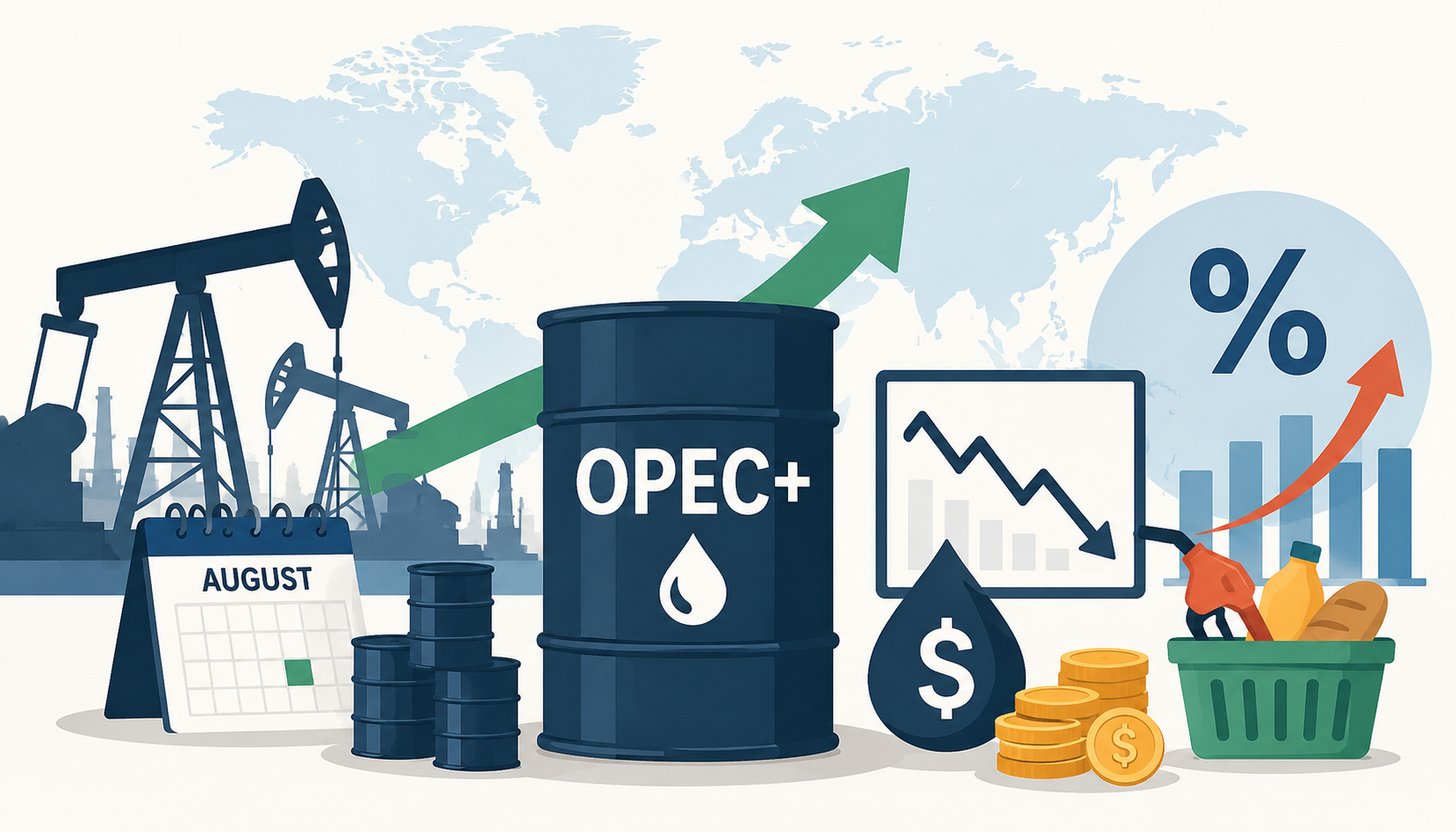
OPEC+ appears ready to add more barrels to the market. The real question is not just supply. It is whether cheaper oil can ease inflation—or whether collapsing demand, fiscal strain among producers, and a Middle East that is only half-healed will complicate the story.
The setup is unusual. When the group’s seven core producers meet on 5 July to set August targets, they will be raising quotas into a market that just lived through the most violent supply shock in OPEC’s history and is now tilting, improbably, toward glut. Understanding that whiplash matters more than the headline barrel figure.
What OPEC+ Is Signaling
Since the United Arab Emirates left the organization on 1 May, only seven of the 21 OPEC+ members have driven monthly policy: Saudi Arabia, Russia, Iraq, Kuwait, Kazakhstan, Algeria, and Oman. Through the first half of 2026 they have kept unwinding the 1.65 million barrels-per-day (bpd) cut first agreed in 2023, adding roughly 188,000 bpd a month once the schedule was adjusted down for the UAE’s departure (OPEC).
By Reuters’ arithmetic, about 567,000 bpd of that original cut remained to be returned from July. If the group sticks to the ~188,000 bpd pace for August and September, the unwind finishes by the end of the third quarter. The 5 July meeting is where the August tranche gets confirmed—or paused.
Here is the distinction that gets lost in the headlines: an output target is not delivered supply. During the closure of the Strait of Hormuz, actual OPEC+ production collapsed far below quota. The group pumped an average of 33.19 million bpd in April, down from 42.77 million in February. Raising a quota you physically cannot fill is a signal about intent, not a barrel that reaches a refinery. The communiqués have stressed exactly this ambiguity—flagging a “cautious approach” and the option to pause or reverse the unwind as conditions demand.
Oil Prices and Inflation
The paradox of this cycle is that the price move now driving the inflation conversation has little to do with the OPEC+ quota at all. Prices are falling because the Strait of Hormuz has begun reopening faster than almost anyone modeled. A U.S. official put crude flows back above 10 million bpd in early July; Iran has shipped more than 40 million barrels since the naval blockade was lifted; and Russian exports have surged to records, piling barrels onto the water.
The result: Brent posted roughly a 30% drop in the second quarter—its steepest quarterly fall since 2020—and both Brent and WTI have slid back toward where they traded the day before the war began on 28 February, with WTI dipping under $70 for the first time since then.
That collapse rewrites the inflation math. The U.S. Energy Information Administration’s June outlook still penciled Brent at an average of $105 a barrel for June and July, but only under the explicit assumption that Hormuz stayed largely shut in the near term (EIA Short-Term Energy Outlook, 9 June; EIA press release). Events overtook that assumption within weeks—a useful reminder of how fragile point forecasts are in this environment. The next STEO lands on 7 July and will almost certainly mark the number down hard.
Energy passes into headline inflation quickly, and the spike earlier this year left fingerprints. The Boston Fed noted that PCE inflation jumped from 2.9% in February to 3.8% in April, driven mainly by energy (Federal Reserve Bank of Boston). In the euro area, headline inflation hit 3% in April as energy prices rose almost 11% (ECB Economic Bulletin). The good news for central bankers is that oil shocks tend to fade relatively fast; the ECB’s own work draws a sharp line between oil, which is immediate but short-lived, and gas, which lingers. Falling crude should ease headline readings later in 2026. Sticky services inflation and wages are another matter.
Demand Risk
Strip away the quota mechanics and a more uncomfortable reading appears: OPEC+ is unwinding cuts into demand destruction, not a boom.
The International Energy Agency now expects global oil demand to fall by 1.1 million bpd year-on-year in 2026, with second-quarter deliveries down about 5 million bpd—the first quarterly demand contraction since the pandemic year of 2020 (IEA Oil Market Report, June). Crude imports into China and Japan fell by roughly 40% at the height of the disruption. The EIA’s demand path tells the same story after three straight downgrades.
So the “confidence” interpretation of higher targets does not really hold. The schedule was set in calmer times, producers have fiscal reasons to keep volumes flowing, and the group is reluctant to be seen abandoning a plan it has defended for months. Whether that logic survives contact with a softening demand picture is the question worth watching in China, Europe, and U.S. consumption data over the summer.
Producer-Country Pressures
Most Gulf budgets are calibrated to oil prices well above where Brent sits today. When crude trades in the low $70s and threatens to go lower, exporters with large spending commitments feel it directly in their fiscal accounts.
That creates a genuine tension. Lower prices argue for restraint, yet several producers still want to pump more—to defend market share, to compensate for volumes lost during the closure, and, in some cases, simply to have their true capacity recognized. The UAE’s exit from OPEC after nearly six decades was rooted in exactly that grievance: a mismatch between its capacity and the quota it was allowed. The fiscal squeeze and the fight over volumes are two sides of the same coin.
Market Implications
Brent and WTI. The near-term picture is a market walking back its war premium. The medium-term risk is oversupply: the IEA projects global supply surging by around 8 million bpd in 2027, pointing to a substantial surplus even as Gulf output normalizes. For now the cushion is thin—OECD government inventories have been drawn to their lowest level since December 1990—but the direction of travel is toward rebuild, not scarcity.
Inflation expectations. Cheaper energy should pull headline inflation down into the back half of the year. Core remains the stubborn part of the story.
Currencies. Oil-linked exporters’ currencies are exposed if prices keep sliding, while net importers across Asia—India and much of ASEAN—get a modest external-balance tailwind.
Central bank sensitivity. The Federal Reserve held its target range at 3.50%–3.75% in June under new Chair Kevin Warsh, who leaned hard on price stability; during the price spike, markets swung from pricing cuts to pricing possible hikes, and are now recalibrating again as crude falls. Earlier FOMC minutes had already flagged how energy-driven inflation was reshaping the rate outlook (Federal Reserve). The ECB has kept its deposit rate at 2.00% and stayed data-dependent, wary of second-round effects (ECB monetary policy decision, 30 April).
Analyst’s View
For a country-risk or credit practitioner, the signal in this cycle is not the size of the August hike. It is the speed of the pivot from record deficit to prospective glut—and what that whipsaw does to exposures that were stress-tested against last quarter’s world.
Sovereign risk among oil exporters is the exposure to watch. If Brent settles in the $60s–$70s while producers are simultaneously ramping volumes back up, fiscal deterioration is the base case, not the tail. Breakeven gaps, reserve adequacy, and sovereign spreads for Gulf and other exporters deserve a fresh look. The UAE’s departure from OPEC and its push for capacity recognition also quietly redraws the Gulf risk map: coalition cohesion is no longer something to take for granted when modeling the region.
For IFRS 9 ECL work, this is an argument for genuinely probability-weighted scenarios rather than a single anchor. A credible scenario set right now spans a near-term tight/high-price tail—driven by any re-escalation around Hormuz—alongside a normalization base case and a 2027 oversupply scenario that pressures exporter creditworthiness. The June STEO’s $105 assumption being overtaken within weeks is a live illustration of why forward-looking overlays for oil-exporter exposures should not be pinned to one point forecast.
Concentration risk compounds all of this. Portfolios heavy in a single Gulf jurisdiction carry correlated oil-price, geopolitical, and coalition-cohesion risk in one position. That argues for a hard look at diversification and for reviewing Force Majeure and pricing terms in long-dated contracts—LNG offtake in particular—where a fast move in energy markets can reset the economics. On the other side of the ledger, cheaper crude is a modest credit tailwind for import-dependent Asian sovereigns, and that asymmetry is worth building into portfolio-level thinking rather than treating every oil move as uniformly good or bad.
The barrels OPEC+ adds in August may barely register against the volumes returning through Hormuz. The more durable lesson is that a market can swing from fear of shortage to fear of surplus in a single quarter—and risk frameworks that assume oil moves slowly are the ones most likely to be caught out.