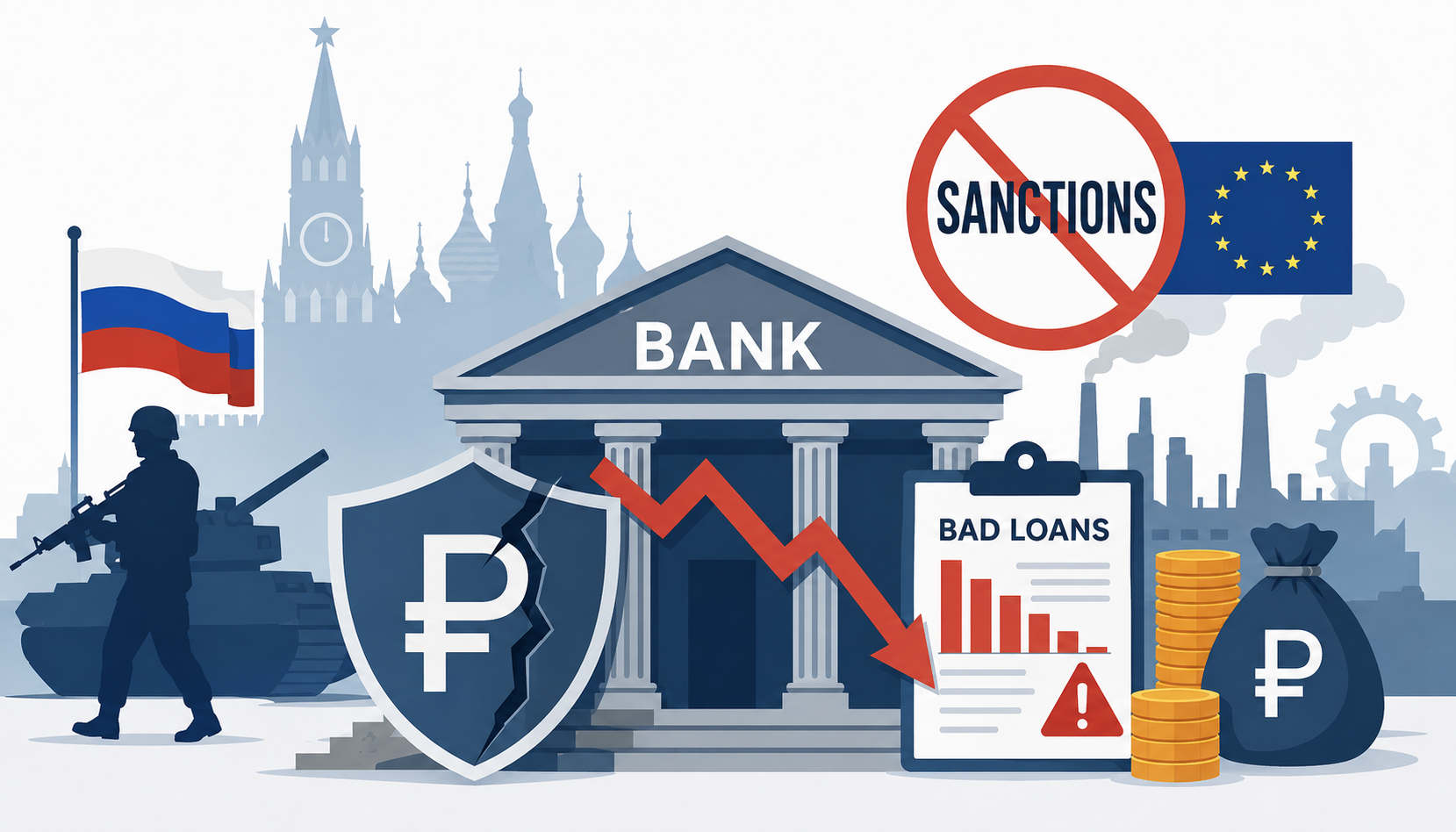
Russia’s war economy has kept factories busy and banks lending, but the same model may now be creating hidden financial stress. A European intelligence report seen by Reuters suggests the pressure could turn into a banking crisis in 2026.
Why this matters now
For nearly four years, Russia has run a curious kind of prosperity. Defence orders have filled factory schedules, wages in war-linked regions have climbed, and the banking system has posted record profits even under the heaviest sanctions regime ever imposed on a G20 economy. The Bank of Russia reported sector-wide net profit of 3.8 trillion rubles in 2024 and still guides toward roughly 3.0–3.6 trillion rubles in both 2025 and 2026. On paper, the banks look healthy.
The intelligence assessment leaked to Reuters on 6 July argues that the paper is the problem. The two-page note, titled “Note on the probability of a banking crisis in Russia in 2026,” contends that state-directed lending, loan restructurings, and government support have masked a genuine deterioration in credit quality — creating what it calls an “explosive” situation that a fresh sanctions shock could detonate.
The timing is not incidental. Brussels is trying to finalise its 21st sanctions package in July, with banks and crypto networks squarely in the crosshairs.
What the intelligence report reportedly says
The numbers cited are worth reading slowly. According to Reuters, the report estimates that around 10% of corporate loans are now doubtful — a sharp jump from 2024 — while some major banks reported retail non-performing loan ratios as high as 15% during 2025.
The household picture is where the report turns pointed. It says more than 500,000 Russians declared bankruptcy in 2025, up almost a third year on year, and that state-backed credit programmes pushed more than 13 million Russians to hold at least three loans simultaneously. That last figure matters more than the headline default numbers, because layered borrowing is exactly the pattern that turns a manageable delinquency problem into a cascading one.
The mechanism the report describes is not exotic. Banks have been leaned on to extend subsidised credit to defence firms, regional projects, and homebuyers. When those borrowers struggle, loans get restructured rather than written down. The exposure stays on the books at face value, provisioning stays light, and the system continues to look profitable — right up until it doesn’t.
How Russia’s banks became part of the war economy
To understand the concern, it helps to see how deeply the state has fused public finance with private balance sheets. The cost of the war has drained the fiscal buffer: European Commission President Ursula von der Leyen noted in June that more than two-thirds of the liquid assets in Russia’s sovereign wealth fund are now gone. With the National Wealth Fund thinner, the banking sector has become the shock absorber of last resort — financing companies and households the budget can no longer directly subsidise.
The aggregate leverage this has produced is visible in the central bank’s own data. As of 1 January 2026, the combined debt of Russian organisations and households reached 174.8 trillion rubles, pushing the debt-to-GDP ratio to roughly 82%. In its most recent Financial Stability Review, the Bank of Russia flagged that the aggregate net debt/EBITDA ratio of the largest non-financial firms hit a four-year high of 1.9, and that 8% of major companies had interest coverage below 1 — meaning their operating earnings no longer covered their interest bills.
Meanwhile the growth engine is stalling. Russia’s Economy Ministry has cut its 2026 GDP forecast to 0.4% from 1.3%, and its 2027 projection to 1.4% from 2.8%. A weaker economy makes it harder for stressed borrowers to grow their way out.
The sanctions channel
This is where the external trigger comes in. The EU’s proposed 21st package would expand transaction bans to 31 more Russian banks plus 20 entities in third countries, and would impose asset freezes on close to 90 banks in total — a step that could push the number of sanctioned Russian lenders past 100, more than half of the country’s internationally connected institutions. For the first time, the package also contemplates a full third-country ban on crypto-asset services used to route around existing restrictions.
There is a catch worth flagging for readers watching the calendar. As of early July, the package is not yet adopted. Bulgaria and Italy have raised objections, and EU diplomats have floated splitting the effort — approving the freeze of the $44.10 oil price cap separately by mid-July while pushing the rest to September. Whether the “explosive” trigger the intelligence note worries about actually gets pulled this summer is, at the time of writing, an open political question.
Counterarguments
Russian officials reject the crisis framing, and not without ammunition. Central bank Deputy Governor Filipp Gabunia said last month that vulnerabilities in the financial sector are “not critical,” stressing that banks’ capital cushion sits at its highest level in three years. Buffers above regulatory minimums have been estimated at around 8 trillion rubles. Governor Elvira Nabiullina has separately dismissed crisis talk while, tellingly, ordering banks to keep building reserves.
The market view is split too. Chris Weafer of Macro Advisory has argued that state dominance and heavy defence spending mean there is no immediate crisis at hand, and that Asian buyers who ignore sanctions blunt the impact of any new Western package. Sberbank’s finance chief, Taras Skvortsov, made the sanctions-fatigue case bluntly: by 2026, he told Reuters, many clients of sanctioned banks do not even notice.
There is also a genuine data ambiguity. The IMF, citing higher oil and commodity prices after the Middle East supply shock, actually raised its 2026 Russia growth forecast to 1.1% earlier this year. A country tipping into a banking crisis and a country enjoying an oil-driven revenue windfall are not the same picture — and both narratives currently have supporting evidence.
Market implications
For global investors, the direct contagion risk looks contained. Russia’s banks are largely walled off from the Western financial system, so a domestic blow-up would not transmit through interbank channels the way a crisis in a globally integrated banking centre would. The transmission, if it comes, would be indirect: a disorderly ruble, wider sovereign risk premia on the thin slice of Russian exposure that still trades, and — most importantly for everyone else — the oil channel. A banking shock that forced the Kremlin to defend the currency or backstop lenders could alter its production and export calculus, with knock-on effects for Brent and for emerging-market risk sentiment.
Analyst’s View
From a country-risk and credit-provisioning standpoint, the interesting question is not whether Russian banks have bad loans — every wartime economy accumulates them — but when those loans get recognised.
Credit risk. The structure the report describes is a textbook case of delayed loss recognition. Under an IFRS 9 lens, subsidised and restructured war-linked lending is precisely the kind of exposure that should be migrating from Stage 1 to Stage 2 as credit quality deteriorates, with expected-loss provisions rising accordingly. Russian banks appear to be doing the opposite — using restructuring to keep loans in a performing bucket and suppress provisioning. That produces a “cliff-edge” profile: provisions look benign until a trigger forces mass reclassification, at which point the loss recognition arrives all at once rather than smoothly. The 13-million-borrower figure for layered household debt is the correlation risk hiding underneath — losses that would crystallise together, not independently.
Sovereign risk. The banking system and the sovereign are now the same balance sheet wearing two hats. With the National Wealth Fund depleted and the budget already carrying defence spending, any recapitalisation of stressed banks would land back on the fiscal ledger. That is the feedback loop country-risk analysts watch for: bank stress becomes fiscal stress, fiscal stress narrows the room to keep subsidising the war economy, and the subsidies were what kept the loans performing in the first place.
Market positioning. The asymmetry is worth respecting. On the upside, elevated oil prices are genuinely cushioning the system and could keep the “illusion of a dynamic economy” intact for longer than bears expect. On the downside, the trigger is political — a sanctions vote in Brussels — and therefore harder to price than an economic variable. For portfolios with residual Russia or CIS exposure, the prudent posture is to treat reported asset quality as a floor on the problem, not a measure of it, and to model the qualitative overlay rather than trust the headline NPL ratio.
The report’s own framing captures the trap well: a system that looks dynamic on the surface can be concealing exactly the opposite underneath. Whether 2026 is the year the surface cracks depends less on the loan book than on a room full of EU diplomats — and that is not a variable any credit model handles cleanly.