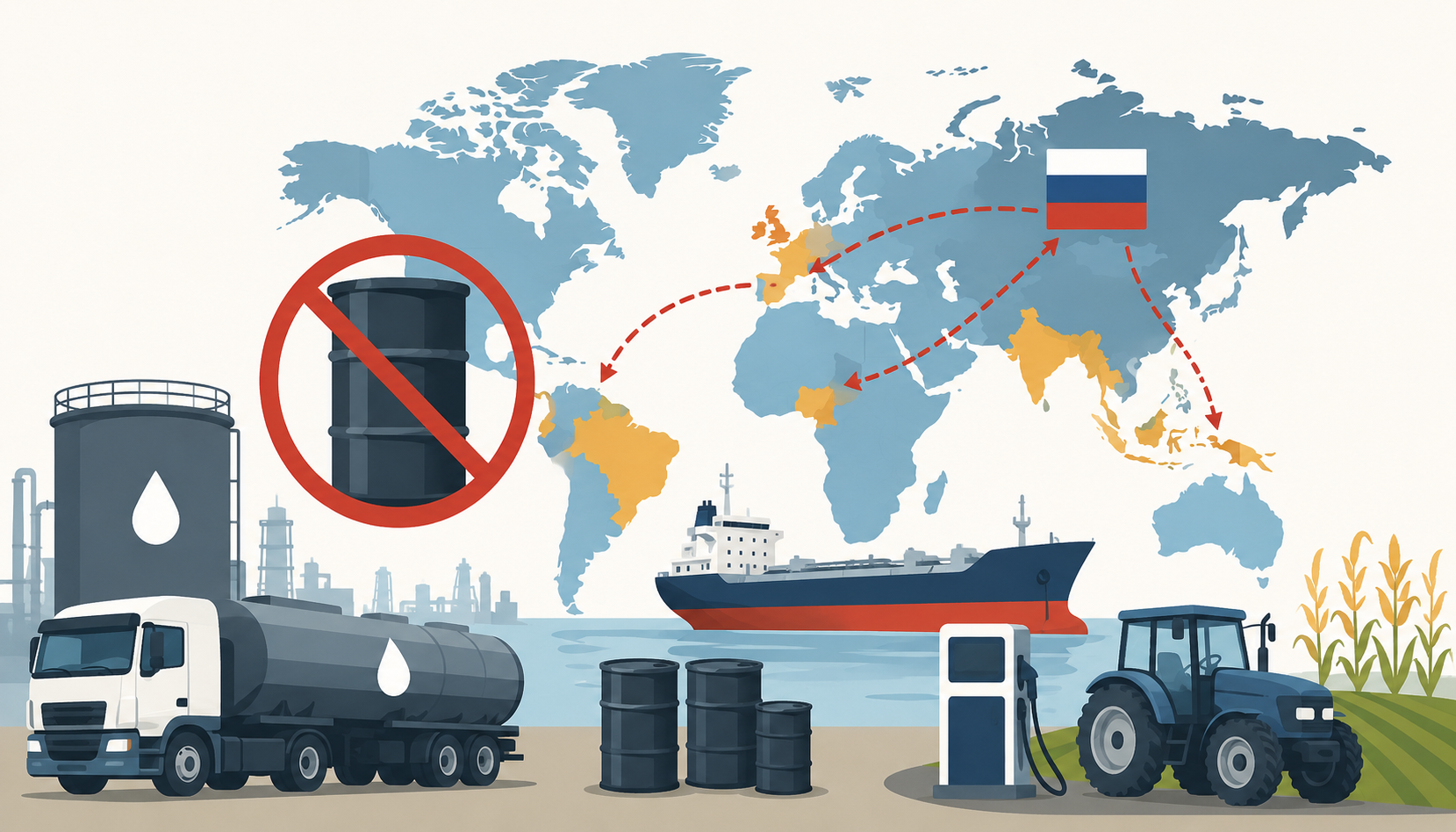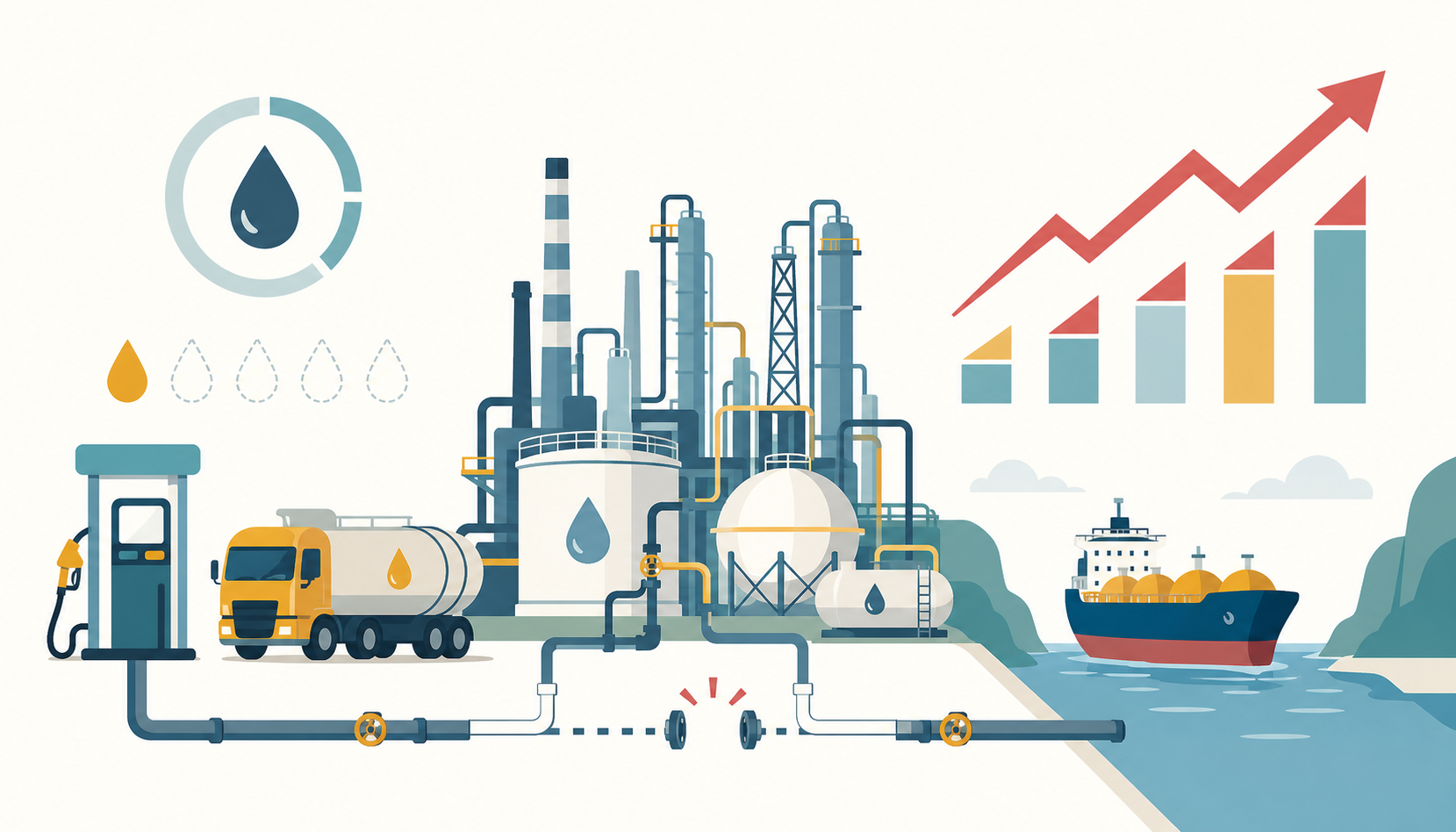
The global oil market is sending two different price signals. Crude supplies are recovering, yet gasoline and diesel remain tight.
The International Energy Agency’s July 2026 Oil Market Report says global oil supply rebounded by 4.1 million barrels per day in June to 98.8 million barrels per day. That improvement helped push benchmark crude prices lower. It did not produce an equivalent recovery in refined fuels.
Global refinery runs increased by 1.5 million barrels per day in June but remained 6 million barrels per day below the level recorded a year earlier. Middle Eastern export refineries have yet to restart fully, Russian processing has been disrupted by attacks, and Asian refineries continue to operate at reduced rates. As a result, gasoline and diesel markets have tightened even while more crude oil has reached the market.
The distinction matters for households, businesses and central banks. Drivers do not buy crude oil. Freight operators, farmers and manufacturers depend on refined products whose prices reflect refinery capacity, transport constraints and regional inventories.
Crude Oil’s Recovery Has Not Reached the Fuel Market
According to the IEA’s July Oil Market Report, Gulf oil exports rose by 6.5 million barrels per day in June to 16.1 million barrels per day. That was a substantial recovery, but it remained well below the pre-war average of 24 million barrels per day.
Crude and condensate accounted for most of the increase. Refined-product and liquefied petroleum gas exports from the Gulf remained below half their pre-war levels. Crude flows recovered faster than refinery operations and product shipments.
This imbalance pushed refined-product margins to four-year highs in early July. Gasoline margins rose sharply, while diesel markets also tightened. Jet fuel availability improved as refiners increased output, but the broader product market remained constrained.
The crude benchmark reflected the partial recovery. North Sea Dated fell by $22 a barrel in June to about $68 a barrel. Prices then moved back toward $77 following renewed hostilities on July 7–8. Fuel buyers therefore face both a physical shortage of refined products and renewed geopolitical risk in crude markets.
Refining Capacity Is the Main Constraint
An oil market can hold sufficient crude while still experiencing a fuel shortage. A barrel of crude must be processed into gasoline, diesel, jet fuel and other products before it reaches most end users.
The current constraint lies in that conversion process. Middle Eastern refineries have not fully resumed exports. Ukrainian attacks have reduced Russian refinery throughput and affected domestic deliveries and exports. Asian runs also remain depressed.
Geography makes the problem harder to solve. A refinery configured for one crude grade or product mix cannot always replace lost diesel or gasoline output elsewhere. Shipping capacity, insurance costs, port access and product specifications impose further limits.
The IEA expects global demand to recover from a May low of 97.9 million barrels per day. By October, demand could be more than 8 million barrels per day above that low as seasonal travel and previously deferred consumption return. Refinery and logistics systems must absorb that increase while several major production centers remain impaired.
Inflation Risk Has Shifted From Crude to Products
Falling crude prices would normally reduce expectations for headline inflation. Tight gasoline and diesel markets weaken that transmission.
Gasoline directly affects household transport costs. Diesel moves through freight, construction, agriculture and industrial supply chains. A sustained increase can raise the delivered price of food, manufactured goods and building materials even when crude benchmarks appear stable.
Central banks will need to distinguish between a short-lived product shortage and a persistent supply shock. A temporary jump may not justify a policy response if underlying inflation continues to ease. A prolonged disruption could affect wages, inflation expectations and business pricing decisions.
The risk is greater in economies that import most of their fuel. Currency depreciation can amplify the local-currency cost of dollar-priced energy. Governments that subsidize retail fuel may absorb the shock through their budgets rather than consumer prices, transferring inflation risk into fiscal and sovereign-credit risk.
UN Trade and Development identifies 61 vulnerable economies exposed to both oil and cereal-import shocks. In Cabo Verde, net imports of oil and petroleum products have averaged 24.6% of GDP in recent years. Higher fuel costs can quickly reach electricity tariffs, transport prices, food bills and public finances in economies with that degree of dependence.
A Fragile Outlook for Late 2026
The IEA projects global oil demand to decline by 1 million barrels per day in 2026 before increasing by 2 million barrels per day in 2027. It also sees the overall oil balance moving toward surplus later this year.
That forecast depends on tanker traffic through the Strait of Hormuz continuing to recover and Gulf producers and refiners restoring operations. Renewed military exchanges show why the assumption remains fragile.
Global observed oil inventories rose by 21 million barrels in June, the first increase in four months. The headline improvement was driven by oil held on water. Onshore inventories continued to fall, including government stocks released by IEA member economies. More oil at sea does not necessarily provide immediate protection against local diesel or gasoline shortages.
The market should therefore track refinery utilization, product exports and regional stocks alongside crude production. Brent or North Sea Dated alone gives an incomplete picture.
Analyst’s View
Credit risk is increasing fastest in transport, logistics, airlines and fuel-intensive manufacturing. Companies with weak pricing power may face margin compression even if crude oil remains below its wartime peak. Refiners with operational capacity and reliable feedstock could benefit from stronger margins, but outages and political intervention remain material risks.
Sovereign risk is concentrated among net fuel importers with limited foreign-exchange reserves, high debt-service burdens and extensive fuel subsidies. A prolonged product-price shock can weaken current accounts, widen fiscal deficits and increase social pressure. Countries exposed to both fuel and food imports face the sharpest transmission channel.
For market positioning, the spread between crude prices and refined-product prices may matter more than a simple directional view on oil. Refining margins, middle-distillate inventories, tanker flows and refinery restart schedules provide better signals of near-term stress. A durable reopening of Gulf routes would reduce the risk premium, but product markets may take longer than crude markets to normalize.
The IEA’s warning is therefore not simply a forecast of higher oil prices. It identifies a bottleneck between crude supply and the fuels used by the real economy. Until refinery operations and product exports recover, gasoline and diesel can remain expensive even when crude oil appears adequately supplied.