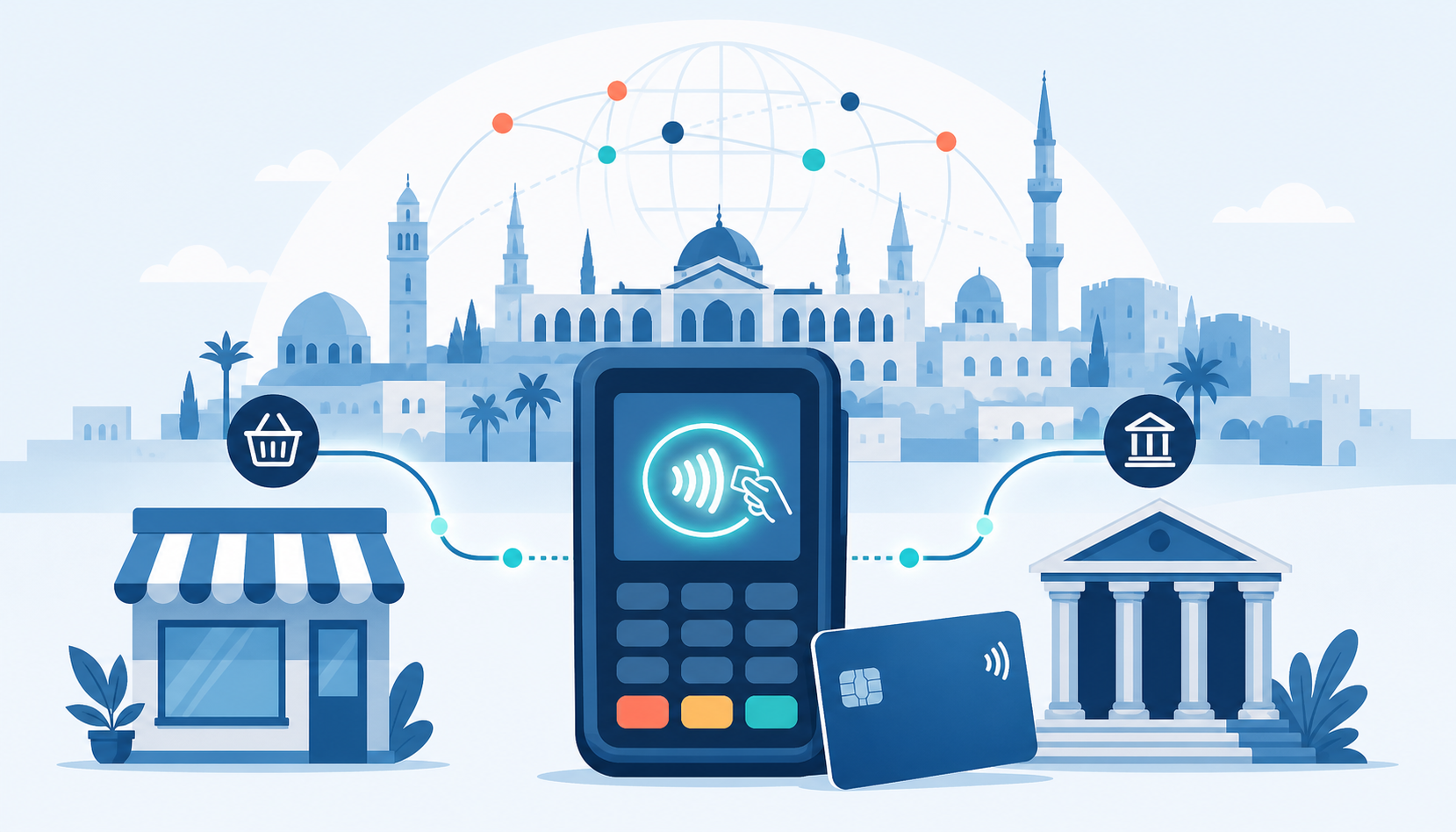
Visa and Mastercard completed separate live international card transactions in Syria on August 26 and 27, a small operational event with a large symbolic weight. Visa said its test, completed with Fransabank Lebanon and the payments company Paymera, was the first live international Visa transaction in Syria. Mastercard and QNB Group said they processed the country’s first international Mastercard card payment in more than 15 years. Both announcements describe a first step toward accepting foreign-issued cards at approved local merchants.
The transactions followed a May decision by the Central Bank of Syria that allowed licensed banks and electronic-payment companies to work with global payment networks. An international card transaction depends on more than a terminal at a shop. It requires acquiring banks, settlement arrangements, transaction monitoring, merchant onboarding, network rules, and controls that can withstand scrutiny from international counterparties. The August transactions show that a limited part of that chain is functioning. They do not show that Syria has regained normal access to global finance.
A payment test, not a financial-system reset
Visa described its event as a test and said it would pave the way for international card acceptance. Mastercard used similar language, calling the transaction a foundation for broader acceptance. That distinction deserves attention. A pilot can validate a technical connection among a card network, an acquiring bank, a processor, and a merchant. Scaling the service requires many more merchants, banks willing to take settlement risk, reliable telecommunications and electricity, clear foreign-exchange arrangements, and safeguards against fraud and financial crime.
For Syria, the commercial uses are immediate even at a limited scale. Foreign visitors, aid workers, diaspora travelers, and firms exploring reconstruction projects have often had to rely on cash or informal arrangements. International card acceptance can reduce the handling of physical currency at hotels, restaurants, transport providers, and approved merchants. It can also produce transaction records that make it easier for businesses to reconcile sales and for financial institutions to assess payment flows. Those benefits are practical, but they are conditional on the availability of legal, secure, and affordable services.
The Central Bank of Syria framed its May authorization as part of a modernization effort that could support electronic payments, financial inclusion, and links with international networks. Visa and Mastercard have each tied their announcements to work with Syrian financial institutions and the central bank. That public alignment is useful for a pilot. It does not remove the due-diligence burden on every bank, processor, network, and merchant that may join later.
Why the sanctions and compliance backdrop still sets the pace
The rollout arrives after a broad shift in the external environment. A 2026 U.S. Treasury risk-assessment report says the United States lifted the comprehensive economic sanctions program previously administered against the Syrian government and that the United States, European Union, United Kingdom, and other jurisdictions provided sanctions relief. The same report also says that sanctions remain on certain individuals and entities linked to proliferation and weapons of mass destruction. That combination is central to the economics of any new payment channel.
Sanctions relief can permit more transactions, yet it does not force private financial institutions to provide services. Card networks and their bank partners must still screen customers, counterparties, merchants, beneficial owners, and payment activity. They need to understand which restrictions remain, how local institutions apply anti-money-laundering and counter-terrorist-financing controls, and whether the transaction path contains a prohibited party. A payment product can be legally available while operational capacity remains narrow because partners set conservative risk limits.
The Treasury report also notes continued concern about Syria’s proliferation-financing risks and the importance of controls as financial links reopen. That makes implementation quality more consequential than the headline announcement. Effective merchant due diligence, suspicious-activity monitoring, sanctions screening, recordkeeping, dispute processes, and cyber resilience will affect whether international banks are willing to expand settlement relationships. A visible pilot may encourage interest, but a weak control failure could have the opposite effect.
There is a second constraint. The United States continues to advise its citizens against travel to Syria because of terrorism, unrest, kidnapping, crime, and armed conflict. Tourism and business travel can support card volumes. Security conditions directly limit the size of that market. The value of the new rails is therefore likely to begin with narrow, higher-control use cases rather than a rapid shift toward mass consumer card use.
From cash dependence to recorded transactions
Cash-heavy economies face costs that rarely appear in a simple payments statistic. Businesses must store, transport, verify, and reconcile banknotes. Consumers have fewer ways to make remote purchases or pay recurring bills. Banks receive less usable transaction data for credit assessment. Tax authorities and regulators have less visibility into formal commercial activity. International payment acceptance will not solve those problems by itself, yet it can create an auditable channel for a portion of cross-border spending.
The key question is whether the channel reaches domestic users as well as foreign cardholders. The corporate announcements focus first on acceptance of internationally issued cards. That is a sensible starting point because it limits the number of issuing institutions and may simplify foreign-exchange management. It also means the first economic effects may be concentrated in travel, hospitality, international organizations, and businesses serving visitors. Domestic issuance, e-commerce, remittances, and wider merchant coverage would require additional regulatory and banking work.
Foreign exchange is another practical issue. A card purchase can appear simple to a shopper, but the system must determine the exchange rate, settle funds, manage liquidity, and handle refunds or chargebacks. In a country rebuilding financial links, a transparent framework for those steps can matter as much as the card terminal. Merchants need clarity on the currency in which they are paid and the timing of settlement. Banks need liquidity and reliable correspondent arrangements. Consumers need confidence that rates and fees will be understandable.
Reconstruction finance needs more than payment access
International card acceptance should be viewed as enabling infrastructure, not as a measure of reconstruction finance. Large reconstruction projects require bankable contracts, insurance, project finance, trade credit, functioning customs and payment systems, and confidence in dispute resolution. Those requirements involve sovereign institutions, commercial banks, development financiers, exporters, and insurers. The first card transactions do not establish that architecture.
They can still reduce friction at the margin. A foreign supplier visiting Damascus can pay routine expenses through a familiar network if the merchant and transaction qualify. A hotel can serve a traveler without arranging cash conversion. A local business can begin to build operating experience with digital settlement and customer-service rules. Over time, those small capabilities can support a larger formal economy if they are matched by reliable regulation, infrastructure investment, and financial-sector supervision.
For international firms, the relevant decision is likely to remain granular. A company will assess the legal status of each transaction, its customer and supplier relationships, the bank handling settlement, insurance availability, security, and reputational risk. A payment-network announcement changes one part of that assessment. It does not substitute for a country-risk process.
What to watch next
Three developments will show whether the August tests become useful economic infrastructure. First, watch the breadth of merchant acceptance and whether it moves beyond approved pilot locations. A growing network of merchants, transparent fees, and dependable settlement would show that the service has moved beyond a demonstration.
Second, watch the banking structure. Public announcements about new acquiring arrangements, correspondent relationships, or domestic issuing products would reveal whether local institutions can support scale. The availability of secure digital wallets and regulated online payments would be another sign that the system is serving residents, rather than only international visitors.
Third, watch the quality of supervision and compliance disclosures. Financial institutions will look for evidence that screening, transaction monitoring, cybersecurity, and consumer protections are operating consistently. Clear rules on foreign exchange, merchant onboarding, and data handling can lower uncertainty. A lack of clarity would keep the service contained even if technical connections continue to expand.
Analyst’s View
Credit risk: Banks and payment firms entering Syria face operational and counterparty risk before they face volume risk. The most relevant early indicators are the quality of acquiring-bank controls, merchant concentration, settlement reliability, and the treatment of disputed or suspicious transactions. Pilot volumes may be low, yet a control failure can create losses or force a partner to exit.
Sovereign risk: The initiative may improve the country’s ability to reconnect formal commerce with international payment rails, but it does not change the broader security, institutional, and financing risks that shape sovereign assessments. Progress will depend on whether regulatory implementation remains credible and whether external restrictions continue to ease without creating new compliance uncertainty.
Market positioning: Payment networks, regional banks, processors, insurers, and travel-linked businesses can treat the rollout as a signal to monitor, not a signal to assume normal market access. Firms with a clear permitted use case and strong compliance capability may find limited opportunities first. Businesses dependent on unrestricted currency conversion, broad consumer demand, or deep local credit markets should expect a longer timetable.
The first international card payments in Syria are meaningful because they turn a policy decision into a functioning transaction. Their long-term value will depend on whether the supporting institutions can deliver secure, compliant, and predictable service. That work will determine whether a highly visible test becomes a durable part of Syria’s financial recovery.