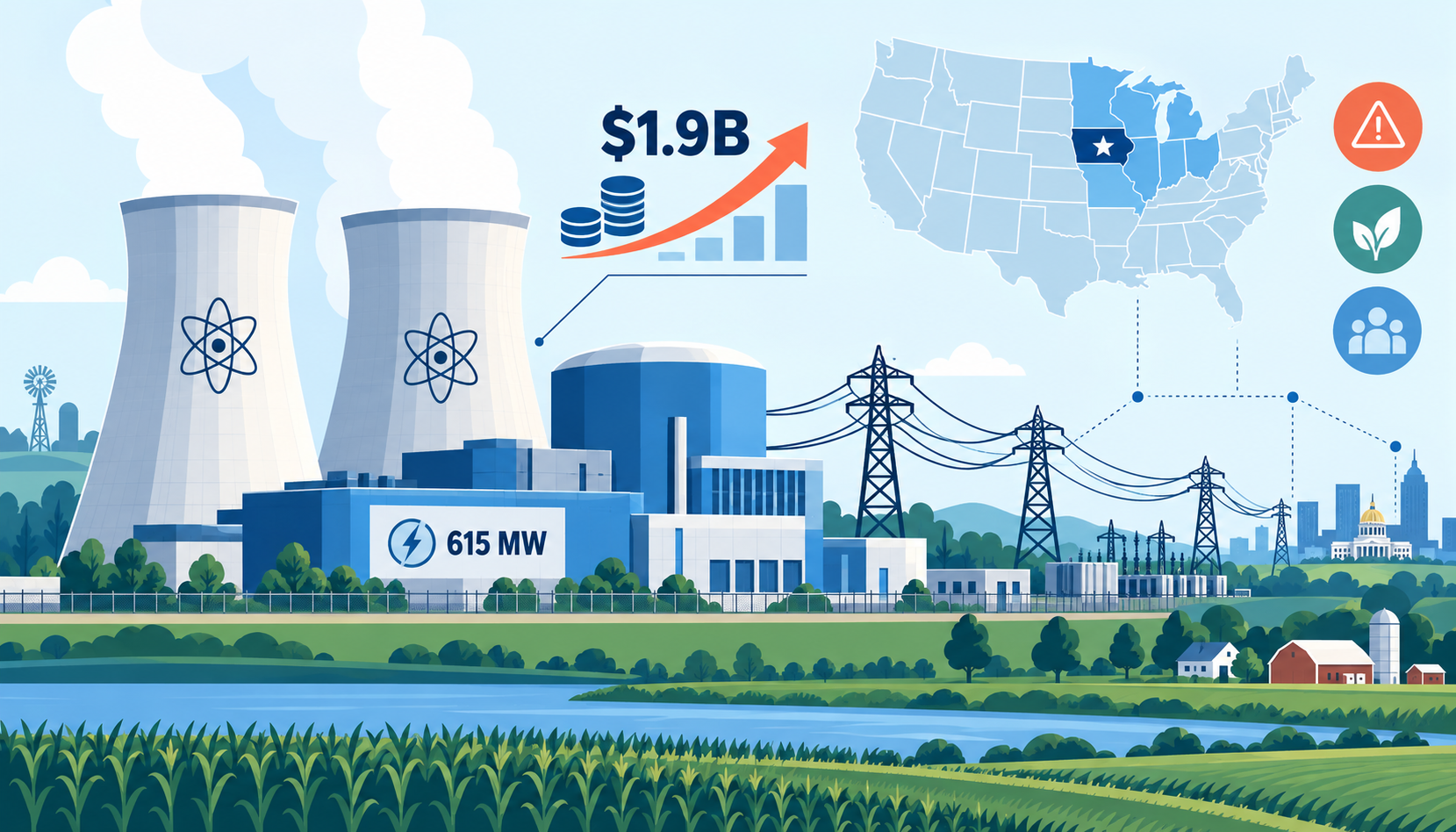
The U.S. Department of Energy has closed a loan of up to $1.9 billion to NextEra Energy to help finance the restart of the Duane Arnold Energy Center in Linn County, Iowa. The project would return Iowa’s only nuclear power plant to the grid, adding 615 megawatts of firm generation if the restart receives the required licensing approvals from the U.S. Nuclear Regulatory Commission. The financial close, announced by DOE on September 8, places federal credit behind a project that links nuclear power, regional grid reliability, and the fast-rising electricity needs of industrial and digital infrastructure.
The plant ceased operations in 2020. DOE says the restart could provide enough electricity for nearly 500,000 homes, create nearly 1,500 construction jobs, and support more than 450 operating jobs. Those figures describe the project’s potential economic footprint rather than guaranteed outcomes. The plant still needs the necessary NRC approvals, and the financing does not remove the technical and regulatory work required before electricity returns to the Midcontinent Independent System Operator, or MISO, grid.
That distinction is central to the transaction. The loan is a financing commitment for a defined asset with an existing site, transmission connections, and operating history. It is not an announcement that the reactor has already restarted. DOE’s project statement identifies the Duane Arnold unit as a 615 MW boiling-water reactor and says the project will support growing demand in Iowa, including demand associated with cloud and artificial-intelligence infrastructure. The department also says the project is expected to support about 1,500 construction jobs and more than 462 permanent operating jobs. DOE’s announcement provides the financing, capacity, employment, and licensing details.
For NextEra, the transaction creates a path to reuse an asset that left the power system six years ago. Nuclear plants require large fixed investments, long operating lives, and careful maintenance. A restart can therefore offer a different economic profile from a greenfield project: the site, some infrastructure, and the plant’s operating record already exist, while the principal challenge is restoring the unit to a condition that can satisfy regulators and markets. The project still carries refurbishment, schedule, cost, and licensing risks, but the federal loan reduces the amount of private capital that must be committed before those risks are resolved.
The policy context is equally important. The DOE’s Office of Energy Dominance Financing has made closed nuclear plants a central part of the administration’s plan to expand domestic electricity supply. The Duane Arnold loan follows other federal support for nuclear restarts, including financing connected with the Palisades and Crane projects. This pattern suggests that the government is trying to create a repeatable financing channel for existing nuclear sites rather than treating each restart as an isolated transaction. The DOE project page describes Duane Arnold’s location, loan amount, capacity, expected jobs, and relationship to the MISO grid.
The commercial rationale is strengthened by the timing of electricity demand. Data centers, semiconductor facilities, manufacturing plants, and electrification projects all require reliable power. Renewable generation can expand quickly, but output varies with weather and time of day. Gas generation can provide flexibility, although fuel prices and emissions policy affect its economics. A restarted nuclear unit offers steady output without direct combustion emissions during generation. That combination can be valuable in a region where grid planners must balance new demand with reliability requirements.
Still, 615 MW is meaningful at a regional level, not a complete answer to the broader U.S. power shortage narrative. A single plant cannot determine national electricity prices or guarantee that every new load receives service. Its value depends on transmission availability, the plant’s capacity factor, refueling and maintenance schedules, the local market’s pricing structure, and the timing of competing generation projects. Investors should read the announcement as evidence of a specific project moving into a more advanced financing stage, not as proof that the entire nuclear fleet can be restored at the same speed.
The transaction also illustrates how public credit can change the risk allocation around long-duration energy projects. The government loan does not eliminate project risk. Instead, it can lower the cost of capital, extend the financing horizon, and make a large refurbishment easier to fund. That matters because a nuclear restart has a long period in which capital is spent before revenue is earned. The lender must assess construction progress, equipment condition, licensing milestones, cost controls, and the borrower’s ability to carry the project through delays. The federal role can support the project while leaving the operator responsible for execution.
For credit analysts, the first issue is completion risk. The critical milestones are the remaining NRC approvals, the engineering and refurbishment schedule, the final cost profile, and the date at which the unit can operate commercially. A loan closing is a positive financing event, but it does not guarantee that the asset will meet its timetable or budget. Any delay would push revenue further into the future and could increase the amount of capital required before the plant reaches stable operations.
The second issue is power-price and offtake risk. The plant will sell into a regional electricity market, so its cash flow will depend on wholesale prices, capacity revenues, congestion, and the plant’s operating performance. A reliable nuclear unit can benefit when firm power is scarce, yet a weak price environment would pressure returns. The project may also receive value from customers seeking dependable low-carbon power, including large technology and industrial buyers. Analysts should look for evidence of contracted revenue, customer commitments, and transmission arrangements rather than relying only on the headline capacity number.
The third issue is policy and sovereign exposure. The federal loan makes U.S. policy a direct part of the project’s financing structure. That can be a credit strength when agency support is stable and the program has clear authority. It can also create concentration risk if future administrations change the treatment of nuclear lending, licensing priorities, or energy-market rules. The project is therefore relevant to sovereign-risk analysis even though the asset is owned by a private company: public policy affects the cost of capital, the approval timetable, and the government’s potential exposure if the project underperforms.
For electricity markets, the project provides a useful signal about the value of existing nuclear sites. Reusing an operating location may shorten development time compared with building a new reactor, but the advantage is not automatic. The condition of the reactor, the availability of specialized suppliers, the ability to hire experienced personnel, and regulator confidence all determine whether a restart is practical. The DOE environmental-review completion letter shows that the federal review process had already examined the proposed assistance for the 615 MW project earlier in 2026. That history supports the view that the financing close follows a longer diligence process, while also showing that financing and licensing remain separate gates.
The announcement arrives as U.S. policymakers debate how to finance a larger industrial base without weakening public balance sheets. A $1.9 billion commitment is large enough to matter for one project and small enough to be part of a broader portfolio. The portfolio approach may help standardize diligence and create a market for suppliers, engineers, and specialized contractors. It also means that future projects will be compared with Duane Arnold on cost, schedule, capacity, employment, and the amount of private capital placed at risk.
For markets, the immediate takeaway is selective rather than universal. Nuclear-related companies and equipment suppliers may benefit from a stronger pipeline of restart work, while utilities may gain another model for meeting firm-power demand. However, investors should distinguish the policy signal from the earnings impact. NextEra’s financial outcome will depend on the eventual cost of the restart, the timing of regulatory approvals, the unit’s operating performance, and the market value of its output. The broader sector impact will depend on whether other sites can meet the same financing and regulatory standards.
Analyst’s View
From a credit-risk perspective, the loan closing improves the project’s funding visibility but leaves completion risk as the main variable. Monitoring should focus on NRC approvals, cost-to-complete estimates, schedule changes, and evidence that the borrower can absorb additional delays.
From a sovereign-risk perspective, the project shows how U.S. energy policy is moving from broad support for nuclear power toward direct asset-level financing. That approach can strengthen domestic capacity and supply-chain demand, but it also increases the government’s exposure to execution and policy-continuity risk.
For market positioning, the most defensible theme is the value of reliable generation in regions adding industrial and data-center load. The opportunity is real, yet the investable winners will be determined by which projects can return to service on time, preserve safety margins, secure transmission access, and earn sufficient power-market revenue. Duane Arnold has cleared an important financing hurdle. It has not cleared the final operating one.