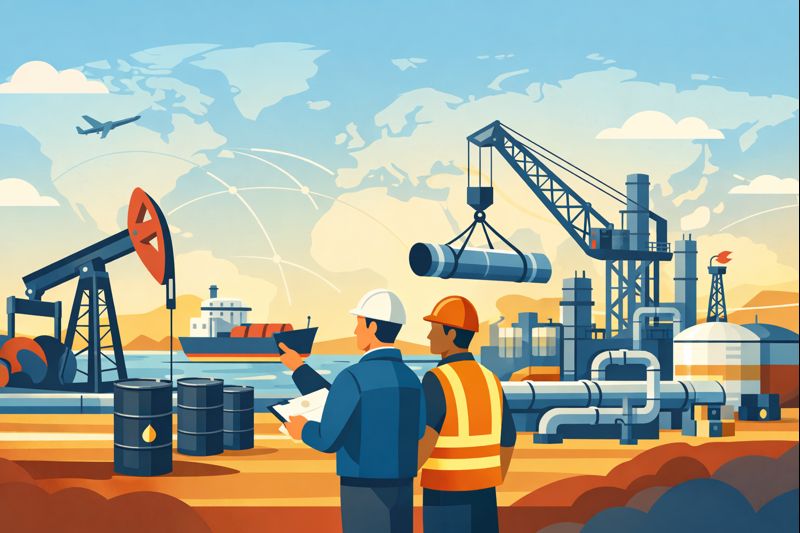
Following years of economic sanctions and infrastructure collapse, Venezuela’s vast oil sector may be on the brink of reintegration into global markets. Recent statements by U.S. President Donald Trump suggest Washington is prepared to subsidize American oil companies to rebuild the country’s deteriorating energy infrastructure—a move that could fundamentally alter oil supply dynamics, sanctions policy, and regional geopolitics across Latin America.
The announcement came after U.S. military forces captured Venezuelan President Nicolás Maduro on January 3, 2026, marking a dramatic escalation in Washington’s efforts to reshape Venezuela’s political landscape. At a press conference from his Mar-a-Lago estate, Trump outlined an ambitious vision: American oil companies would spend billions of dollars to restore Venezuela’s oil sector, with the understanding that they would be “reimbursed” either by the U.S. government or through oil revenues.
The Collapse of a Petroleum Giant
To understand the significance of this policy shift, one must first grasp the scale of Venezuela’s decline. The country sits atop the world’s largest proven oil reserves—an estimated 303 billion barrels, representing roughly 17% of global reserves according to OPEC data. This surpasses even Saudi Arabia’s holdings and positions Venezuela as a potential energy superpower.
Yet production tells a starkly different story. Venezuela currently produces approximately 1 million barrels per day, less than 1% of global output. This represents a catastrophic 70% decline from the early 2000s, when the country pumped more than 3 million barrels daily. For context, the United States produces 13 million barrels per day, while Saudi Arabia exports over 6 million barrels daily.
The causes of this collapse are complex and intertwined. Chronic mismanagement under the Chávez and Maduro administrations hollowed out state oil company Petróleos de Venezuela (PDVSA) through politicization, corruption, and underinvestment. When Venezuela nationalized its oil industry in 1976, and again seized foreign assets in the mid-2000s, international expertise and capital fled. U.S. sanctions imposed since 2017, and dramatically tightened in 2019, then accelerated the decline by cutting off access to technology, spare parts, and financial markets.
The result is infrastructure decay on a massive scale. PDVSA acknowledges that many pipelines are over 50 years old and have not been meaningfully updated. Experts estimate that returning to even 1990s production levels would require investments exceeding $8 billion, while reaching 4 million barrels per day—above historical peaks—would demand more than $100 billion over at least a decade, according to Francisco Monaldi, director of the Latin America Energy Program at Rice University.
A Strategic Pivot in U.S. Policy
Trump’s proposal represents a fundamental departure from the sanctions-only approach that has defined U.S.-Venezuela relations for nearly two decades. Rather than simply restricting Venezuela’s oil sector to force regime change, Washington now appears willing to actively rebuild it—but under terms that ensure American influence and commercial benefit.
The president has been explicit about the strategic motivations. Venezuela’s heavy crude is particularly suited to U.S. Gulf Coast refineries, many of which were originally designed to process exactly this type of oil. Approximately 70% of U.S. crude imports are heavy oil, with Canada currently supplying about 60% of that volume. Venezuelan barrels could provide supply security and price stability, potentially reducing diesel costs and easing inflationary pressures.
There are also broader geopolitical calculations at play. Venezuela has become increasingly dependent on China, which is now its largest oil buyer and a major creditor with an estimated $60 billion in outstanding loans. Chinese firms have also gained access to Venezuela’s rare earth mineral deposits, critical inputs for advanced weapons systems. By reasserting American presence in Venezuela’s energy sector, Washington aims to counter Chinese influence in a region it considers its strategic backyard.
Yet the mechanics of Trump’s proposal remain vague. The president said oil companies would “spend billions” and “be reimbursed for what they’re doing,” but provided no details on whether reimbursement would come from U.S. taxpayers, Venezuelan oil revenues, or some hybrid arrangement. The legal framework for such operations—especially while sanctions technically remain in place—is equally unclear.
The Oil Industry’s Cautious Response
Despite Trump’s optimism, major American oil companies have responded with notable restraint. Chevron, the only U.S. producer currently operating in Venezuela with a Biden-era sanctions waiver, issued only a brief statement affirming it would continue following “relevant laws and regulations.” ConocoPhillips said it would be “premature to speculate on any future business activities.” ExxonMobil declined to comment.
This wariness is rooted in bitter historical experience. When Venezuela nationalized foreign oil assets in 1976, U.S. companies collectively lost roughly $5 billion but received minimal compensation. A second wave of nationalizations in 2006-2007 under Hugo Chávez forced ExxonMobil and ConocoPhillips to abandon operations. International courts later awarded the companies over $11 billion combined in compensation, but Venezuela has paid only a fraction of that amount.
Beyond historical grievances, current market conditions are unfavorable for major new investments. Global oil markets are oversupplied, with prices below $60 per barrel and falling—West Texas Intermediate closed at $57.32 on January 3, down from nearly $80 a year earlier. Long-term demand projections are increasingly uncertain as the world transitions toward electric vehicles and renewable energy. European oil majors with net-zero commitments are particularly unlikely to invest in Venezuela’s extra-heavy crude, among the most carbon-intensive in the world to produce.
There is also significant political risk. The post-Maduro security situation remains unclear. Libya and Iraq offer sobering precedents for how regime change can destabilize oil production for years or even decades. Without a stable government that offers commercial, fiscal, and legal guarantees, few companies will commit capital at scale.
Global Market Implications
Even if Venezuela’s oil sector revives, the impact on global markets may be more modest than Trump suggests. At current production of roughly 1 million barrels per day, Venezuela accounts for less than 1% of global supply. Even optimistic scenarios that see production double within five years would still leave Venezuelan output well below that of major exporters.
Cornelia Meyer, chairperson of LBV Asset Management, notes that even a full restoration of sanctioned Venezuelan barrels would represent less than 1% of global supply. “Markets would absorb it rather than be flooded by it,” she told media outlets. The real question is not volume but timing and market psychology. If investors believe Venezuelan production can recover quickly, the mere expectation could put downward pressure on prices, potentially complicating OPEC+ production management strategies.
For OPEC+, which has maintained production cuts to support prices, significant Venezuelan supply growth could force difficult choices. Saudi Arabia, the cartel’s de facto leader, may need to cut its own output further to make room for Venezuelan barrels—a politically fraught decision. Alternatively, OPEC+ might allow prices to fall, risking budgetary crises among members heavily dependent on oil revenues.
The type of crude Venezuela produces adds another dimension. Extra-heavy crude requires specialized refining capabilities that only certain facilities possess. This could create localized supply dynamics, with Venezuelan crude primarily flowing to U.S. Gulf Coast refineries and certain Asian markets, rather than broadly displacing light crude in global trade.
Regional and Geopolitical Consequences
The U.S. military operation to remove Maduro has already triggered sharp international reactions. Russia called it “armed aggression,” while China expressed being “deeply shocked.” Several Latin American governments condemned the action as violating Venezuelan sovereignty, though others with opposition to Maduro remained notably silent.
For Cuba, Venezuela’s closest regional ally, the implications are particularly dire. Venezuela has been a crucial provider of subsidized oil and financial support to the island. A pro-U.S. government in Caracas would almost certainly end this arrangement, potentially destabilizing Cuba’s already fragile economy.
China faces significant losses. Beyond outstanding loans that may never be repaid, Chinese oil companies like CNPC have invested heavily in Venezuelan joint ventures. Beijing has also gained privileged access to Venezuelan heavy crude at discounted prices. An American-controlled Venezuelan oil sector would end these advantages.
For neighboring countries like Colombia, Brazil, and Guyana, the calculus is more complex. Political instability in Venezuela could create refugee flows and security challenges. However, a stable, productive Venezuela integrated into Western energy markets might eventually provide economic opportunities and reduce regional migration pressures that have strained social services across South America.
Risks and Realities
Several substantial obstacles stand between Trump’s vision and its realization. First, the political situation remains fluid. It is unclear who will govern Venezuela following Maduro’s removal, what legitimacy that government will possess, and whether it can maintain security and the rule of law sufficient for major foreign investment.
Second, the infrastructure challenges are genuinely daunting. Decades of deferred maintenance mean that wells, pipelines, refineries, and port facilities are in severe disrepair. Simply assessing the damage and developing remediation plans could take years. Actual reconstruction would require massive imports of equipment, specialized technical expertise, and workforce training—all of which take time to organize even under ideal conditions.
Third, Venezuelan oil is expensive and dirty. Extra-heavy crude requires not just specialized extraction techniques but also significant processing before it can be transported and refined. Production costs are inherently higher than for conventional oil, making Venezuelan projects economically marginal when oil prices are below $65-70 per barrel. The carbon intensity of this crude also makes it increasingly difficult to finance as institutional investors face pressure to reduce fossil fuel exposure.
Fourth, there is the question of competition. Neighboring Guyana has recently discovered over 10 billion barrels of lighter, cleaner crude with lower production costs and fewer political risks. Major oil companies already operating there may prioritize Guyanese expansion over Venezuelan ventures. Similarly, other producing nations with more stable environments may offer better risk-adjusted returns.
What to Watch
For investors, policymakers, and energy analysts, several indicators will reveal whether this initiative gains traction:
Concrete financial arrangements: If the U.S. government commits specific funding mechanisms—whether direct subsidies, loan guarantees, or political risk insurance—this would signal serious intent beyond rhetoric.
Oil company commitments: Watch for formal investment announcements, not just exploratory discussions. Chevron’s actions will be particularly telling, as the company with existing Venezuelan operations.
Sanctions policy evolution: The Treasury Department’s Office of Foreign Assets Control will need to issue detailed guidance on which activities are permissible. General licenses for specific companies and operations would indicate structured policy rather than ad hoc decisions.
Political stability metrics: The formation of a stable post-Maduro government with international recognition, effective security services, and transparent governance institutions is a prerequisite for sustained investment.
Production data: Monthly figures from PDVSA and international monitors will show whether output begins recovering. Small increases of 50,000-100,000 barrels per day within 6-12 months would suggest initial success; anything more ambitious seems unrealistic.
Chinese and Russian responses: How Beijing and Moscow respond—whether they accept losses or actively work to destabilize a pro-U.S. Venezuelan government—will significantly impact the security environment.
Conclusion: Ambition Meets Reality
Trump’s vision of rapidly reviving Venezuela’s oil sector reflects both genuine strategic interests and significant optimism about what can be achieved. The United States would clearly benefit from access to nearby heavy crude, reduced Chinese influence in the Western Hemisphere, and potential downward pressure on energy prices.
However, history suggests caution. Regime change operations rarely produce stable outcomes quickly, and oil sector reconstruction in conflict-affected states typically takes decades, not years. The combination of massive capital requirements, technical complexity, unfavorable market conditions, and political uncertainty creates formidable barriers.
What seems most likely is a prolonged, uncertain process. Chevron may gradually expand its existing operations with explicit U.S. government support. Other American firms might enter cautiously with specific project commitments rather than broad investment programs. Venezuelan production could increase incrementally—perhaps to 1.5-2 million barrels per day within five years under favorable conditions.
This would represent meaningful progress but fall well short of transforming global energy markets. The real test will be whether the U.S. government and oil companies maintain commitment through the inevitable setbacks, cost overruns, and political complications that will emerge. For now, Trump’s announcement signals intent; execution will determine whether Venezuela’s petroleum riches finally benefit its people rather than remaining locked beneath deteriorating infrastructure.
The coming months will reveal whether this represents a genuine turning point in Venezuelan history and Western Hemisphere energy politics, or another ambitious plan that founders on the complex realities of resource nationalism, market economics, and geopolitical rivalry.