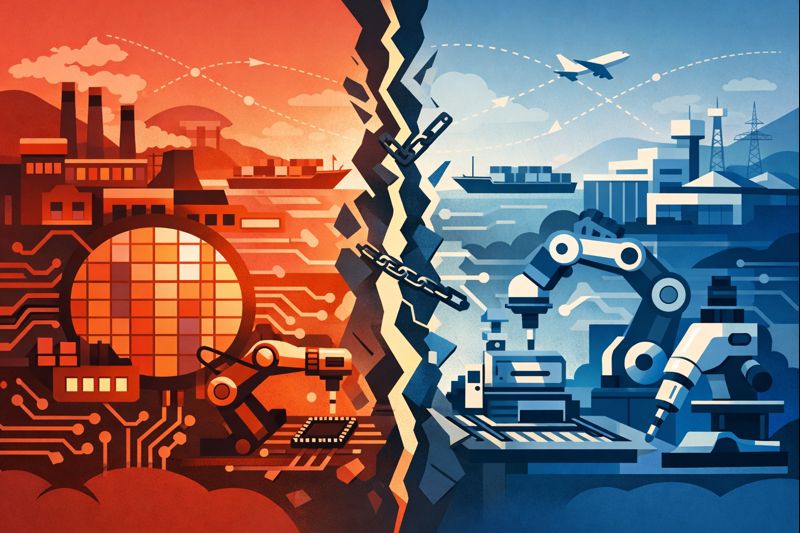
Lead: Japan’s latest move to tighten export controls on strategic technologies has reignited friction with China, underscoring how economic security concerns are reshaping trade ties in East Asia—and forcing global firms to rethink supply chains.
The fragile equilibrium of East Asian economic interdependence faces a new stress test as China imposed sweeping export controls on dual-use items destined for Japan, effective immediately in early January 2026. The move, Beijing’s most aggressive trade action against Tokyo since 2010, was triggered by Japanese Prime Minister Sanae Takaichi’s November 2025 remarks suggesting Japan could deploy military forces if China attempts to seize Taiwan by force. What began as a diplomatic spat has rapidly escalated into a high-stakes confrontation with profound implications for global supply chains, semiconductor markets, and the trajectory of U.S.-China tech competition. For investors and corporate strategists, the clash underscores a harsh reality: economic security now trumps traditional trade logic in Asia’s largest bilateral relationship.
What Triggered the Latest Clash
Japan’s approach to technology export controls has evolved gradually but deliberately. In early 2025, Tokyo expanded restrictions to include cutting-edge chips, quantum computing technologies, and lithography equipment, framing the measures as necessary to prevent weapons proliferation. These controls aligned Japan more closely with U.S.-led efforts to limit China’s access to advanced manufacturing capabilities, following earlier 2023 restrictions on semiconductor production equipment.
China’s response has been swift and multifaceted. Beyond the dual-use export ban, Beijing suspended flights to Japan, warned citizens against traveling there, halted Japanese seafood imports, and intensified military patrols in disputed waters. The January 2026 export controls represent the culmination of this pressure campaign, explicitly targeting items that could enhance Japan’s defense capabilities. Chinese authorities also signaled potential tightening of licensing reviews for medium and heavy rare earth elements, evoking memories of the 2010 rare earth embargo following a maritime territorial dispute.
Why Export Controls Matter
Japan occupies a unique chokepoint position in global semiconductor supply chains, not as a chip manufacturer but as the dominant supplier of critical upstream materials and equipment. Japanese companies command approximately 88% of the global market for semiconductor coater/developer systems, 53% for silicon wafers, and 50% for photoresists—all essential inputs for chip fabrication. In materials overall, Japan holds 56% global market share, with 32% in manufacturing equipment.
This specialization in precision equipment and materials reflects Japan’s strategic pivot after losing its once-dominant position in chip manufacturing. Companies like Tokyo Electron, Screen Holdings, Shin-Etsu Chemical, and SUMCO now provide technologies that enable semiconductor production worldwide, making them indispensable to fabs in Taiwan, South Korea, China, and the United States. Any disruption to this supply could ripple through the entire industry.
China’s control over rare earth elements creates a mirror vulnerability. China produces approximately 98% of global gallium, a critical material for compound semiconductors used in high-performance applications from smartphones to military radar systems. Following China’s July 2023 export restrictions on gallium and germanium, prices nearly doubled in European markets, demonstrating Beijing’s leverage over strategic materials. Japan’s semiconductor equipment manufacturers and automotive sector—heavily reliant on these materials—now face potential supply chain disruptions if China follows through on threatened rare earth restrictions.
Economic Fallout for Asia
The immediate economic impact on Japan could be substantial. Nomura Research Institute estimates that if rare earth export restrictions last three months, Japan would face economic losses of approximately ¥660 billion, reducing GDP by 0.11%. More broadly, dual-use items that Japan imports from China total ¥10.7 trillion (roughly $68 billion), representing 42% of Japan’s total goods imports from China in 2024.
The automotive sector faces particularly acute risks. Japanese automakers depend on rare earth elements for electric vehicle motors, catalysts, and battery systems. Production disruptions could cascade through supply chains that span ASEAN, where many Japanese manufacturers have established operations. South Korean companies, which compete directly with Japanese semiconductor equipment firms, may gain market share if uncertainty drives customers to diversify suppliers.
Taiwan’s TSMC and South Korean Samsung, already navigating complex U.S. export controls on advanced chipmaking to China, now confront additional regional instability. Both companies source critical materials and equipment from Japan; prolonged Japan-China friction could force them to accelerate costly supply chain diversification efforts. For ASEAN economies integrated into electronics manufacturing networks, the decoupling pressure creates difficult choices between maintaining access to Chinese demand and alignment with Japan-U.S. technology frameworks.
Geopolitics vs. Free Trade
Japan’s tightening export controls reflect its deepening strategic alignment with Washington’s technology containment strategy toward China. The trilateral coordination among the U.S., Japan, and the Netherlands on semiconductor equipment exports—targeting China’s ability to produce advanced chips—represents a fundamental departure from decades of market-driven trade policy. Tokyo has framed its measures as national security imperatives rather than commercial restrictions, invoking the same logic Washington uses for its own controls.
From Beijing’s perspective, these actions constitute economic containment designed to prevent China’s technological advancement. Chinese officials have consistently urged Japan to pursue an independent foreign policy on export controls rather than following U.S. directives. The Taiwan issue adds explosive volatility: China views Takaichi’s military deployment comments as crossing a red line, while Japan insists it maintains its longstanding “One China” policy while preparing for regional contingencies.
This confrontation challenges the multilateral trading system’s core principles. The World Trade Organization permits export controls for national security reasons, but the expanding scope of what constitutes “security” risks fragmenting global trade into competing blocs. If Japan and China normalize tit-for-tat restrictions based on political disputes rather than proliferation concerns, the precedent could undermine trade stability across Asia and beyond.
Market and Investor Implications
Equity markets have already begun pricing in elevated risks. Japanese rare earth-related stocks rallied on speculation of supply constraints and price increases, while automaker shares declined amid concerns about production impacts. For semiconductor equipment manufacturers, the outlook depends heavily on how broadly China interprets its dual-use ban and whether it extends to private commercial transactions.
Currency markets may see renewed pressure on the yen if investors fear prolonged trade friction will weigh on Japan’s export-dependent economy. Conversely, the yuan could weaken if China’s rare earth weaponization prompts accelerated Western efforts to develop alternative supply sources, reducing long-term Chinese pricing power.
Portfolio managers should consider scenario analysis across three potential trajectories:
Escalation
China implements comprehensive rare earth restrictions; Japan retaliates with broader semiconductor equipment controls; both economies suffer measurable GDP impacts. This scenario favors non-Asian semiconductor equipment makers and alternative rare earth producers.
Stabilization
Diplomatic channels produce tacit agreements limiting further escalation; trade continues under heightened licensing requirements. Markets gradually adjust to higher compliance costs and supply chain friction.
Resolution
High-level political engagement leads to de-escalation; both sides signal willingness to compartmentalize trade from security disputes. Risk premiums compress, benefiting companies with China-Japan exposure.
Current positioning suggests markets are pricing something between escalation and stabilization, with significant uncertainty premiums in affected sectors.
What to Watch Next
Several indicators will clarify the conflict’s trajectory:
Rare earth export data: Whether China actually implements the threatened licensing restrictions on medium and heavy rare earths, or maintains current gallium/germanium controls without expansion.
Corporate responses: How Japanese manufacturers adjust sourcing strategies; whether they accelerate rare earth diversification efforts or accept higher costs to maintain Chinese suppliers.
U.S. policy signals: Whether Washington provides Japan diplomatic or economic support, potentially through coordinated responses or alternative rare earth sourcing arrangements.
TSMC and Samsung supply chain decisions: Any announcements regarding equipment procurement changes or accelerated qualification of alternative suppliers.
Diplomatic engagement: Whether Japan-China government-to-government dialogues on export controls, such as the bilateral meetings held in September 2025, resume or break down entirely.
Multinational company statements: How European and American firms with Asia exposure communicate supply chain risks to investors and adjust regional investment plans.
Conclusion
The China-Japan export control confrontation marks a turning point in East Asian economic integration. What was once the world’s most complementary bilateral trade relationship—China providing manufacturing scale and Japan supplying precision technology—now faces systematic decoupling pressure driven by competing security imperatives. For global investors, the message is clear: Asia’s technology supply chains are fragmenting along geopolitical fault lines, and the costs of this transition will be measured not just in billions of dollars but in years of strategic uncertainty.