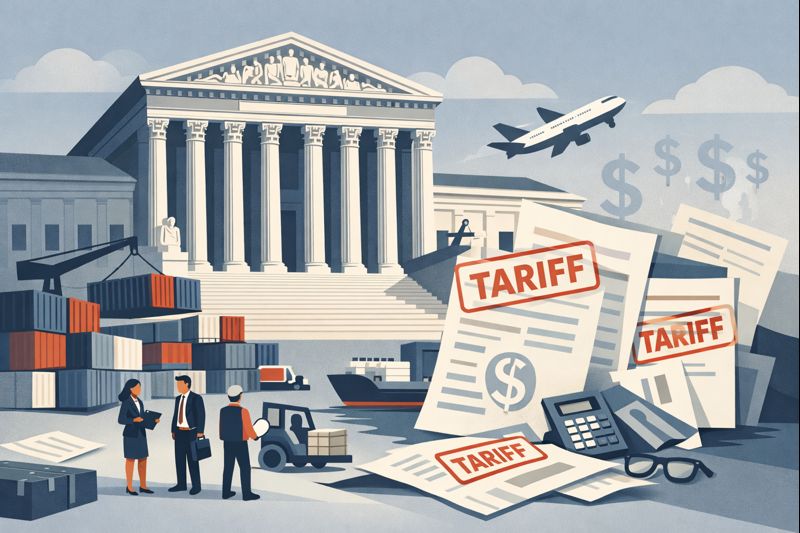
The United States Supreme Court stands at a critical juncture in American trade policy. As early as Friday, January 10, 2026, the nation’s highest court could issue a ruling that threatens to invalidate the cornerstone of President Donald Trump’s second-term economic agenda—and potentially trigger one of the largest refund obligations in modern US fiscal history. At stake: approximately $150 billion in tariff collections, thousands of corporate balance sheets, and the fundamental question of presidential authority over trade policy.
The case centers on whether Trump exceeded his constitutional authority by invoking emergency powers to impose sweeping tariffs on imports from virtually every major US trading partner. If the Court rules against the administration, the government could face unprecedented refund claims from importers who have already paid these duties—a scenario that would reshape trade policy, strain federal finances, and send shockwaves through global markets.
What’s at Stake in the Supreme Court Case
The legal challenge targets Trump’s use of the International Emergency Economic Powers Act (IEEPA), a 1977 statute originally designed to give presidents authority to respond to foreign threats through economic sanctions. Beginning in February 2025, the Trump administration invoked IEEPA to impose tariffs in two phases: first, targeting China, Canada, and Mexico with duties linked to fentanyl trafficking and illegal immigration; then in April, announcing “reciprocal” tariffs ranging from 10% to 50% on imports from most US trading partners, justified by trade deficits as a national emergency.
The legal dispute revolves around a fundamental constitutional question: does IEEPA’s language authorizing the president to “regulate importation” include the power to impose tariffs? Lower courts have already answered decisively in the negative. The US Court of International Trade and the Federal Circuit Court of Appeals both ruled that Trump exceeded his authority, concluding that the power to impose tariffs—essentially a form of taxation—belongs exclusively to Congress under Article I of the Constitution.
During oral arguments in November 2025, Supreme Court justices across the ideological spectrum voiced skepticism about the administration’s position. Justice Sonia Sotomayor and Chief Justice John Roberts emphasized that tariffs generate revenue from American citizens and thus implicate Congress’s core taxing authority rather than a mere regulatory function. Justice Amy Coney Barrett pressed the government to identify other statutes where “regulate importation” has been interpreted to include tariff authority—a challenge the Solicitor General could not meet.
The $150 Billion Refund Scenario
The magnitude of potential refunds has grown steadily since the tariffs took effect. According to US Customs and Border Protection (CBP) data, IEEPA-related tariffs generated $133.5 billion in collections between February 4 and December 14, 2025. Based on average daily collection rates through mid-December, Reuters calculations estimate the current total has approached $150 billion by early January 2026.
This figure represents an unprecedented scale for tariff refunds. To put it in perspective, the largest previous tariff refund case—involving harbor maintenance fees struck down by the Supreme Court in 1998—resulted in $730 million in refunds distributed over two years. The IEEPA refund scenario would exceed that by more than 200-fold.
The calculation is relatively straightforward: every entry summary filed by importers with CBP details specific line items indicating duty rates paid, product codes, and countries of origin. This documentation provides a clear paper trail for refund claims. However, the administrative complexity lies not in identifying what was paid, but in the sheer volume and timing of refund processing.
Which sectors face the largest exposure? Manufacturing firms, particularly in automotive and machinery sectors, consumer electronics importers, retail giants like Costco and major logistics providers have the most at stake. Companies ranging from footwear manufacturer Deer Stags to multinational corporations like Diageo, EssilorLuxottica, and Kawasaki Motors have already filed protective lawsuits to preserve their refund rights.
The refund timeline creates additional complications. Importers typically have 314 days to make corrections to their import entries before they are “liquidated”—finalized with no possibility of refunds. For Chinese imports hit with tariffs in February 2025, this deadline has already passed, raising questions about whether even a Supreme Court ruling could enable refunds for the earliest tariff payments.
Market and Corporate Impact
The uncertainty surrounding the Supreme Court decision has created what market analysts describe as a “live valuation risk window” for thousands of global importers. The immediate question facing corporate finance departments is whether tariff payments sitting on balance sheets should be classified as recoverable assets or permanent costs.
Auditors and financial gatekeepers are increasingly questioning the accounting treatment of these tariff payments, creating tension around earnings disclosures and audit sign-off timing. For companies like Peloton, Goodyear, and smaller import-dependent firms tracked in indices like the Russell 2000, the difference between permanent loss and potential recovery could significantly impact equity valuations and credit ratings.
A favorable Supreme Court ruling would inject $150 billion to $200 billion in liquidity back into the corporate sector over subsequent months. Market strategists at BNY Markets project this would particularly benefit retail, consumer goods, and electronics sectors. Small-cap stocks, which are disproportionately sensitive to import costs, could see outsized gains. The Russell 2000 small-cap index, already up 4% in early 2026, could receive what one advisor described as “rocket fuel” from combined tariff relief and Federal Reserve liquidity support.
Conversely, an adverse ruling that upholds Trump’s tariff authority would cement these costs as permanent, forcing companies to accelerate supply chain diversification strategies and potentially triggering margin compression across import-dependent industries. The unpredictability of presidential tariff authority would itself become a persistent market risk factor.
Some companies are not waiting for judicial clarity. A secondary market has emerged where smaller firms are selling their potential refund claims to hedge funds and specialized investors for pennies on the dollar. These transactions allow companies like small manufacturers to de-risk their balance sheets immediately, transferring legal recovery risk and potential upside to investors with longer time horizons and greater litigation resources.
Fiscal and Political Fallout
For the US government, a ruling against the tariffs would create immediate fiscal pressure. The Treasury Department collected tariff revenues under the assumption of statutory legality, and these funds have already been incorporated into federal budget planning. Returning $150 billion would not technically increase the deficit—the money legally belongs to the importers who paid it—but it would remove a significant revenue stream that the administration has relied upon.
Trump has repeatedly touted tariff revenue as a means to fund domestic priorities. In November 2025, he proposed allocating tariff collections to provide a $2,000 dividend to low- and middle-income Americans, with excess funds directed toward reducing the national debt. A Supreme Court decision invalidating the tariffs would eliminate the funding source for such proposals.
Treasury Secretary Scott Bessent has expressed confidence that the administration could pivot to alternative tariff authorities if IEEPA is ruled unconstitutional. Section 232 of the Trade Expansion Act of 1962 (national security grounds) and Section 301 of the Trade Act of 1974 (unfair trade practices) remain available, though both require agency investigations and have more limited scope than IEEPA’s emergency powers.
The political dimension extends beyond revenue concerns. A ruling against the tariffs would represent Trump’s most significant legal defeat since returning to the White House and would constrain a policy tool that has become central to his governing approach. It would also reaffirm congressional authority over trade policy at a time when executive power in this domain has steadily expanded over decades.
For Congress, the decision could force a long-overdue reckoning with trade policy delegation. Multiple statutes currently grant presidents varying degrees of tariff authority, creating a patchwork system that lacks coherent principles or consistent congressional oversight. A Supreme Court decision narrowing presidential authority might catalyze legislative efforts to modernize the trade policy framework—or it might simply prompt the executive branch to exploit remaining statutory ambiguities more aggressively.
Global Trade Signal
The Supreme Court’s ruling will reverberate far beyond US borders. America’s trading partners have watched the IEEPA tariff case closely, understanding that the outcome will shape expectations about US trade policy reliability and predictability.
A decision against Trump would signal to allies and rivals alike that unilateral US tariff actions face meaningful judicial constraints. This could strengthen the credibility of US trade commitments and reduce the risk premium that foreign governments and companies associate with exposure to the American market. European Union officials, who have long criticized Trump’s tariff approach as inconsistent with World Trade Organization rules, would view such a ruling as vindicating their emphasis on multilateral trade frameworks.
Conversely, upholding broad presidential tariff authority would confirm that US trade policy can shift dramatically based on executive discretion and political considerations rather than established legal frameworks. This uncertainty would likely accelerate existing trends toward supply chain diversification away from US dependence, particularly among countries that have experienced the sharp edge of Trump’s tariff policies.
For China, the case carries particular significance. If Trump’s tariffs are struck down but the administration successfully imposes replacement duties under Section 301 or Section 232, Beijing would face the prospect of sustained US trade restrictions through alternative legal channels. This could harden Chinese perceptions that economic decoupling from the United States is inevitable, regardless of the specific legal mechanisms employed.
The ruling will also inform how other countries approach their own trade policy authorities. If the US Supreme Court imposes meaningful limits on executive trade powers, other democracies may examine whether their own legal frameworks provide appropriate checks on unilateral tariff actions. Alternatively, if the Court upholds Trump’s approach, some countries might view this as license to exercise their own executive trade authorities more aggressively.
What Comes Next
The Supreme Court faces several options in crafting its decision. The most straightforward outcome would be a clear ruling that IEEPA does not authorize tariffs, with instructions for the lower Court of International Trade to oversee the refund process. This would provide clarity but would also force the administration to quickly pivot to alternative tariff authorities if it wishes to maintain trade pressure on foreign partners.
A more nuanced decision might strike down some tariffs while upholding others, depending on the specific national emergency rationales offered. For example, the Court could distinguish between tariffs tied to fentanyl trafficking (a security threat) and those based on trade deficits (arguably an economic rather than security emergency). Such a ruling would create complexity but might offer the administration a narrower path to maintain some tariff leverage.
The Court could also address the refund mechanism directly, either establishing a framework for how CBP should process refunds or delegating this determination to the Court of International Trade. Recent developments suggest administrative preparation for this possibility: CBP announced on January 2, 2026, that it will transition all tariff refunds to electronic distribution through the Automated Clearing House (ACH) network effective February 6, with a mandatory registration deadline for importers. This infrastructure upgrade appears designed to handle large-scale refund processing more efficiently than the previous paper-check system.
If the Supreme Court rules against Trump, the administration has already signaled its intention to impose replacement tariffs through other legal authorities. US Trade Representative Jamieson Greer has expressed confidence that any lost revenues could be replicated with new tariffs levied under Section 232 or Section 301. However, these alternatives come with procedural requirements—Section 232 mandates Commerce Department investigations, while Section 301 requires USTR investigations and comment periods—that would limit the speed and scope of unilateral tariff actions.
The long-term implications for US trade governance are profound. If IEEPA’s tariff authority is constrained, future presidents will face greater difficulty responding quickly to perceived trade threats through unilateral action. This could shift power back toward Congress, which has largely abdicated its constitutional trade authority to the executive branch over the past century. Alternatively, it could simply prompt the executive branch to become more creative in invoking the remaining tariff authorities available—a pattern already evident in Trump’s expansive interpretation of “national security” under Section 232.
Conclusion
The Supreme Court’s impending decision on Trump’s tariffs represents more than a technical legal dispute about statutory interpretation. It poses fundamental questions about the separation of powers, the scope of presidential authority in an age of economic globalization, and the relationship between democratic accountability and executive flexibility in trade policy.
For the thousands of companies that have paid $150 billion in disputed tariffs, the stakes are immediate and concrete: will these payments be recognized as legitimate or returned as unauthorized? For the Trump administration, the decision will either validate its most significant economic policy initiative or force a fundamental recalibration of its trade strategy. For global markets, the ruling will shape expectations about US policy stability and the predictability of the American economic environment.
As the justices prepare to render their judgment, one thing remains certain: regardless of how the Court rules, the debate over presidential trade authority is far from over. The IEEPA tariff case will set precedents that inform trade policy disputes for years to come, determining not just the fate of Trump’s specific tariff program, but the broader balance between executive power and constitutional limits in an interconnected global economy.