SEO Title: IMF Warns AI Job Displacement Could Deepen Global Inequality
Meta Description: The IMF urges governments to strengthen worker protections as AI accelerates job displacement, warning of rising inequality and economic instability without policy action.
Meta Keywords: IMF AI jobs, AI job displacement, future of work, labor market policy, global inequality
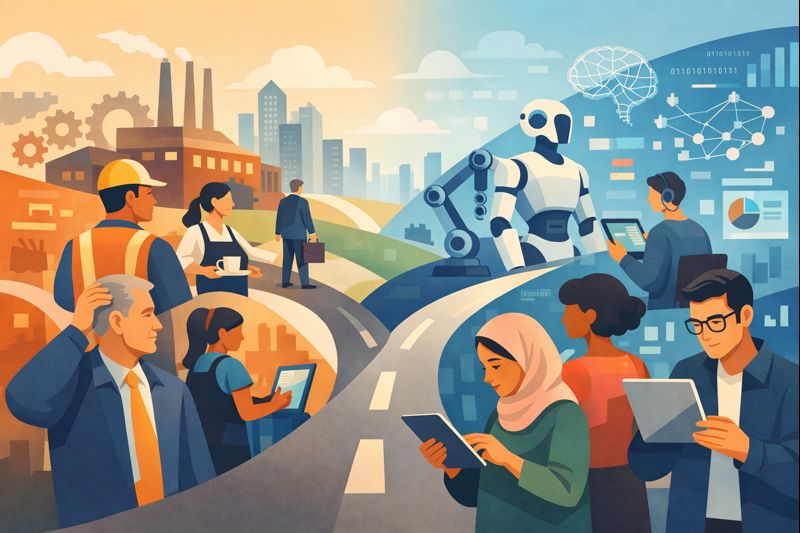
Artificial intelligence is delivering productivity gains and corporate profits at an accelerating pace. But without decisive policy action, it threatens to widen inequality and destabilize societies across both advanced and emerging economies. In its latest research and policy guidance, the International Monetary Fund is warning that governments are running out of time to protect workers displaced by the most disruptive automation wave in modern history.
The urgency reflects a stark reality: employment levels in AI-vulnerable occupations are already 3.6 percent lower in regions with high demand for AI skills compared to regions with less demand after five years. Unlike previous technological transitions where workers had decades to adapt, AI is reshaping labor markets in real time, and the evidence of displacement is no longer theoretical.
Why the IMF Is Raising the Alarm Now
The pace and scope of AI adoption has shifted dramatically over the past two years. What began as experimental deployments of chatbots and image generators has evolved into widespread integration across services, manufacturing, and white-collar professions. One in 10 job postings in advanced economies and one in 20 in emerging markets now require at least one new skill, reflecting how rapidly employers are reconfiguring roles around AI capabilities.
The IMF’s concern centers on three interrelated developments. First, the scale of potential displacement far exceeds historical automation waves. In advanced economies, about 60 percent of jobs are exposed to AI, compared to 40 percent in emerging market economies and 26 percent in low-income countries. Second, the speed of change is unprecedented—where previous industrial transitions unfolded over generations, AI capabilities are doubling at intervals measured in months, not decades. Third, and perhaps most critically, the policy infrastructure to support displaced workers remains dangerously inadequate.
What makes AI fundamentally different from past technological shocks is its capacity to automate cognitive tasks that were previously considered immune to mechanization. Previous automation waves primarily affected routine manual and clerical work, allowing displaced workers to transition into jobs requiring judgment, creativity, or interpersonal skills. AI, by contrast, is targeting precisely those cognitive functions. Legal research, financial analysis, content creation, diagnostic medicine—occupations that once represented safe harbors from automation are now on the front lines of displacement risk.
Which Jobs and Economies Are Most at Risk
The exposure patterns reveal uncomfortable truths about who bears the greatest risk. In advanced economies, professional and technical occupations face the highest displacement potential. Clerical workers, administrative staff, paralegals, junior analysts, and entry-level professionals in finance, media, and technology are experiencing the earliest impacts. AI poses a risk of eliminating 10-20 percent of entry-level white-collar jobs within the next one to five years, fundamentally altering traditional career progression pathways.
The gender dimension is particularly stark. Women are more likely to be at risk of disruption from AI because they are more often in service, sales, and clerical roles, while men are more represented in occupations that are unlikely to be impacted by AI at this stage, like farm workers, machine operators, and low-skill elementary workers. This pattern threatens to reverse decades of progress in closing gender gaps in labor force participation and earnings.
Emerging markets face a different but equally serious challenge. While their immediate exposure is lower due to less cognitive-task-intensive employment structures, they are also less ready to seize AI’s advantages, which could exacerbate the digital divide and cross-country income disparity. Manufacturing-dependent economies risk seeing their competitive advantages evaporate as AI enables production reshoring to advanced economies or leapfrogging to fully automated facilities that bypass traditional development pathways.
The age gradient compounds these risks. College-educated workers are better prepared to move from jobs at risk of displacement to high-complementarity jobs, while workers without postsecondary education show reduced mobility. Older workers face particularly acute challenges, struggling with reemployment prospects, technological adaptation, and the psychological toll of career-ending displacement in their 50s and 60s.
The Policy Tools the IMF Is Advocating
The IMF’s policy prescription combines immediate support mechanisms with longer-term structural reforms. At the core is recognition that passive welfare alone will not suffice—active labor market policies must facilitate transitions, not simply cushion falls.
Reskilling and lifelong learning programs represent the first line of defense. But the IMF emphasizes these must be radically reimagined. Today’s students need cognitive, creative, and technical skills that complement AI and help them use it rather than compete with it. This requires education systems to shift from knowledge transmission to capability development—teaching adaptability, complex problem-solving, and human skills that remain beyond AI’s reach.
Social protection systems require strengthening, particularly unemployment insurance that provides adequate duration and income replacement to enable genuine job search rather than desperate acceptance of the first available position. The evidence is clear: longer job search periods enabled by robust benefits lead to better employment matches and mitigate the permanent wage scarring that typically follows displacement.
Active labor market policies—job placement services, wage subsidies for hiring displaced workers, and supported transitions—prove far more effective than passive income support alone. But these programs require funding. The fiscal challenge is real: comprehensive support for workers during AI transitions could cost 1-2 percent of GDP annually in advanced economies, straining budgets already stressed by demographic pressures and elevated debt levels.
Political constraints add further complexity. Support programs require sustained commitment across election cycles, yet visible costs often precede diffuse benefits. This timing mismatch creates political vulnerabilities that can derail even well-designed programs before they achieve meaningful impact.
Risks of Inaction: Economic and Political Fallout
The consequences of inadequate policy response extend far beyond individual hardship. At the macroeconomic level, widespread displacement without effective reemployment mechanisms reduces aggregate demand. Displaced workers unable to find comparable employment reduce consumption, creating negative multiplier effects that can slow growth even as AI boosts productivity in specific sectors.
The inequality implications are particularly concerning. Unlike previous waves of automation that increased both wage and wealth inequality, AI could reduce wage inequality through the displacement of high-income workers, but these workers’ tasks appear highly complementary with AI, potentially increasing their productivity, and they are better positioned to benefit from higher capital returns. The result could be a bifurcated labor market where those who successfully adapt to AI see substantial gains while displaced workers face permanent income losses.
Political stability faces direct threats from large-scale displacement without adequate support. Historical evidence from previous deindustrialization episodes demonstrates clear links between economic dislocation and rising populism, political polarization, and social unrest. From post-coal Britain to post-industrial American towns, when livelihoods vanished, mental health deteriorated, addiction rose and political extremism found fertile ground. The AI wave threatens to replicate these dynamics on a global scale and at unprecedented speed.
Perhaps most perversely, productivity gains from AI may fail to translate into shared prosperity if capital owners capture the bulk of benefits while displaced workers lack the leverage to share in gains. This dynamic—where efficiency improvements enrich shareholders but immiserate workers—represents a fundamental failure of market mechanisms to deliver socially optimal outcomes.
What This Means for Investors and Markets
For global macro investors, labor policy is becoming a crucial investment variable, not simply a social concern. The quality and generosity of worker support systems will directly influence consumption patterns, political stability, and ultimately growth trajectories across markets.
Sectoral implications are already emerging. Technology and AI-adjacent sectors benefit from both productivity gains and capital concentration, while traditional service sectors face margin compression from displacement-driven demand weakness. Financial services, professional services, and media face restructuring pressures that will separate adaptable firms from those clinging to obsolete business models.
Country-level divergence will likely accelerate. Nations that invest proactively in worker transitions may see AI boost potential growth while maintaining social cohesion. Those that neglect displacement risks face populist backlashes that could derail technology adoption, impose punitive regulations, or trigger fiscal crises as automatic stabilizers activate without offsetting policy reforms.
The long-term growth implications remain highly uncertain and policy-dependent. Optimistic scenarios where AI raises productivity broadly enough to create more jobs than it destroys require not just technological progress but also functioning institutions that enable transitions and distribute gains. Pessimistic scenarios where displacement outpaces creation, leading to permanent reductions in employment-to-population ratios, remain entirely possible without effective policy intervention.
Currency markets will increasingly reflect these divergences. Countries with robust support systems and successful transitions should see stronger domestic demand, higher potential growth, and more stable political environments—all factors supporting currency valuations. Conversely, nations experiencing displacement without adequate support may face capital flight, political risk premia, and currency weakness.
The Window for Action
The IMF’s warning carries particular weight because it comes from an institution not known for alarmism. Their message is clear: the policy window for proactive intervention is closing. Once displacement accelerates beyond the capacity of labor market institutions to manage, reactive policy becomes exponentially more difficult and expensive.
The challenge demands more than incremental adjustments. It requires comprehensive reimagining of social contracts, education systems, and labor market institutions to function in an economy where AI augments some work, eliminates other work, and creates entirely new categories of economic activity. The countries and companies that recognize this imperative and act decisively will shape the future of work. Those that delay face prospects of managing crises rather than transitions.
For policymakers, business leaders, and investors alike, AI’s labor market impacts cannot be treated as someone else’s problem or deferred to future action. The disruption is already underway. The question now is whether policy can keep pace, or whether AI’s productivity promise will be overshadowed by the social and political costs of its displacement effects.