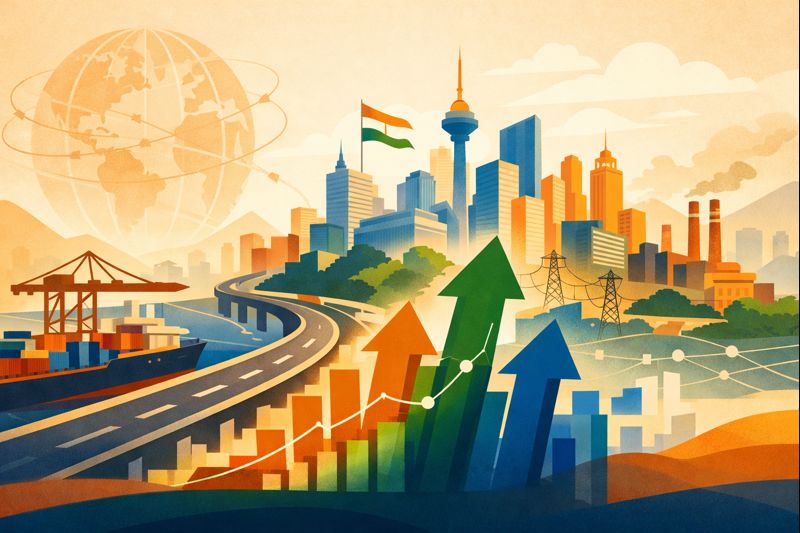
India’s economy has once again outperformed expectations. Strong third-quarter growth is reshaping global institutions’ outlooks, with the IMF now likely to revise its GDP forecast upward—highlighting India’s rising role as a global growth anchor amid slowing momentum elsewhere.
Q3 Growth Beats Expectations
India’s economic performance has defied gravity in recent quarters, with real GDP expanding by 8.2% in Q2 of fiscal year 2025-26, significantly exceeding both market consensus and the IMF’s previous projections. This marks a sharp acceleration from the 5.6% growth recorded in the same quarter of the previous fiscal year and follows an already robust 7.8% expansion in Q1 FY 2025-26.
The sustained momentum reflects a fundamental strength in India’s economic architecture. Domestic demand has remained resilient despite global headwinds, with private consumption expanding robustly alongside continued government infrastructure investment. The services sector, which grew by 9.2% in Q2, has been particularly dynamic, demonstrating India’s competitive edge in global service exports. Meanwhile, the industrial sector contributed 8.1% growth, underscoring broad-based economic strength.
This performance comes against a backdrop of easing inflation—which fell to 2.0% in December 2025, reaching the Reserve Bank of India’s target—and improving labor market indicators. The combination of growth acceleration and inflation moderation presents a rare “Goldilocks” scenario that has captured global attention.
Why the IMF Is Rethinking Its Forecast
The IMF’s forecasting process is typically conservative and data-driven, with major revisions reserved for significant deviations from baseline assumptions. The signals emerging from Washington suggest India has crossed that threshold.
IMF spokesperson Julie Kozack recently acknowledged that India’s economic performance “has come in stronger than anticipated,” and that this “improving the odds of an upward revision” when the Fund releases its January World Economic Outlook update. Her characterization of India as “a key driver of global growth” with performance that “continues to stand out among major economies” represents a notable departure from the Fund’s traditionally measured language.
The IMF’s most recent Article IV staff report had projected 6.6% growth for India in FY 2025-26. However, with the economy already growing at 8.0% through the first half of the fiscal year, maintaining that forecast would require an implausible deceleration. Multiple international institutions have already moved: the Reserve Bank of India raised its projection from 6.5% to 7.3%, while the Asian Development Bank lifted its forecast to 7.2%, and Fitch raised its FY26 projection to 7.4%.
The timing of the IMF’s likely revision is significant. Coming at a moment when global growth is fragile—projected at just 3.2% for 2025—India’s outperformance provides a crucial counterweight to decelerating momentum in other major economies.
India vs Other Major Economies
The contrast between India’s growth trajectory and that of other economic powerhouses has never been starker, fundamentally reshaping the global growth landscape.
China, long the world’s growth engine, is projected by the IMF to expand 5.0% in 2025 and 4.5% in 2026. While these figures nominally exceed India’s projections, they mask deeper structural challenges. China’s growth is increasingly dependent on exports—with its current account surplus projected to reach 3.3% of GDP in 2025—while domestic demand remains anemic. The property sector, which accounts for roughly 25% of economic activity, continues its multi-year contraction, with prices still falling and inventory elevated. Goldman Sachs estimates the property downturn is shaving approximately 2 percentage points off China’s annual GDP growth.
Moreover, China’s headline growth figures have come under scrutiny. Independent analysts at Rhodium Group estimate that China’s actual 2025 growth fell below 3%, significantly lower than the official 5.2% figure, with growth “sputtering around 1%” by late 2025. The divergence between official statistics and real economic activity has raised questions about the sustainability of China’s reported performance.
The advanced economies present an even more sobering picture. The United States is forecast to grow 2.0% in 2025 and 2.1% in 2026—respectable by developed-market standards but representing a marked deceleration from the 2.8% expansion in 2024. The Eurozone faces even greater headwinds, with the IMF projecting growth of just 1.2% in 2025 and 1.1% in 2026. Germany, Europe’s largest economy, is expected to expand by a mere 0.2% in 2025, barely avoiding recession after years of stagnation.
This positioning gives India a unique role in the global economy. Among major economies, only India is demonstrating both growth acceleration and improving fundamentals, making it an increasingly rare source of global demand at a time when synchronized slowdowns have historically triggered broader economic stress.
What’s Powering India’s Momentum
India’s growth story rests on several structural and cyclical pillars that distinguish it from peers facing headwinds.
Government Capital Expenditure: Infrastructure investment has been a defining feature of India’s recent economic strategy. Public capital formation has surged, with the government maintaining ambitious spending on roads, railways, ports, and digital infrastructure. This investment serves a dual purpose: providing immediate demand stimulus while addressing long-standing infrastructure bottlenecks that have constrained productivity growth. The impact extends beyond direct spending, as improved logistics and connectivity lower costs for businesses and expand market access.
Demographics and Consumption: India’s demographic dividend continues to provide a foundational advantage. With a median age of approximately 28 years and a working-age population that will continue expanding through the 2030s, India possesses what China and most developed economies have lost: a growing labor force. This translates directly into consumption growth, as younger populations typically have higher marginal propensities to consume. Urban consumption has strengthened markedly, with retail trade volumes in late 2025 running 1.5% higher than year-earlier levels.
Structural Reforms: Recent policy initiatives have begun bearing fruit. Goods and Services Tax (GST) reforms have simplified India’s complex indirect tax system, reducing compliance costs and improving efficiency. Labor market reforms have enhanced flexibility while maintaining worker protections, encouraging formal sector employment. The Reserve Bank of India reports that formal payroll additions through the Employees’ Provident Fund Organization reached 21 million net new members in July 2025, representing 5.6% growth—tangible evidence that reforms are translating into job creation.
Manufacturing Push: India’s “Make in India” initiative, combined with production-linked incentive schemes, has attracted significant foreign direct investment in manufacturing. Companies seeking to diversify supply chains away from single-country dependencies have increasingly selected India as a production base, particularly in electronics, pharmaceuticals, and automotive sectors. This shift is slowly rebalancing India’s economy away from its historical service-sector dominance toward more diversified industrial strength.
Services Resilience: India’s traditional strength in services exports—particularly in information technology, business services, and professional services—continues to provide stable foreign exchange earnings. Services exports reached an estimated $270 billion in the first eight months of FY 2025-26, expanding 8.7% year-over-year and underscoring India’s growing competitiveness in global knowledge-intensive sectors.
Risks and Constraints
Despite the positive momentum, India’s growth trajectory faces several material constraints that could moderate the pace of expansion.
Inflation and Fiscal Pressures: While headline inflation has moderated to target levels, food price volatility remains a persistent risk, particularly given India’s vulnerability to weather shocks. Unpredictable monsoon patterns or global commodity price spikes could reignite inflationary pressures, potentially forcing the RBI to maintain tighter monetary conditions than growth would otherwise warrant. On the fiscal side, the government faces the delicate task of maintaining its consolidation path—targeting a deficit of 2.8% of GDP by FY 2026-27—while sustaining the infrastructure spending that has been central to growth. The IMF has noted that “achievement of the fiscal deficit target will require strong spending discipline.”
Global Slowdown and Trade Risks: India’s growth remains partially dependent on global economic conditions. A sharper-than-expected slowdown in advanced economies or a deeper contraction in China could dampen demand for Indian exports, particularly in services. Moreover, the current environment of heightened trade protectionism and geoeconomic fragmentation poses risks. While India has benefited from supply chain diversification away from China, further deepening of trade tensions or disruptions to global trade flows could create headwinds.
Employment and Income Distribution: While aggregate growth figures are impressive, questions persist about the quality and inclusiveness of job creation. India needs to create approximately 8-10 million jobs annually to absorb new labor market entrants, and ensuring these jobs offer adequate wages and security remains a challenge. Female labor force participation, while improving to 34.2%, remains low by international standards, representing unrealized economic potential.
Infrastructure and Institutional Capacity: Despite recent progress, infrastructure gaps persist in transportation, power generation, urban amenities, and digital connectivity, particularly in rural areas. Addressing these systematically requires not just financial resources but sustained institutional capacity and execution capability across multiple levels of government.
The IMF’s Article IV consultation flagged several of these concerns, emphasizing that “comprehensive structural reforms are critical to support India’s economic development” and calling for enhanced human capital, deeper trade integration, and continued improvements in the business environment.
Global Market Implications
India’s strong growth performance carries significant ramifications across global financial markets and capital flows, reshaping investor strategies and risk assessments.
Impact on Emerging Market Capital Flows: India’s economic outperformance has already begun redirecting capital flows within emerging markets. Foreign direct investment to India captured “great momentum” in the first half of FY 2025-26, according to official data, as investors increasingly view India as a rare combination of growth potential and relative political stability. Portfolio flows have also strengthened, with equity markets reaching record highs on the back of “investor confidence in India’s long-term growth prospects.” As China’s growth model transitions and structural headwinds intensify, India stands to capture an increasing share of EM-designated capital that previously flowed predominantly to China.
Currency and Equity Market Perceptions: The rupee has benefited from strong remittance inflows—which grew 10.7% year-over-year in Q2 FY 2025-26—and robust services exports, helping contain the current account deficit at a modest 1.3% of GDP. This external stability, combined with growth momentum, positions the rupee favorably relative to other EM currencies facing pressure from China’s export competitiveness. Indian equity markets have reflected this optimism, with valuations rising despite global uncertainty, as investors price in sustained earnings growth underpinned by domestic demand expansion.
India’s Role in Global Growth Rebalancing: At the systemic level, India’s emergence as a reliable growth driver matters for global economic stability. With China’s growth increasingly dependent on exports that pressure other countries’ manufacturing sectors, and with advanced economies growing below potential, India’s domestically-driven expansion provides a different model—one based on internal consumption and investment rather than external surpluses. The World Bank projects India will grow 6.5% in 2026, while Moody’s forecasts it will “remain the fastest-growing G20 economy” through 2027. This performance helps offset China’s slowing momentum and supports global commodity demand, benefiting resource-exporting economies.
For institutional investors, India’s weight in global indices continues to rise, necessitating greater allocation regardless of active views. The IMF’s April 2025 assessment that India had surpassed Japan to become the world’s fourth-largest economy (with a GDP of $4.18 trillion) and projections that it will displace Germany from third place within three years underscore this structural shift in global economic architecture.
What to Watch Next
Several near-term developments will determine whether India’s growth momentum can be sustained and what level of revision the IMF ultimately implements.
IMF Formal Forecast Update Timeline: The IMF’s January 2026 World Economic Outlook update, expected in the coming days, will provide the first formal indication of how significantly the Fund has revised its India forecast. Markets will parse not just the new growth numbers but the underlying assumptions and risk assessments. Any upgrade toward 7% or above would represent a significant shift in the IMF’s view of India’s potential growth trajectory.
Upcoming Macro Data and Policy Signals: Several data releases and policy decisions in the coming months will be critical. The Q3 FY 2025-26 GDP data, expected in late February, will reveal whether the strong first-half momentum has been sustained. The Reserve Bank of India’s February monetary policy meeting will signal whether the central bank sees room for rate cuts given benign inflation, or whether it remains cautious about underlying price pressures. And the Union Budget for FY 2026-27, traditionally presented in early February, will clarify the government’s fiscal stance and infrastructure investment plans for the coming year.
External Risk Factors: The evolution of global trade tensions will significantly influence India’s outlook. Any escalation in U.S.-China trade conflicts could create opportunities for India to capture displaced production, but could also disrupt supply chains and dampen global demand. Oil price movements remain particularly relevant given India’s energy import dependence—the recent decline in crude prices has provided fiscal breathing room, but any reversal would tighten constraints. Finally, the pace of China’s economic adjustment matters: a hard landing in China would likely drag down regional growth and commodity prices, creating spillovers even to economies like India that are less directly integrated with China’s supply chains.
Structural Reform Implementation: Perhaps most importantly for long-term growth sustainability, investors should monitor the pace of structural reforms in areas identified by the IMF as critical: labor market flexibility, trade liberalization, financial sector development, and productivity-enhancing investments in education and technology. India’s ability to sustain 6.5-7% growth over the medium term depends less on cyclical demand management and more on successfully executing reforms that raise potential growth.
Conclusion
India’s stronger-than-expected economic performance represents more than a statistical surprise—it signals a potential inflection point in global growth dynamics. As the IMF prepares to revise its forecasts upward, investors and policymakers are confronting a world in which India plays an increasingly central role as a driver of global demand and a destination for capital flows.
The contrast with China’s decelerating, export-dependent growth model and the advanced economies’ sluggish expansion makes India’s domestically-driven momentum particularly valuable. Yet this prominence also brings scrutiny. Sustaining growth at 6.5-7% over the coming years will require India to successfully navigate fiscal consolidation while maintaining investment, manage external risks while deepening trade integration, and address employment quality while expanding job creation.
For global macro investors, the implications are clear: India’s weight in portfolios must rise, not simply to capture alpha but to maintain beta exposure to a shifting global economy. For economists and policy watchers, India offers a real-time test of whether large-scale structural transformation can deliver broad-based prosperity in a fragmenting global order. And for business professionals focused on emerging markets, India has transitioned from a promising long-term story to an immediate growth opportunity that demands strategic attention.
The IMF’s forthcoming forecast revision will formalize what the data already suggests: India has become too important to the global growth equation to be overlooked. As the world economy navigates uncertainty in 2026 and beyond, India’s success or stumbles will reverberate far beyond South Asia.