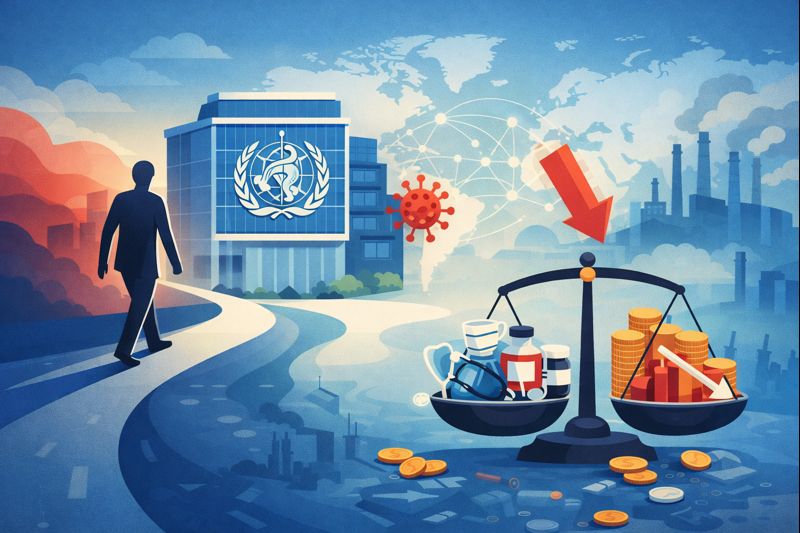
On January 20, 2025, hours after his inauguration, President Donald Trump signed an executive order withdrawing the United States from the World Health Organization, marking a seismic shift in global health governance that carries profound implications for economic resilience, pandemic preparedness, and international cooperation. This decision, which mirrors a similar attempt during Trump’s first term that was reversed by President Biden, raises urgent questions about the future of multilateral health coordination and its cascading effects on the global economy.
A Break from Multilateral Health Leadership
The U.S. withdrawal, citing the WHO’s handling of the COVID-19 pandemic and concerns about political influence from member states, particularly China, represents a dramatic rupture in America’s seven-decade partnership with the organization. Since WHO’s founding in 1948, the United States has served as its largest financial contributor and a key architect of global health policy.
The executive order immediately froze all U.S. funding to WHO, recalled American personnel, and halted negotiations on the WHO Pandemic Agreement. By January 24, WHO Director-General Tedros Adhanom Ghebreyesus informed staff that the withdrawal announcement had triggered significant budget cuts, including recruitment freezes and restrictions on travel and technical support missions.
The stated rationale centers on three grievances: WHO’s pandemic response, undue political influence from China, and unfair financial burden-sharing. The administration argues that China, with a population three times larger than the United States, contributes nearly 90% less to the organization. However, this comparison overlooks the fundamental principle behind WHO’s funding structure—assessed contributions are calculated based on economic capacity (GDP), not population size.
Financial Impact on the WHO
The budgetary implications are substantial. The U.S. has historically contributed roughly 18% of WHO’s total budget, providing more than $10 billion in the previous fiscal year. This includes both assessed contributions—mandatory membership dues calculated based on GDP—and voluntary contributions earmarked for specific programs.
The U.S. currently owes approximately $278 million in unpaid assessed contributions for the past two years, plus several hundred million dollars in promised voluntary contributions. WHO’s 2024-2025 biennial budget totals $6.83 billion, with only 20% funded through assessed contributions and the remaining 80% dependent on voluntary contributions from donors.
This funding structure reveals a critical vulnerability: WHO operates with heavily earmarked, unpredictable financing, where over 60% originates from just nine major donors. The U.S. withdrawal exacerbates this structural weakness, potentially forcing the organization to scale back programs precisely when global health threats remain elevated.
The immediate funding gap creates operational challenges across WHO’s core functions:
- Disease surveillance systems: WHO coordinates global networks monitoring infectious disease emergence and spread
- Emergency response capabilities: Technical teams deploy to outbreak zones, often in conflict-affected areas where other organizations cannot operate
- Technical assistance: Support for laboratory capacity, health system strengthening, and workforce training in low- and middle-income countries
- Standard-setting: Development of clinical guidelines, essential medicines lists, and international health regulations
The question now is whether other major economies—particularly the European Union, China, and Japan—can mobilize resources to fill this void. While some countries have indicated willingness to increase contributions, sustained commitment remains uncertain. Historical patterns suggest that donor enthusiasm for pandemic preparedness wanes rapidly once immediate crises subside.
Global Economic Implications
The economic rationale for robust global health governance is compelling, and the data is stark. The COVID-19 pandemic caused a 3.3% decrease in global GDP in 2020, with total economic losses estimated between $13.8 trillion and $22 trillion—representing the largest economic shock in three-quarters of a century.
These figures dwarf the modest investment required for pandemic preparedness. Historical data shows that even moderate pandemics carry significant economic costs: the 1958 and 1968 influenza pandemics cost 3.1% and 0.7% of global GDP respectively. More recently, the 2014-2016 Ebola outbreak, though ultimately contained, cost more than $2 billion and threatened to destabilize West African economies.
Expert panels recommend an additional $15 billion in annual investment for pandemic preparedness globally, with national governments dedicating 1% of GDP to health systems strengthening. To put this in perspective: $15 billion represents approximately 65 cents per person globally—a modest premium for insurance against trillion-dollar economic shocks.
The U.S. withdrawal threatens this coordination framework at a time when conditions for pandemic emergence are worsening. Emerging infectious disease events are increasing significantly, driven by:
- Population growth and urbanization: Creating dense human settlements that facilitate rapid transmission
- Climate change: Altering disease vector ranges and disrupting ecosystems
- Agricultural intensification: Increasing human-animal interfaces where zoonotic transfers occur
- Global connectivity: Enabling pathogens to reach every continent within hours
Impact on Emerging Markets
For emerging markets and low-income countries, the implications are particularly acute. These nations depend on WHO technical assistance for disease surveillance, laboratory capacity, and emergency response. Weakened WHO capacity could delay outbreak detection and containment, allowing localized epidemics to evolve into global health emergencies.
Consider the economic transmission channels:
- Trade disruption: Health emergencies trigger border closures and trade restrictions, disrupting global supply chains
- Capital flight: Uncertainty drives portfolio rebalancing, increasing borrowing costs for emerging market sovereigns
- Tourism collapse: Travel restrictions devastate tourism-dependent economies
- Labor market disruption: Illness, mortality, and containment measures reduce labor force participation
- Healthcare system overload: Emergency response diverts resources from routine care, worsening long-term health outcomes
The World Bank estimates that a severe pandemic could cost nearly 5% of global GDP, or roughly $3 trillion. For context, this exceeds the combined GDP of most sub-Saharan African nations. Low- and middle-income countries, with limited fiscal space and fragile health systems, face disproportionate impacts.
Research demonstrates that proactive prevention is far more cost-effective than reactive response. Health surveillance, early warning systems, and rapid containment save both lives and economic resources. By weakening the institutional architecture for prevention, the U.S. withdrawal increases the probability of costlier future interventions.
Geopolitical and Institutional Fallout
The U.S. withdrawal sends powerful signals beyond the health sector. It represents the latest example of American retreat from multilateral institutions—following withdrawals from the Paris Climate Agreement during Trump’s first term, the Iran nuclear deal, and UNESCO. This pattern raises fundamental questions about the reliability of U.S. commitments to global governance frameworks.
The Leadership Vacuum
China’s Ministry of Foreign Affairs responded swiftly, stating that the WHO’s role should be “strengthened rather than weakened” and reaffirming Beijing’s commitment to international health cooperation. This creates a leadership vacuum that China and other powers may seek to fill, potentially reshaping global health priorities and norms in ways that diverge from Western democratic values.
China has already increased its influence within UN specialized agencies over the past decade, often using financial contributions and diplomatic pressure to advance strategic interests. The U.S. absence removes a crucial counterweight, potentially allowing authoritarian regimes to shape international health standards, data-sharing protocols, and crisis response frameworks.
Diplomatic Consequences
The Johns Hopkins Bloomberg School of Public Health warns that the withdrawal will be “incredibly costly for both the American people and the global community,” noting that health cooperation provides diplomatic entry points even with adversarial nations. Throughout modern history, health has served as a rare area of consensus where rivals collaborate on shared threats.
For example, during the Cold War, the U.S. and Soviet Union cooperated on smallpox eradication despite broader geopolitical tensions. PEPFAR, launched under Republican President George W. Bush, demonstrated bipartisan support for global health leadership and saved millions of lives. The current withdrawal breaks from this legacy.
Risks to U.S. Interests
For U.S. interests specifically, withdrawal means:
- Reduced intelligence: Limited access to global disease surveillance data, virus samples, and real-time outbreak intelligence
- Diminished influence: Loss of voting rights and participation in setting international health regulations
- Scientific isolation: American researchers excluded from WHO collaborative networks and emergency response teams
- Regulatory divergence: U.S. standards may drift from international norms, complicating pharmaceutical development and trade
The exclusion of American scientists from WHO response teams hampers both global outbreak control and domestic preparedness. When novel pathogens emerge, rapid international collaboration—sharing samples, sequencing data, and clinical findings—proves essential. The U.S. withdrawal erects barriers to this collaboration precisely when speed matters most.
Comparison to Past Withdrawals
Historical precedent offers limited comfort. When the Reagan administration withdrew from UNESCO in 1984 citing mismanagement and anti-Western bias, the U.S. absence lasted nearly two decades before rejoining in 2003. The organization survived but evolved in directions that frustrated U.S. policymakers.
Similarly, the U.S. withdrawal from the Paris Climate Agreement during Trump’s first term weakened global climate coordination without halting the accord entirely. However, health crises differ from climate change in one critical respect: they move faster. A delayed pandemic response measured in weeks, not years, can mean the difference between containment and catastrophe.
Market and ESG Perspectives
From an investor standpoint, the U.S. withdrawal introduces several risk factors that warrant careful monitoring.
Systemic Risk Assessment
First, it signals potential fragmentation in global health governance, complicating risk assessment for multinational corporations operating across borders. Health crises represent material business risks, disrupting supply chains, labor markets, and consumer demand. During COVID-19, sectors from automotive manufacturing to electronics experienced cascading disruptions as component suppliers in affected regions shut down.
The just-in-time inventory systems that optimize efficiency under normal conditions become vulnerabilities during health emergencies. Investors must now factor in elevated tail risk—the probability that WHO’s weakened capacity allows local outbreaks to become global pandemics before adequate international response mobilizes.
ESG Framework Implications
Second, the decision challenges ESG frameworks that increasingly incorporate global health security as a pillar of sustainability. Following COVID-19’s devastating impact on portfolios, institutional investors have grown attentive to pandemic preparedness as a systemic risk factor. Rating agencies and ESG research providers now assess corporate exposure to pandemic risk and evaluate supply chain resilience.
The U.S. withdrawal from WHO creates ambiguity around governance standards for global health. ESG investors seeking to measure corporate alignment with international health norms face the question: which standards apply when the world’s largest economy exits the primary standard-setting body?
Sector-Specific Impacts
Specific sectors face direct implications:
Pharmaceuticals and Biotechnology: These companies benefit from WHO’s coordination of clinical trial networks, regulatory harmonization (through WHO prequalification), and technology transfer initiatives. The WHO Emergency Use Listing procedure, established during Ebola, accelerates access to vaccines and treatments during crises. Reduced U.S. participation could slow regulatory convergence and increase development costs.
Healthcare and Insurance: These sectors depend on international disease surveillance for epidemiological modeling and risk pricing. Insurance actuaries use WHO data to assess mortality risks and price products. Gaps in global surveillance increase model uncertainty and potentially raise premiums or reduce coverage.
Travel, Tourism, and Aviation: These sectors remain acutely vulnerable to health crises that disrupt global mobility. WHO travel advisories and health recommendations influence border policies worldwide. A weakened WHO may issue less timely guidance, potentially prolonging travel disruptions during future outbreaks.
Food and Agriculture: WHO sets food safety standards through the Codex Alimentarius Commission (jointly with FAO). U.S. absence could diminish influence over standards affecting agricultural exports and food trade, with particular implications for emerging markets dependent on these sectors.
Development Finance Implications
The withdrawal affects U.S. bilateral health programs. PEPFAR, which has saved millions of lives through HIV/AIDS response, and global vaccination initiatives like Gavi coordinate extensively with WHO. Reduced coordination could diminish program effectiveness and return on investment for development assistance.
The Trump administration has already announced plans to end U.S. funding for Gavi, which has played a critical role in childhood immunization in developing nations. This compounds concerns about global health system fragility and creates additional uncertainty for development finance institutions and impact investors operating in the health sector.
Fragmentation vs. Cooperation: The Long View
The central question is whether the world moves toward fragmented, regionalized health governance or finds pathways to sustain multilateral cooperation despite U.S. withdrawal.
Scenario 1: Fragmented Health Governance
In a fragmented scenario, countries pursue bilateral and regional arrangements rather than universal coordination through WHO. We might see:
- Regional health blocs: The EU, African Union, and ASEAN develop parallel surveillance and response systems
- Competing standards: Divergent clinical guidelines, regulatory requirements, and data-sharing protocols
- Duplicated infrastructure: Inefficient allocation of limited resources across redundant systems
- Slower responses: Coordination delays during cross-regional outbreaks
Historical precedent suggests fragmentation carries high costs. During the early COVID-19 response, lack of coordination led to export restrictions on medical supplies, vaccine nationalism, and competitive bidding wars that disadvantaged lower-income countries. These failures extended the pandemic and deepened economic damage.
Scenario 2: Adaptive Multilateralism
Alternatively, WHO and remaining member states might adapt and strengthen, potentially:
- Reforming governance: Addressing legitimate concerns about efficiency and political influence
- Diversifying funding: Reducing dependence on any single donor through broader contribution base
- Enhancing transparency: Improving accountability mechanisms to restore confidence
- Building redundancy: Developing robust capabilities that withstand individual country withdrawals
China, the EU, Japan, and other major economies could increase contributions and influence. This might produce a more truly multilateral WHO, though potentially one less aligned with U.S. interests and values.
Alternative Mechanisms
The Trump administration has directed officials to identify “credible and transparent” alternatives to WHO. Possibilities include:
- Coalition of democracies: Health cooperation limited to like-minded nations
- Private-public partnerships: Expanded role for philanthropies like the Gates Foundation
- Bilateral programs: Direct country-to-country health assistance
- Regional organizations: Pan American Health Organization (PAHO) or other regional bodies
However, each alternative faces limitations. No single substitute can replicate WHO’s global reach, political legitimacy among 194 member states, or technical infrastructure built over 75 years. Private philanthropies, while valuable, lack democratic accountability. Bilateral programs create dependency relationships and may prioritize donor interests over public health needs.
What Investors and Policymakers Should Watch
Key indicators for monitoring this evolving situation:
- Funding trajectory: Whether European and Asian donors increase contributions to fill U.S. gap
- Operational impact: Whether WHO maintains core surveillance and response capabilities
- U.S. policy evolution: Possibility of future administration reversing withdrawal (as Biden did in 2021)
- Outbreak responses: Real-world tests of coordination capacity without full U.S. participation
- Regulatory divergence: Degree of drift between U.S. and international health standards
- Market reactions: Whether pandemic risk premiums increase in affected sectors
- Alternative mechanisms: Emergence and effectiveness of non-WHO coordination platforms
Conclusion: Insurance Against Catastrophe
Global health security functions as insurance—not just for populations, but for economies. The modest cost of prevention looks trivial compared to the catastrophic expense of inadequate response. The U.S. withdrawal from WHO represents a decision to cancel a critical insurance policy at a time when hazards are intensifying.
For policymakers, the challenge is maintaining preparedness during periods when threats seem distant. History shows that pandemic funding evaporates rapidly once immediate crises fade, only to be rebuilt hurriedly when the next emergency strikes. Breaking this cycle requires sustained political commitment and institutional memory.
For investors, the withdrawal introduces elevated tail risk across multiple asset classes and sectors. Those with exposure to healthcare, international trade, emerging markets, or global supply chains should reassess pandemic preparedness in their risk models.
The economic case for global health cooperation remains overwhelming. The question is whether short-term political considerations and legitimate governance concerns can be addressed without dismantling the institutional architecture that protects us all. In an interconnected world, no nation—not even the wealthiest—achieves security in isolation.
As the WHO’s response to the withdrawal emphasized, for over seven decades the organization and the United States have “saved countless lives and protected Americans and all people from health threats.” The consequences of ending that partnership will unfold over years, measured not just in budget lines and diplomatic cables, but in lives saved or lost, and economies strengthened or shattered, when the next pandemic inevitably arrives.